
TL;DR: Voicemail drop software automates the 30-second message reps leave on unanswered calls, recovering roughly 25 hours per rep per month ($12,834 per year per rep, or $128,340 annually for a 10-person team at $89,000 fully loaded cost and $42.78 per hour). Voicemails do not generate callbacks (4-5% rate); their value is priming email replies. Pairing one or two voicemails with immediate follow-up emails lifts reply rates from 2.73% to 5.87%, while a third voicemail drops replies to 2.2% (below the no-voicemail baseline). The FCC ruled in February 2022 that ringless voicemails are TCPA calls, and B2B is not exempt when dialing cell phones, with fines of $500 to $1,500 per message without Prior Express Written Consent. Software pricing spans pay-per-drop ($0.02 to $0.06) to integrated dialers ($50 to $150+ per user per month).
Sales development is a mathematical discipline. Every dial, connection, meeting, and closed deal is part of a larger conversion formula that revenue operations teams constantly attempt to optimize. For years, one of the most inefficient variables in this formula has been the time sales professionals spend leaving manual voicemails. When representatives spend hours repeating the same 30-second script into answering machines, the operational cost rises while productivity stalls.
Voicemail drop software, which allows representatives to leave a pre-recorded audio message with a single click, was developed to eliminate this inefficiency. However, evaluating the return on investment for this technology requires more than just measuring time saved. It requires analyzing call data, understanding how voicemails influence prospect behavior across other communication channels, and calculating the pipeline value of reclaimed selling hours.
The implementation of automated voicemails also introduces significant legal considerations. Regulators have established strict rules regarding automated communications, and businesses must manage these laws carefully. This comprehensive report breaks down the factual data, mathematical models, software comparisons, and compliance frameworks required to accurately evaluate the return on investment of voicemail drop technology.
The Cost of Leaving Voicemails Manually
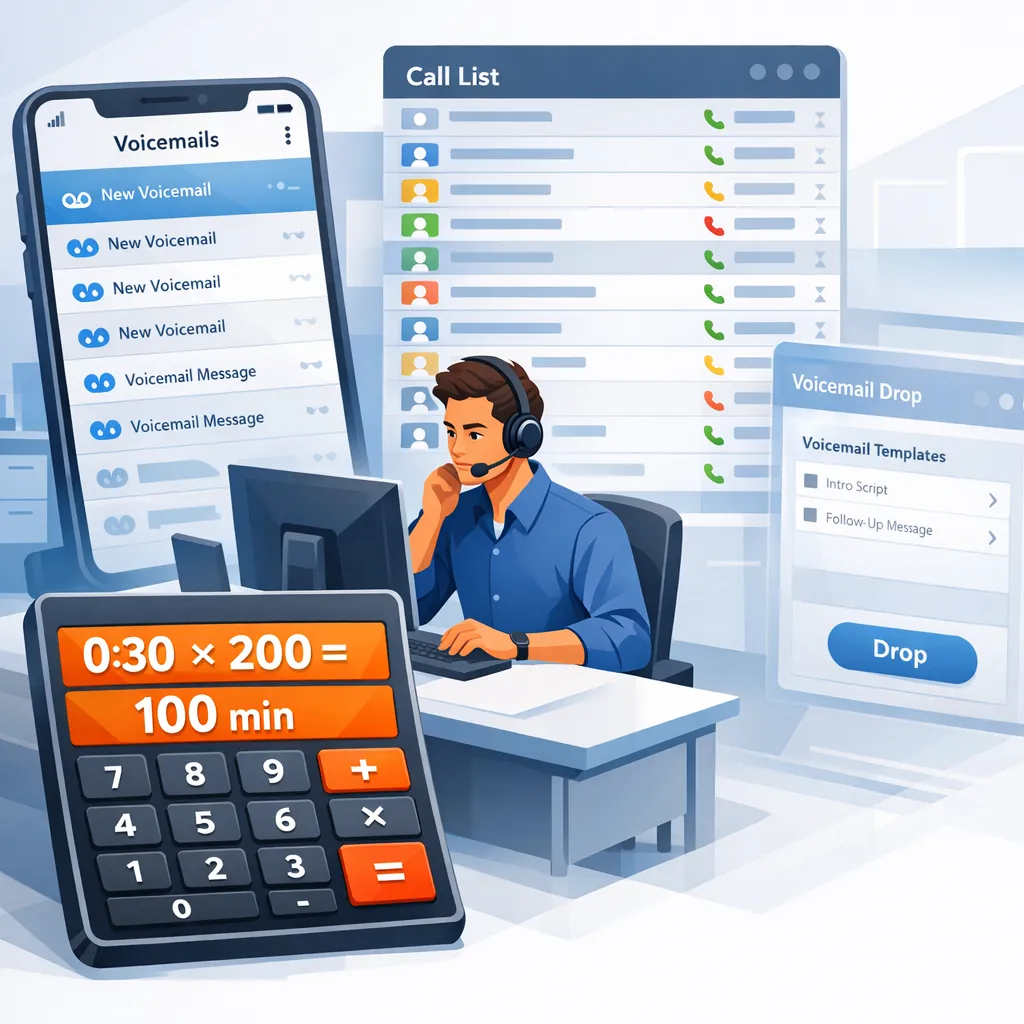
To accurately calculate the return on investment of any automation tool, organizations must first quantify the cost of the manual process it replaces. In outbound sales, the manual process of leaving voicemails is a significant drain on resources.
The Time Cost of Leaving Voicemails
A standard sales development representative makes an average of 52 calls per day. In modern business settings, the vast majority of these calls do not result in a live conversation. Industry data reveals that approximately 80 percent of all outbound sales calls go directly to voicemail. Therefore, an average representative will encounter roughly 40 to 42 voicemails during a standard working day.
Leaving a manual voicemail is a time-consuming process. When a representative dials a number, the phone typically rings for about 15 seconds before the call is forwarded to an answering machine. The prospect’s personal greeting usually plays for another 15 seconds. Once the tone sounds, the representative leaves a verbal message that typically lasts about 30 seconds.
Combined, this process takes one full minute per unanswered call. If a representative encounters 40 to 50 voicemails daily, they spend 40 to 50 minutes simply waiting for tones and speaking to machines. Over the course of a standard 20-day working month, this equates to 20 to 25 hours per representative dedicated entirely to leaving voicemails. That represents more than half a standard workweek lost every single month.
The Financial Cost of Manual Voicemails
Time lost translates directly into capital wasted. To understand the financial impact, revenue leaders must look at the fully loaded cost of an outbound sales professional.
While base salaries for entry-level sales roles typically range from $45,000 to $65,000 depending on the market and industry, the “fully loaded” cost of an employee, which includes commissions, taxes, software licenses, benefits, and overhead, is substantially higher. A widely accepted industry benchmark places the average fully loaded cost of a sales development representative at approximately $89,000 per year.
Assuming a standard working year consists of 2,080 hours, the hourly cost of keeping a representative on the floor is $42.78.
When a representative spends 25 hours a month leaving voicemails, the company is paying $1,069.50 per month for that specific task ($42.78 multiplied by 25 hours). Annually, that equals $12,834 per representative. Paying a highly trained professional over $12,000 a year to recite the exact same 30-second script into a machine is fundamentally inefficient. The primary mathematical argument for voicemail drop technology is the elimination of this fixed labor waste.
What Voicemail Data Says About Sales Outreach
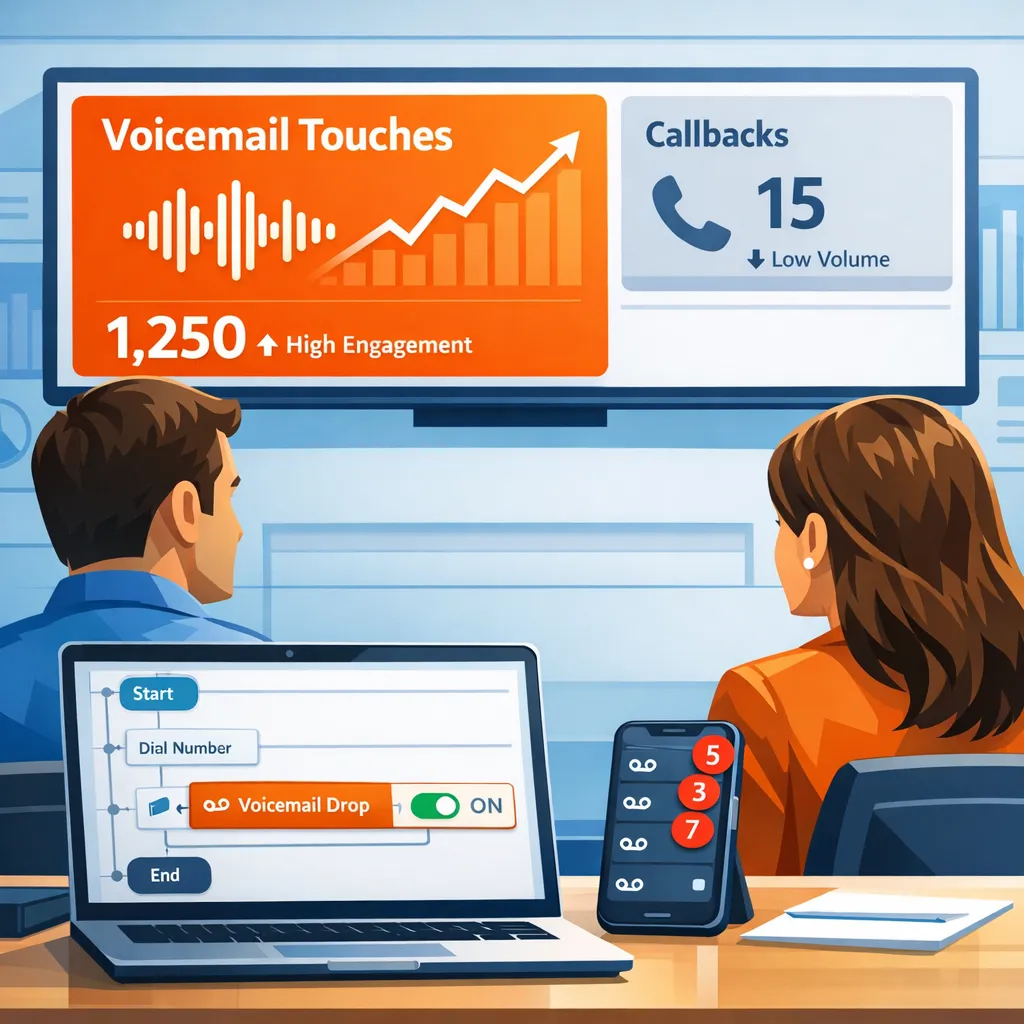
Before investing in software to automate voicemails, leaders often ask whether voicemails are actually effective. Historically, sales managers judged the effectiveness of a voicemail by how many prospects called the representative back. Modern data analysis proves that this is the wrong metric to track.
Why Voicemail Callbacks Are the Wrong Metric
If the goal of a voicemail is to generate a callback, the strategy is a mathematical failure. Industry benchmarks consistently show that the average business-to-business voicemail callback rate is exceptionally low, typically hovering between 4 and 5 percent. In many cases, it drops even lower depending on the quality of the contact data and the familiarity of the brand.
Furthermore, leaving a voicemail can actually negatively impact your ability to connect with a prospect on the phone in the future. A comprehensive analysis of over 300 million cold calls revealed that leaving a voicemail reduces the future phone connect rate by 28 percent. When no voicemail was left, prospects picked up subsequent calls 7.18 percent of the time. When a voicemail was left, the subsequent pickup rate fell to 5.17 percent.
By leaving a message, the representative signals that they are a salesperson, prompting the buyer to screen future calls from that number. If callback rates are minimal and future connect rates decline, the value of the voicemail might seem non-existent. However, the true value of a voicemail lies in how it influences other communication channels.
How Voicemails Boost Email Reply Rates
The primary function of a sales voicemail is not to secure a callback, but rather to serve as an audio primer for a follow-up email. Studies tracking omnichannel outreach demonstrate that voicemails have a profound impact on a prospect’s inbox behavior.
According to the analysis of 300 million outbound calls, when representatives rely solely on email without leaving a corresponding voicemail, the average email reply rate sits at a baseline of 2.73 percent. However, when a representative leaves a voicemail and immediately follows it up with an email, the email reply rate jumps to 5.87 percent.
This represents an increase of more than 100 percent in email engagement. The psychological mechanism here is simple name recognition. The voicemail acts as an introductory touchpoint that creates a brief flicker of familiarity. When the prospect subsequently sees an email from that same name a few minutes later, the communication feels expected rather than entirely unsolicited, lowering the friction required to open and respond to the message.
The Danger of Leaving Too Many Voicemails
While the data supports leaving voicemails to boost email replies, it also provides a strict mathematical limit on volume. More voicemails do not equate to more engagement.
The data shows that leaving one or two voicemails for a single prospect is the optimal strategy. If a representative leaves three or more voicemails for the same prospect throughout a sales sequence, the email reply rate craters to 2.2 percent. This is lower than the baseline reply rate of 2.73 percent achieved by leaving no voicemails at all.
Leaving excessive voicemails signals desperation and annoys the prospect, causing them to disengage entirely and ignore the accompanying emails. Therefore, automated voicemail drop systems must be configured strategically, limiting drops to a maximum of two per prospect per sequence to protect the integrity of the outreach campaign.
How to Calculate Voicemail Drop ROI

With the baseline costs and conversion metrics established, revenue operations leaders can build concrete financial models to calculate the return on investment of voicemail drop software. There are three primary ways to model this return labor savings, pipeline velocity, and opportunity cost.
Labor Savings Model for Voicemail Drops
The most direct financial impact of automated voicemail drops is the recovery of labor hours. By utilizing software with “one-click” drop functionality or artificial intelligence detection, representatives can bypass the greeting and tone, instantly moving to the next call on their list.
Here is a worked example for a standard outbound team consisting of 10 sales development representatives.
- Fully Loaded Annual Cost per Representative: $89,000
- Hourly Cost per Representative: $42.78 (based on 2,080 hours)
- Time Saved per Representative per Month: 25 hours
- Monthly Savings per Representative: 25 hours × $42.78 = $1,069.50
- Annual Savings per Representative: 300 hours × $42.78 = $12,834
- Total Annual Savings for a 10-Person Team: $12,834 × 10 = $128,340
In this model, if the voicemail drop software costs the company $1,000 per month ($12,000 annually) for the entire 10-person team, the software yields a net positive return of $116,340 in reclaimed productivity.
Pipeline Velocity Model for Voicemail Drops
Labor savings only account for internal efficiency. To measure external effectiveness, organizations must calculate how the boost in email reply rates translates into tangible revenue pipeline.
Consider a single representative executing an automated omnichannel strategy. Over the course of a month, the representative makes calls and leaves 1,000 voicemails utilizing a drop tool, pairing each with an automated follow-up email.
- Old Method Reply Rate (No Voicemails or Inconsistent Manual Voicemails): 2.73 percent
- Replies Generated (Old Method): 1,000 × 0.0273 = 27 replies
- New Method Reply Rate (Automated Voicemail + Email): 5.87 percent
- Replies Generated (New Method): 1,000 × 0.0587 = 58 replies
- Net Increase: 31 additional prospect replies per month
To turn this into a dollar amount, apply standard sales funnel conversion rates. If 10 percent of all email replies convert into a booked discovery meeting, the representative generates 3.1 additional meetings per month. If the sales team closes 20 percent of their meetings, and the average contract value (ACV) is $10,000, the math is as follows
- Additional Closed Deals per Month: 3.1 meetings × 0.20 close rate = 0.62 deals
- Additional Revenue per Month: 0.62 deals × $10,000 ACV = $6,200
- Additional Revenue per Year per Representative: $6,200 × 12 = $74,400
For a team of 10 representatives, standardizing an automated voicemail-to-email strategy can theoretically generate $744,000 in additional annual revenue, creating a massive return on investment relative to the cost of the software.
Opportunity Cost Model for Voicemail Drops
The third model evaluates what the sales team does with the 25 hours they recover each month. If an automated system allows them to skip the voicemail process, they can use that time to make more dials.
If a single manual dial and voicemail takes approximately two minutes total (including ring time and logging notes), recovering 25 hours (1,500 minutes) allows a representative to make an additional 750 dials per month. Even with a conservative connect rate of 5 percent, those 750 extra dials yield 37 additional live conversations with prospects every month. For a team of 10, that equates to 370 extra live conversations monthly, creating significantly more at-bats for the sales team to uncover pain points and set meetings.
Voicemail Drop Software Compared by Features and Price
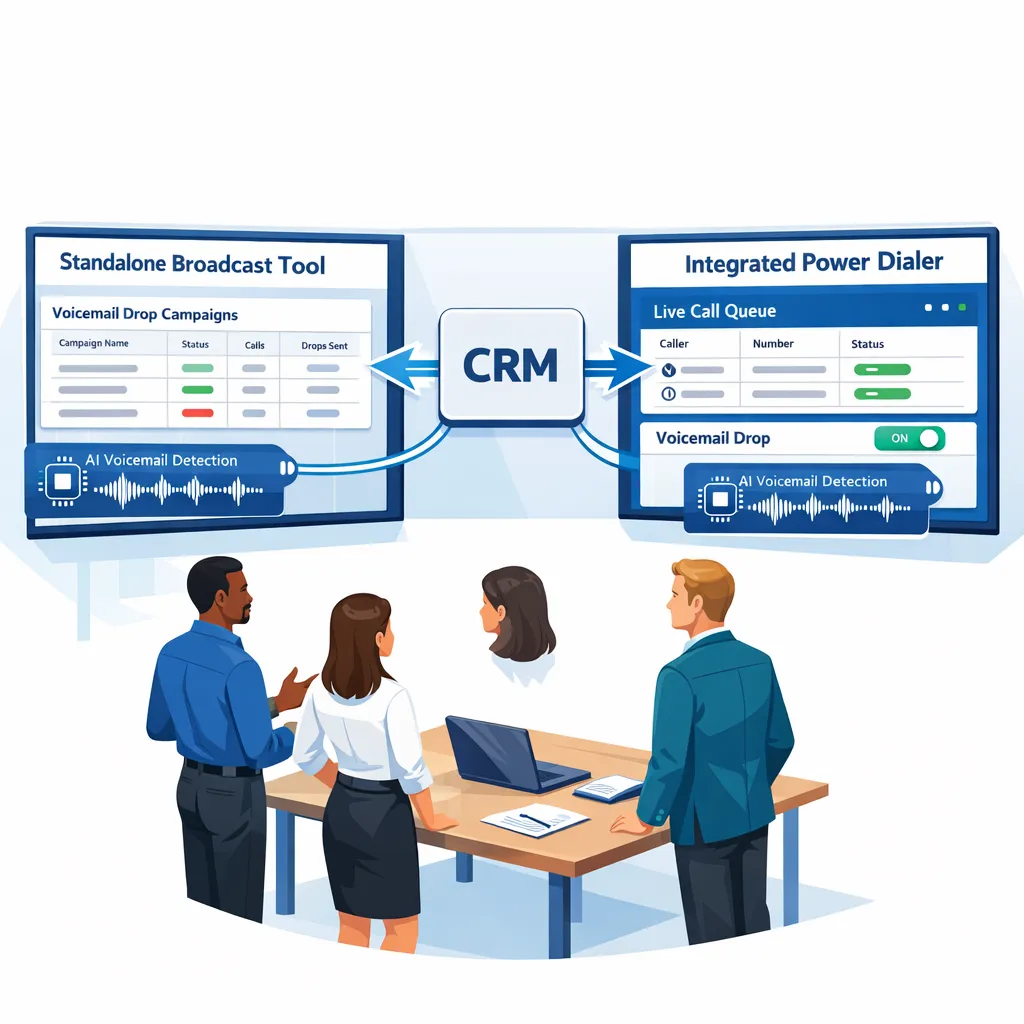
Realizing these returns requires selecting the correct technology. The market offers a variety of software solutions, ranging from standalone broadcast tools to integrated power dialers. When evaluating tools, revenue operations leaders should look for specific features such as CRM integration, artificial intelligence voicemail detection, and robust compliance guardrails.
Voicemail Drop Software Features and Pricing
Below is a comparison of several prominent software providers that facilitate automated voicemails, highlighting their features and pricing structures.
| Provider | Core Technology Focus | Key Features | Pricing Model | Best Use Case |
|---|---|---|---|---|
| Kixie | Integrated Sales Dialer | AI voicemail detection, one-click drops, deep CRM syncing (Salesforce/HubSpot), local presence dialing. | Subscription-based per user. | High-volume B2B sales teams needing deep CRM integration. |
| PhoneBurner | Power Dialer | One-touch voicemail drops, eliminates lag, multi-line dialing, SMS integration. | Subscription-based per user. | Sales teams focused on maximizing live call productivity without wait times. |
| Slybroadcast | Mass Voicemail Broadcasting | Ringless delivery directly to inbox, AI voice generation, custom lists. | Pay-per-drop (starting at ~$0.06). | Small businesses or marketing campaigns sending bulk updates. |
| CallFire | Voice Broadcasting | Contact list uploads, dynamic caller ID, detailed real-time analytics. | Pay-as-you-go ($0.02-$0.04) or starter plans ($99/mo). | Mid-to-large organizations running high-volume broadcast campaigns. |
| JustCall | Cloud-based VoIP | One-click recorded messages, unlimited storage for templates, team analytics dashboard. | Subscription-based with flexible volume options. | Sales and support teams requiring a unified communications platform. |
| VoiceDrop.ai | AI-Powered Ringless Drops | AI voicemail generation, advanced scheduling, API access, performance tracking. | Volume-based pricing. | Teams looking to clone voices or scale highly personalized audio messages. |
| Klenty | Sales Engagement Platform | Instantly recognizes greetings and beeps using AI, automatic drops. | $0.05 per drop with volume discounts. | Outbound teams wanting to integrate voice directly into email sequences. |
When calculating ROI, companies must subtract the cost of these tools. For pay-per-drop models like Klenty or Slybroadcast, dropping 1,000 voicemails a month costs approximately $50 to $60 per representative. For subscription dialers like Kixie or PhoneBurner, the monthly license cost typically covers unlimited drops but carries a higher flat fee. Organizations should model their expected call volume to determine which pricing structure yields the highest margin.
TCPA Rules and Voicemail Compliance Risks
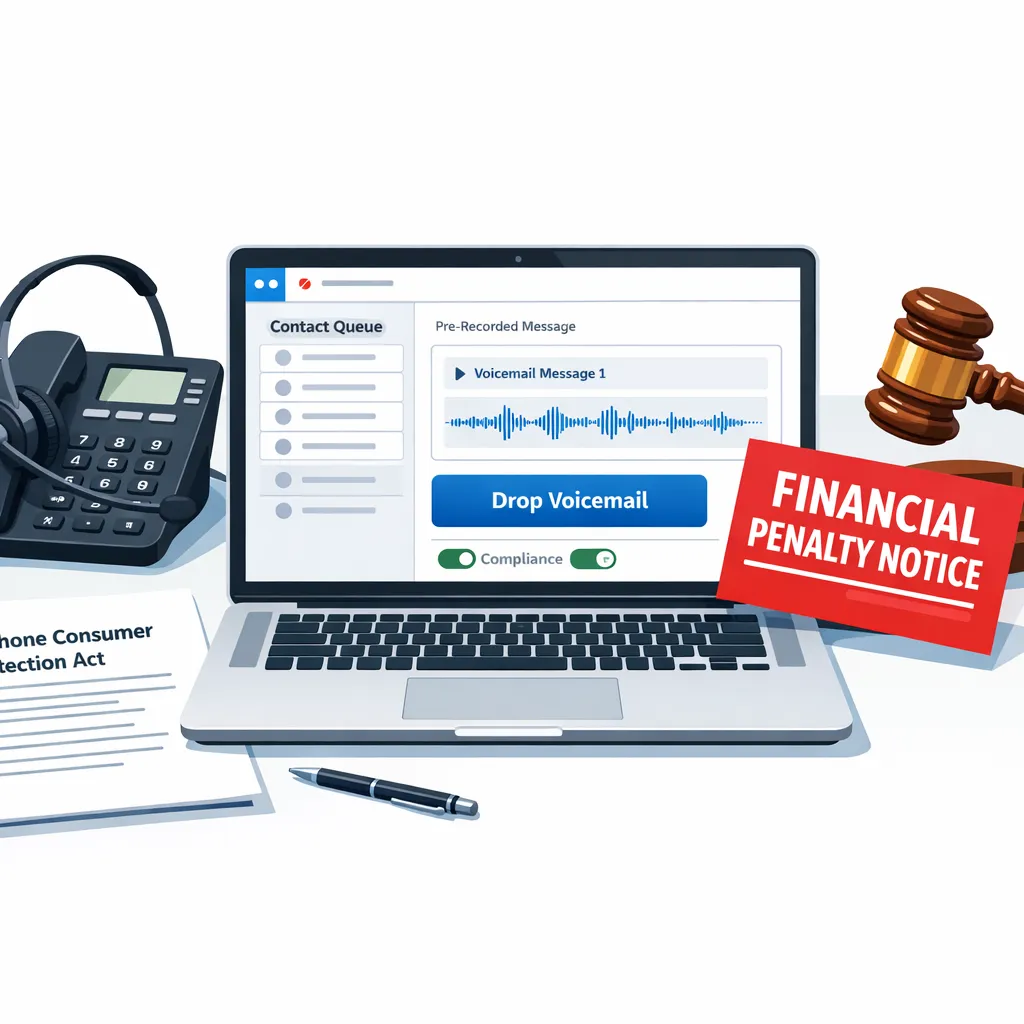
The mathematical models outlined above look highly profitable in a vacuum. However, revenue operations leaders must factor in legal risk. Non-compliance with telemarketing regulations can result in catastrophic financial penalties that instantly eradicate any positive return on investment generated by the software.
Understanding Ringless Voicemail Regulations
Many voicemail drop tools utilize “ringless” technology, which places a message directly into a consumer’s voicemail server without the mobile device ever ringing. For several years, software vendors argued that because the phone never rang, these messages did not qualify as “calls” and were therefore exempt from telemarketing laws.
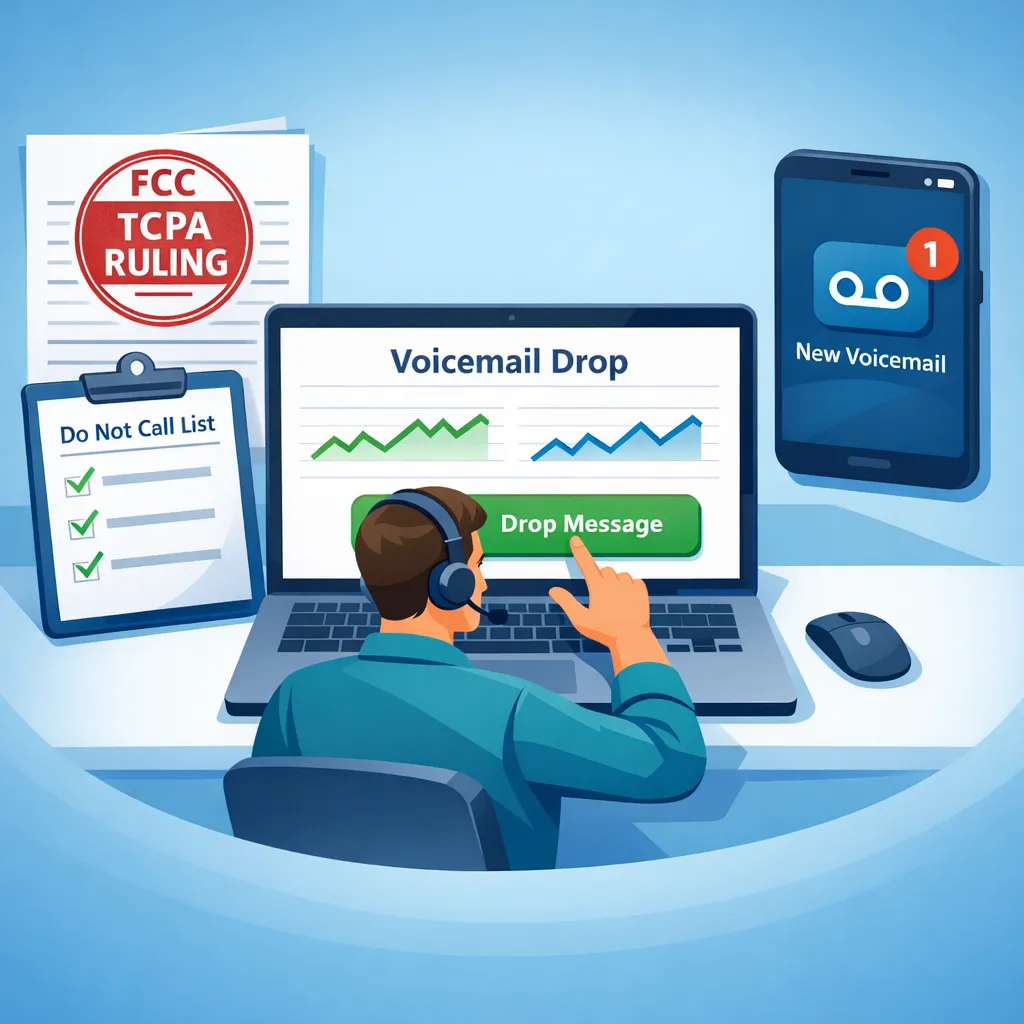
This legal gray area was closed. In February 2022, the Federal Communications Commission (FCC) issued a definitive ruling stating that ringless voicemails are indeed classified as “calls” under the Telephone Consumer Protection Act (TCPA). This means ringless voicemails are subject to the exact same strict regulations as traditional robocalls or automated dialing systems.
Furthermore, regulators treat AI-generated voicemails and pre-recorded audio files as “artificial or prerecorded voice” messages. Under the TCPA, businesses are strictly prohibited from using automated technology or prerecorded voices to contact cellular phones for marketing purposes unless the recipient has provided Prior Express Written Consent.
If a company uses voicemail drop software to send marketing messages without this explicit, documented consent, they are violating federal law. The penalties for TCPA violations are severe, ranging from $500 to $1,500 per individual illegal message. If a sales team drops 10,000 automated voicemails to a purchased lead list, the company could face statutory damages between $5 million and $15 million. Such litigation entirely destroys the ROI of automation.
The B2B Voicemail Exemption Myth
A common, dangerous misconception among sales professionals is that TCPA regulations only apply to consumer outreach (B2C), and that business-to-business (B2B) calls are exempt. This is factually incorrect regarding automated technology.
The TCPA applies to the technology used and the type of phone being dialed, not the purpose of the call. Specifically, the TCPA strictly regulates calls made to any cellular phone. Because modern B2B sales predominantly involve calling prospects’ mobile devices, especially in an era of remote work, the use of prerecorded voicemails or ringless voicemail drops to these numbers requires proper consent.
Courts have repeatedly ruled that if a mobile number is registered on the National Do Not Call (DNC) Registry, it is treated as a residential number for protection purposes, regardless of whether it is used for business. An employee utilizing an automated voicemail drop on a B2B prospect’s cell phone without consent creates identical liability to a consumer robocall.
Voicemail Best Practices for Avoiding Fines
To protect the return on investment of a voicemail campaign, organizations must implement rigorous compliance protocols.
- Understand Consent Requirements: Never use automated, prerecorded, or ringless voicemail drops for cold outbound marketing to purchased or scraped lists. Prior Express Written Consent is required for commercial marketing drops. Live-agent drops (where a human clicks to drop a recording during a live dial) carry different risk profiles than bulk broadcast ringless drops, but both involve prerecorded voices. Organizations should consult legal counsel regarding their specific workflow.
- Scrub Against Do Not Call Registries: Companies must scrub their contact lists against the National Do Not Call Registry at least every 31 days. Furthermore, organizations must maintain and respect an internal, company-specific Do Not Call list.
- Honor Time Restrictions: Federal regulations restrict marketing calls to between 800 AM and 900 PM in the recipient’s local time zone. Automated drops outside of these hours violate the law.
- Provide Clear Identification and Opt-Outs: Every prerecorded message must clearly identify the business at the beginning of the audio and provide instructions on how the prospect can opt out of future communications.
How to Build a Voicemail Drop Strategy
If an organization has secured the proper technology and established legal compliance guardrails, they must then deploy a strategy that maximizes the statistical likelihood of success. Based on the data indicating that voicemails should prime email replies, the strategy must be strictly orchestrated.
The Double Tap Voicemail Framework
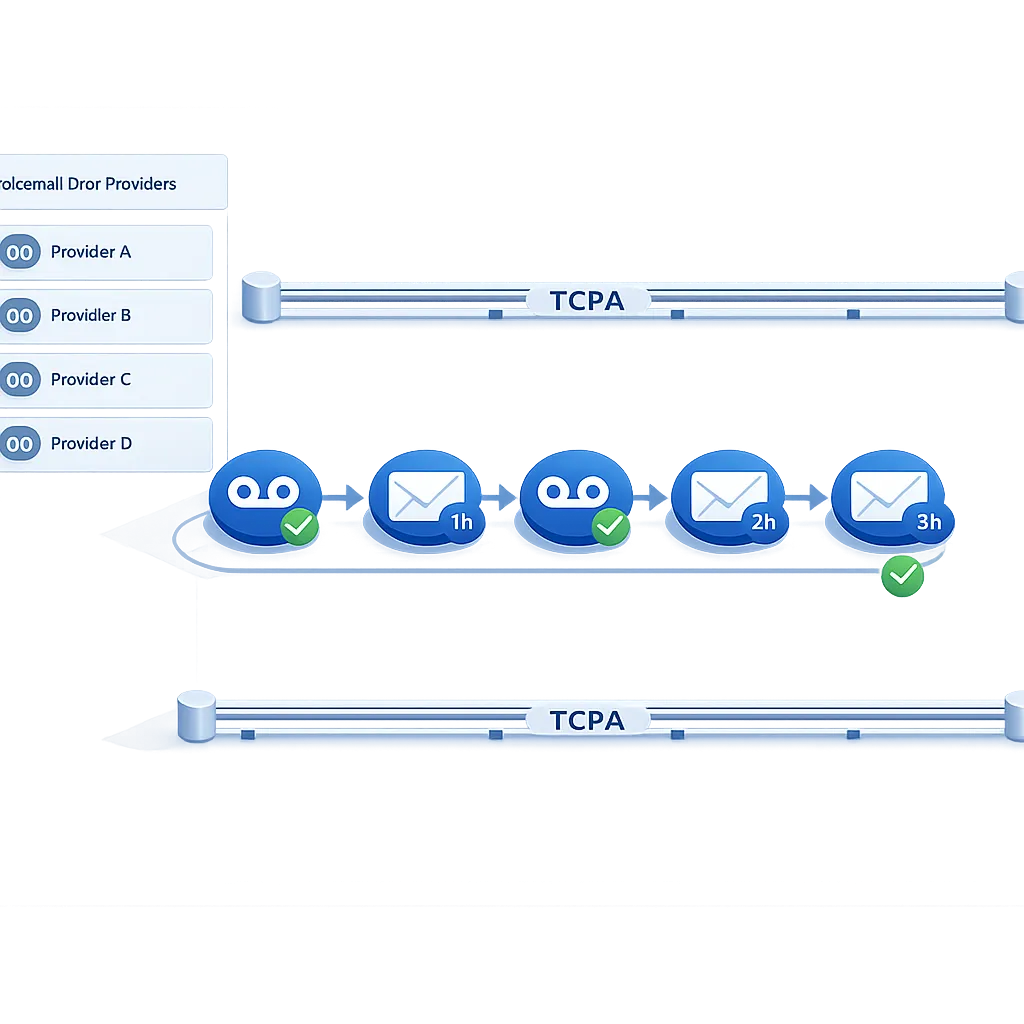
The most effective deployment of voicemail automation is commonly referred to in the industry as the “Double Tap” framework. This involves pairing an automated voicemail drop with an automated follow-up email.
For teams building that second touch with automation, Kixie’s guide to AI-generated emails for missed calls breaks down the timing, prompt structure, and example templates that turn a voicemail into a reply-focused email.
- Step One The First Voicemail Drop. The representative dials a prospect. Upon reaching the answering machine, the representative uses their dialer to drop a pre-recorded 15-second audio file. This file contains no sales pitch. It simply provides context, states the representative’s name, and instructs the prospect to look for an email.
- Step Two The Immediate Email. Within 30 to 60 seconds of dropping the voicemail, the representative (or their automated sales engagement platform) sends a plain-text email to the prospect. This email references the missed call and delivers the actual value proposition. Delaying this email by more than an hour causes the “priming” effect to fade.
- Step Three The Second Voicemail Drop. Later in the sequence, the representative drops a second pre-recorded voicemail. This audio file can be slightly longer (up to 30 seconds) and should include a piece of social proof, such as a metric achieved for a similar customer. This is immediately followed by a second email.
- Step Four Stop Dropping Voicemails. As the data indicates, leaving a third voicemail damages conversion rates. From this point forward in the cadence, the representative should rely exclusively on email, social media touches, and phone calls where no voicemails are left if the prospect does not answer.
Voicemail Scripting for Automation and Transcription
When pre-recording audio files to be dropped into inboxes, representatives must account for mobile operating systems. Features like Apple’s Live Voicemail and Android’s call screening services automatically transcribe voicemails into text on the user’s screen in real time.
Because modern buyers read their voicemails rather than listening to them, audio files must be scripted like short-form advertising copy. The message should be under 20 to 30 seconds. The most valuable information, the reason for the call, must be front-loaded into the first 8 to 10 seconds of the recording. If a representative spends the first 10 seconds slowly stating their name and company history, the prospect will stop reading the transcription and delete the message before reaching the core value proposition.
Voicemail Drop Frequently Asked Questions
How many voicemails should a sales rep leave per prospect?
Based on the analysis of over 300 million outbound calls, a sales representative should leave a maximum of one or two voicemails per prospect. Leaving one or two voicemails has been shown to double subsequent email reply rates. However, leaving three or more voicemails causes the email reply rate to drop to 2.2 percent, which is worse than leaving no voicemails at all.
Does voicemail drop software actually increase callback rates?
No, voicemail drop software is not designed to significantly increase callback rates. The average callback rate for B2B voicemails is historically low, generally between 4 and 5 percent. Furthermore, leaving a voicemail actually reduces the likelihood that a prospect will pick up your next phone call by 28 percent. The true value of a voicemail drop is to increase name recognition and boost the reply rate of follow-up emails.
Is ringless voicemail legal for business to business sales?
Ringless voicemail is heavily regulated and is not automatically exempt simply because it is used for business-to-business (B2B) sales. In 2022, the FCC ruled that ringless voicemails are classified as “calls” under the Telephone Consumer Protection Act (TCPA). The TCPA restricts the use of prerecorded voices and automated technology when contacting cell phones, regardless of whether the cell phone is used for business. Companies must ensure they have proper consent and scrub against Do Not Call lists to avoid severe fines.
What is the average cost of voicemail drop software?
Pricing varies based on the underlying technology. Standalone ringless broadcast tools typically charge on a pay-per-drop model, ranging from $0.02 to $0.06 per successful voicemail drop. Integrated power dialers and sales engagement platforms that feature one-click voicemail drops generally charge a flat monthly subscription fee per user, which can range from $50 to over $150 per month, but often include unlimited drops and CRM integrations.
How quickly should an email follow a voicemail drop?
To maximize the omnichannel psychological effect, the follow-up email should be sent within 30 to 60 seconds of the voicemail drop, and certainly no longer than 30 minutes later. Sending the email immediately ensures that the prospect’s memory of the missed call or voicemail notification is completely fresh, lowering the friction required for them to open the corresponding email.
Do voicemails hurt future connect rates on cold calls?
Yes. Data indicates that when a representative leaves a voicemail for a prospect, that prospect connects on future phone calls only 5.17 percent of the time. When no voicemail is left, the future connect rate is 7.18 percent. Because voicemails alert the prospect that the caller is a salesperson, they are more likely to screen future calls from that number. This reinforces why voicemails should be used sparingly and specifically to drive email engagement.
Voicemail Drop ROI Key Takeaways
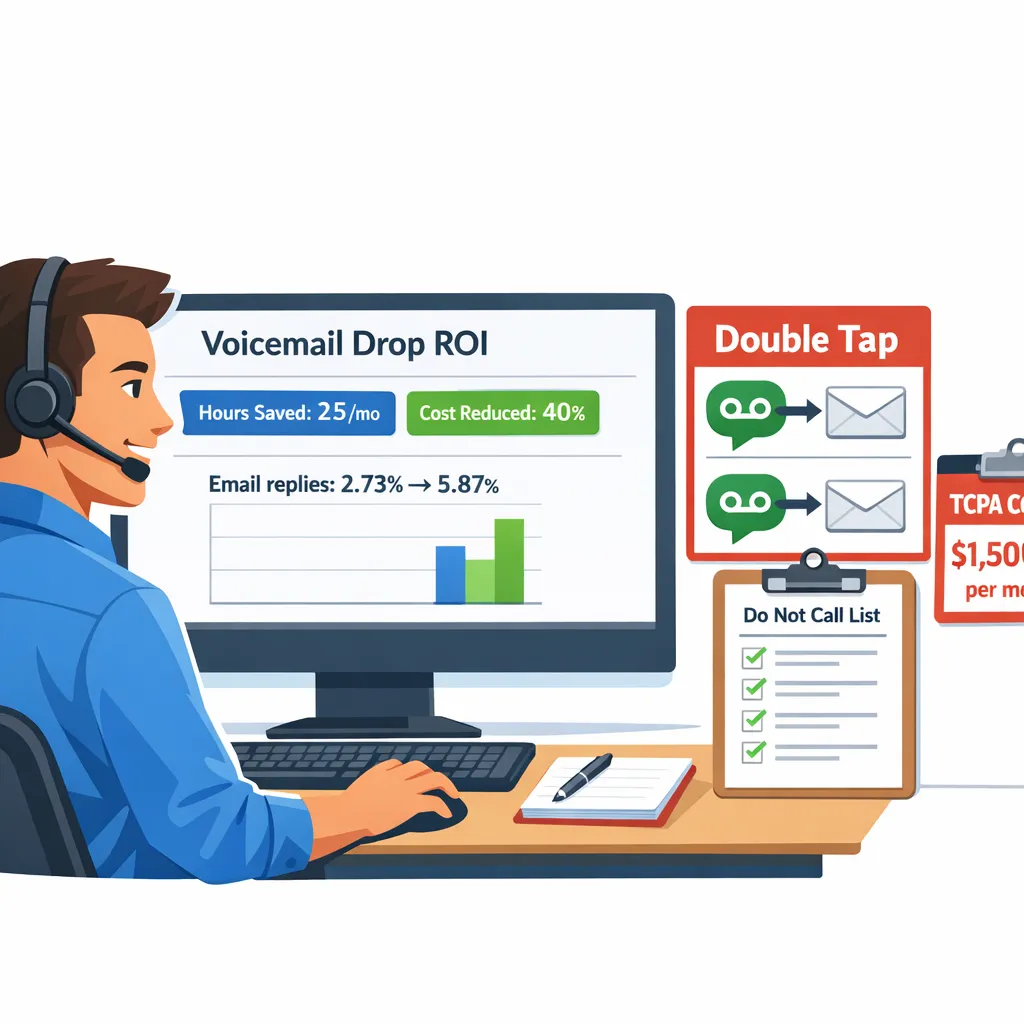
Evaluating voicemail drop return on investment is a straightforward mathematical exercise that bridges labor costs, pipeline velocity, and regulatory risk. By eliminating the manual process of reciting greetings into answering machines, an organization can reclaim roughly 25 hours per month per sales representative. Valued at standard industry compensation rates, this labor recovery alone yields over $12,000 in annual savings per employee.
However, the technology’s actual revenue generation relies entirely on an omnichannel strategy. Voicemails do not generate meaningful callbacks; they generate email replies. Implementing a strict “Double Tap” framework, dropping a maximum of two concise voicemails paired immediately with contextual emails, can increase a team’s email reply rate from an average of 2.73 percent to 5.87 percent. Exceeding this two-message limit severely damages conversion rates.
Finally, all financial modeling is contingent upon strict legal adherence. Ringless voicemails and automated audio drops are classified as prerecorded calls under the TCPA, and B2B marketers dialing cell phones are not exempt from these rules. Without robust consent tracking, Do Not Call list scrubbing, and time-zone management, organizations expose themselves to statutory penalties of up to $1,500 per message. When deployed legally and strategically, voicemail drop software transforms a significant labor drain into a measurable, high-return pipeline driver.
Ready to close more deals with Kixie?
See how Kixie's AI-powered tools can transform your sales and support operations.
Start Free Trial