
TL;DR: High-volume outbound calling to 10,000 dials a day is framed as a RevOps system built around dials × connect rate × meeting rate × show rate × close rate × average contract value, with capacity, validated phone data, dialer choice, CRM dispositions, caller ID reputation monitoring, DNC and suppression workflows, consent, call-recording notices, audit trails, and counsel review mattering more than raw dialing speed. Manual scale needs about 200 SDRs at 50 calls each, while 25 reps using parallel dialers can reach 10,000 dials, and the example funnel turns 10,000 dials at 6% connect rate into 600 live conversations, 42 meetings at 7% connect-to-meeting, 31.5 held meetings at 75% show rate, 3.15 closed deals at 10% close rate, and $47,250 revenue at $15,000 ACV. Reverse planning for $1,000,000 monthly outbound revenue at $15,000 ACV requires about 66 deals, 660 held meetings, 880 booked meetings, 12,571 live conversations, 209,516 monthly dials, and 10,475 dials per working day. Benchmarks cited include 3% to 8% connect rates, roughly 5.3% average on major dialing platforms, 7% meeting conversion, about 240 dials per meeting at 6% and 7%, manual or power reps at 80 dials per day producing about one meeting every three days, reps losing up to 70% of time to non-selling work, and manual dialing wasting about 70% of time on voicemail, bad numbers, and ringing. The recommended operating rhythm uses coiling the spring to preload lists, research, scripts, and personas before calling, call blocks around 10 AM to 11 AM and 4 PM to 5 PM, time-zone sequencing, CRM fields, dispositions, QA scorecards, coaching, scripts, and daily reporting on connects, meetings, show rates, and number performance. Dialer tradeoffs are power dialers like Kixie and PhoneBurner for one-line sequential calling, cleaner CRM hygiene, and 80 to 150 dials per rep per day, parallel dialers like Orum and Nooks for up to 10 simultaneous lines, hundreds or over 1,000 dials per rep per day, and a one-to-three-second telemarketer pause plus dropped leads when two prospects answer, and ConnectAndSell as human-assisted dialing with agents handling phone trees, gatekeepers, and voicemails before live transfer at up to $1,495 per user per month.
What 10,000 sales calls a day requires
Research suggests that scaling a sales team to execute more than 10,000 dials a day requires a precise combination of automated dialing technology, strict data validation, and strategic caller ID management. While many organizations attempt to reach these volumes by simply hiring more personnel, the evidence leans toward process optimization and technology as the most cost-effective methods. It seems likely that without proper compliance protocols, high-volume campaigns will suffer from spam flagging and declining connect rates.
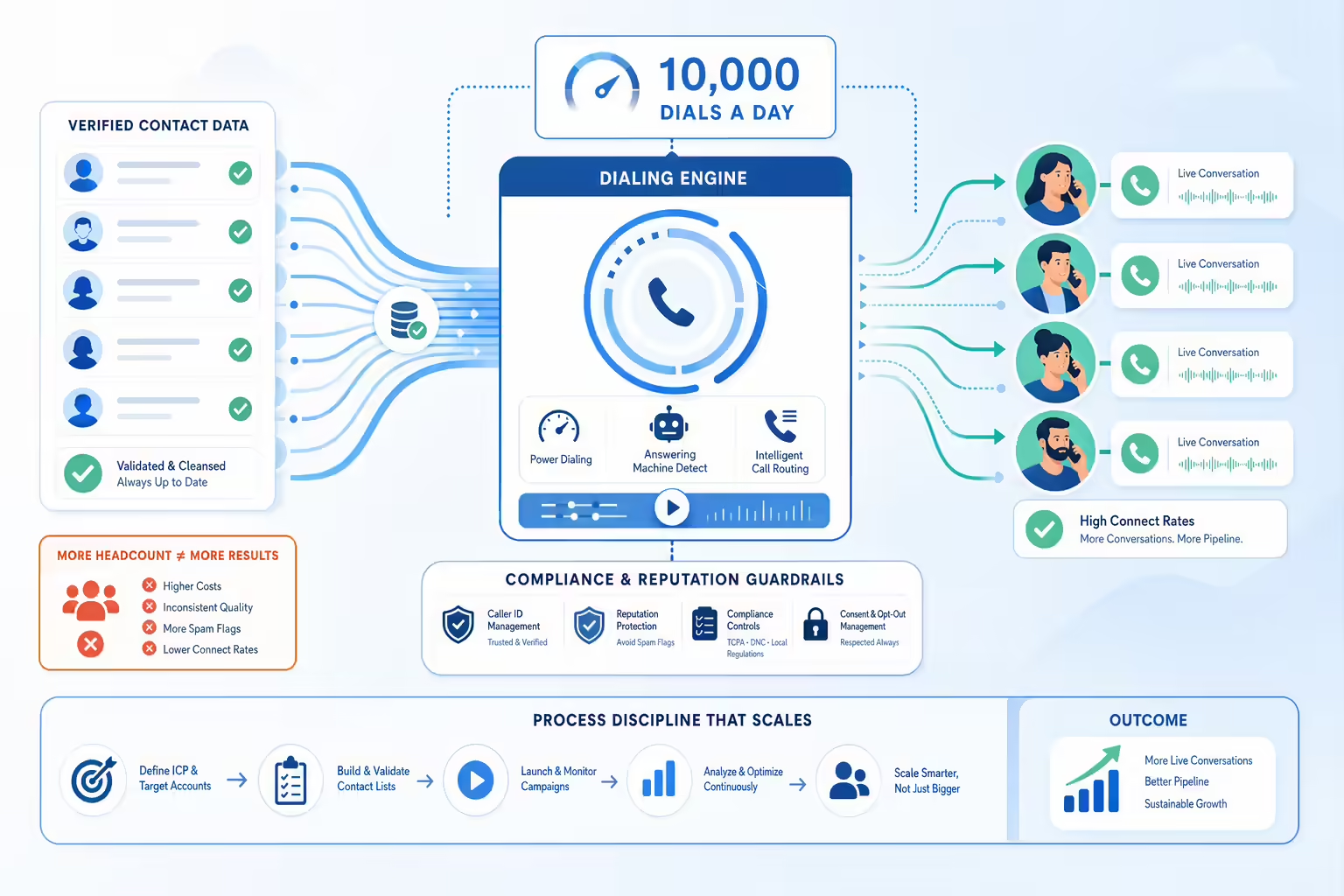
- Define the daily capacity model by role, segment, talk-time goal, and dialing workflow before setting a 10,000-dial target.
- Validate phone data before calling so reps are not burning volume on disconnected, reassigned, or incorrect records.
- Choose between manual dialing, power dialing, and parallel dialing based on list quality, account value, and the conversation quality required.
- Set caller ID governance rules for number usage, reputation monitoring, and escalation when answer rates decline or spam labels appear.
- Document compliance workflows for DNC and internal suppression lists, consent requirements, call-recording notices, and audit trails; review these processes with qualified counsel for the markets you call.
- Build the operating system around the dialer: CRM fields, dispositions, scripts, coaching, QA scorecards, and daily reporting on connects, meetings, show rates, and number performance.
Achieving 10,000 outbound sales calls in a single day is a massive operational undertaking. For a traditional team dialing manually, it would require approximately 200 sales development representatives completing 50 calls each. However, with modern software infrastructure, a team of 25 representatives using parallel dialers can accomplish the same feat. This scale requires robust revenue operations planning.
The core challenge is not simply executing the dials but ensuring those calls connect with human beings. Organizations often struggle to balance the quantity of calls with the quality of the resulting conversations. High call volumes can lead to representative burnout, poor data hygiene within the customer relationship management system, and an increase in phone numbers flagged as spam by telecommunications carriers.
To build a sustainable high-volume sales motion, revenue operations leaders must analyze the mathematics of their sales funnel, select appropriate telephony tools, and implement behavioral standards that protect their caller ID reputation. Use the sections below as a planning framework for capacity, dialing technology, data quality, caller ID health, and the daily metrics that determine whether volume is creating pipeline.
Plan your sales call funnel

Before an organization attempts to scale its daily dialing volume, leadership must understand the underlying mathematics of the outbound sales funnel. Without a clear grasp of conversion metrics, scaling call volume simply multiplies inefficiencies. Success or failure in high-volume cold calling is largely determined by two simple metrics. The first is the connect rate, which measures how many dials it takes on average to speak to a prospect. The second is the connect conversion rate, which measures how many live connections are required to set a qualified meeting.
A simple high-volume sales call calculator should use your own historical rates instead of generic benchmarks:
OutputFormulaDaily dialing capacityReps × calling hours × dials per hourLive conversationsTotal dials × connect rateMeetings bookedLive conversations × meeting-booking rateQualified opportunitiesMeetings held × qualification rateProjected revenueClosed deals × average contract valueThis model makes it easier to see whether the constraint is rep capacity, dialer throughput, phone data quality, live-call conversion, show rate, or close rate.
Calculate your outbound sales call funnel
Industry benchmarks provide a baseline for what revenue teams can expect. On average, standard connect rates range between 3% and 8%. Some organizations report an average connect rate of roughly 5.3% on major dialing platforms, though this can improve with better data. Furthermore, the conversion rate from a connected call to a booked meeting is typically around 7%.
For high-volume sales calls, the core calculator is simple: dials × connect rate × meeting conversion rate = meetings booked. RevOps teams should run this calculation by segment, list source, persona, and calling window rather than relying on one blended average.
Funnel stepFormulaIllustrative outputTotal dialsDaily dial target10,000 dialsLive conversationsDials × connect rate10,000 × 6% = 600 connectsBooked meetingsLive conversations × meeting conversion rate600 × 7% = 42 meetingsDials per meeting1 ÷ (connect rate × meeting conversion rate)1 ÷ (6% × 7%) ≈ 238 dials, rounded to 240Consider a worked example using these baseline metrics to understand the effort required to book a single meeting. If an organization has a 6% connect rate, it requires approximately 16 dials to achieve one live connection. If the connect conversion rate is 7%, it takes about 15 live connections to generate one booked meeting. Multiplying these figures reveals that it takes roughly 240 dials to generate a single meeting.
If a sales development representative makes 80 manual or power dials per day, they will generate one new meeting every three days, resulting in roughly seven new meetings per month. In a scenario where 10,000 dials are made across an entire team in a single day, the mathematics scale accordingly. At a 6% connect rate, 10,000 dials will yield 600 live conversations. At a 7% conversion rate, those 600 conversations will result in 42 booked meetings per day for the organization.
Forecast revenue from daily sales calls
To justify the expense of scaling to 10,000 dials a day, organizations should model the full path from dial volume to closed-won revenue. The basic calculator is: dials × connect rate × meeting-booked rate × show rate × close rate × average deal size = projected new revenue.
Funnel stepExample assumptionExample resultDialsStarting call volume10,000Live conversations6% connect rate600Booked meetings7% of live conversations42Held meetings75% show rate31.5Closed deals10% close rate on held meetings3.15New revenue$15,000 average deal size$47,250These numbers are illustrative, so revenue operations teams should replace each assumption with their own historical benchmarks. A team with higher data quality, stronger scripts, better list segmentation, or a more efficient sales process may see very different results than a team calling unvalidated lists.
The same formula also works in reverse. Using the example assumptions above, if a company needs to generate $1,000,000 in new outbound revenue per month and has an average deal size of $15,000, it needs about 66 closed deals. At a 10% close rate, that requires 660 held meetings. At a 75% show rate, it requires 880 booked meetings. At a 7% connect-to-meeting rate, it requires 12,571 live conversations. At a 6% connect rate, the team must make about 209,516 dials per month, or roughly 10,475 dials per day across 20 working days.
Build a sales team for call volume
Scaling past 10,000 dials a day is impossible without a structured, highly disciplined sales team. A common failure point for scaling teams is the administrative burden placed on representatives. Representatives often spend up to 70% of their time on non-selling tasks, such as finding contacts, researching accounts, and logging information into the customer relationship management software. To hit high volumes, management must remove these obstacles.
Prep reps before sales calls
A highly effective strategy for managing high-volume calling operations is known as “coiling the spring.” This concept involves front-loading all preparation and administrative work before the representative begins their dialing block. The friction in a standard sales day comes from switching contexts. A representative will research an account for five minutes, make a one-minute cold call, log the notes for two minutes, and then begin researching the next account. This start-and-stop motion destroys dialing velocity.
Coiling the spring dictates that a representative, or a dedicated data team, builds the contact lists and reviews the accounts in advance. By the time the representative sits down to dial, their only objective is to execute the calls. They possess a filtered database, pre-written messaging scripts, and a clear understanding of the target personas. With the preparatory work complete, the representative can simply push a button on their automated dialer and remain in a continuous flow state, allowing them to easily execute 100 or more dials in a single session.
Block time for high-volume sales calls
Time management is critical for high-volume execution. A structured daily schedule ensures that calls are made during the statistically optimal windows for human connection. Industry data indicates that the best times to reach prospects are generally in the late morning, from 10:00 AM to 11:00 AM, and in the late afternoon, from 4:00 PM to 5:00 PM.
A recommended schedule divides the day into distinct activity blocks. For example, a representative might spend the first 90 minutes of their day sending customized emails, followed by an intensive cold calling block from 10:30 AM to 12:00 PM. During the midday hours, when prospects are typically in internal meetings or at lunch, the representative can focus on administrative tasks, pipeline management, or researching accounts for the next day. The day concludes with a final calling block from 3:30 PM to 5:00 PM.
To further optimize connect rates, representatives can use time zones. An East Coast representative might focus their morning call block on local prospects and use their late afternoon block to call prospects on the West Coast, effectively capturing the early morning window for the Pacific time zone.
Choose the right sales dialer

Executing 10,000 dials a day relies heavily on the underlying telephony infrastructure. Manual dialing, where a representative types numbers into a desk phone or software keypad, is entirely unsuited for this scale. Manual dialing wastes approximately 70% of a representative’s time navigating voicemails, disconnected numbers, and endless ringing. To scale, organizations must invest in automated dialing systems.
Power dialers vs parallel sales dialers
The market for automated dialers is divided into two primary categories. The first is the power dialer, and the second is the parallel dialer. Understanding the distinction is vital for matching the tool to the team’s specific strategy.
A power dialer automatically dials numbers sequentially from a pre-loaded list. As soon as one call ends, the software immediately begins dialing the next number. This eliminates physical dialing time and ensures a steady pace. Power dialers are highly effective for teams that prioritize CRM data hygiene and high-quality, personalized interactions. Because the system only dials one line at a time, the representative is fully prepared when a prospect answers. The primary limitation is volume; a representative using a power dialer will typically max out between 80 and 150 dials per day. Therefore, hitting 10,000 dials requires a very large team. Popular power dialers include Kixie and PhoneBurner.
A parallel dialer, sometimes called a multi-line dialer, dials multiple phone numbers simultaneously for a single representative. Some platforms allow a representative to dial up to 10 lines at once. The software’s artificial intelligence listens to the ringing lines. When it detects a human voice, it immediately drops the other lines and bridges the live call to the representative. This technology allows a single representative to make hundreds, or even over a thousand, dials in a single day. However, this speed comes with a trade-off. Parallel dialers often suffer from a slight audio delay, known as the “telemarketer pause,” when bridging the call. This one-to-three-second delay can signal to the prospect that they are receiving an automated call, leading to immediate hang-ups and lowered conversion rates. Additionally, if two prospects answer simultaneously, one must be dropped, potentially burning a valuable lead. Leading parallel dialers include Orum and Nooks.
Use human assisted sales dialing
A third, highly specialized category is the human-assisted dialing system. ConnectAndSell is the primary vendor in this space. Rather than relying purely on software, ConnectAndSell utilizes trained human agents to manage complex phone trees, gatekeepers, and voicemails.
Once the human agent secures a live decision-maker on the line, the call is instantly transferred to the sales representative. This model provides the high volume of a parallel dialer without the artificial intelligence delay, providing a seamless handoff. However, it is an exceptionally expensive solution, often costing up to $1,495 per user per month, making it viable only for enterprise teams with massive budgets and high-value target accounts.
Compare sales dialer software
When evaluating dialers to scale to 10,000 daily dials, revenue operations leaders must balance monthly subscription costs against the actual cost per connected conversation. The table below compares leading sales dialers based on market data.
| Software Platform | Dialer Type | Est. Monthly Cost (Per Rep) | Est. Cost Per Conversation | Key Features and Integrations | Ideal Use Case |
|---|---|---|---|---|---|
| Orum | AI Parallel (Multi-Line) | $150 – $300 | $44 | Up to 10 lines, AI voicemail detection, Salesforce/HubSpot sync. | Large tech SDR teams prioritizing maximum daily call volume. |
| Nooks | AI Parallel (Multi-Line) | $95 – $195 | $24 | Up to 5 lines, virtual sales floor collaboration, call analytics. | Mid-size to large teams wanting a collaborative, in-office feel. |
| ConnectAndSell | Human-Assisted | $1,495 | $357 | Human agents bypass IVRs, instant live handoffs, no AI lag. | Enterprise teams targeting C-suite executives at high-value accounts. |
| PhoneBurner | Power Dialer (Single) | $149 | $29 | Voicemail drop, automatic logging, local presence options. | Teams seeking reliable single-line automation without multi-line complexity. |
| Kixie | Power / Multi-Line | $65 – $150 | N/A | Deep 2-way CRM sync, 65-country local presence, SMS automation. | SMB teams prioritizing tight CRM integration and international calling. |
When integrating these platforms with existing CRMs, companies should budget time for configuration. Connecting dialers with Salesforce can sometimes require upwards of 20 hours of setup and ongoing monthly maintenance, whereas integrations with HubSpot tend to be more straightforward out of the box.
Avoid spam flags on sales calls
As organizations increase their outbound dialing capacity to thousands of calls a day, they inevitably encounter resistance from telecommunications networks. In recent years, consumers have been overwhelmed by illegal robocalls and caller ID spoofing. In response, carrier networks and federal regulators have implemented strict filtering algorithms to block high-volume callers. If a sales team simply dials 10,000 numbers blindly from a single phone number, their calls will quickly be labeled as “Scam Likely” or “Spam Risk,” devastating their connect rates.
Check call attestation levels
The Federal Communications Commission mandated the implementation of the STIR/SHAKEN framework under the TRACED Act. STIR stands for Secure Telephony Identity Revisited, and SHAKEN stands for Signature-based Handling of Asserted information using toKENs.
This framework requires originating voice service providers to attach a digital certificate to the SIP (Session Initiation Protocol) header of an outbound call. This certificate authenticates that the caller has the right to use the phone number displayed on the caller ID. When the call reaches the destination network, the receiving provider checks this signature.
Providers assign one of three “attestation” levels to the call:
- A-Level Attestation (Full): The service provider verifies the caller’s identity and confirms they have the exclusive right to use the specific phone number. These calls are highly likely to be delivered without a spam warning.
- B-Level Attestation (Partial): The provider verifies the caller’s identity but cannot verify their authorization to use the specific number (often occurring when using third-party routing or PBX systems).
- C-Level Attestation (Gateway): The provider can only verify where the call entered the network, usually applied to international gateway traffic. These calls face strict scrutiny and high blocking rates.
To survive in a high-volume calling operation, an organization must work closely with their dialer vendor to ensure their phone numbers are properly registered and routinely achieve A-Level attestation. Providers that fail to meet these requirements can be removed from the Robocall Mitigation Database, causing all of their traffic to be blocked across networks.
Protect caller ID from spam flags
Even with A-Level attestation, high calling volume can trigger behavioral spam filters. STIR/SHAKEN verifies identity, but it does not evaluate intent. Telecommunication AI systems operated by companies like AT&T and Verizon analyze call patterns. Short call durations, incredibly high volumes, and low answer rates perfectly mimic the behavior of illegal robocallers.
Under FCC safe harbor rules, carriers have significant leeway to block authenticated calls if the behavioral patterns suggest unwanted spam. Therefore, high-volume sales teams must implement strict caller ID rotation strategies to spread the call volume across a large pool of phone numbers.
Industry best practices suggest limiting call volume to between 50 and 70 dials per phone number per day, with an absolute maximum of 100 to 150 calls before resting the line. Platforms like Kixie automate this rotation with built-in local presence dialing across 65 countries, cycling through number pools so reps never have to manage it manually. If a team intends to make 10,000 dials a day, and strictly limits each number to 50 dials, the organization must purchase, register, and manage a pool of 200 distinct phone numbers.
Furthermore, sales teams must maintain specific behavioral habits to protect these numbers. Carriers penalize phone numbers that exclusively make two-second calls. Representatives should strive to keep prospects on the line for at least 10 seconds, even if the prospect is not interested. Leaving pre-recorded voicemails is also highly recommended; dropping a 15-second voicemail increases the mathematical average duration of the calls associated with that phone number, signaling to carrier algorithms that the caller is legitimate. Finally, companies should proactively register their business numbers with analytics platforms like Hiya and TNS to ensure their brand name appears correctly on caller ID screens.
Improve data quality for sales call connects
Scaling dialing volume exposes the underlying flaws in a company’s data infrastructure. If a sales team utilizes a parallel dialer to make thousands of calls to a poorly maintained contact list, they will simply burn through their total addressable market with zero results.
Why more sales calls can lower connects
The phenomenon known as the “Parallel Dialing Paradox” suggests that while multi-line dialers exponentially increase call volume, they can actually decrease overall sales effectiveness if the data is poor. When teams deploy parallel dialers, leadership dashboards show a massive spike in activity. However, if the connect rate drops to between 2% and 4%, representatives must make over 50 dials just to have one conversation.
Furthermore, parallel dialers operate on the assumption that any live human is a good outcome. If a system dials five numbers simultaneously, and a low-level manager answers one millisecond before the CEO of a major target account, the system bridges the representative to the manager and hangs up on the CEO. This creates a poor customer experience and burns high-value prospects. The strategy of using speed without validation merely accelerates failure.
Validate phone numbers before sales calls
To fix the conversion problem at high volumes, teams must invest in data validation. It is estimated that up to 40% of standard B2B contact lists consist of disconnected, reassigned, or incorrect phone numbers. Calling these numbers wastes time and damages caller ID reputation. Using number validation software, such as ConnectRate, allows teams to scrub their lists and filter out bad data before loading it into the dialer. Kixie’s deep two-way CRM integrations with HubSpot, Salesforce, and Pipedrive help keep contact data clean in real time by syncing call outcomes and dispositions automatically. Removing dead numbers can improve connect rates by 70% or more, drastically lowering the cost per conversation.
Beyond basic validation, advanced teams are using “phone intent” data. The core philosophy of phone intent is recognizing that only roughly 20% of the population is willing to answer a cold call from an unknown number. Using predictive tools to score a prospect’s likelihood to answer allows teams to segment their lists. By focusing high-volume efforts strictly on the demographic that actually picks up the phone, teams can achieve connect rates as high as 25% to 30%, completely bypassing the spam flag risks associated with excessive dialing. This strategic approach requires 60% fewer dials to yield the same number of booked meetings, representing a much more sustainable strategy than blindly dialing 10,000 unverified numbers.
High-volume sales calls FAQ
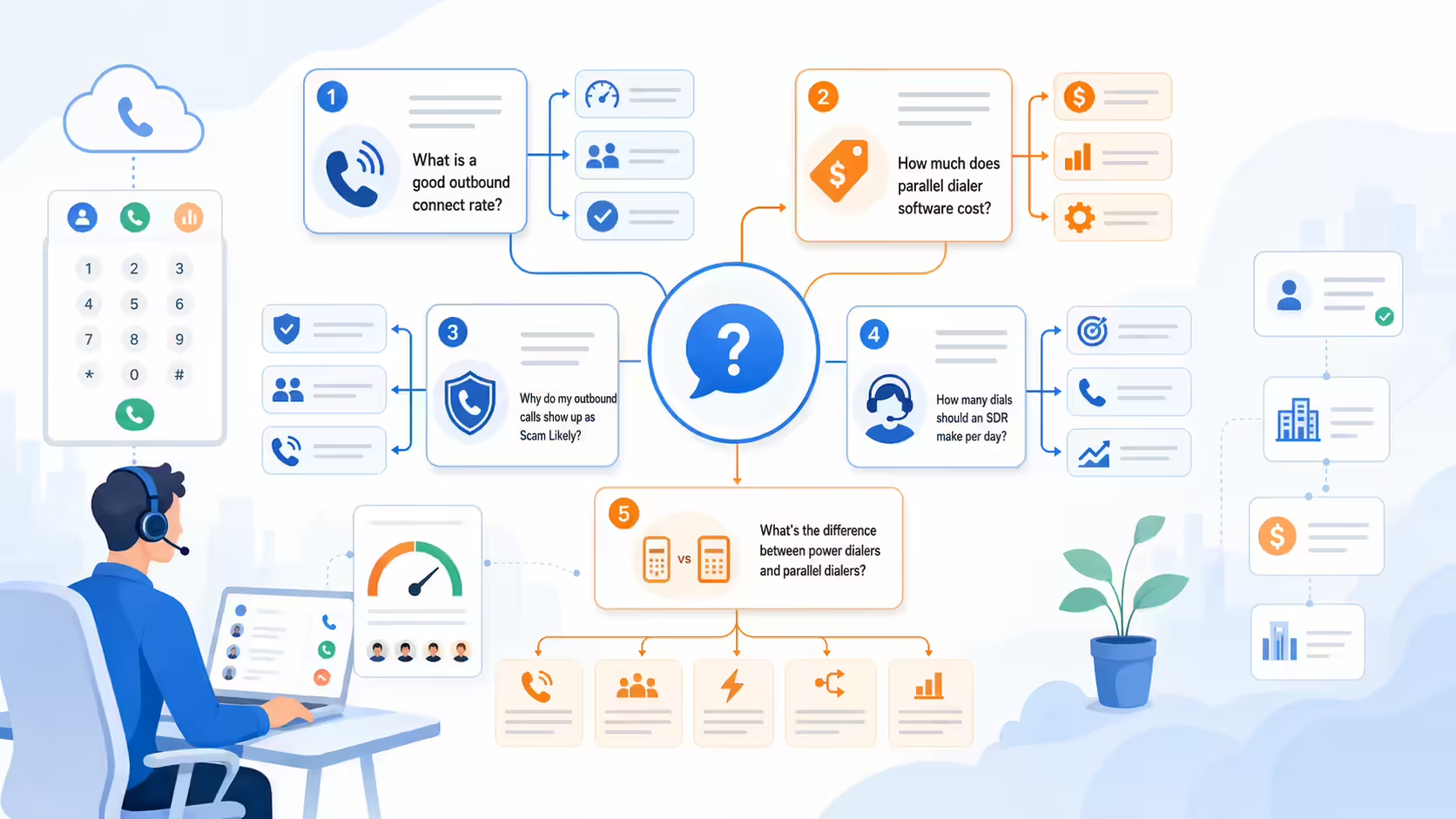
What is a good connect rate for sales calls?
A standard connect rate for outbound B2B sales calls typically falls between 3% and 8%. Dialing platforms like Orum report a platform-wide average of 5.3%. Teams that utilize highly validated mobile numbers or specialized phone intent data can sometimes push their connect rates above 20%. Connect rates below 3% usually indicate severe data hygiene issues or numbers that have been flagged as spam by telecommunication carriers.
How much does sales dialer software cost?
Parallel dialers are premium software solutions. Subscriptions for major platforms like Orum generally cost between $150 and $300 per user per month, often requiring a minimum seat count and annual billing. Competitors like Nooks typically range from $95 to $195 per user per month. When evaluating costs, organizations should also calculate the “cost per conversation” to fully understand the software’s ROI.
Why do outbound calls show as Scam Likely?
Outbound calls are flagged as “Scam Likely” or “Spam Risk” due to a combination of carrier AI filters and STIR/SHAKEN regulations. Carrier algorithms monitor behavioral patterns, automatically flagging phone numbers that make high volumes of calls (e.g., more than 100 per day), generate extremely short call durations, and suffer from low answer rates. Additionally, if the originating telecom provider cannot verify the caller’s identity with an A-Level STIR/SHAKEN attestation, the call is highly susceptible to blocking.
How many calls should an SDR make per day?
The optimal daily dial count depends entirely on the technology used and the industry target. For enterprise sales representatives manually researching high-value accounts, 30 to 50 dials per day is standard. For high-volume transactional sales using single-line power dialers, 80 to 100 dials per day is an aggressive but achievable baseline. Representatives using parallel dialers can easily exceed 300 to 500 dials per day. However, the goal is to generate 2 to 4 qualified meetings, not simply to hit an arbitrary dial metric.
What is the difference between sales power dialers and parallel dialers?
A power dialer automates the calling process by dialing phone numbers sequentially from a list one at a time. The representative waits on the line for the prospect to answer. A parallel dialer, conversely, calls multiple phone numbers simultaneously (e.g., 3 to 10 lines at once). Using artificial intelligence, the parallel dialer drops unanswered lines and instantly bridges the representative only when a human voice is detected. Parallel dialers generate significantly higher call volume but can introduce a slight audio delay upon connection.
Use these answers as operational guidance for planning high-volume sales calls. For compliance questions involving TCPA, DNC lists, consent, call recording, or state-specific rules, work with qualified legal counsel before launching or scaling an outbound program.
High-volume sales call takeaways
Scaling a revenue organization to execute more than 10,000 outbound sales calls per day is a highly complex initiative that requires technical precision, strict operational discipline, and an emphasis on data quality. Throwing more personnel at poor data with manual processes guarantees diminishing returns. To successfully scale cold calling operations, leaders must shift their focus from raw activity metrics to optimizing the systems that enable those activities.
Key takeaways for scaling outbound sales calls include:
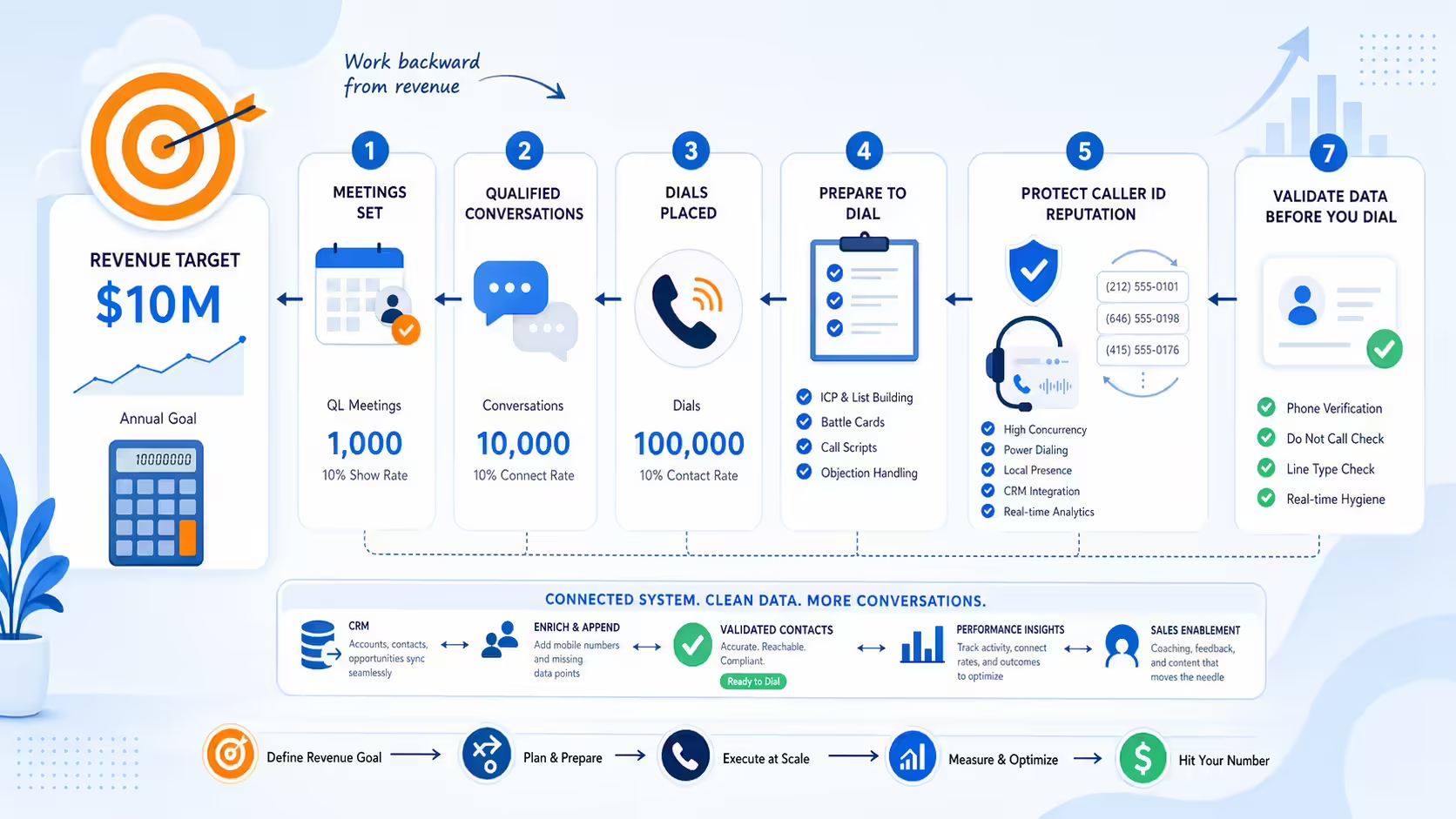
- Work Backward from Revenue: Understand the mathematical realities of the outbound funnel. Calculate the specific number of dials required based on historical connect rates, conversion rates, show rates, and average deal sizes.
- Implement “Coiling the Spring”: Mandate that sales teams prepare their contact lists, scripts, and research before executing calls. Separating administrative work from active dialing drastically increases hourly call volume.
- Select the Proper Dialer: Choose between power dialers, parallel dialers, or human-assisted systems based on the team’s size, budget, and the value of the target accounts. High-volume parallel dialing is highly effective but requires pristine data.
- Protect Caller ID Reputation: Secure A-level STIR/SHAKEN attestation from telecommunication providers. Avoid spam flags by aggressively rotating local presence numbers and ensuring no single number executes more than 50 to 70 dials per day.
- Validate Phone Data: Do not waste parallel dialing bandwidth on disconnected numbers. Utilize number validation software and phone intent data to focus entirely on the demographics statistically likely to answer the phone.
Ready to close more deals with Kixie?
See how Kixie's AI-powered tools can transform your sales and support operations.
Start Free Trial