TL;DR: Federal telemarketing rules generally limit outbound residential sales calls to 8 a.m. to 9 p.m. in the called party’s local time, but state rules can be narrower. Every row in the table below was checked against the state’s own statute or rule. Twenty states set a window narrower than the federal one and Pennsylvania joins them on October 18, 2026; five ban Sunday calls outright, with Pennsylvania the sixth from that date; and four cap repeat calls within a 24-hour period. Use the table to set campaign windows, then have counsel or your compliance vendor confirm consent, registration and do-not-call requirements for every state before calling. Kixie can support local-time dialing workflows, CRM logging, and suppression-list processes, but legal compliance depends on your policies, configuration, lists, consent records, and legal review.
This article is for general business information, not legal advice. Telemarketing laws change, exemptions vary, and state rules may apply differently based on who is calling, what is being sold, the recipient type, consent, phone type, call technology, and whether the call is B2B or consumer-facing. Before launching a campaign, confirm the rule set with qualified counsel.
Federal telemarketing calling hours in 2026
The federal baseline is the starting point, not the full compliance answer.
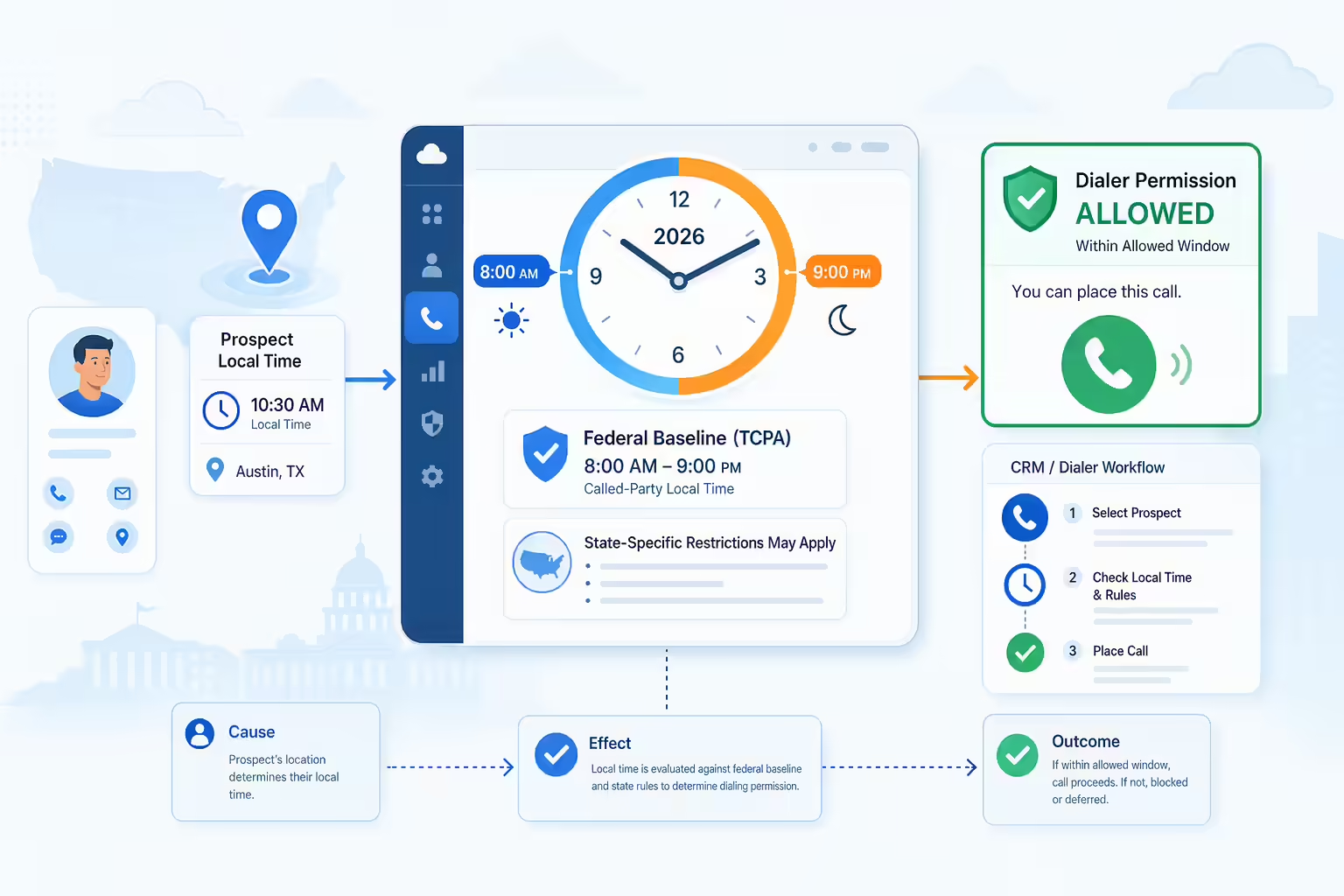
The FTC’s Telemarketing Sales Rule says that, without prior consent to call at another time, outbound telemarketing calls to a person’s home are limited to 8 a.m. to 9 p.m. local time at the called person’s location. The current rule text appears in the TSR calling-time rule, and the FTC’s business guidance explains the same calling-time restriction in plain language.
The FCC’s TCPA implementing rule also prohibits telephone solicitations to residential subscribers before 8 a.m. or after 9 p.m. local time at the called party’s location. See the FCC delivery restrictions rule for the current text.
That federal window does not mean every state lets your team call from 8 a.m. to 9 p.m. Some states set narrower windows, Sunday limits, holiday limits, frequency caps, registration rules, or separate requirements for automated dialing, prerecorded voice, artificial voice, text messages, and revocation requests.
State telemarketing calling hours table for 2026
Read this table as a planning screen, not a final legal matrix. Every row was checked against the state’s own statute or administrative rule, linked in the planning note. "Checked statute" or "Checked regulation" means the state sets its own calling window and the row quotes it. "Statute sets no state hours, federal rule applies" means we read the state’s telemarketing law and found no calling-hour provision, so the federal 8 a.m. to 9 p.m. local-time rule is the operative limit there. Neither label confirms the absence of consent, registration, do-not-call, or technology-specific restrictions, which are outside the scope of this table.
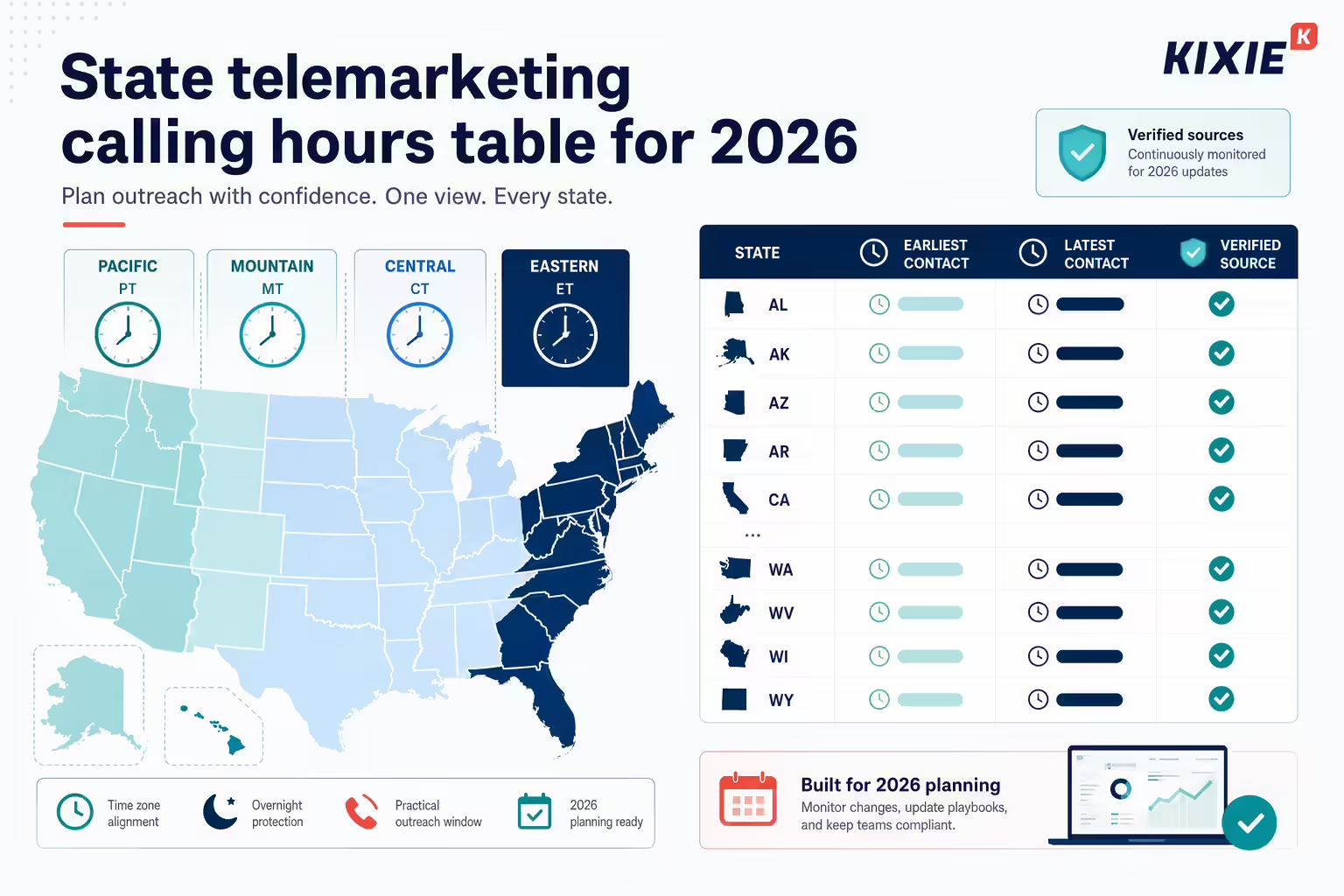
| State | Planning call window | 2026 planning note | Source confidence |
|---|---|---|---|
| Alabama | 8 a.m. to 8 p.m.; no Sunday or holiday calls | Ala. Admin. Code r. 770-X-5-.17(2)(b), the Public Service Commission rule for live solicitation calls, states: "No solicitation calls are allowed on Sundays or holidays. On the days that calls are allowed, none will be placed prior to 8 a.m. or after 8 p.m." Subsection (1)(b) applies the same rule to automated calls. | Checked regulation |
| Alaska | 8 a.m. to 9 p.m. (federal) | AS 45.50.475 and AS 45.63.045 cover the do-not-call registry, recorded messages, caller identification and hang-up duties, but set no calling hours. | Statute sets no state hours, federal rule applies |
| Arizona | 8 a.m. to 9 p.m. (federal, adopted by reference) | ARS 44-1278(B)(6) bars initiating an outbound call "except as provided in 47 Code of Federal Regulations, section 64.1200 or 16 Code of Federal Regulations section 310.4." The state sets no hours of its own; the federal window is enforceable as Arizona law. | Statute sets no state hours, federal rule applies |
| Arkansas | 8 a.m. to 9 p.m. (federal, adopted by reference) | Ark. Code 4-99-405(3) makes it unlawful to make a telephone solicitation that violates the FTC rule in 16 CFR 310.4 "as in effect on March 1, 2003." No separate state hours. | Statute sets no state hours, federal rule applies |
| California | 8 a.m. to 9 p.m. (federal) | Business and Professions Code 17590 to 17594 and Civil Code 1770(a)(22) contain no calling-hour provision. California’s consent, autodialer, call-recording and privacy rules are separate and still apply. | Statute sets no state hours, federal rule applies |
| Colorado | 8 a.m. to 9 p.m. (federal) | CRS 6-1-304 and the Colorado No-Call List Act (CRS 6-1-904) set registration, no-call and caller-ID duties but no calling hours. Read in the 2023 code edition. | Statute sets no state hours, federal rule applies |
| Connecticut | 9 a.m. to 8 p.m. | Conn. Gen. Stat. 42-288a(c) limits telephonic sales calls to "between the hours of nine o’clock a.m. and eight o’clock p.m. local time." Subsection (l) also requires prior express written consent for any telephonic sales call. | Checked statute |
| Delaware | 8 a.m. to 9 p.m. (federal) | 6 Del. C. Chapter 25A sets registration and prohibited acts, including a ten-year company-specific do-not-call duty, but no calling hours. | Statute sets no state hours, federal rule applies |
| Florida | 8 a.m. to 8 p.m. | Florida Statutes section 501.616(6)(a), as amended by chapter 2021-185, bars commercial telephone solicitation calls before 8 a.m. or after 8 p.m. local time in the called person’s time zone, including calls made through automated dialing or recorded messages. Section 501.616(6)(b) also caps calls at three per 24-hour period on the same subject matter, regardless of the number used. This window is one hour narrower than the federal baseline. | Checked statute |
| Georgia | 8 a.m. to 9 p.m. (federal) | OCGA 46-5-27 and OCGA 10-5B-4 contain no calling-hour provision as of the 2025 amendments. | Statute sets no state hours, federal rule applies |
| Hawaii | 8 a.m. to 9 p.m. | HRS 481P-3(8) bars outbound calls to a consumer’s residence "at any time other than between 8:00 a.m. and 9:00 p.m. local time at the location of the consumer called." Same window as federal, enforced under state law; mainland teams must schedule to Hawaii time. | Checked statute |
| Idaho | 8 a.m. to 9 p.m. (federal) | Idaho Code Title 48, Chapter 10 covers registration, the no-call list and prohibited acts, with no time-of-day language. | Statute sets no state hours, federal rule applies |
| Illinois | 8 a.m. to 9 p.m. live calls; 9 a.m. to 9 p.m. autodialer | 815 ILCS 413/15(a) bars solicitation calls "during the hours between 9 p.m. and 8 a.m." The Automatic Telephone Dialers Act, 815 ILCS 305/15(a), bars autodialer calls between 9 p.m. and 9 a.m. | Checked statute |
| Indiana | 8 a.m. to 9 p.m. (federal) for live calls; 9 a.m. to 8 p.m. for automated devices | Indiana’s do-not-call and telephone solicitation chapters set no hours for live calls. IC 24-5-14-8(b) bars automatic dialing-announcing device solicitations received "before 9 a.m. or after 8 p.m." | Statute sets no state hours for live calls, federal rule applies |
| Iowa | 8 a.m. to 9 p.m. (federal) | Iowa Code 714.16 has no calling-hour language; the former automated-dialing limits in 476.57 were repealed in 2018. | Statute sets no state hours, federal rule applies |
| Kansas | 8 a.m. to 9 p.m. (federal) | KSA 50-670 and 50-670a require identification, prompt disconnect and do-not-call compliance but set no calling hours. | Statute sets no state hours, federal rule applies |
| Kentucky | 10 a.m. to 9 p.m. | KRS 367.46955(16) makes it a prohibited practice to make telephone solicitations to a person’s residence at any time other than between 10 a.m. and 9 p.m. local time at the called person’s location. The morning start is two hours later than the federal baseline. | Checked statute |
| Louisiana | 8 a.m. to 8 p.m. Monday to Saturday; no Sunday or legal-holiday calls | The Louisiana Public Service Commission Do Not Call General Order, section V(A)(2), states: "No calls will be placed on Sunday or Legal Holidays. No calls will be placed between the hours of 8:00 P.M. and 8:00 A.M. Monday through Saturday." The statute itself (RS 45:844.11 to 844.14) sets no hours; the order does. | Checked regulation |
| Maine | 8 a.m. to 9 p.m. (federal) for live calls; automated devices weekdays 9 a.m. to 5 p.m. only | Maine sets no hours for live calls. 10 MRS 1498(3) limits automated calling devices to "weekdays between 9 a.m. and 5 p.m." with one call per number per 8 hours, and 1498(2)(D) bans automated solicitation calls to residential numbers outright. | Statute sets no state hours for live calls, federal rule applies |
| Maryland | 8 a.m. to 8 p.m. | Maryland Commercial Law 14-4502(c) bars telephone solicitations, including automated or recorded calls, "during the hours between 8 p.m. and 8 a.m. in the called party’s time zone" and "more than three times to the same called party during a 24-hour period on the same subject matter or issue." Subsection (a) lists exemptions, including some business-to-business and existing-relationship calls. | Checked statute |
| Massachusetts | 8 a.m. to 8 p.m. | MGL c.159C section 3(ii) bars unsolicited telephonic sales calls received "between the hours of 8:00 p.m. and 8:00 a.m., local time, at the consumer’s location." 201 CMR 12.02(2) mirrors it. | Checked statute |
| Michigan | 9 a.m. to 9 p.m. | MCL 750.540e(1)(f), in the Penal Code, makes it a misdemeanor to make "an unsolicited commercial telephone call that is received between the hours of 9 p.m. and 9 a.m." Last amended 2023 PA 199. The Home Solicitation Sales Act sets no hours. | Checked statute |
| Minnesota | 9 a.m. to 9 p.m. | Minn. Stat. 325E.30: a caller "shall not use an automatic dialing-announcing device nor make any commercial telephone solicitation before 9:00 a.m. or after 9:00 p.m." Existing business or personal relationships are exempt under 325E.27(b). | Checked statute |
| Mississippi | 8 a.m. to 8 p.m. Central Standard Time; no Sunday calls | Miss. Code 77-3-723(1): calls "may only be made between the hours of 8:00 a. m. and 8:00 p. m. Central Standard Time. No telephone solicitations may be made on a Sunday." The statute fixes the window to Central time, not the consumer’s local time. Amended effective July 1, 2024. | Checked statute |
| Missouri | 8 a.m. to 9 p.m. | RSMo 407.1076(5) bars telemarketing to a consumer’s residence "at any time other than between 8:00 a.m. and 9:00 p.m. local time at the called consumer’s location." | Checked statute |
| Montana | 8 a.m. to 9 p.m. | MCA 30-14-1412(1)(d) bars telemarketing to a person’s residence "at any time other than between 8 a.m. and 9 p.m. local time at the called person’s location." | Checked statute |
| Nebraska | 8 a.m. to 9 p.m. (federal) for live calls; same window in state law for automated devices | Nebraska sets no hours for live calls. Neb. Rev. Stat. 86-248(1) bars automatic dialing-announcing device solicitations to residential lines "before 8 a.m. or after 9 p.m. at the location of the person called." | Statute sets no state hours for live calls, federal rule applies |
| Nevada | 9 a.m. to 8 p.m. | NRS 598.0918(3) makes it a deceptive trade practice if a person "solicits a person by telephone at his or her residence between 8 p.m. and 9 a.m." The section covers solicitation by telephone or text message since the 2021 amendment. | Checked statute |
| New Hampshire | 8 a.m. to 9 p.m. (federal, adopted by reference) | RSA 359-E:8 II requires anyone covered by the FTC Telemarketing Sales Rule to comply with it for calls into New Hampshire, so the federal window is enforceable as state law with a $5,000 civil penalty per violation. No separate state hours. | Statute sets no state hours, federal rule applies |
| New Jersey | 8 a.m. to 9 p.m. | NJSA 56:8-128(d): a telemarketer "shall not make or cause to be made any unsolicited telemarketing sales call to any customer between the hours of 9:00 p.m. and 8:00 a.m., local time, at the customer’s location." NJAC 13:45D-4.1 mirrors it. | Checked statute |
| New Mexico | 9 a.m. to 9 p.m. | NMSA 57-12-22(B)(5) makes it unlawful to make telephone solicitations "that are received before 9:00 a.m. or after 9:00 p.m." Courts have applied the section to cell phones. | Checked statute |
| New York | 8 a.m. to 9 p.m. | Gen. Bus. Law 399-z(2): no telemarketing "at any time other than between 8:00 A.M. and 9:00 P.M. at the location of the customer" absent express consent. Subsection 5-a also bars unsolicited sales calls into any locality under a declared state of emergency. | Checked statute |
| North Carolina | 8 a.m. to 9 p.m. | NCGS 75-102(f): "No telephone solicitor shall make a telephone solicitation before 8:00 A.M. or after 9:00 P.M." | Checked statute |
| North Dakota | 8 a.m. to 9 p.m. | NDCC 51-28-05: a caller "may not use an automatic dialing-announcing device nor make any telephone solicitation before eight a.m. or after nine p.m. at the telephone subscriber’s location." The definition of telephone solicitation includes text messages. | Checked statute |
| Ohio | 8 a.m. to 9 p.m. (federal) | ORC Chapter 4719 and the Attorney General’s direct-solicitation rule (OAC 109:4-3-11) contain no time-of-day provision. | Statute sets no state hours, federal rule applies |
| Oklahoma | 8 a.m. to 8 p.m. | 15 O.S. 775C.4(A) (Telephone Solicitation Act of 2022) bars commercial telephone solicitation calls "before 8 a.m. or after 8 p.m. local time in the called person’s time zone" and more than three calls in 24 hours on the same subject matter. Effective November 1, 2022. | Checked statute |
| Oregon | 8 a.m. to 8 p.m. | ORS 646.563(1)(b) makes it unlawful to initiate a telephone solicitation "outside the hours of 8 a.m. to 8 p.m. or initiates a solicitation more than three separate times to a party within a 24-hour period," unless an established business relationship exists. Amended 2025 to cover text messages. | Checked statute |
| Pennsylvania | 9 a.m. to 7 p.m., no Sunday calls (from October 18, 2026) | Act 47 of 2026 (Senate Bill 992) amends the Telemarketer Registration Act effective October 18, 2026. From that date, telephone solicitations are prohibited before 9 a.m., after 7 p.m., on Sundays, and on legal holidays. The act also brings marketing texts, voicemails and ringless voicemails under the definition of telephone solicitation and narrows the consent exclusion to prior express written consent. Before October 18, 2026 the state window matched the federal 8 a.m. to 9 p.m. baseline. | Checked statute |
| Rhode Island | Weekdays 9 a.m. to 6 p.m. and Saturday 10 a.m. to 5 p.m.; no Sunday or holiday calls | R.I. Gen. Laws 5-61-3.6 limits unsolicited telephonic sales calls to "hours of operation," which 5-61-2(2) defines as "Monday through Friday, except a state or federal holiday, nine o’clock (9:00 a.m.) to six o’clock (6:00 p.m.); Saturday ten o’clock (10:00 a.m.) to five o’clock (5:00 p.m.)." The chapter’s definition of telephonic seller is narrower than most states’, so check 5-61-2(9) and (10) for coverage. | Checked statute |
| South Carolina | 8 a.m. to 9 p.m. live calls; 8 a.m. to 7 p.m. automated devices | SC Code 37-21-30 (Telephone Privacy Protection Act, 2018) bars solicitations "at any time other than between 8:00 a.m. and 9:00 p.m. local time at the consumer’s location" absent prior written consent. SC Code 16-17-446(C)(3) limits automatic dialing-announcing device calls to 8 a.m. to 7 p.m. | Checked statute |
| South Dakota | 9 a.m. to 9 p.m.; no Sunday calls | SDCL 37-30A-3(2) bars unsolicited consumer telephone communications "received before 9 a.m. or after 9 p.m. at the consumer’s local time" and any such communications on Sunday. | Checked statute |
| Tennessee | 8 a.m. to 9 p.m. | TCA 65-4-402: a solicitor "shall not call or text the subscriber at any time other than between the hours of eight o’clock a. m. (8:00 a. m.) to nine o’clock p. m. (9:00 p. m.), prevailing time." Amended 2023 to add texts. | Checked statute |
| Texas | 9 a.m. to 9 p.m. on weekdays and Saturdays, noon to 9 p.m. on Sundays | Tex. Bus. & Com. Code 301.051(b)(2) permits calls only "after 12 noon and before 9 p.m. on a Sunday or after 9 a.m. and before 9 p.m. on a weekday or a Saturday." Express-request, existing-debt and prior business relationship calls are excluded under 301.051(a). | Checked statute |
| Utah | 8 a.m. to 9 p.m.; no Sunday or legal-holiday calls | Utah Code 13-25a-103(3) bars telephone solicitations to residential or cellular phones without prior express consent "between the hours of 9 p.m. and 8 a.m. local time; on a Sunday; or on a legal holiday." Effective May 4, 2022. | Checked statute |
| Vermont | 8 a.m. to 9 p.m. (federal) | 9 VSA 2464a covers registration, do-not-call and caller ID and incorporates the federal do-not-call rules, but sets no calling hours. The Attorney General enforces the federal window through the Consumer Protection Act. | Statute sets no state hours, federal rule applies |
| Virginia | 8 a.m. to 9 p.m. | Va. Code 59.1-511: no telephone solicitation "at any time other than between 8:00 a.m. and 9:00 p.m. local time at the contacted person’s location" absent prior consent. Section amended 2025 (c. 626); hours unchanged. | Checked statute |
| Washington | 8 a.m. to 8 p.m. | RCW 80.36.390(8): a telephone solicitor "shall not place calls to any person which will be received before 8:00 a.m. or after 8:00 p.m. at the call recipient’s local time." RCW 19.158.110(4) carries the same rule for commercial solicitors. Calls must end within 10 seconds of a request. | Checked statute |
| West Virginia | 8 a.m. to 9 p.m. | W. Va. Code 46A-6F-601(a)(4) bars telemarketing to a person’s residence "at any time other than between eight a.m. and nine p.m. local time, Monday through Sunday, at the called person’s location." | Checked statute |
| Wisconsin | 8 a.m. to 9 p.m. | Wis. Admin. Code ATCP 127.16(3) bars initiating a telephone solicitation "before 8:00 AM or after 9:00 PM without the prior consent of the consumer," measured at the consumer’s local time. Wis. Stat. 100.52 itself sets no hours. | Checked regulation |
| Wyoming | 8 a.m. to 8 p.m. | Wyo. Stat. 40-12-302(d): no unsolicited telephonic sales call "before the hour of 8 a.m. or after 8 p.m. local time at the consumer’s location." | Checked statute |
The safest operational rule is to apply the narrowest verified window that may govern a campaign, then add suppressions for recipient local time, Sundays, holidays, revocation, consent status, and state-specific DNC requirements.
Weekend, holiday and frequency rules
Calling hours are only one part of the schedule. Sales teams also need to account for:
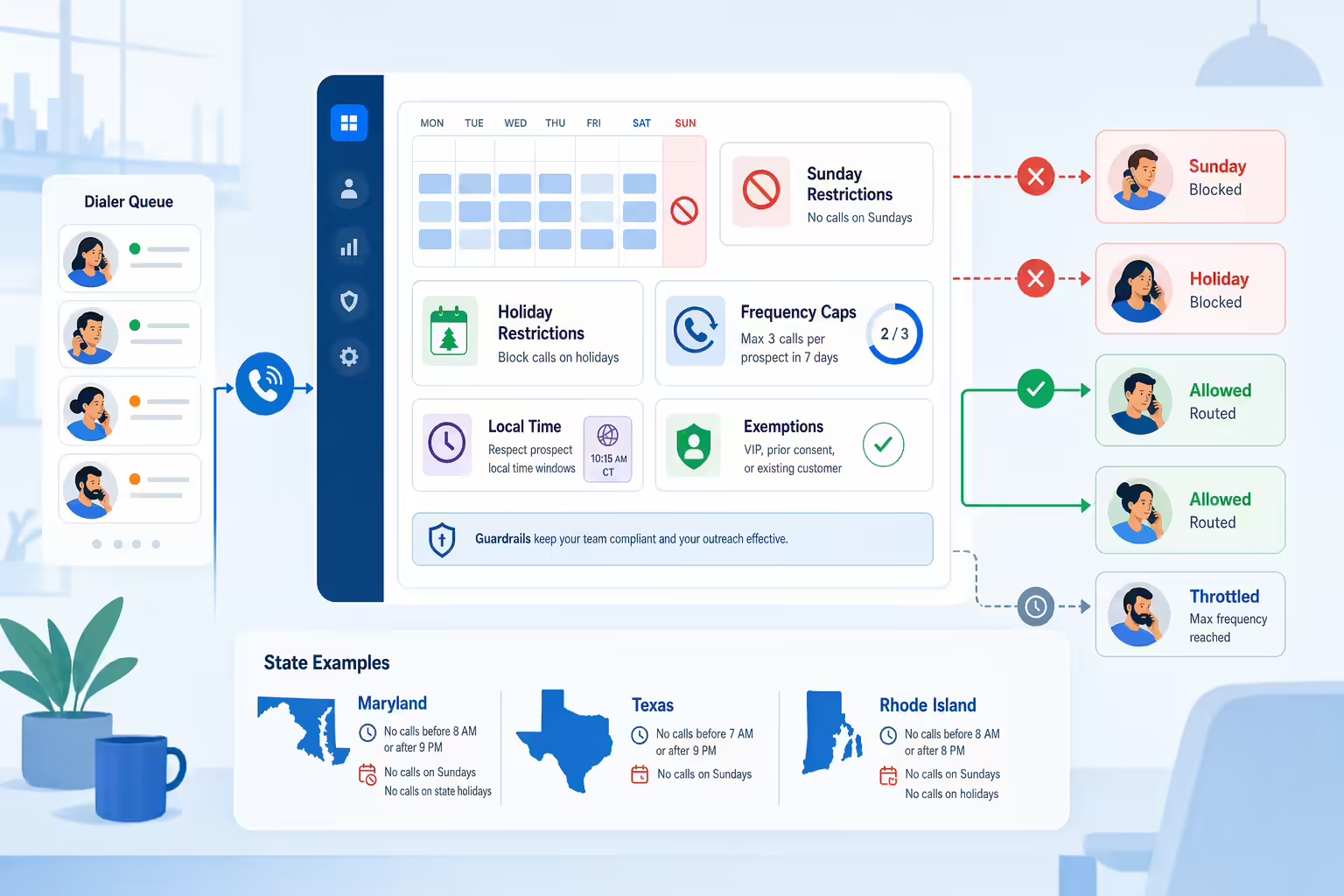
- Sunday restrictions, where a state may allow fewer hours or no calls.
- State and federal holidays, where a state may prohibit or narrow solicitation calls.
- Frequency caps, where a state may limit repeated calls to the same called party in a set period.
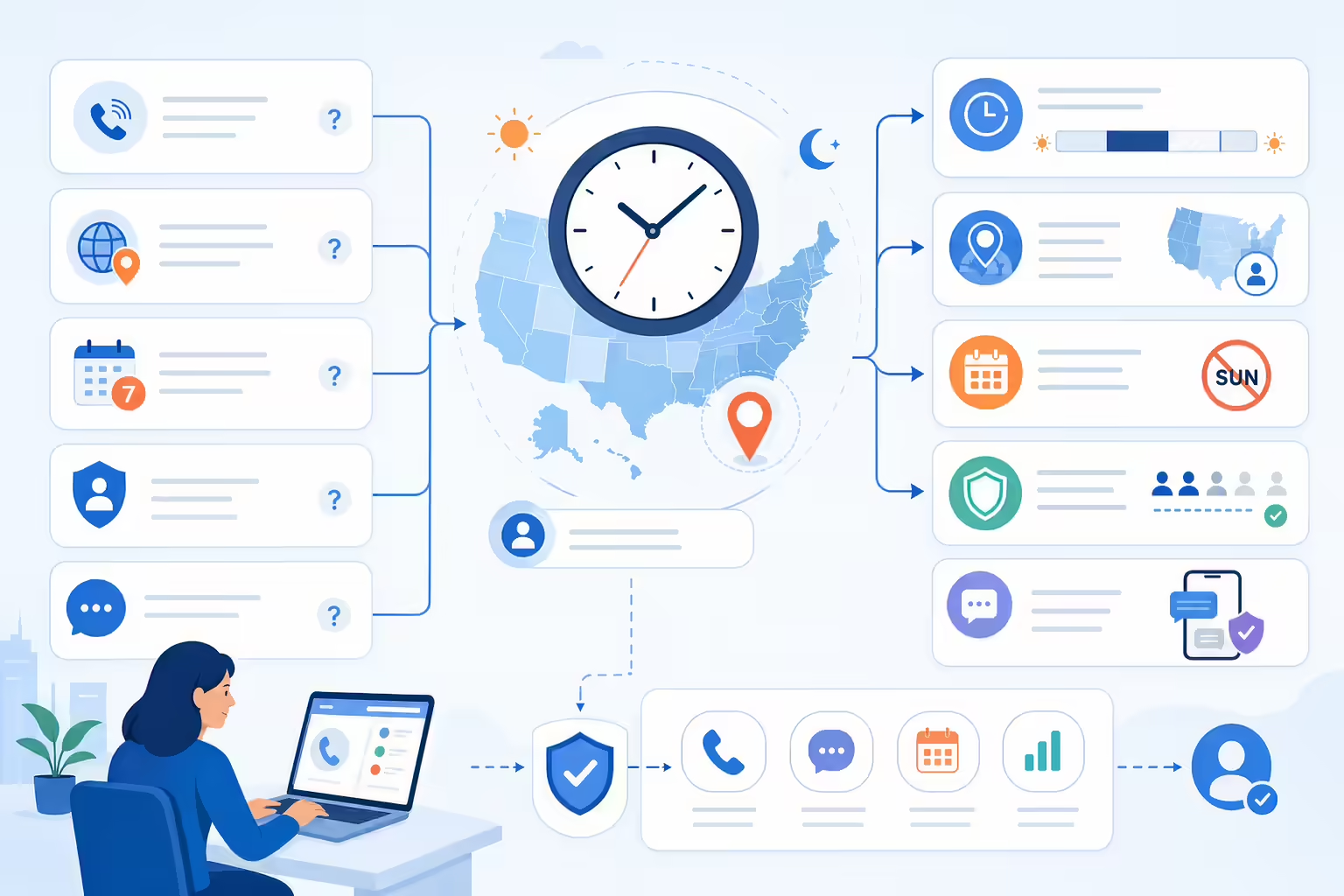
- Time-zone uncertainty, especially when a number’s area code does not match the prospect’s actual location.
- Exemptions, including some existing-relationship, nonprofit, B2B, consumer-initiated, or consent-based scenarios that still need legal review.
Sunday is the rule most teams miss. Alabama, Louisiana, Mississippi, South Dakota and Utah ban Sunday solicitation calls outright, Pennsylvania joins them on October 18, 2026, and Texas allows Sunday calls only from noon. Alabama, Louisiana, Pennsylvania, Rhode Island and Utah also bar calls on legal holidays. Four states cap repeat calls at three per 24-hour period: Florida, Maryland and Oklahoma on the same subject matter, and Oregon for any solicitation of the same party. Twelve states close at 8 p.m. rather than 9 p.m.: Alabama, Connecticut, Florida, Louisiana, Maryland, Massachusetts, Mississippi, Nevada, Oklahoma, Oregon, Washington and Wyoming, and Pennsylvania will close at 7 p.m. Eight start later than 8 a.m.: Connecticut, Michigan, Minnesota, Nevada, New Mexico, South Dakota and Texas at 9 a.m., and Kentucky at 10 a.m. Mississippi fixes its window to Central Standard Time rather than the consumer’s local time. Rhode Island creates a different kind of scheduling problem because its weekday window ends at 6 p.m. and Saturday ends at 5 p.m.
Rules beyond calling hours: consent, texts, AI voice and autodialers
Do not treat the timing table as a complete TCPA, TSR, state mini-TCPA, DNC, SMS, or AI voice compliance guide.
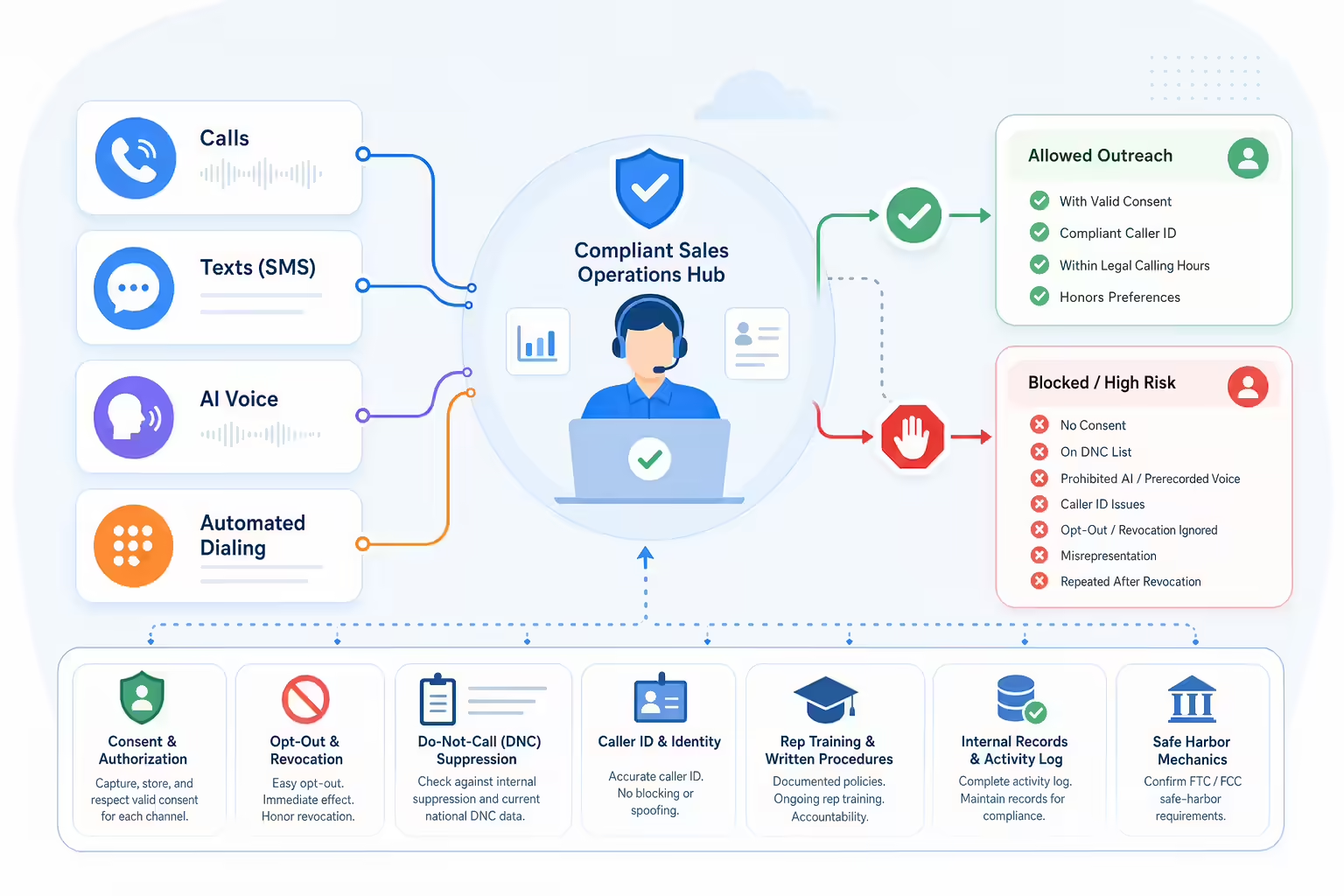
A call may be inside the right hours and still create risk if the campaign lacks proper consent, uses a prohibited prerecorded or artificial voice, ignores a DNC registration, fails to honor a company-specific opt-out, misrepresents caller identity, blocks caller ID, or keeps calling after revocation.
The FCC and FTC rules also include revocation and do-not-call procedures. In practical terms, that means written procedures, rep training, internal suppression records, and current national DNC data. The federal rules include a 31-day registry-version requirement, but teams should confirm how the FTC and FCC safe-harbor mechanics apply to each campaign.
How to operationalize calling hour compliance in a sales dialer
A practical sales workflow should turn the legal matrix into campaign controls:
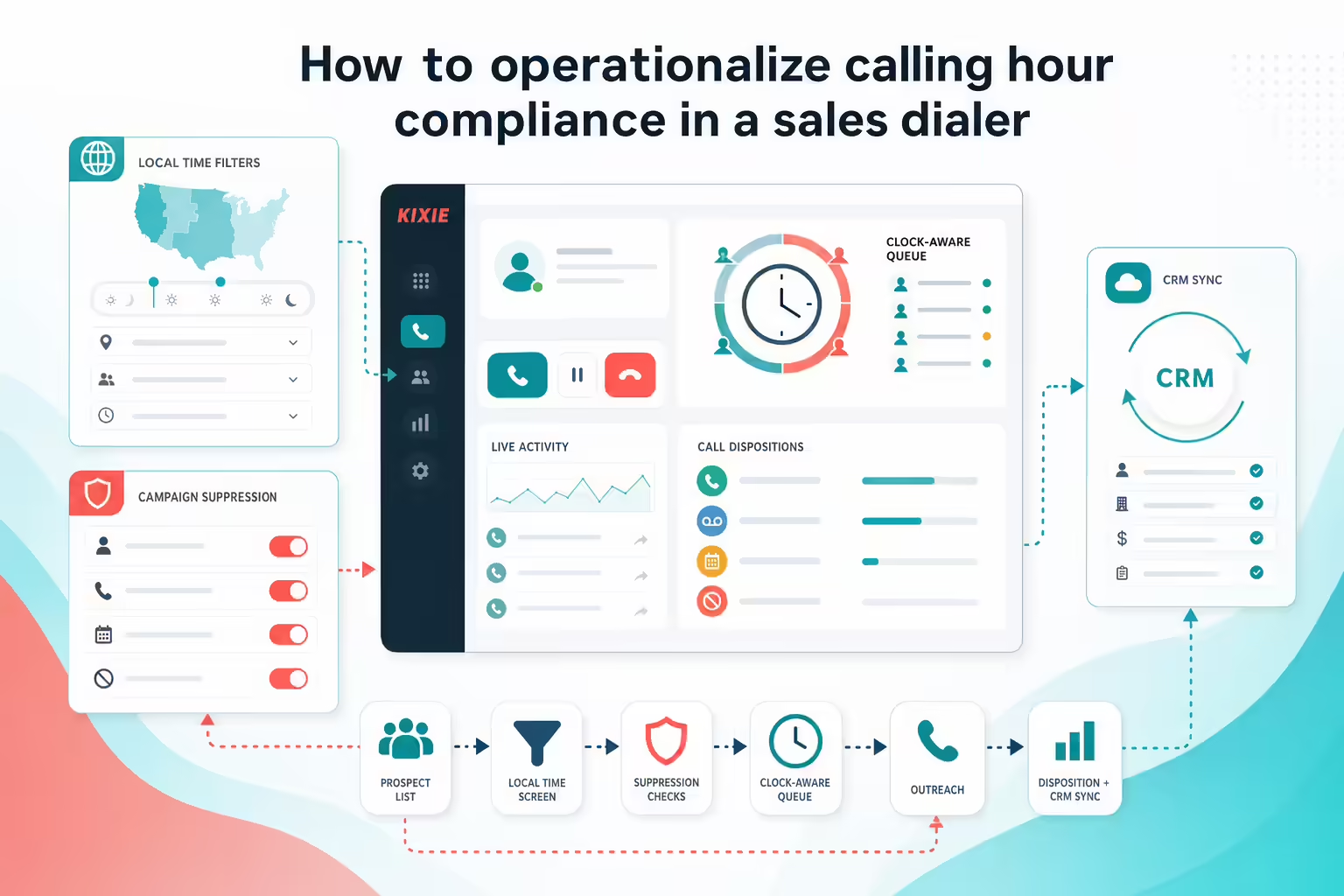
- Capture the prospect’s likely local time zone from CRM address, phone data, form data, and account context.
- Suppress calls outside the narrowest verified window for that prospect.
- Maintain state-specific holiday and Sunday suppression rules.
- Enforce frequency caps by prospect, phone number, campaign, and subject matter.
- Keep national and state DNC suppression processes current.
- Log consent source, revocation, opt-out requests, and disposition history in the CRM.
- Train reps on what to do when a prospect says "do not call," "stop," or similar language.
- Review campaign rules before every new market, list source, offer, and dialer mode.
This is where tools matter. A sales team using a sales dialer or power dialer needs more than a faster call button. The workflow should make it easy to segment lists, pause risky records, log outcomes, and sync activity back to the CRM.
How Kixie fits a compliance-aware calling workflow
Kixie is built for outbound sales teams that need calling, texting, voicemail, automation, and CRM visibility in one workflow. For compliance-aware operations, the practical value is process control:
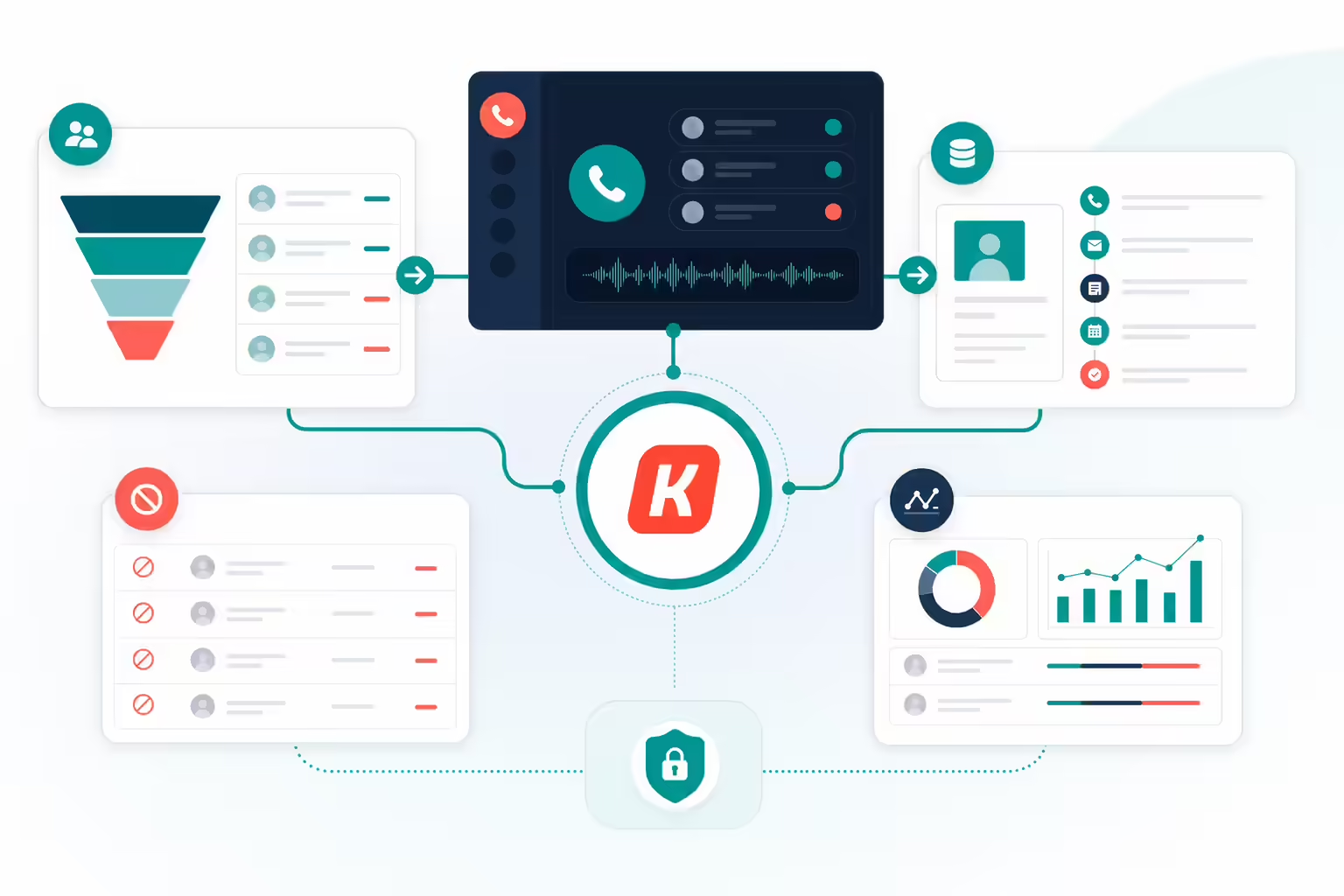
- Reps can work from segmented calling lists instead of manually choosing numbers from spreadsheets.
- Managers can build calling workflows around approved campaigns and markets.
- Call outcomes and activity can sync through bi-directional CRM integrations.
- Teams can combine dialing workflows with internal compliance procedures, list suppression, and call review.
Kixie does not replace counsel, consent management, DNC scrubbing, or campaign governance. Your team is responsible for configuring the platform, maintaining suppression lists, training reps, and verifying the rules that apply to each campaign.
If you are evaluating the operational side of outbound calling, compare Kixie’s pricing or request a demo to see how sales dialer workflows fit your CRM process.
Telemarketing calling hours FAQ
How late can telemarketers call?
Until 9 p.m. in the called person’s local time under the federal rules, and not before 8 a.m. Twelve states stop earlier: Alabama, Connecticut, Florida, Louisiana, Maryland, Massachusetts, Mississippi, Nevada, Oklahoma, Oregon, Washington and Wyoming all close at 8 p.m., Rhode Island closes at 6 p.m. on weekdays and 5 p.m. on Saturdays, and Pennsylvania closes at 7 p.m. from October 18, 2026. Prior consent to be called at another time changes the answer under the federal rule and in several states.
Are calling hours based on my time or the prospect’s time?
Federal rules use the called party’s local time. Sales teams should design campaigns around the prospect’s local time, not the rep’s office time.
Can telemarketers call on Sunday?
Not in Alabama, Louisiana, Mississippi, South Dakota or Utah, which ban Sunday solicitation calls outright, and not in Pennsylvania from October 18, 2026. Texas allows Sunday calls only from noon to 9 p.m., and Rhode Island sets no Sunday window at all. Alabama, Louisiana, Pennsylvania, Rhode Island and Utah also bar calls on legal holidays. Federal law has no Sunday ban, so the remaining states follow their normal window on Sundays.
How many times can a telemarketer call before it becomes harassment?
There is no single national number that makes every campaign safe or unsafe. Federal rules prohibit repeated or continuous calls made with intent to annoy, abuse, or harass, and some states add specific frequency caps. Florida, Maryland, Oklahoma and Oregon all cap solicitation calls at three per 24-hour period; in Florida, Maryland and Oklahoma the cap applies per subject matter, in Oregon to any solicitation of the same party. Applicability depends on the campaign and any exemptions.
Do the same calling hours apply to texts?
Do not assume voice-call timing rules are the only SMS rule. Marketing texts can trigger separate consent, opt-out, revocation, quiet-hour, platform, carrier, and state-law requirements. Treat SMS as its own compliance track.
Sources and review method
The state-by-state table above is a planning screen, not legal advice, and it is not a substitute for review by your own counsel.
Every row in the table was checked against the state’s own statute or administrative rule, linked in that row and listed below. Where the state law sets calling hours, the row quotes the operative sentence. Where the state law was read and contains no calling-hour provision, the row says so and the federal 8 a.m. to 9 p.m. rule applies. No row relies on an agency FAQ, vendor summary or law-firm note.
Telemarketing statutes, FCC and FTC rules, and enforcement priorities change. Verify the current law for every state you plan to call, and confirm each campaign with your counsel before dialing.
Official sources cited in this guide:
- 16 CFR 310.4, the FTC Telemarketing Sales Rule calling-time provision
- 47 CFR 64.1200, the FCC delivery restrictions rule
- Alabama Administrative Code r. 770-X-5-.17
- Alaska Statutes 45.50.475
- Arizona Revised Statutes 44-1278
- Arkansas Code 4-99-405
- California Business and Professions Code 17590 to 17594
- Colorado Revised Statutes 6-1-304
- Connecticut General Statutes 42-288a
- Delaware Code Title 6, Chapter 25A
- Florida Statutes 501.616
- Georgia Code 46-5-27
- Hawaii Revised Statutes 481P-3
- Idaho Code Title 48, Chapter 10
- Illinois 815 ILCS 413/15
- Indiana Code 24-5-14-8
- Iowa Code 714.16
- Kansas Statutes 50-670
- Kentucky Revised Statutes 367.46955
- Louisiana Public Service Commission Do Not Call General Order
- Maine Revised Statutes Title 10, section 1498
- Maryland Commercial Law 14-4502
- Massachusetts General Laws c.159C section 3
- Michigan Compiled Laws 750.540e
- Minnesota Statutes 325E.30
- Mississippi Code 77-3-723
- Missouri Revised Statutes 407.1076
- Montana Code Annotated 30-14-1412
- Nebraska Revised Statutes 86-248
- Nevada Revised Statutes 598.0918
- New Hampshire RSA 359-E
- New Jersey Statutes 56:8-128
- New Mexico Statutes 57-12-22
- New York General Business Law 399-z
- North Carolina General Statutes 75-102
- North Dakota Century Code 51-28
- Ohio Revised Code Chapter 4719
- Oklahoma Statutes Title 15, section 775C.4
- Oregon Revised Statutes 646.563
- Pennsylvania Senate Bill 992, Act 47 of 2026
- Rhode Island General Laws 5-61-3.6
- South Carolina Code 37-21-30
- South Dakota Codified Laws 37-30A-3
- Tennessee Code 65-4-402
- Texas Business and Commerce Code 301.051
- Utah Code 13-25a-103
- Vermont Statutes Title 9, section 2464a
- Virginia Code 59.1-511
- Washington RCW 80.36.390
- West Virginia Code 46A-6F-601
- Wisconsin Administrative Code ATCP 127.16
- Wyoming Statutes 40-12-302
Sources verified and content reviewed by the Kixie Research Team on October 12, 2026.
Ready to close more deals with Kixie?
See how Kixie's AI-powered tools can transform your sales and support operations.
Start Free Trial