TL;DR: TCPA compliance in 2026 is not just a legal memo for outbound sales teams. It is an operating discipline for consent capture, list hygiene, opt-out handling, DNC checks, call and text workflows, CRM records, and manager review. This article is general information, not legal advice. The key 2026 update to watch is the FCC’s January 6, 2026 order extending the waiver for part of its consent revocation rule to January 31, 2027. Sales teams should coordinate with counsel, document consent sources, honor opt-outs, keep internal suppression lists current, review state calling rules, and use sales engagement tools like Kixie only as workflow support, not as a substitute for legal review.
TCPA compliance in 2026 is harder to manage as an afterthought. Sales teams call, text, follow up, recycle leads, route records through a CRM, and often rely on multiple vendors before a rep ever speaks with a prospect. That creates more places for consent records, opt-outs, and do-not-call rules to break down.
This guide is written for sales, RevOps, and revenue leaders who need a practical framework for outbound engagement. It is not legal advice. TCPA obligations can depend on campaign purpose, call or message type, technology used, consent source, customer relationship, and jurisdiction. Review your policies with qualified counsel before changing calling or texting practices.
What TCPA compliance means for sales teams in 2026
The Telephone Consumer Protection Act is a federal law that regulates certain calls, texts, prerecorded messages, artificial voice calls, and fax communications. For sales teams, the practical question is rarely “Can we call anyone?” It is usually “What type of consent, suppression process, and record trail do we need for this specific outreach motion?”

The answer depends on details. A manual call, an automated or prerecorded call, a marketing SMS, an informational message, a call to a wireless number, and a call to a business line can raise different issues. The FCC and FTC also operate in related but separate lanes. The FCC administers TCPA rules, while the FTC’s Telemarketing Sales Rule gives businesses requirements around telemarketing practices and the National Do Not Call Registry.
For sales operations, TCPA compliance usually comes down to four workflow questions:
- Where did the phone number and consent come from?
- What type of outreach is the team sending?
- How does the team suppress records when someone opts out or appears on a do-not-call list?
- Can the company prove what happened later?
That last question is why compliance-minded sales teams treat CRM activity, call dispositions, SMS replies, consent fields, and list hygiene as part of the same workflow.
The 2026 TCPA revocation update to watch
One current 2026 issue is consent revocation. On January 6, 2026, the FCC’s Consumer and Governmental Affairs Bureau released DA 26-12, an order extending the waiver of part of section 64.1200(a)(10) to January 31, 2027. The order is specific: it concerns the requirement to treat a revocation request made in response to one type of call or text as applying to all robocalls and robotexts from that caller on unrelated matters.

That is a narrow but important point. It does not mean sales teams can ignore opt-outs. It does not erase existing consent, DNC, or suppression obligations. It means companies should be careful about how they describe the 2026 status of the FCC’s revocation framework and should review their opt-out handling with counsel.
In day-to-day operations, the safest workflow posture is straightforward: capture opt-outs quickly, route them to the correct suppression list, document the request, and avoid sending another campaign until the record’s status is clear.
This section is general information and not legal advice. If your team relies on multiple brands, affiliates, product lines, lead sources, or messaging vendors, counsel should review how revocation requests move across those systems.
Consent rules still depend on call type, message type, and technology
Consent is not a single checkbox that works for every campaign. The level of consent a business needs can vary based on whether the outreach is marketing or informational, whether it uses regulated technology, whether the number is wireless, and whether the message is a call, text, prerecorded voice, or artificial voice.

The FTC’s Telemarketing Sales Rule guidance explains related telemarketing requirements, including how sellers and telemarketers should think about written agreements, prerecorded messages, and opt-out mechanisms. FCC guidance also treats consent as highly context-specific.
For sales teams, the operational takeaway is to document consent at the record level instead of assuming list-level permission. A useful CRM record should answer:
- Who gave consent?
- When was it captured?
- What disclosure did the person see or hear?
- Which seller, campaign, or communication type did it cover?
- What source system created or imported the record?
One-to-one consent deserves special care. On January 24, 2025, the Eleventh Circuit set aside the FCC’s one-to-one consent rule in Insurance Marketing Coalition Ltd. v. FCC, and the FCC acknowledged the change in a public notice. That decision removed the specific one-to-one requirement before it took effect, but it did not eliminate the TCPA’s existing prior express written consent requirements for covered telemarketing calls and texts. Treat lead-generation consent chains as a topic for counsel rather than a shortcut for broad claims in sales documentation.
Opt-out and DNC workflows need clear ownership
Opt-outs are where many sales workflows become fragile. A prospect may say “stop” in a text, tell a rep not to call again, fill out a web form, reply to an email, or contact support. If those signals do not reach the dialing and messaging systems, the company can keep contacting someone who already tried to revoke permission.
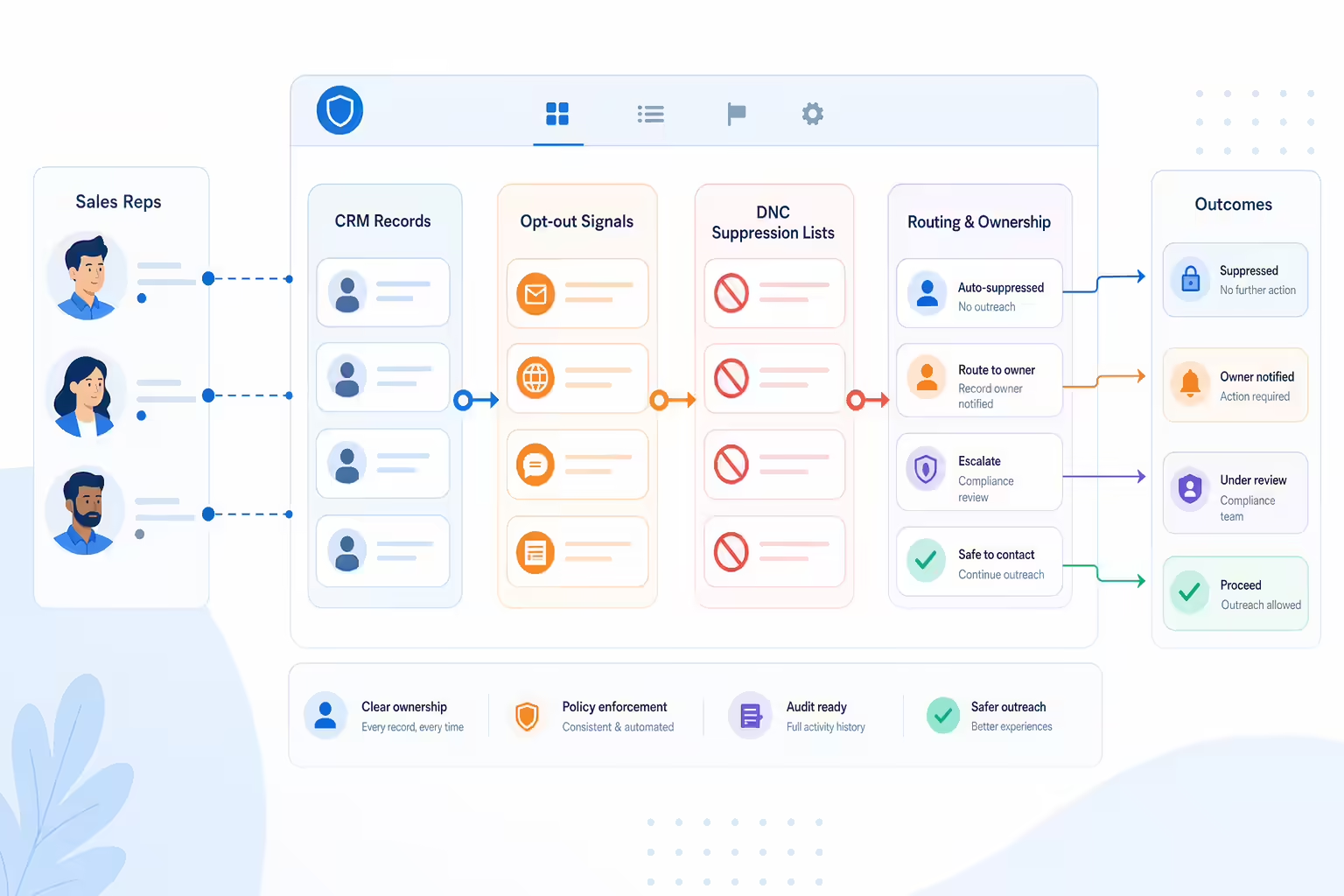
The FTC’s telemarketing materials describe the National Do Not Call Registry and related seller obligations. The FTC also announced FY2026 fees for access to the National Do Not Call Registry, which is a reminder that DNC access and suppression should be treated as an active business process, not a one-time setup.
Teams should define ownership for these steps:
- DNC screening before outbound campaigns.
- Internal do-not-call list updates after a direct opt-out.
- SMS opt-out handling, including common stop requests.
- Lead vendor suppression and return processes.
- CRM status updates so reps do not revive suppressed records.
- Audit trails that show when a record was suppressed and by whom.
This is general operational guidance, not legal advice. The exact suppression timing, scope, and process should be reviewed by counsel for your outreach model.
SMS compliance adds consent, opt-out, and carrier expectations
TCPA compliance can apply to texts as well as calls, which is why SMS outreach needs the same level of process discipline as dialing. Sales teams should be able to show why a contact is eligible for a text, what message type is being sent, how the recipient can opt out, and how the opt-out flows back into the CRM or engagement platform.

There is also a separate ecosystem around carrier and messaging-program expectations. Those expectations are not the same thing as TCPA law, but they matter operationally because carriers and messaging providers can block or filter campaigns that appear risky or poorly governed.
Keep the distinction clear: legal review owns TCPA and other legal requirements, while sales operations owns the workflow that helps the business follow approved policy. A compliance-minded SMS workflow should include approved templates, consent fields, opt-out capture, suppression sync, and periodic review of campaign categories.
State calling rules can be stricter than federal TCPA rules
Federal TCPA and TSR rules are only part of the rule set sales teams need to consider. State telemarketing laws can add requirements around calling windows, registrations, disclosures, call frequency, consent, or private claims. Florida, Oklahoma, Washington, and Maryland are often discussed in telemarketing compliance planning because state-level rules can materially affect calling operations.

Do not treat a state example as a complete rule summary. State statutes and enforcement priorities change, and a campaign that is allowed in one state may need different controls in another. Kixie’s state-by-state telemarketing guide can help teams identify topics to ask counsel about, but it should not replace review of current state law.
For sales teams, the practical workflow is to segment outbound activity by jurisdiction when needed. That may include time-zone handling, state-level suppression rules, campaign eligibility fields, and manager approval before launching new dialing or SMS motions.
This section is general information, not legal advice. Verify current state requirements with counsel before launching or expanding a campaign.
Penalties and enforcement risk make recordkeeping essential
TCPA and telemarketing violations can create significant exposure through private litigation, regulatory enforcement, customer complaints, and reputational damage. The exact risk depends on the claim, facts, jurisdiction, technology, consent trail, and number of contacts involved.

That is why recordkeeping is not just an administrative concern. If a prospect challenges a call or text, the team may need to show the consent source, the campaign category, the number dialed, the disclosure shown at capture, the opt-out path, and the date the record entered a suppression list.
This section is general information, not legal advice. Counsel should decide what records the company keeps, how long it keeps them, and which systems are authoritative for consent, DNC, and opt-out status.
A practical TCPA compliance workflow for sales engagement
The strongest compliance programs turn legal requirements into repeatable sales operations. A practical workflow for outbound teams might look like this:

- Intake leads with source, seller, campaign, and consent fields.
- Reject or quarantine records that lack required consent details.
- Screen lists against the National Do Not Call Registry and internal suppression lists when required.
- Segment campaigns by channel, purpose, jurisdiction, and contact type.
- Give reps clear approved actions inside the CRM or sales engagement platform.
- Capture call outcomes, SMS replies, and opt-outs in structured fields.
- Sync opt-outs back to internal suppression lists and source systems.
- Review exceptions with RevOps, compliance, and counsel.
- Audit campaigns periodically before scaling volume.
This workflow does not make a campaign compliant by itself. It gives the business a better chance of applying approved rules consistently and proving what happened later.
Where Kixie fits in a compliance-minded workflow
Kixie can support parts of a compliance-minded sales engagement workflow when it is configured around policies reviewed by your legal and compliance owners. It should not be treated as legal advice, a compliance certification, or a guarantee that a campaign satisfies TCPA, TSR, state, carrier, or industry requirements.

| Workflow need | How a sales engagement platform can support it | What legal or compliance review still owns |
|---|---|---|
| Consistent rep activity | Use structured calling, SMS, dispositions, notes, and CRM activity logging so managers can inspect outreach patterns. | Define which campaigns are allowed, which contacts are eligible, and which disclosures or consent sources are required. |
| Opt-out handling | Help reps capture outcomes and route follow-up tasks when a prospect asks not to be contacted. | Define what counts as revocation, where it applies, and the approved suppression timing for each campaign. |
| CRM record hygiene | Keep calling and messaging activity connected to CRM records so teams have a better operational trail. | Decide which fields are legally required, how long records are retained, and which system is authoritative. |
| Campaign governance | Support sales workflows that separate campaign types, reps, teams, and follow-up actions. | Approve campaign rules, vendor data policies, state coverage, scripts, and escalation paths. |
Teams evaluating Kixie can start with the Kixie features page and the Kixie article on TCPA considerations for cold calling. Use those resources as workflow context, then have counsel map the workflow to your specific obligations.
TCPA compliance checklist for 2026
This checklist is general information, not legal advice. Use it as an internal planning prompt, then validate the final policy with counsel.

- Confirm the campaign purpose before launching calls or texts.
- Map the technology used for each call or message type.
- Document consent source, disclosure, seller, timestamp, and scope.
- Screen against federal DNC and internal suppression lists when required.
- Define how opt-outs are captured across calls, SMS, forms, email, and support.
- Sync suppression data across CRM, dialer, SMS, lead vendor, and marketing systems.
- Review state calling rules for the jurisdictions in your campaign.
- Separate legal TCPA requirements from carrier or messaging-program requirements.
- Train reps on approved language and escalation steps.
- Audit records before increasing outbound volume.
TCPA compliance FAQs
This FAQ is general information, not legal advice. It is written in operational terms for sales teams and should be reviewed against your specific outreach model.

What is new for TCPA compliance in 2026
One important 2026 development is the FCC’s DA 26-12 order extending the waiver for part of the consent revocation rule to January 31, 2027. Sales teams should not read that as permission to ignore opt-outs. Common practice is to keep opt-out capture, suppression, and documentation workflows active while counsel reviews how the order affects specific campaigns.
What are the new TCPA revocation rules
Revocation rules address how a consumer can withdraw consent to receive certain calls or texts. Because the FCC has delayed part of the broader revoke-all treatment requirement, teams should describe the 2026 status carefully and avoid broad claims. Operationally, teams typically capture opt-outs, suppress the record, and document what happened.
Is the TCPA rule delayed
Part of the FCC’s consent revocation framework was delayed by DA 26-12 until January 31, 2027. That delay is specific and should not be described as a full TCPA delay. Other TCPA, TSR, DNC, state, and internal suppression obligations can still matter.
What are common TCPA violation risks
Common risk areas include unclear consent, weak opt-out handling, poor DNC screening, stale lead-source records, use of regulated technology without proper review, and state-rule gaps. The facts matter, so counsel should decide how these risks apply to a specific campaign.
Can software make a sales team TCPA compliant
Software can help support approved workflows, records, routing, and review. It does not replace legal analysis. A sales engagement platform like Kixie can help teams operationalize policies, but legal and compliance owners still need to define the rules those workflows follow.
The bottom line for sales leaders
TCPA compliance in 2026 is a cross-functional operating problem. Legal sets the policy. RevOps designs the workflow. Sales managers train and inspect behavior. Reps follow approved outreach steps. Systems like Kixie can help support execution and recordkeeping, but they should sit inside a policy framework that counsel has reviewed.

If your team is increasing outbound calls or texts this year, start with the basics: consent source, campaign purpose, opt-out routing, DNC screening, state review, and CRM records. Those controls are less flashy than a new outreach tactic, but they are what make sales engagement easier to manage at scale.
Sources and review method
The review focused on the current 2026 revocation waiver, the FCC rule text, the FTC’s telemarketing guidance, and the court decision affecting the FCC’s one-to-one consent rule.
This article is general information, not legal advice. Confirm current requirements with qualified counsel.
- FCC DA 26-12 waiver-extension order
- 47 CFR 64.1200
- FTC Telemarketing Sales Rule guidance
- Insurance Marketing Coalition Ltd. v. FCC
Sources verified and content reviewed by the Kixie Research Team on August 3, 2026.
Ready to close more deals with Kixie?
See how Kixie's AI-powered tools can transform your sales and support operations.
Start Free Trial