TL;DR: Kixie enables sales teams to call inbound leads in under 60 seconds using automated LeadCaller, webhook-triggered dialing, availability-based routing, and AI-powered multi-line Power Dialer (up to 10 parallel lines). Response within 1 minute yields 391% higher conversions; within 5 minutes, 21x more likely to qualify; after 1 hour, contact probability drops 10x. Key features include Prioritized PowerLists (5 priority tiers with Standby Mode), ConnectionBoost (50,000+ local numbers, doubles answer rates), AI Answering Machine Detection (95-98% accuracy, 350% lift in talk time), Auto-SMS on missed calls (68% response rate), and bi-directional CRM integration with Salesforce, HubSpot, and HighLevel. Multi-touch campaigns of 7-12 messages achieve up to 90% response rates versus 8% for single-message outreach. 78% of B2B buyers purchase from the first company to respond.
If you wait even 5 minutes to call a lead, you’ve already lost most of your advantage. In the high-speed world of B2B sales, the window between a prospect’s intent signal and a live human response has become the single most significant factor in conversion success.
The necessity of bridging this gap in under sixty seconds (frequently referred to as the “Platinum Minute”) is driven by the rapid erosion of buyer interest and the psychological tendency for prospects to engage with the first available responder. Organizations that prioritize speed to conversation recognize that 78% of buyers ultimately choose the first company that actually speaks with them, often regardless of price or brand reputation.
The traditional metric of “speed to lead,” which merely tracks the time to the first automated lead response time, has become insufficient for modern revenue teams. Elite organizations focus on establishing a bidirectional, live dialogue, knowing that every second of latency between a form submission and a phone call directly correlates with a quantifiable drop in qualification probability.
| Response Window | Impact on Qualification/Connection | Conversion Lift | Strategic Outcome |
|---|---|---|---|
| < 1 Minute | 391% Higher Conversions | +391% | Instant Intent Capture |
| < 5 Minutes | 21x More Likely to Qualify | +100% | Optimal Speed-to-Conversation |
| 5 vs. 10 Minutes | 80% Drop in Qualification Odds | -80% | Critical Drop-off Point |
| < 1 Hour | 7x More Likely to Qualify than > 1 hr | Negligible | Standard Aspirational Goal |
| 24+ Hours | 60x Lower Qualification Odds | -95% | “Ghost Leads” |
Trigger the Call Instantly to Call Leads Fast
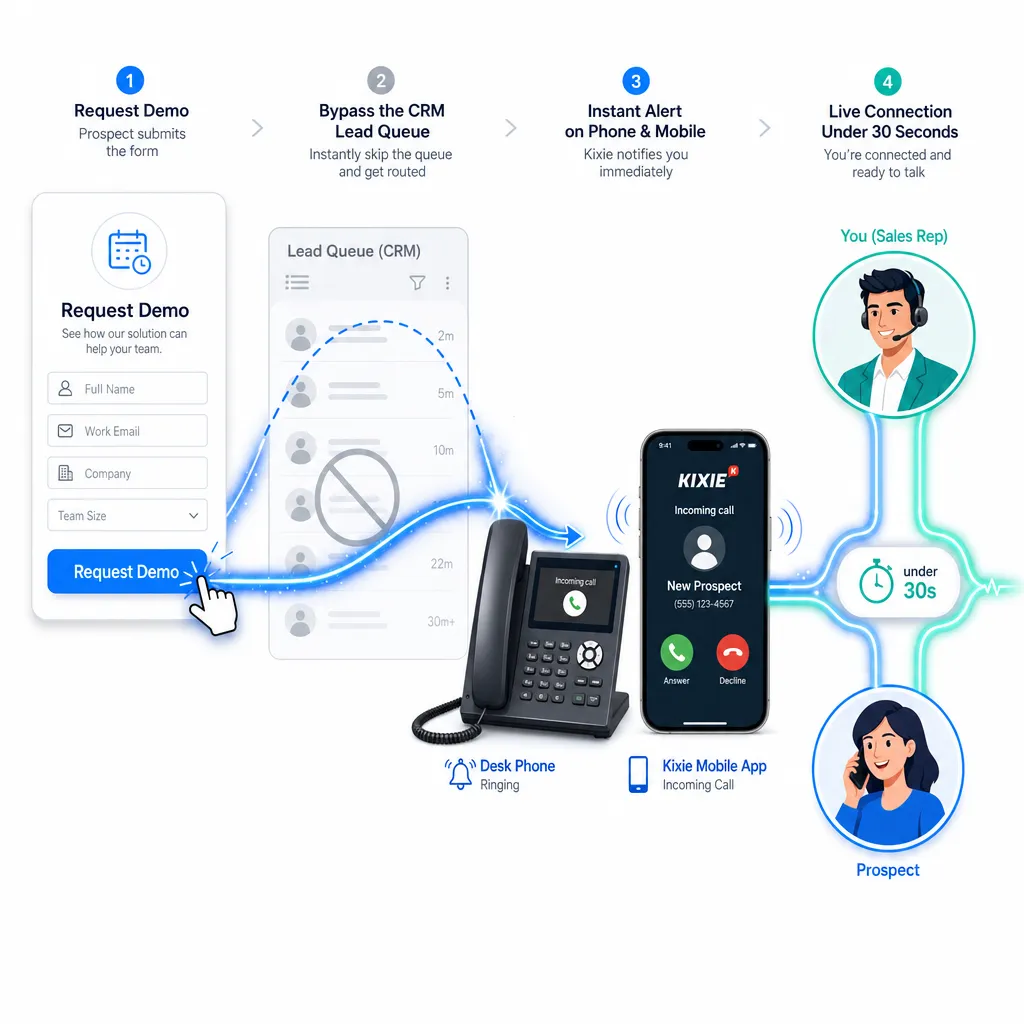
To achieve sub-minute response times, a sales organization must eliminate the “Assignment-to-Action Gap,” which represents the time wasted between lead creation and a representative initiating contact. Most legacy CRM workflows rely on a “pull” model, where leads are dropped into a passive queue, requiring a representative to monitor their inbox or CRM dashboard manually before taking action.
This passive model is inherently flawed because it relies on human attention, which is subject to distraction and operational latency. To truly call leads fast, teams must implement a “push” architecture where the form submission itself acts as a direct telephony trigger.
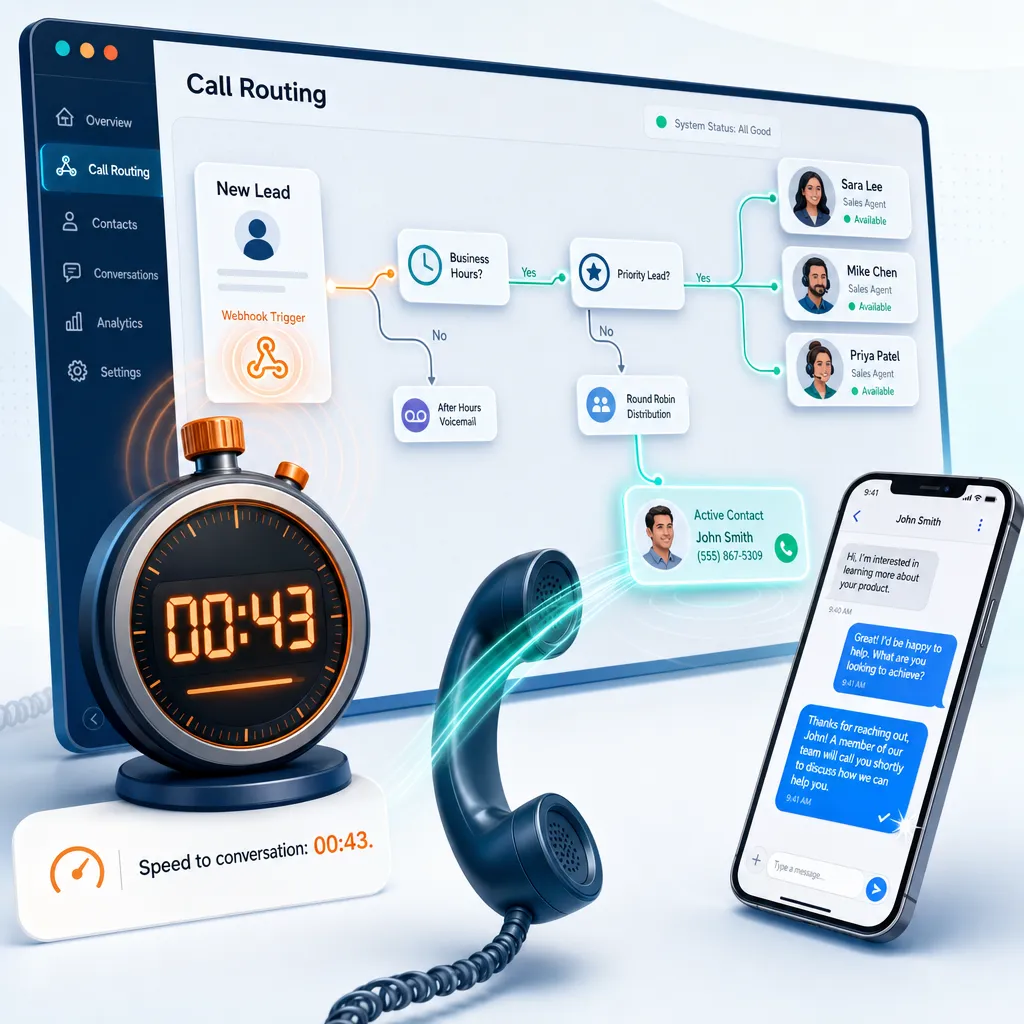
Kixie’s Automated LeadCaller operates on a push-based “hunt-and-bridge” framework. When a prospect performs a high-intent action, such as submitting a demo request form, the system identifies the appropriate representative and immediately calls their desk phone or mobile app. Once the representative answers, the system automatically dials the prospect and bridges the two lines in under 30 seconds.
How Webhook-Triggered Calling Works
Modern inbound lead response requires the use of webhooks and APIs to synchronize data between the lead source and the telephony system. A webhook is a method for one software application to send real-time data to another whenever a specific event occurs, such as a contact being created in a CRM.
For example, a HubSpot or Salesforce workflow can be configured to send a POST request to a Kixie webhook URL the moment a new lead is added to a specific campaign. This lets you automatically call new Salesforce leads without any manual data entry from the sales representative.
| Integration Feature | Legacy Pull Model | Modern Kixie Push Model |
|---|---|---|
| Engagement Model | Passive (Rep monitors queue) | Active (System initiates call) |
| Average Time-to-Call | 42 – 47 Hours | < 30 Seconds |
| Lead Engagement % | ~70% (30% never contacted) | 100% of high-intent leads |
| Rep Productivity | 40% loss per “context switch” | High; stays in-flow until call |
By automating the first touch, organizations ensure that every prospect is engaged when their buying intent is at its peak. This capture of intent is critical, as research indicates that buyer interest signals begin to fade significantly within 90 seconds of the initial interaction.
Speed to Lead Best Practices via Webhooks
Setting up a high-velocity response system involves connecting the CRM and the dialer through an intermediary like Zapier or a direct webhook integration. The process typically involves creating an “Instant Action” in the CRM that fires a webhook to a catching URL.
This workflow is particularly effective for prospects who engage with marketing material, such as opening a specific email or clicking a pricing link. When these events occur, the system can automatically initiate a call to the lead, ensuring that the sales representative connects with the prospect exactly when they are most engaged with the brand.
Route Leads Based on Rep Availability
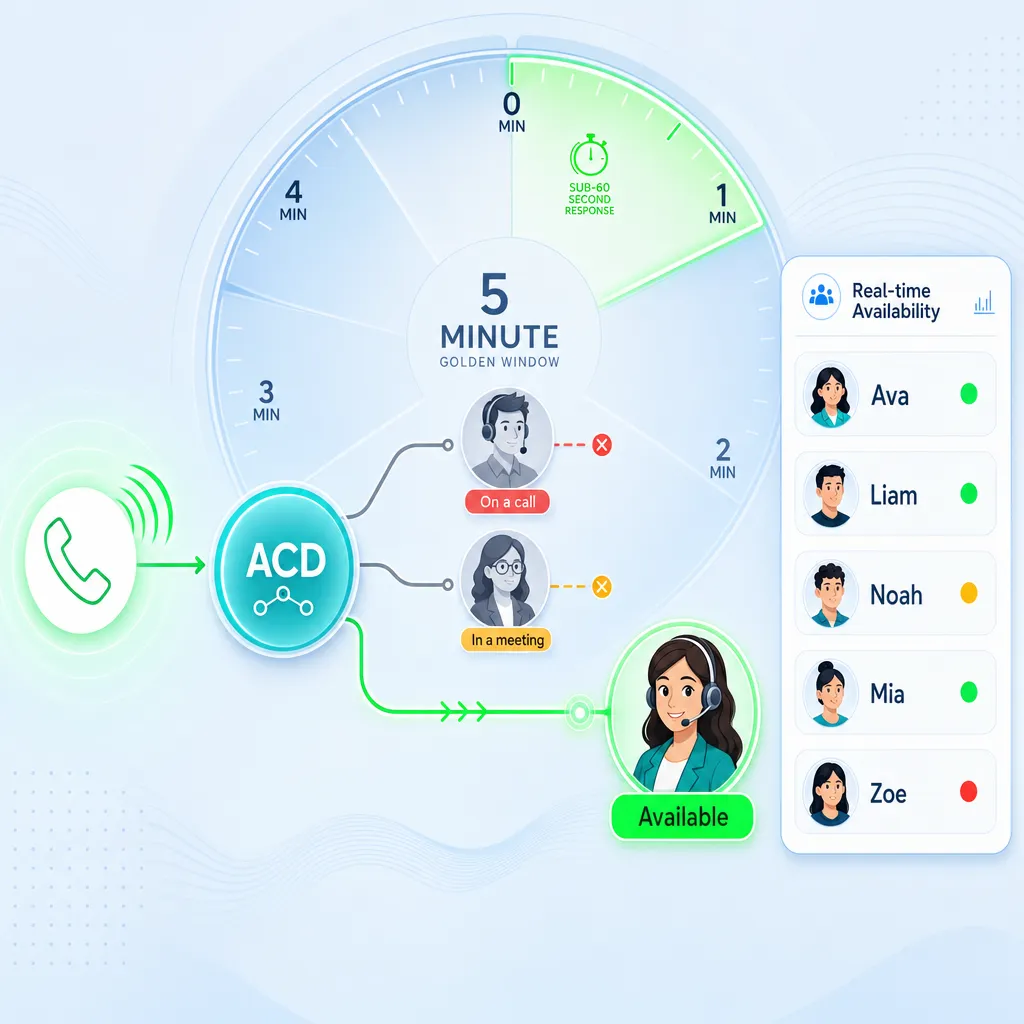
Achieving a sub-60-second response time is impossible if the lead is routed to a specific representative who is currently unavailable, in a meeting, or on another call. While territory-based routing or strict account ownership is important for long-term account management, it is often the primary bottleneck for speed to conversation.
Organizations must prioritize available representatives over rigid assignment rules to ensure that the initial contact occurs within the “Golden Window” of five minutes. Intelligent call routing, or Automatic Call Distribution (ACD), uses real-time presence data to direct leads to the first representative who can actually answer the phone.
Stop Lead Cherry-Picking with Prioritized Queues
A common issue in manual lead management is “cherry-picking,” where representatives naturally gravitate toward the leads they perceive as being the highest value, while letting others grow cold. This behavior results in massive pipeline leakage, as many qualified prospects are ignored during their peak intent window.
Kixie’s Prioritized PowerLists solve this by replacing static lists with a dynamic, prioritized queue that forces reps to dial high-intent leads first. These lists can be categorized into five priority levels: Highest, High, Medium, Low, and Lowest.
| Priority Level | Use Case | Routing Action |
|---|---|---|
| Highest | New Inbound Leads | Instant dial via Standby Mode |
| High | Recent Email Clicks | Added to top of rep’s active queue |
| Medium | Standard MQLs | Standard follow-up sequence |
| Low | Colder Lead Follow-up | Dialed after higher priority is cleared |
| Lowest | Dormant Leads | Long-term nurturing |
Using “Standby Mode” ensures that representatives who are not currently on a call are automatically notified the second a new lead enters the “Highest” priority list. This mechanism allows the team to engage 100% of inbound leads in seconds, capturing the 21x qualification bonus associated with sub-five-minute response times.
How Intelligent Triage Speeds Up Lead Response
An intelligent triage system acts as a traffic controller for inbound leads, ensuring that no lead is lost due to representative distraction. By utilizing a round-robin or hunt-group approach, the system cycles through available agents until one answers, at which point the lead is bridged.
This “push” model eliminates the latency risk inherent in the “pull” model, where a representative might not see a Slack or email notification for several minutes. By the time a representative manually reacts to a notification, the prospect may have already moved on to a competitor’s website.
Call Leads First, Not Email
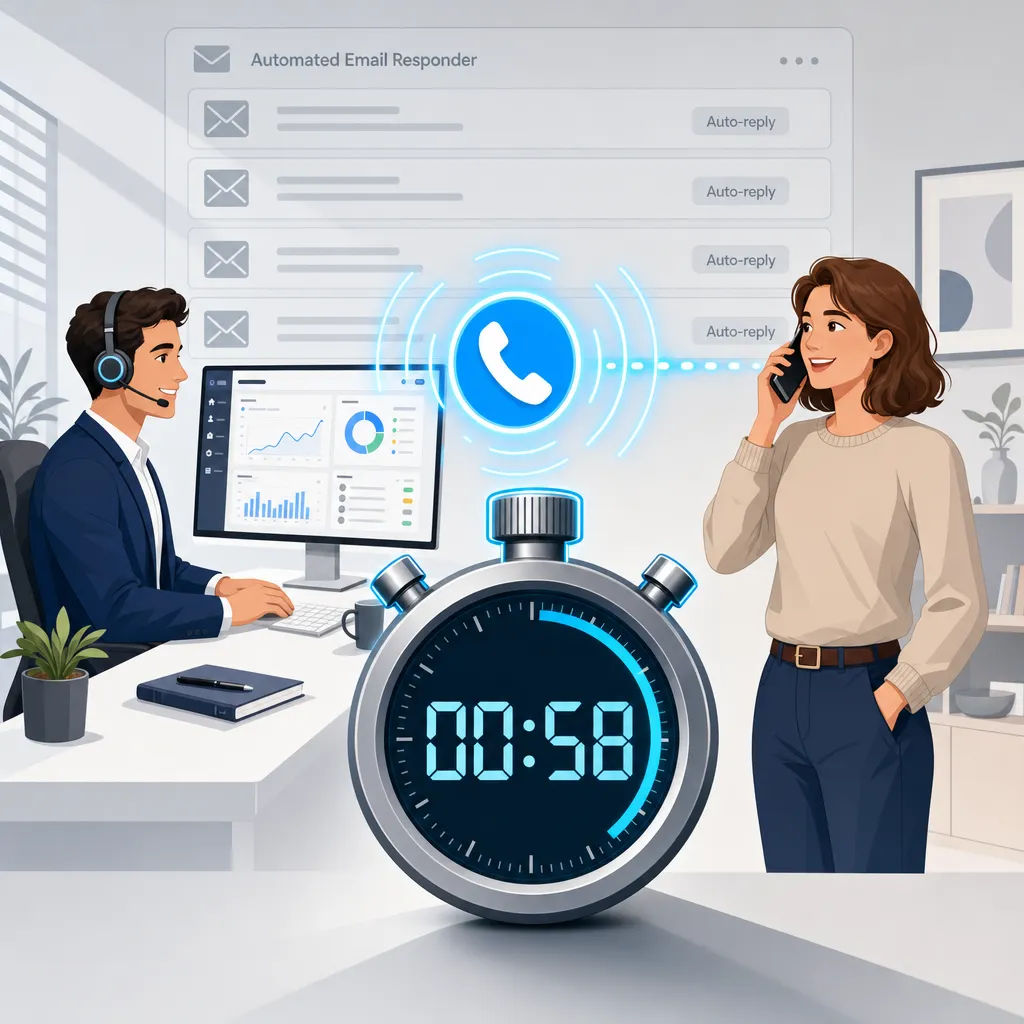
In the hierarchy of sales communication, the phone call remains the most effective tool to contact leads quickly and establish immediate rapport. While automated email responders are a common first touch, they are passive and often fail to convert high-intent prospects into active conversations.
Speed to conversation measures the interval between an intent signal and a live, bidirectional dialogue. Automated emails provide a “speed to lead” metric but fail to address the core needs of a buyer who expects an instant, personalized response. The telephone allows for immediate objection handling, rapport building, and the identification of specific pain points, making it the primary channel for high-growth sales teams.
Why the First Call Wins the Deal
Buyers are increasingly impatient, with 82% rating an “immediate” response as important and 66% stating that speed is as important as price in their decision-making process. When a representative calls a prospect while the brand is still on their screen, it signals that the organization is organized, attentive, and respects the customer’s time.
Organizations that rely on email as their primary channel often see stagnant conversion rates because those automated touches fail to establish a human connection. Research from Harvard Business Review found that 78% of B2B buyers purchase from the first company to respond to their inquiry, emphasizing that the race to the first human conversation is the race to the deal.
| Communication Channel | Strategic Function | Conversion Effectiveness |
|---|---|---|
| Voice Call | Rapport, objections, qualification | 6x more effective than email |
| SMS | High-visibility follow-up | 68% response rate |
| Fallback, document sharing | Lowest initial engagement | |
| Voicemail Drop | One-click personalization | Supports multi-touch cadences |
Overcoming the Manual Lead Dialing Bottleneck
The biggest obstacle to calling first is human latency, the time it takes for a representative to manually dial a number and wait for a response. AI-powered calling tools like Kixie’s Multi-line Power Dialer remove this friction by auto-dialing up to 10 numbers in parallel and using AI Human Voice Detection to skip voicemails and IVRs.
This technology ensures that representatives only spend their time in live conversations with real people. By removing the dead air of manual dialing, a representative can have five times as many conversations per day, significantly increasing the team’s ability to increase connect rate.
Use SMS If No Answer to Keep Leads Warm
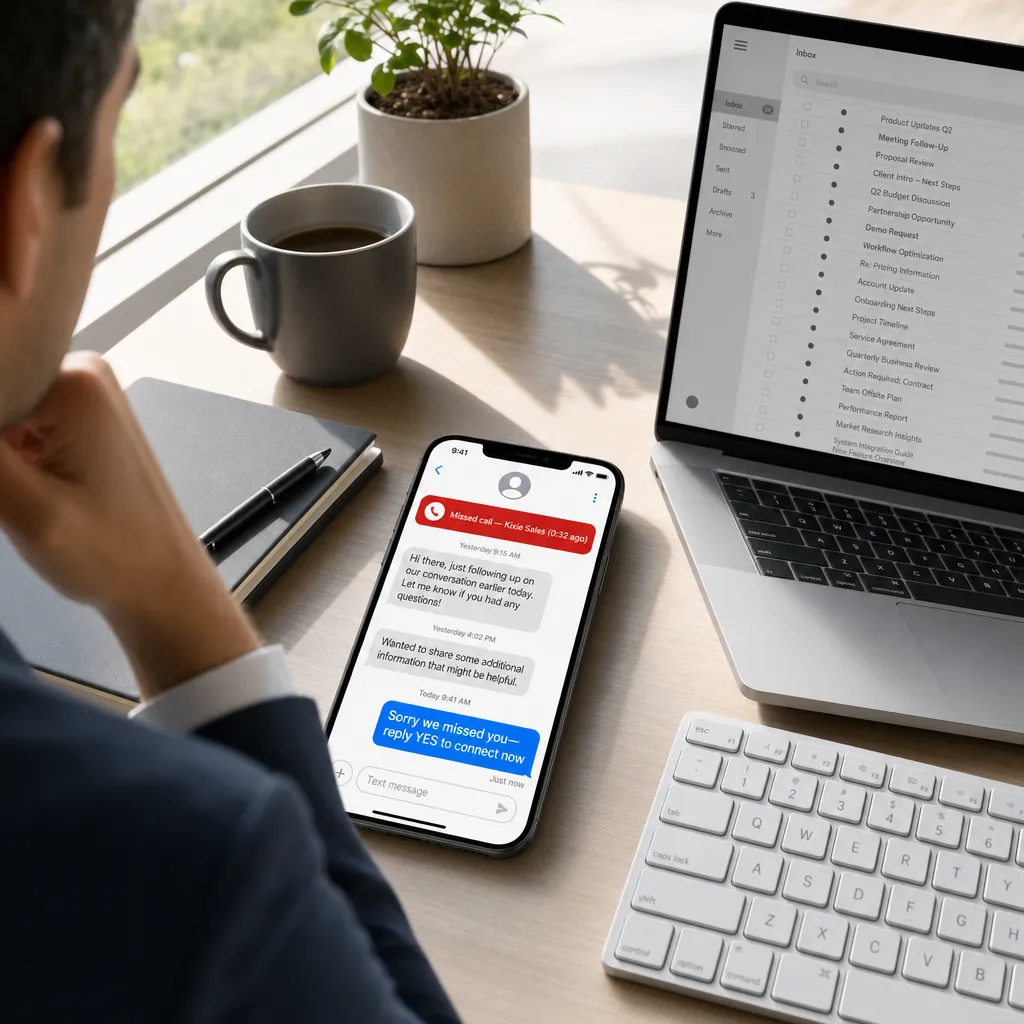
When a live phone call fails to connect, the next step in an effective inbound lead response strategy is an immediate, automated SMS. SMS has a much higher visibility and response rate than email, with some studies showing response rates as high as 68%.
A short follow-up text sent immediately after a missed call reinforces the urgency of the interaction and ensures the brand remains at the top of the prospect’s mind. This multi-channel approach is critical because it takes an average of 8 to 12 touches to engage a decision-maker successfully.
Crafting High-Engagement SMS Templates for Fast Follow-Up
Effective follow-up texts must be concise, personalized, and include a clear call to action. Using CRM variables allows the system to populate the prospect’s first name ([fname]) and the representative’s name ([ffname]), making the automated message feel like a personal reach-out.
- Brevity: Keep messages under 160 characters to avoid being split by carriers and to maintain a professional tone.
- Urgency: “Hi [fname], this is [ffname] from Kixie. I just tried calling to discuss your inquiry. Is now a good time to chat?”
- Value: “We’ve helped companies like yours increase productivity by 20%. Let’s discuss how we can do the same for you.”
- Avoid Spam Triggers: Do not use link shorteners like bit.ly, as these are frequently blocked by mobile carriers.
| SMS Best Practice | Rationale |
|---|---|
| Personalize with [fname] | Increases trust and open rates |
| Keep under 160 characters | Ensures deliverability and clarity |
| Send immediately after call | Capitalizes on recent intent signal |
| Avoid link shorteners | Prevents messages from being flagged as spam |
Automating Multi-Channel Lead Follow-Up
Kixie can be configured to send an “Auto-SMS” triggered by a specific call disposition, such as “Left Voicemail.” This ensures that even if a live conversation was not established on the first attempt, the communication cycle continues without requiring manual representative effort.
This automation is vital for maintaining a consistent speed to conversation throughout the day, especially when representatives are busy with other calls. A strategic follow-up schedule (sending an SMS a few minutes after a missed call and another follow-up a day later) is far more effective than a single attempt.
Retry Aggressively to Call Leads Fast
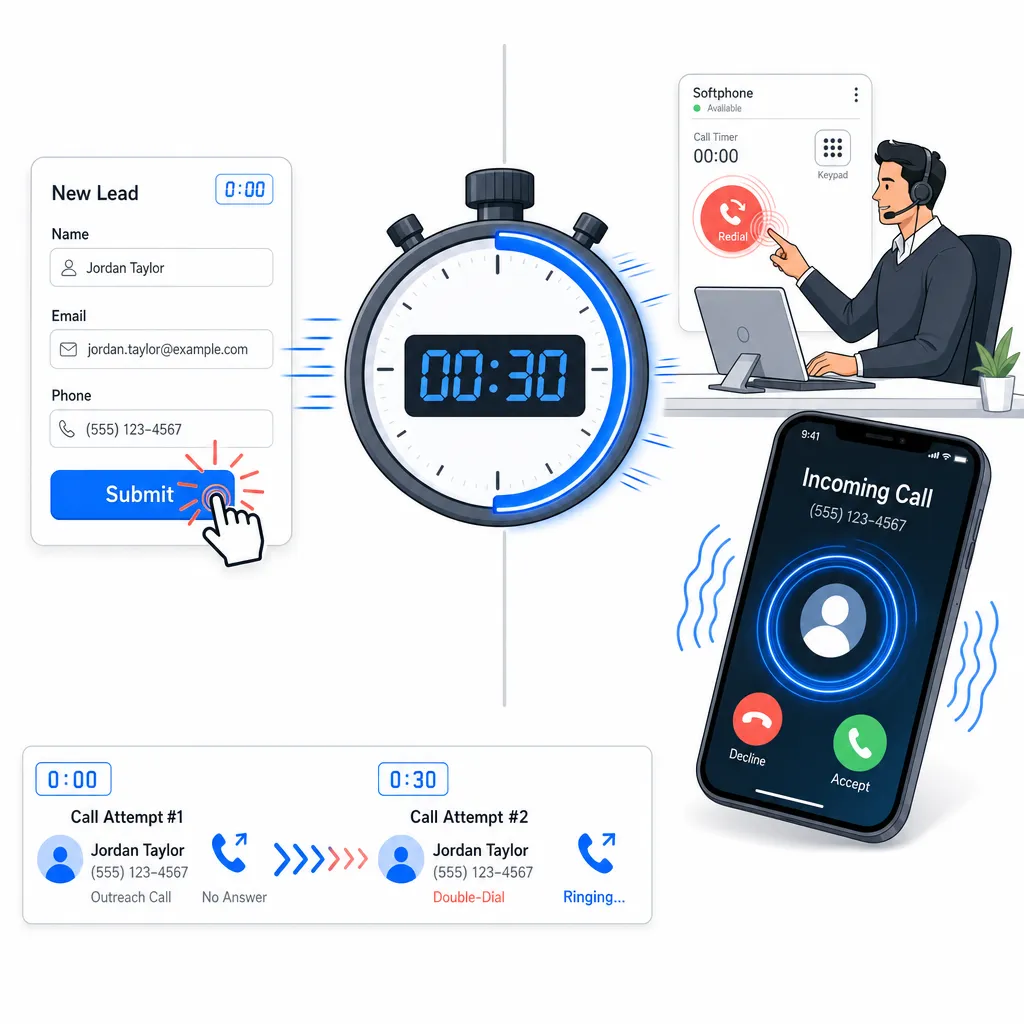
The first 5 to 10 minutes following an inbound lead submission are the most critical, yet many teams abandon leads after a single failed attempt. After just 60 minutes, the likelihood of making successful contact with a lead drops by 10 times. To improve speed to conversation, teams must adopt an aggressive retry strategy during this initial window.
A “double-dial” technique (calling a prospect again within 30 seconds if they don’t pick up the first time) can significantly increase pickup rates. The urgency and persistence conveyed by a quick second call often prompt prospects to answer out of curiosity or a sense of priority.
The Persistence Framework for Calling Leads Fast
Elite sales teams recognize that the “Platinum Minute” is just the beginning of the relationship. Campaigns with only one message have an 8% response rate, while multi-touch sales cadences consisting of 7 to 12 messages over several days achieve response rates of up to 90%.
- Day 1 (Initial Window): Call 1 (within 60s), Call 2 (within 5 mins), SMS 1 (immediate), Email 1 (immediate).
- Day 1 (Late Afternoon): Call 3, SMS 2.
- Day 2: Call 4, Email 2.
- Day 3-5: Continued multi-channel follow-ups.
| Follow-up Attempt | Timing | Channel | Strategic Goal |
|---|---|---|---|
| Attempt 1 | < 60 Seconds | Phone Call | Instant Conversion |
| Attempt 2 | < 5 Minutes | Double-Dial | Capture “Curiosity” Pickup |
| Attempt 3 | < 10 Minutes | SMS | High-Visibility Touch |
| Attempt 4 | Day 1 (PM) | Phone Call | Catch after-hours interest |
| Attempt 5-8 | Days 2-5 | Multi-channel | Nurture and persist |
Using ConnectionBoost and Local Presence to Call Leads Fast
Calling aggressively only works if your calls are being answered. Prospects are significantly more likely to answer an unknown number if it appears to be coming from a local area code. Kixie’s ConnectionBoost technology manages a pool of over 50,000 local numbers and automatically rotates them to match the prospect’s geographic location.
This AI-powered local presence dialing can double answer rates and protect your phone numbers from being flagged as “Spam Risk” or “Scam Likely.” Combining local presence with an aggressive retry strategy creates a powerful mechanism for contacting leads quickly while maintaining a high level of professionalism and strong caller ID reputation.
Boost Lead Connect Rates with AI Answering Machine Detection

One of the most significant wastes of representative time is manual handling of voicemails and IVR systems. Healthy B2B outbound connection rates typically fall between 8% and 15%, but the average representative still needs roughly 18 dials to reach a single buyer. Every second spent listening to a voicemail greeting is a second lost for the next lead in the queue.
Modern AI-powered Answering Machine Detection (AMD) reaches 95-98% accuracy, cutting silent calls and false positives by over 50% compared to legacy rule-based systems. By integrating AI AMD into a multi-line dialer, teams can ensure that representatives are bridged only when a live human is on the line, dramatically increasing live talk time.
| AMD Technology | Accuracy | Impact on Sales Team |
|---|---|---|
| Legacy Rule-Based | ~40% | High dead air, inconsistent results |
| Modern AI-Powered | 95-98%+ | 350% lift in talk time |
The Power of Parallel Dialing for Faster Lead Contact
To truly increase connect rate, teams often utilize parallel dialers that can call multiple prospects simultaneously. Kixie’s Power Dialer can dial up to 10 numbers at once while the AI AMD filters out non-human responses.
This volume-based approach, when combined with precision routing for inbound leads, ensures that a sales team is always maximizing its conversation potential. While parallel dialing carries a higher risk of “dropped calls” if multiple people answer at once, advanced platforms like Kixie use intelligent pacing to minimize these occurrences while maximizing the representative’s live talk time.
Build the “Platinum Minute” into Your Lead CRM Workflow
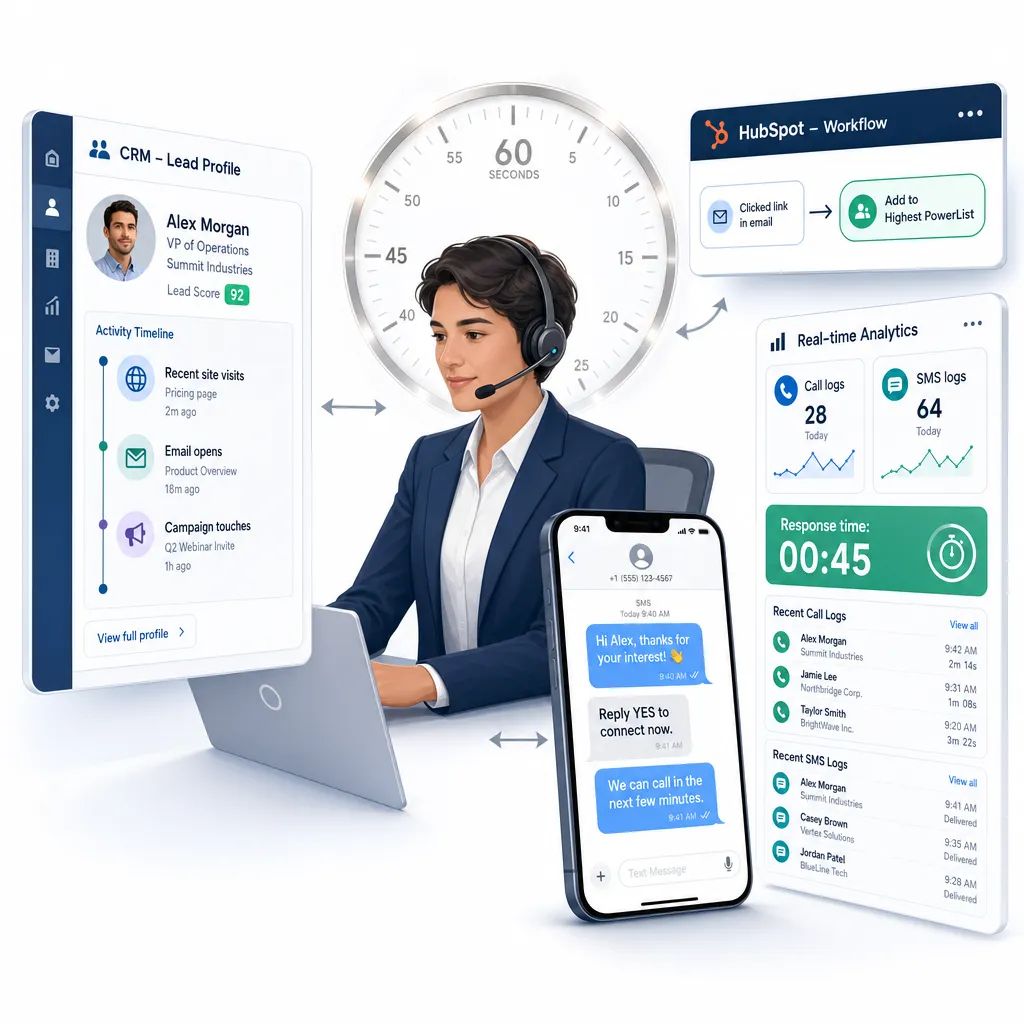
The goal of achieving a sub-minute response time is not just about the phone call. It is about the integrity of the entire revenue operation. By integrating Kixie directly into CRMs like Salesforce, HubSpot, or HighLevel, every interaction is automatically logged, creating a perfect objective dataset for sales leaders to analyze.
This deep, bi-directional integration allows for “contextual calling,” where a representative answers a lead bridge and is immediately presented with the lead’s entire CRM history, including recent website visits, email opens, and marketing interactions.
- Salesforce: Transforms the “pull” model into a “push” model, bypassing passive notifications for active phone calls.
- HubSpot: Uses workflow triggers like “clicked link in email” to add contacts to a “Highest” priority PowerList instantly.
- HighLevel: Automates outreach via PowerLists and triggers SMS sequences based on call outcomes.
| CRM Integration Task | Operational Outcome |
|---|---|
| Auto-Call Trigger | Eliminates manual lead-to-call latency |
| Disposition Webhook | Triggers automated follow-up sequences |
| Call & SMS Logging | Provides real-time analytics on response time |
| Context Display | Gives reps immediate info on the prospect |
Speed to Conversation Is Won in the First Minute
In modern B2B sales, the ability to respond to a lead in under 60 seconds is no longer a luxury; it is a mathematical mandate for survival. Organizations that fail to reach prospects within the first hour are essentially chasing “ghost leads,” as the probability of contact and qualification drops by a factor of ten after the first 60 minutes.
By implementing a “push” model of lead management (using webhooks to trigger calls instantly, routing based on availability, and applying AI to maximize connect rates) sales teams can capture the massive 391% conversion lift associated with the “Platinum Minute.” The telephone call must be the primary channel, supported by immediate SMS and a persistent, multi-touch cadence.
Achieving this level of speed is not about telling representatives to “work faster”; it is about implementing an automated system that makes instant engagement the default. The organizations that win in 2025 and beyond will be those that recognize that speed to conversation is won in the first minute.
Track how fast you talk to leads, not just how fast you respond.
Ready to close more deals with Kixie?
See how Kixie's AI-powered tools can transform your sales and support operations.
Start Free Trial