TL;DR: Speed to conversation measures the time between a prospect’s intent signal and an actual live dialogue with a sales rep, not just an outreach attempt. Data shows 78% of buyers choose the first company to respond, and sub-minute response times produce a 391% conversion boost compared to 30+ minute delays. The industry average response time is 47 hours, with 63% of leads never contacted at all. Kixie’s Automated LeadCaller uses a push-based “hunt-and-bridge” framework to connect reps with leads in under 60 seconds, eliminating manual pull-based workflows. ConnectionBoost manages caller ID reputation across 50,000+ numbers with real-time ASR monitoring and automatic spam quarantine. The Multi-line Power Dialer handles up to 10 parallel calls with AI human voice detection. Integrated SMS, voicemail drop, and CRM auto-logging (100+ native integrations including HubSpot, Salesforce, GoHighLevel, Pipeline CRM) remove administrative overhead. Universal coaching (Listen, Whisper, Barge) and AI conversation intelligence provide real-time and post-call quality management. Modeled revenue impact: sub-minute response generates $150,000 per 1,000 leads at $5K ACV versus $7,500 at the 42-hour industry average, a 20x improvement from the same lead pool.
Why B2B Sales Teams Are Shifting from Speed to Lead to Speed to Conversation
Most sales organizations already know that responding to inbound leads quickly matters. The concept of “speed to lead” has been a staple of sales training for years. But there is a critical distinction that separates high-performing teams from everyone else: it is not enough to simply attempt contact fast. What matters is how quickly a rep gets into an actual, live dialogue with the prospect.
That distinction is the gap between speed to lead and speed to conversation, and the data behind it is stark. Research indicates that 82% of consumers rate an immediate response as “important” or “very important” when they have a sales-related inquiry. Despite this, the average response time across the B2B sector remains a staggering 47 hours, with 63% of leads receiving no response at all. This is not merely an operational oversight. It is a structural failure of the standard “pull-based” sales workflow, where human latency and administrative burdens prevent representatives from acting within the critical 60-second window where conversion probability is highest.

How the Lead Decay Curve Shapes Speed to Conversation
The probability of a successful sales interaction is an exponential decay function of time. Buyer intent peaks at the moment of submission, and every subsequent minute of delay significantly erodes the likelihood of qualification and conversion. The data suggests that the “first responder advantage” is the single most decisive factor in winning a deal: 78% of buyers choose the first company that responds to their inquiry. This advantage is so profound that it often outweighs brand reputation, price, and even product features.
The table below synthesizes the impact of response time on key performance indicators. Notice the catastrophic performance deterioration that occurs beyond the first five minutes.
| Response Window | Qualification Likelihood | Conversion Boost | Strategic Outcome |
|---|---|---|---|
| < 1 Minute | 100x vs. 30 min | 391% increase | Instant Intent Capture |
| < 5 Minutes | 21x vs. 30 min | 8x vs. > 5 min | Optimal Speed-to-Conversation Window |
| < 1 Hour | 7x higher | Moderate | Standard Aspirational Goal |
| 24+ Hours | 60x lower | Minimal | Pipeline Leakage |
Organizations that fail to reach prospects within the first hour are essentially chasing “ghost leads.” After sixty minutes, the likelihood of making successful contact drops tenfold, and 71% of internet leads are wasted due to inadequate follow-up procedures. The economic cost is immense: billions in global advertising spend are effectively abandoned because sales teams cannot overcome human latency.
Why Intent Fades and Human Latency Kills Conversations
The root cause is what you might call the “crisis of human latency.” Modern sales representatives face an impossible equation: a high volume of leads, insufficient time for manual research, and a constant barrage of administrative tasks. In a typical manual workflow, a lead enters the CRM, an alert fires (often via email or a notification bell), the rep must see the alert, navigate to the record, verify the data, and then initiate the call. Even if this process takes only three to five minutes, the prospect’s focus has likely shifted. They may have closed the browser tab, answered another call, or engaged with a competitor who used an automated response system.
Traditional automation tools have historically focused on internal workflow optimization rather than the buyer experience. Systems that merely route a lead to a “To Do” list or trigger an automated email sequence fail to address the core human need for rapport and real-time objection handling. Speed to conversation addresses this gap by using technology to force an instant interaction, bridging the divide between a digital signal and a human relationship.
How Kixie’s LeadCaller Enables Instant Speed to Conversation
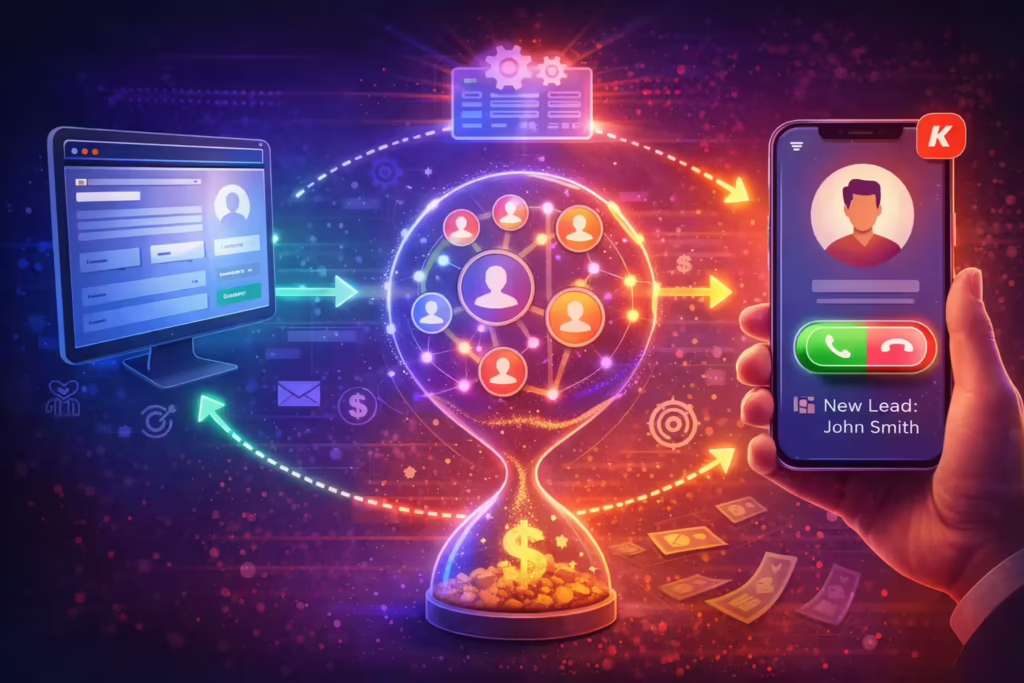
Solving the latency problem requires a fundamental shift from “pull” to “push” frameworks. In a pull-based system, the rep has to notice a lead, open a record, and decide to call. In a push-based system, the technology initiates the connection automatically. Kixie’s Automated LeadCaller is built on this push-based “hunt-and-bridge” framework, and the workflow is designed to minimize the time between intent signaling and voice connection:
- Intent Trigger: A prospect performs a high-intent action, such as submitting a web form or clicking a specific link in a pricing email.
- Representative Selection: The system identifies the most appropriate representative based on pre-defined routing rules (geographic proximity, industry expertise, or round-robin availability).
- The Representative Ring: Kixie immediately calls the sales representative’s desk phone, mobile app, or computer.
- The Prospect Bridge: As soon as the representative answers, the system provides a brief whisper (e.g., “New Lead: John Smith”) and automatically dials the prospect’s number.
This mechanism eliminates the representative’s “choice” to delay. The system ensures the lead is contacted in seconds rather than minutes, which is what produces the 391% increase in conversion probability: it catches the prospect while the brand is literally still on their screen.
How Kixie’s Push Framework Compares to Legacy CRM Dialers
The distinction between passive and active frameworks becomes clearer when comparing specialized tools like Kixie to native CRM solutions such as Salesforce Sales Dialer.
| Operational Feature | Salesforce Work Queues (Legacy) | Kixie LeadCaller (Modern) |
|---|---|---|
| Engagement Model | Pull-based (Passive) | Push-based (Active) |
| Latency Risk | Rep distraction / monitoring required | Eliminated via system-initiated call |
| Monitoring Threshold | Limited to CRM Role Hierarchy | Universal access (Listen / Whisper / Barge) |
| Follow-up Integration | Requires manual Flow configuration | Built-in Auto-SMS and templates |
| Success Correlation | Lower conversion due to latency | 391% conversion boost via sub-minute response |
The structural advantage of the push framework is that it protects the pipeline from human error. In a pull-based system, if a representative is away from their desk or distracted by another tab, the lead cools off. In the Kixie framework, the system actively “hunts” for the representative across multiple devices to ensure the bridge is established.
How ConnectionBoost Protects Speed to Conversation from Spam Filters
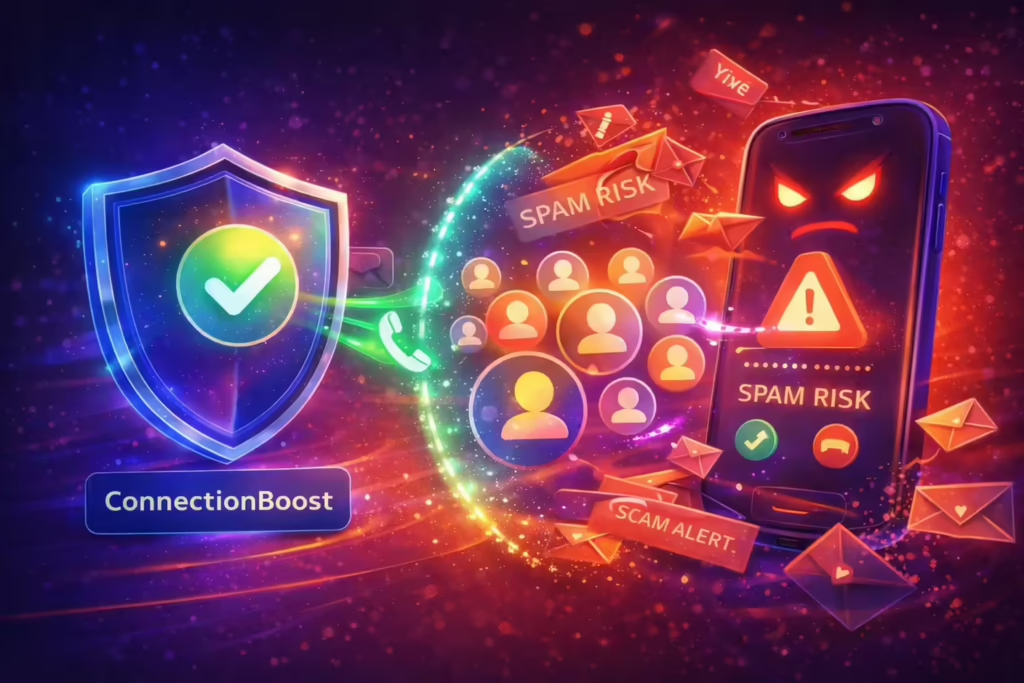
Even the fastest dialing system in the world is useless if the prospect never sees the call. The modern telecommunications environment is plagued by aggressive carrier-level filtering, where legitimate sales calls are frequently flagged as “Spam Risk” or “Scam Likely.” To overcome this, Kixie uses ConnectionBoost, an AI-driven suite of caller ID reputation management and connection-optimization tools.
How Caller ID Reputation Remediation Works
At the core of ConnectionBoost is an automated spam detection and remediation engine. The system monitors Answer Seizure Ratios (ASR) in real-time across a dynamic pool of over 50,000 numbers. When the ASR for a specific number drops (a primary indicator that the number has been flagged by a major carrier like Verizon or AT&T), the system automatically quarantines that number and replaces it with a fresh, unflagged one from the pool. This proactive approach removes the burden of reputation management from the IT administrator and places it in the hands of an autonomous AI.
How Local Presence Dialing Improves Answer Rates
Prospects are significantly more likely to answer a call from a local area code. ConnectionBoost uses local presence dialing to display a number matching the prospect’s geographic location. Kixie takes this further with “Progressive Caller ID,” which automatically rotates the numbers used for a specific prospect. This prevents the “frequency capping” blocks that occur when a lead sees the same unknown number multiple times and decides to manually block it.
How AI Human Voice Detection Saves Rep Time
One of the most significant wastes of representative time is the manual handling of answering machines and IVR systems. Kixie’s Multi-line Power Dialer uses AI algorithms to detect the difference between a live human greeting and a recording, allowing the system to auto-dial up to 10 numbers in parallel. It skips voicemails and only bridges the representative when a live person answers. The efficiency gains are substantial: by removing the dead air of voicemails, a representative can have five times as many conversations per day compared to manual dialing.
Why Multi-Channel Follow-Up Matters for Speed to Conversation
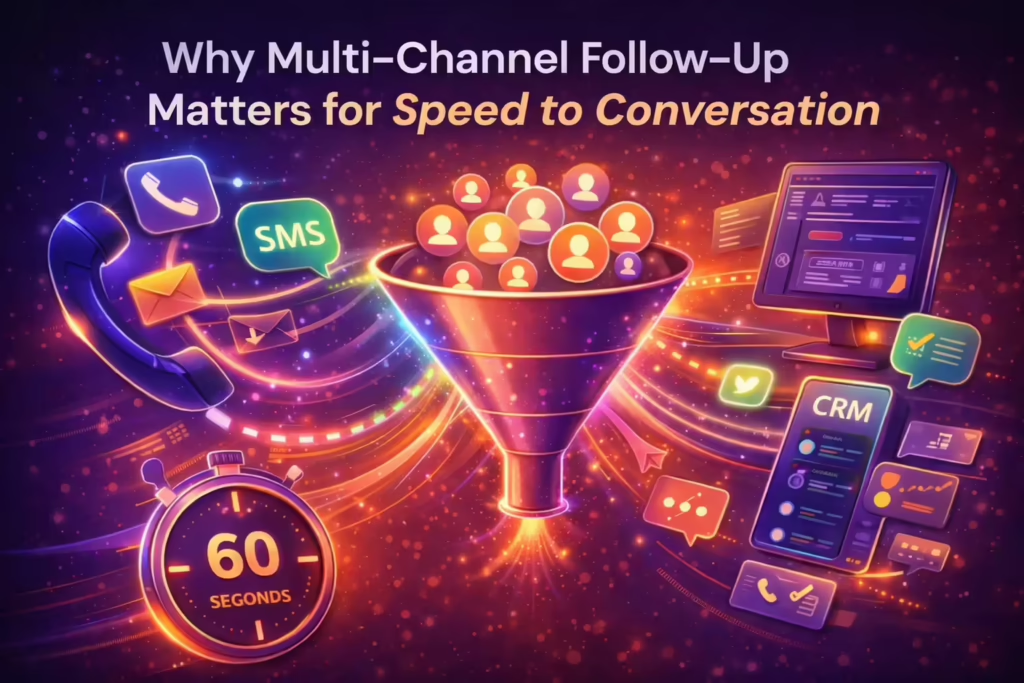
Speed to conversation is not solely a function of voice calls. It is a holistic engagement strategy that incorporates multiple touchpoints. The modern buyer expects seamless continuity across channels, and Kixie addresses this by integrating SMS directly into the dialing interface and the CRM workflow.
How Business SMS Bridges Missed Conversations
Prospects respond to SMS at a much higher rate than other forms of digital communication. Within the Kixie ecosystem, SMS works both as a primary outreach tool and as a secondary “bridge” for missed calls. The system can be configured to send an “Auto-SMS” triggered by a specific call disposition (e.g., “Left Voicemail”), ensuring that even if a live conversation was not established on the first attempt, the brand maintains its presence in the prospect’s inbox and increases the likelihood of a callback.
Each channel in the speed-to-conversation stack serves a distinct strategic function:
| Communication Channel | Strategic Function |
|---|---|
| Voice Call | Direct objection handling and human rapport building |
| Automated SMS | High-visibility follow-up for missed call bridges |
| Voicemail Drop | One-click delivery of personalized messages |
| CRM Logging | Automatic synchronization of all multi-channel touchpoints |
The integration of these channels ensures that the conversation never truly stops. If a lead fill occurs and the representative is on another call, Kixie can automatically send a text: “Hi [Name], I’m currently on a call but will be reaching out in exactly three minutes to discuss your inquiry.” This pre-emptive engagement satisfies the buyer’s need for immediacy and “claims” the lead before a competitor can intervene.
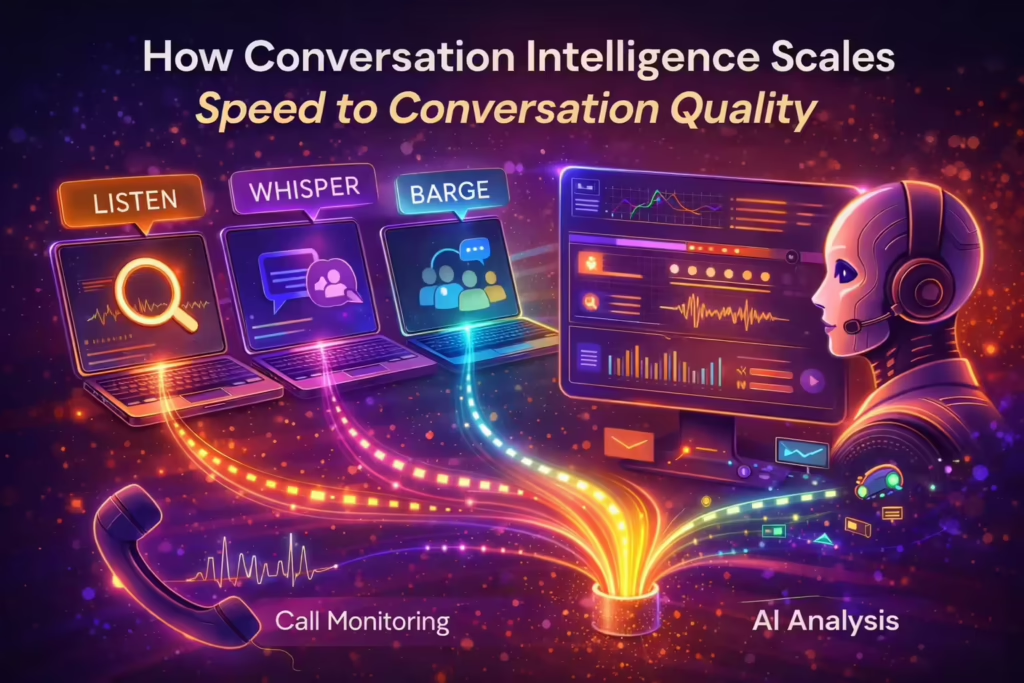
How Conversation Intelligence Scales Speed to Conversation Quality
High-velocity dialing without high-quality interactions is just noise. As teams scale, the ability for managers to oversee and improve live conversations becomes a critical success factor. Kixie provides a universal call coaching framework that is uncoupled from rigid CRM hierarchies, allowing any designated team lead or coach to monitor calls in real-time.
How Listen, Whisper, and Barge Give Managers Real-Time Control
The universal coaching suite offers three levels of engagement:
- Listen: Allows a manager to monitor a call for quality assurance without either party knowing they are present.
- Whisper: Enables the coach to speak directly to the representative with real-time guidance (e.g., “Don’t forget to mention the Q3 discount”) that the prospect cannot hear.
- Barge: Allows the manager to join the call as a third party, particularly effective for closing high-value deals or resolving complex objections.
This real-time feedback loop is essential for onboarding new representatives and ensuring that speed does not come at the cost of conversation quality. Unlike Salesforce, which often charges for “Digital Engagement” add-ons or doubles minute usage during monitoring, Kixie includes these features in its core enterprise offering without usage penalties.
How AI Conversation Intelligence Improves Post-Call Analysis
Kixie also integrates with platforms like Gong and offers native Kixie AI Insights for deeper post-call analysis. AI-powered conversation intelligence automatically transcribes calls, identifies keywords, and performs sentiment analysis. This data allows managers to pinpoint why certain reps have higher conversion rates and replicate those winning talk tracks across the entire organization. Call summaries are automatically synced to the CRM, removing the administrative burden of manual note-taking.
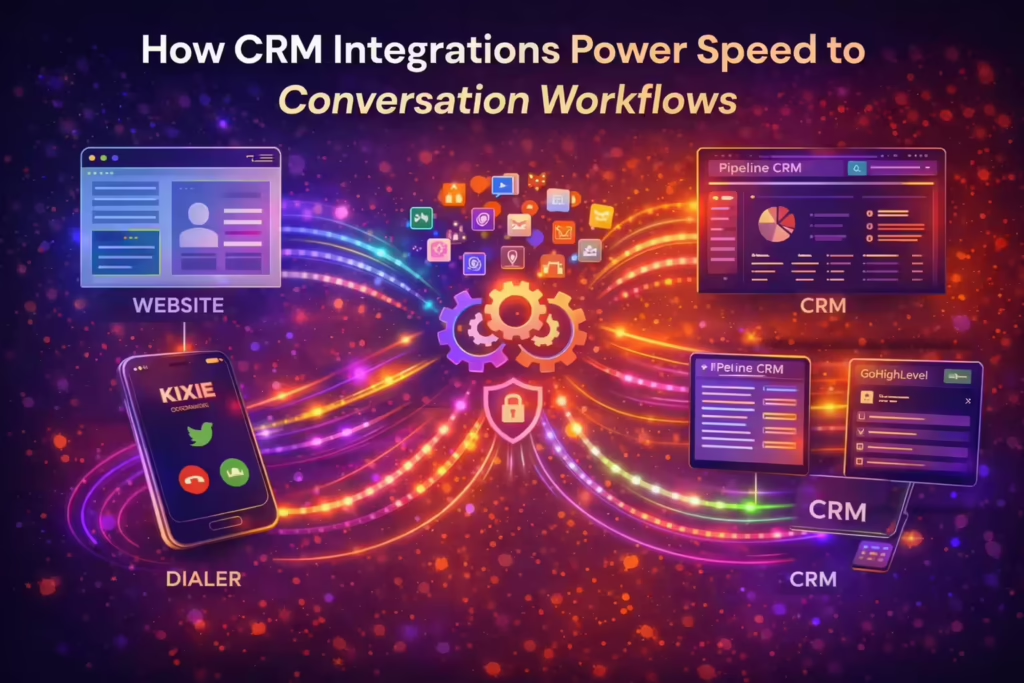
How CRM Integrations Power Speed to Conversation Workflows
A speed-to-conversation engine is only as effective as its integration with the organization’s “System of Record.” Kixie’s 100+ native integrations ensure that lead data flows seamlessly between the website, the dialer, and the CRM without manual intervention.
GoHighLevel and Pipeline CRM Integration Examples
In a GoHighLevel environment, Kixie PowerCall integrates via the “Lead Connector” protocol. The administrator selects the appropriate sub-account, and the system automatically maps fields to ensure that every call and SMS is logged to the correct contact record.
In Pipeline CRM, the integration follows three steps:
- Authentication: Using the Kixie Business ID and API Key to establish a secure link.
- Activity Mapping: Determining how different call outcomes (completed, missed, voicemail) should be categorized in the CRM’s activity timeline.
- Verification: Using webhooks to confirm that data is pushing correctly in real-time.
This real-time synchronization is critical for maintaining data integrity. When a representative has a conversation with a lead, that interaction must be visible across the entire organization immediately to prevent duplicate outreach or conflicting messaging.
How Automation Removes the Administrative Tax on Speed to Conversation
The primary constraint on sales growth is often not lead volume but the administrative “tax” on sales representatives. Studies show that the average salesperson spends 20% of their time on CRM updates and manual data entry, and another 6.4 hours per week in internal meetings. That is time that should be spent having live conversations.
Kixie addresses this by automating the busywork:
- Automatic Call Logging: Every call, text, and recording is logged instantly to the CRM.
- New Lead Creation: If a lead from a web form is not already in the system, Kixie can automatically create a new contact record, pulling details from web databases where possible.
- Disposition Triggers: Managers can set up automations based on call outcomes. For example, a “Demo Scheduled” disposition in Kixie can automatically move the lead to the next stage in the HubSpot pipeline and send a confirmation email.
By removing these menial tasks, Kixie enables a lean sales team to handle a significantly higher lead volume than would be possible with manual processes. This scalability is essential for organizations looking to increase their media spend, as it ensures that the increased lead flow will be handled with consistent speed and quality.
The Revenue Cost of Slow Speed to Conversation
The ultimate metric for any revenue technology is its impact on the bottom line. The cost of slow lead response is quantifiable through Cost Per Lead (CPL) and Return on Ad Spend (ROAS). When 63% of leads receive no response, the organization is effectively throwing away 63% of its marketing budget. The table below models the revenue impact of transitioning from a moderate manual response to an instant automated response.
| Performance Tier | Median Response Time | Lead-to-Qualification Rate | Revenue per 1,000 Leads ($5K ACV) |
|---|---|---|---|
| Industry Average | 42 Hours | 0.15% | $7,500 |
| Optimized Manual | 1 Hour | 0.75% | $37,500 |
| Automated Speed | 5 Minutes | 2.10% | $105,000 |
| Kixie LeadCaller | < 1 Minute | 3.00% | $150,000 |
An automated speed-to-conversation strategy can generate 20x more revenue than the industry average from the exact same lead pool. For a mid-market company, this is the difference between a failing marketing campaign and a highly profitable growth engine.
How Revenue Leakage Adds Up Without Fast Conversations
The abandonment of 51% to 63% of leads represents a catastrophic failure to meet customer expectations. In many industries, the cost per lead can exceed $100 or even $500. If 630 leads out of 1,000 are never contacted, the organization is losing $63,000 to $315,000 in sunk costs alone, before accounting for the lifetime value of the lost customers. Speed to conversation serves as a “plug” for this leakage, ensuring that every marketing dollar has a fair chance to convert into revenue.
The Future of Speed to Conversation and Autonomous Revenue Engines
The concept of sales automation is evolving into what many are now calling “autonomous revenue engines.” This shift is driven by the integration of AI sales agents that can think, remember, and personalize interactions at scale. These agents do not just execute predefined sequences; they adapt their messaging based on buyer signals and handle objections authentically.
In this future, speed to conversation becomes even more critical. If an AI agent can qualify a lead in real-time on a website, the handoff to a human representative must be instantaneous to maintain the continuity of the experience. Organizations that have already built a foundation of automated lead bridging and multi-channel orchestration with tools like Kixie will be best positioned to integrate these advanced AI capabilities and achieve a truly frictionless buyer experience.
Strategic Recommendations for Revenue Leaders
The transition from speed to lead to speed to conversation is an operational necessity in an increasingly competitive B2B market. The data is clear: speed is the primary driver of conversion, and human latency is the primary driver of revenue leakage. To capitalize on this shift, organizations should adopt the following strategic framework:
- Prioritize the “Push” Framework: Replace passive work queues with active lead bridging systems that “hunt” for representatives and facilitate sub-minute connections.
- Automate Reputation Management: Use AI-driven tools to monitor Caller ID reputation and rotate numbers dynamically, ensuring that calls are not blocked by carrier filters.
- Integrate Multi-Channel Follow-up: Layer automated SMS and voicemail drops into the initial outreach cadence to maintain momentum when a live call is not initially possible.
- Use Universal Coaching: Implement real-time monitoring and whisper capabilities to ensure that high-velocity interactions maintain high-quality standards.
- Audit the “Expectation Gap”: Continuously measure actual response times against the 60-second gold standard, using real-time dashboards to foster a culture of urgency and competition.
By adopting these principles, sales organizations can transform their inbound response engine from a source of frustration and wasted spend into a high-performance driver of growth and competitive advantage. In the digital economy, the first conversation is often the only one that matters.
Ready to close more deals with Kixie?
See how Kixie's AI-powered tools can transform your sales and support operations.
Start Free Trial