TL;DR: Cold calling is still effective, but the part that broke is not the conversation. It is the connect. A call now has to get past carrier labeling, screening apps, and a public that has put more than 258 million numbers on the National Do Not Call Registry. So stop asking whether the channel works and start asking which link in your chain is failing. Measure attempts, valid numbers, connects, real conversations, meetings booked, meetings held, qualified opportunities and cost per opportunity. One of those will be your constraint. Ignore published success rates, because nobody defines success the same way, and even the FTC labels its own Do Not Call complaint counts as unverified consumer reports rather than survey data. Your numbers beat somebody else’s blended average every time. Cold calling holds up when you have a narrow list, a defensible reason to call, contact data you actually checked this quarter, reps who can run discovery, and a manager reviewing recordings. It falls apart on bought lists, generic scripts, a weak offer, and quotas that reward dials over fit. B2B and B2C are different games, and not only in tone: most business-to-business calls sit outside the Telemarketing Sales Rule, while consumer telemarketing carries the 8 a.m. to 9 p.m. local time limit on calls to a person’s home at the location called, absent prior consent, and a registry scrub at least every 31 days. Run one segment as a real pilot, write down what counts as a connect before you dial, change one variable at a time, and let pipeline decide how much phone belongs in your mix.
Someone on your team says cold calling does not work anymore. Someone else says their best deal last quarter started with a cold call. Both of them are describing the same week on the same floor.
That is the problem with the question. Is cold calling still effective is not one question. It is three. Can you reach a human? Is that human someone who can buy? Does the conversation produce a next step? Those three fail for different reasons, and a single headline success rate hides all of it.
The channel did not die. The connect step got expensive. Everything below is about finding which link in your chain is actually broken.
Is cold calling still effective, or did the connect just get harder
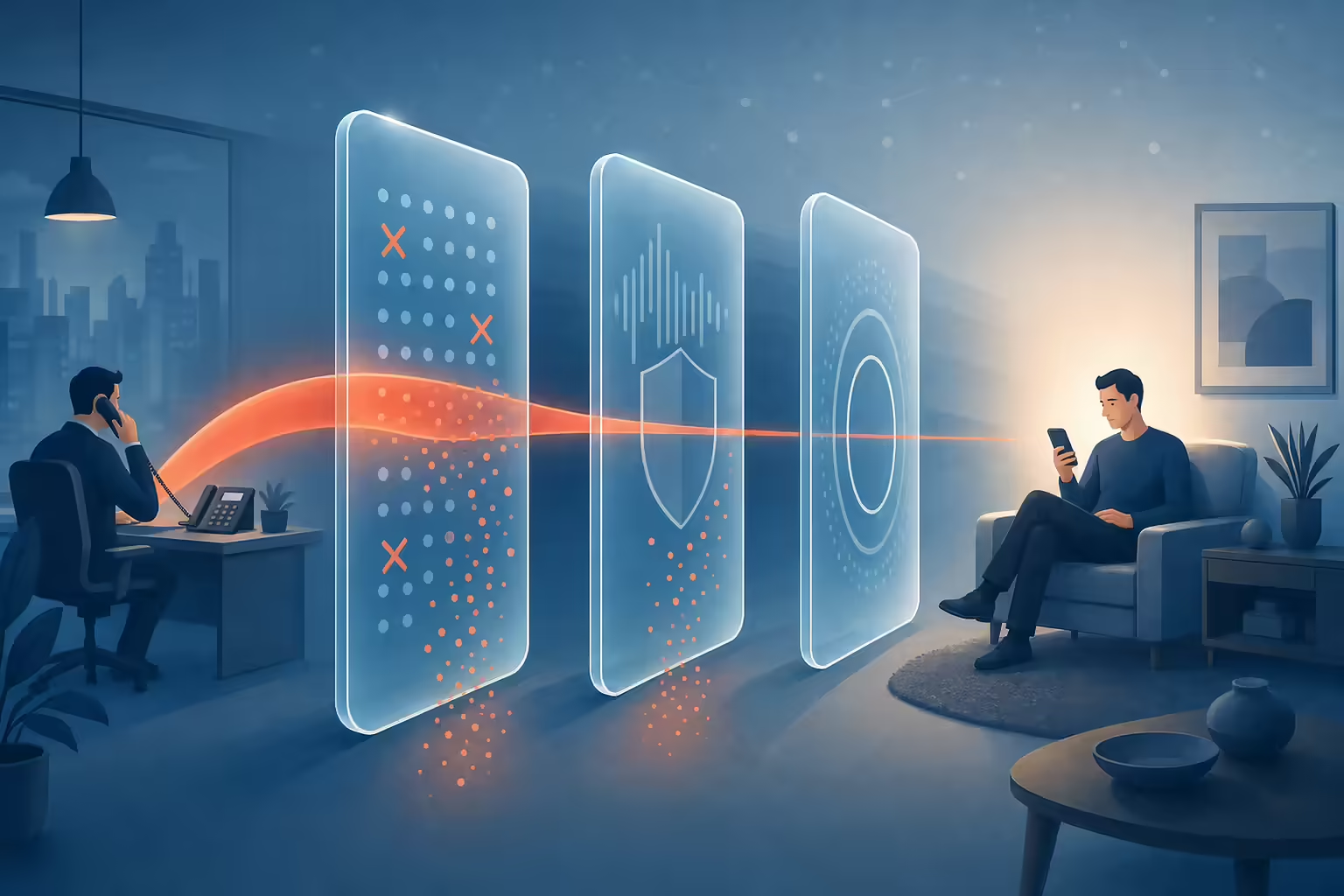
Think about what a cold call has to survive now before anyone says hello. The number has to not be flagged by the carrier. It has to get past a screening app that sends unknown numbers to voicemail. It has to reach a person who has been conditioned by years of robocalls to let anything unfamiliar ring out. Only then does your rep get to open their mouth.
None of that changed the value of a live conversation. A phone call is still the fastest way to hear an objection in real time, ask a follow-up question the same second, and get a yes or a no instead of silence. Nothing else in the stack does that.
What changed is the cost of buying that conversation. That is a math problem, not a philosophy problem. If your answer rate drops by half, your rep needs twice the attempts for the same number of conversations, and every downstream metric shifts with it. Teams that call this “cold calling is dead” are usually reporting a connect problem and diagnosing it as a channel problem.
So before you cut the channel, find out where the loss is. If reps are having plenty of conversations that go nowhere, the list or the offer is wrong. If they cannot get anyone on the line at all, you have a phone-number reputation problem, and that is a different fix. Kixie covers that specific failure in the spam likely call prevention checklist.
What the do not call data actually says about cold calling
There is one large, dated, government-published number in this debate worth knowing. In fiscal year 2025, the National Do Not Call Registry held over 258 million active registrations, and the Federal Trade Commission received more than two and a half million Do Not Call complaints. That is from the FTC’s own Data Book, published December 2025.
Now read it carefully, because the FTC does. The agency states plainly that its Do Not Call complaint data comes from unverified complaints filed by consumers and is not based on a consumer survey. So that complaint total counts complaints, not people, and one person can file more than one. It measures how many reports consumers filed. It is not a measure of how many unwanted calls happened, and it is definitely not a measure of how the market feels about your outreach.
What the 258 million figure does tell you is the scale of consumer opt-out. That is the ground your consumer campaigns operate on. It is also the reason the general public conversation about calling is so hostile, and why sales teams keep absorbing that hostility as evidence about their own program.
Here is the part most articles skip. That registry describes consumer telemarketing. Under the Telemarketing Sales Rule, business-to-business calls are not covered by the Rule, with narrow exceptions for retail sales of nondurable office or cleaning supplies and for soliciting sales or charitable contributions from employees. If you sell software to a revenue leader, that registry figure is context rather than a direct limit on your calling. Treating it as a hard stop is how a B2B team talks itself out of a channel that is still open to it.
Be careful with that, though. An exemption from one rule is not an exemption from the rest. B2B calling is still governed by other federal and state requirements, and calls to mobile numbers, call recording, and your own suppression obligations each carry federal and state rules of their own. Check them for the markets you call rather than assuming one exemption covers the rest. Kixie’s guide to calling legally walks the specific rules, and none of this is legal advice.
Why published cold calling success rates are close to useless
Search the question and you will find confident percentages. Ignore almost all of them.
Ask what the number counted. One study counts a “success” as a booked meeting. Another counts any conversation longer than thirty seconds. Another counts a closed deal. Those are three different denominators and three different businesses. Blending them produces a figure that describes nobody.
Then ask who produced it. A dialer vendor’s benchmark is drawn from that vendor’s customers, which is a selected population by definition. A survey of sales leaders reports what people believe about their own performance. A community thread reports what people remember. All three are useful for spotting the shape of an argument. None of them is a planning input.
The most defensible position is unglamorous: cold calling effectiveness varies enormously by segment, offer, data quality and caller skill, and the only number that predicts your next quarter is the one your own team produced last quarter. If you do not have that number yet, that is the actual finding, and it is fixable this month.
The numbers that tell you whether cold calling is still effective for your team
Dial count is an input, not a result. A rep can hit 120 dials into a dead list and produce nothing. Track the chain instead, and tie each number to a decision you would actually make.

- Attempts: raw dials placed. Useful only as the denominator for everything below.
- Valid numbers: the share of attempts that reach a working line belonging to the intended person. If this is low, stop coaching and fix the data source.
- Connect rate: attempts that reach the target human. A falling connect rate with a stable list points at caller ID reputation, not effort.
- Conversation rate: attempts that produce a real exchange rather than a brush-off. This separates “they answered” from “they engaged”.
- Meeting-booked rate: conversations that produce a scheduled next step. Low here with healthy conversations means the opening or the offer is not landing.
- Meeting-held rate: booked meetings that actually happen. A gap between booked and held usually means reps are booking soft commitments to get off the call.
- Qualified-opportunity rate: meetings that clear your own qualification bar. This is where a bad list finally shows up in the numbers.
- Cost per opportunity: rep time, data, tooling and management divided by qualified opportunities. This is the number that settles budget arguments.
Who decides what counts as a conversation? Write the definitions down before the campaign starts, or the answer will be whoever is presenting that week. Two managers reporting on the same activity will produce two different success rates otherwise, and you will spend the review arguing about arithmetic instead of the business.
One more habit worth building. Look at each metric as a ratio to the one above it. That is how you find the single broken link instead of throwing more dials at a problem that lives three steps downstream. If connects look weak, the tactics in improving your cold calling connection rate address that link specifically.
When cold calling is still effective
Calling earns its place when several conditions hold at once. Not most of them. All of them, or the weakest one sets your ceiling.
- A narrow ideal customer profile. Reps can name the industry, company size, role and business situation that fits. “Anyone with a sales team” is not a profile.
- A defensible reason for the call. Something happened: a hire, a funding round, a product launch, a tool they just adopted. A name appearing on a list is not a reason.
- Contact data you have actually checked. Not data you bought and assumed. Sample it, dial it, and measure how much of it is wrong before you scale the campaign.
- An offer that survives thirty seconds of scrutiny. If the rep cannot state the relevance in plain language without overpromising, the script is not the problem.
- Reps who can run discovery. The ability to ask a question, hear the answer, and change direction. That skill is what makes the phone worth more than an email.
- Follow-up that is designed, not improvised. The call is one step in a sequence with defined attempts and a stop condition.
- A manager reviewing actual calls. Somebody listening to recordings, grouping them by outcome, and changing the targeting or the opening based on what they hear.
These conditions do not guarantee results. They guarantee you can tell why the campaign worked or did not, which is the thing most teams are missing.
When cold calling stops being effective
Calling breaks down in predictable ways, and every one of them is a process failure rather than a channel failure.
Which one is yours? Bought lists with no filtering. Generic scripts read the same way to a founder and a procurement manager. An offer nobody asked for, delivered louder. A quota that pays for dials, which teaches reps to burn the easiest records first and mark them closed lost.
Watch for the lazy close-out specifically. How many real attempts happened before someone made that call? A record marked no-response after two attempts and one voicemail is not a tested lead. It is an abandoned one. If your closed lost pile is full of accounts with thin attempt histories, your connect rate is not the problem and neither is your script. Your follow-up discipline is. The follow-up call is where most of the recoverable pipeline is sitting.
Calling is also the wrong opening move in some situations. When a buyer needs real education before they can even evaluate the problem, a cold call asks them to make a decision they are not equipped to make. When your contact data is mostly wrong, more dials just produce more wrong numbers. And repeated low-context attempts do real damage: you teach an entire market to ignore your number.
Cold calling in B2B versus B2C sales
These are not the same activity with a different tone. They differ in who picks up, what they expect, and which rules apply.
B2B calling reaches someone at work, inside a role, usually with other stakeholders behind them. The first call often is not aiming at a sale. It is aiming at a referral to the right person, a piece of information about how they handle the process today, or twenty minutes on the calendar. Longer cycles mean the value of one conversation is realized weeks later, which is exactly why teams misjudge the channel on a two-week test.
B2C calling reaches a person at home, in personal time, with a much lower tolerance for interruption and a much larger body of regulation around it. Under the Telemarketing Sales Rule, and absent the person’s prior consent, outbound telemarketing calls to a person’s home cannot happen outside the hours of 8 a.m. and 9 p.m. local time at the location called. The Rule also requires caller ID transmission, prohibits abandoned calls outside a narrow exception a caller only earns by meeting the conditions the Rule sets, and requires deleting all National Do Not Call Registry numbers from your calling lists at least every 31 days.
Do not carry benchmarks across that line in either direction. A connect rate from a consumer campaign tells you nothing about calling revenue operations leaders, and the reverse is just as true. Even inside B2B, calling a twelve-person agency is a different motion than working a global account with centralized procurement. Segment the reporting or the averages will lie to you.
How to make cold calling effective again
Research the account, not the person’s hobbies
Spend the preparation time on things that could make the offer relevant: how the business likely makes money, what the role is accountable for, what tool they recently adopted, whether anyone at the company has talked to you before. Skip the forced personalization about someone’s marathon. Buyers can tell, and it signals that you had nothing better.
Open directly and say why you are calling
State who you are, why you are calling this specific company, and why it might matter to them. That is the whole job of the opening. It buys thirty seconds, not a demo. Do not perform familiarity you have not earned, and do not ask whether you caught them at a bad time when you already know the answer.
Ask questions that could disqualify the deal
Good discovery is not an interrogation and it is not a checklist. Ask how they handle the relevant process now, whether fixing it is on anyone’s list this quarter, and what would have to be true for a next step to be worth their time. Be willing to hear a no. A fast disqualification returns the hour to your rep, and a healthy team is measured on that too.
Treat an objection as information
“Not interested,” “send me something,” and “we already have a tool” mean different things. One is a brush-off, one is a soft maybe, one is a real constraint you can work with. Acknowledge it, ask one clarifying question when the moment allows, and stop when someone asks you to stop. Arguing a buyer out of a real concern is wasted effort and it costs you the referral later.
Review calls by outcome, not by highlight
Pull recordings into groups: connected but no interest, connected and booked, disqualified, objection at the same point, wrong contact entirely. Patterns live in the groups. A single great call proves nothing. Confirm your recording and review practice meets the rules that apply to your markets before you build the habit.
Point coaching and comp at held meetings
If booked meetings rarely get held or rarely qualify, adding dials amplifies the wrong behavior at scale. Move the incentive to held meetings and qualified opportunities. Reps optimize for what you count, so count the thing you actually want.
Where the phone fits with email and other channels
Phone and email solve different problems. A call gets you real-time objection handling and a decision. Email gives the buyer time and something they can forward to the person who actually approves things. Social gives context. A referral skips the cold part entirely, because someone the buyer already trusts made the introduction.
A workable multichannel sequence looks something like this:
- Research the account and write down the reason you are calling.
- Call, and leave a short message when the situation warrants one.
- Send a brief email that states the business relevance and proposes one concrete next step.
- Use another professional channel only if it genuinely fits that audience.
- Call again, referring to the topic rather than pretending they read your email.
- Stop at a defined attempt count, or immediately when someone asks you to.
The point is not to be everywhere at once. It is to let each channel do the thing it is good at while the buyer experiences one coherent conversation.
How to test whether cold calling is still effective for you
Do not decide this from a hunch or a bad month. Run a real pilot.
- Pick one segment. One industry, one company size band, one role, one geography. Mixed samples produce averages that describe nothing.
- Write the hypothesis. Why this audience, why the phone, and what you expect to see. Writing it down stops you from moving the goalposts later.
- Define every outcome first. What counts as a connect, a conversation, a booked meeting, a held meeting, a qualified opportunity. Get the team to agree before the first dial.
- Fix the cadence. Attempt limits, channel order, timing, stop conditions, and a test window long enough to see downstream results.
- Record the context. Data source, time of day, disposition, objection, follow-up activity, and what happened after. Without this you cannot explain your own result.
- Change one variable at a time. Testing a new opening and a new list at once tells you nothing about either.
- Review quality and cost, not just activity. Opportunity quality, rep hours, data spend, pipeline created. A campaign that books meetings and creates no pipeline is a failure with good-looking metrics.
Small samples swing wildly, and big mixed samples hide the segment that is actually working. Keep going until the result is stable enough that you would bet headcount on it.
Cold calling FAQs for sales teams
Is cold calling dead?
No. There is no evidence that the channel stopped working, and plenty that untargeted, low-context calling has become inefficient. Those are different claims. Judge it against your own audience and your own cost per opportunity.
What is a good cold calling success rate?
There is no single figure that transfers between teams. It depends on how you define success, plus segment, offer, data quality, sales cycle, caller skill and how you attribute deals. Build the baseline from your own qualified outcomes and compare yourself to last quarter.
How many cold calls should a rep make per day?
Set it from role design, account complexity, research time, and typical conversation length, then check it against quality. A universal quota mostly teaches reps to burn the easy records and skip the follow-up.
Should reps use a cold call script?
Use a framework, not a monologue. Give reps an opening, a value hypothesis, discovery questions, objection guidance and next-step options, then expect them to leave it the moment the buyer goes somewhere else.
Is cold calling still effective in B2B?
For many B2B teams, yes, and the federal rules are more permissive than most people assume, since most business-to-business calls fall outside the Telemarketing Sales Rule. The binding constraints are usually list quality and connect rate, not the channel itself.
Is cold calling still effective?
It is effective when it is targeted, measured, well executed and appropriate for the audience. Treat it as one part of a broader prospecting motion, define the outcomes before you test it, and let your own pipeline data decide how much of your week belongs on the phone.
Sources
How this article was built: the measurement framework and the pilot design are reasoned from first principles and written so you can substitute your own figures, because connect rates, conversation rates and meeting rates vary too much by list, market and offer for any published benchmark to be useful. Where the article states a regulatory requirement or a registry figure, it comes from the current federal agency material linked below and is quoted with the agency’s own scope and caveats intact. Rule coverage depends on your contact types, markets and campaign design, and state law adds requirements the federal rules do not, so nothing here is legal advice. Kixie publishes this article and sells sales engagement software for business calling and texting.
- Federal Trade Commission: Complying with the Telemarketing Sales Rule. Current FTC business guidance for the Telemarketing Sales Rule, source for the 8 a.m. to 9 p.m. local time restriction on telemarketing calls to a person’s home absent prior consent, the requirement to delete National Do Not Call Registry numbers from calling lists at least every 31 days, caller ID transmission, the prohibition on abandoned calls and its conditional exception, and the business-to-business exemption and its narrow carve-outs, accessed August 24, 2026.
- Federal Trade Commission: National Do Not Call Registry Data Book for Fiscal Year 2025. Published December 2025, source for over 258 million active Registry registrations and over 2.6 million Do Not Call complaints in fiscal year 2025, and for the FTC’s own statement that the complaint data are unverified consumer complaints and are not based on a consumer survey, accessed August 24, 2026.
- Federal Trade Commission: National Do Not Call Registry. Primary reference for consumer registration and the suppression obligations that follow from it, accessed August 24, 2026.
Sources verified by the Kixie Research Team on August 24, 2026. All source links checked on August 24, 2026.
Ready to close more deals with Kixie?
See how Kixie's AI-powered tools can transform your sales and support operations.
Start Free Trial