
Quick answer: In the United States, recording a phone call is governed by both federal and state law. The federal Wiretap Act, 18 U.S.C. § 2511, permits recording when at least one party to the call consents, which is known as the one-party consent baseline. Some states go further and require the consent of every party on the call, and violating those statutes can carry civil and criminal penalties. If your team records calls with people in more than one state, the safest practical approach is to disclose the recording at the start of every call, obtain consent, and have your policy reviewed by counsel.
This article explains the federal baseline, then walks through four state statutes as examples of stricter recording rules, including laws that require all-party consent or prohibit secret recording. It is general information for sales teams, not legal advice. For questions about your specific situation, talk to a qualified attorney.
Why call recording laws matter for sales teams
Call recording is one of the most useful tools a sales organization has. Recordings power coaching, quality assurance, dispute resolution, and onboarding. But because a recorded call captures another person’s voice and words, the law treats it differently than an ordinary business record. Before your team records outbound calls, you need to understand two things: the federal baseline, and the fact that many states impose stricter requirements on top of it.
One-party vs. all-party consent: the core distinction
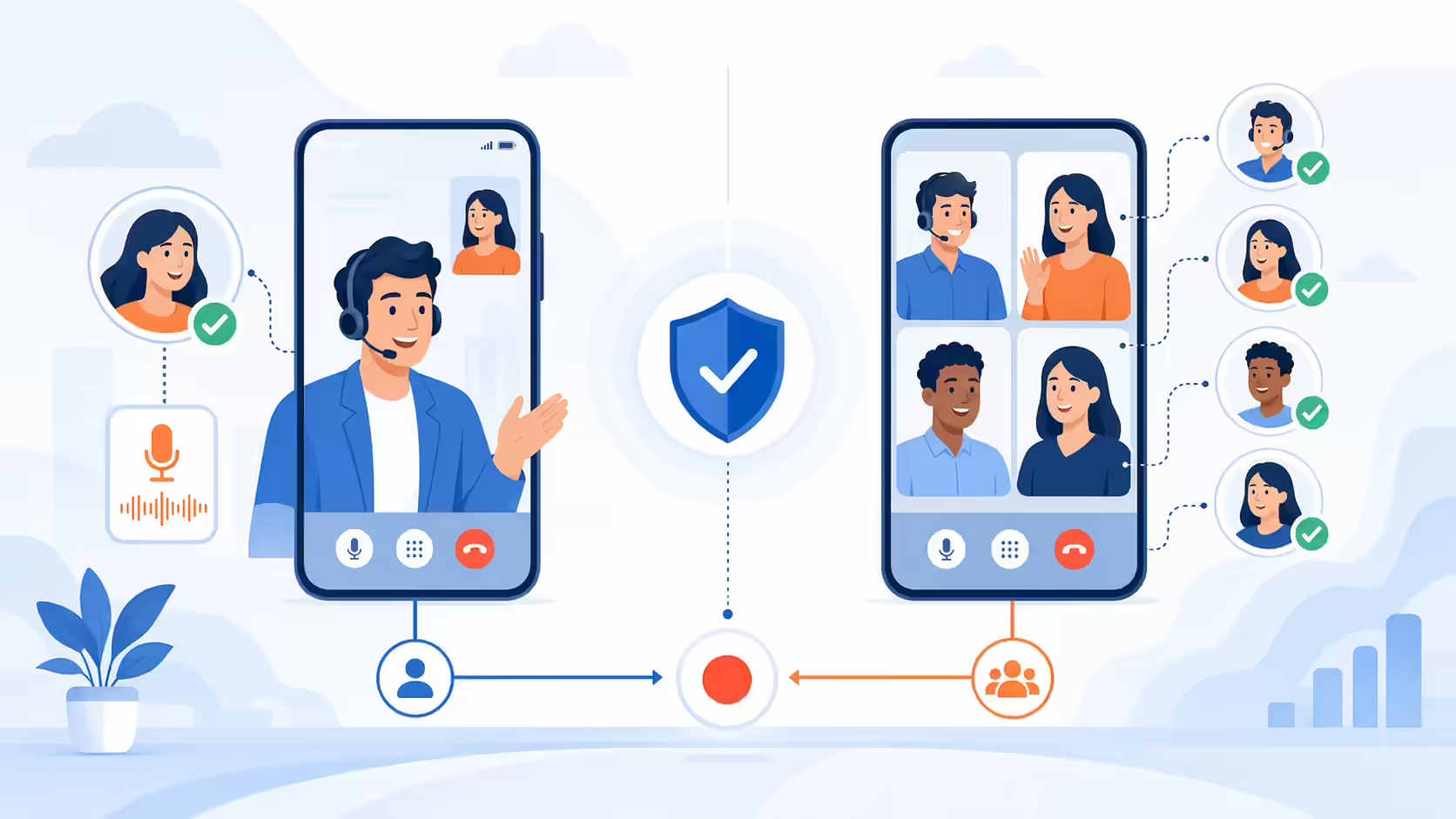
Call recording consent rules generally fall into two categories:
- One-party consent: The recording is lawful if at least one participant in the conversation consents. If you are on the call and you consent to recording it, that can satisfy a one-party rule.
- All-party consent: The recording is lawful only if every participant in the conversation consents. Under these statutes, your own consent as the person recording is not enough. The other people on the call must consent too.
Federal law sets a one-party consent floor, but states are free to require more, and a number of them do. That is why a recording practice that is fine in one state can create legal exposure in another.
The federal baseline: 18 U.S.C. § 2511
The federal Wiretap Act, codified at 18 U.S.C. § 2511, generally prohibits the intentional interception of wire, oral, or electronic communications. The statute contains an important exception: it is not unlawful for a person to intercept a communication where that person is a party to the communication, or where one of the parties has given prior consent, so long as the interception is not carried out for a criminal or tortious purpose.
In plain terms, federal law allows you to record a call you are a party to, or a call where one participant has consented. This is the one-party consent baseline. But the federal statute is a floor, not a ceiling. It does not override state laws that impose stricter consent requirements, and a multi-state sales operation cannot rely on the federal rule alone.
State examples: four stricter recording statutes
The four statutes below illustrate how state law can require more than the federal baseline. Some require all-party consent for covered communications; Massachusetts focuses on secret interception. These are examples, not a complete list. Other states also impose stricter rules, statutes are amended over time, and courts interpret them in ways a short summary cannot capture. Always check the current statute and case law, or ask counsel, before relying on any summary, including this one.
California: Penal Code § 632
California Penal Code section 632 makes it an offense to intentionally eavesdrop upon or record a confidential communication without the consent of all parties, including communications carried over telephone lines. Violations can be punished by a fine, imprisonment, or both. The statute turns in part on whether the communication is “confidential,” which the statute itself defines, so how it applies to a given business call depends on the circumstances of that call.
Florida: Fla. Stat. § 934.03
Florida Statutes section 934.03 prohibits the intentional interception of wire, oral, or electronic communications. Unlike the federal statute, Florida’s consent exception for private parties requires that all of the parties to the communication have given prior consent to the interception. Recording a covered call in Florida without the consent of everyone on the line can expose the recorder to criminal liability.
Washington: RCW 9.73.030
Washington’s statute, RCW 9.73.030, makes it unlawful to intercept or record a private communication transmitted by telephone or other device without first obtaining the consent of all participants. The statute also describes how consent can be established: it is considered obtained whenever one party has announced to all other parties, in a reasonably effective manner, that the communication is about to be recorded, and that announcement is itself recorded. This is one reason a clear, recorded disclosure at the start of the call is such a widely used practice.
Massachusetts: Mass. Gen. Laws ch. 272, § 99
Massachusetts General Laws chapter 272, section 99 prohibits the secret interception of wire and oral communications, and its definition of interception centers on recording that is done secretly and without authorization from the parties. The statute carries criminal penalties. Because the prohibition targets secret recording, open and disclosed recording practices are treated very differently under the statute than undisclosed ones.
What this means for multi-state sales teams
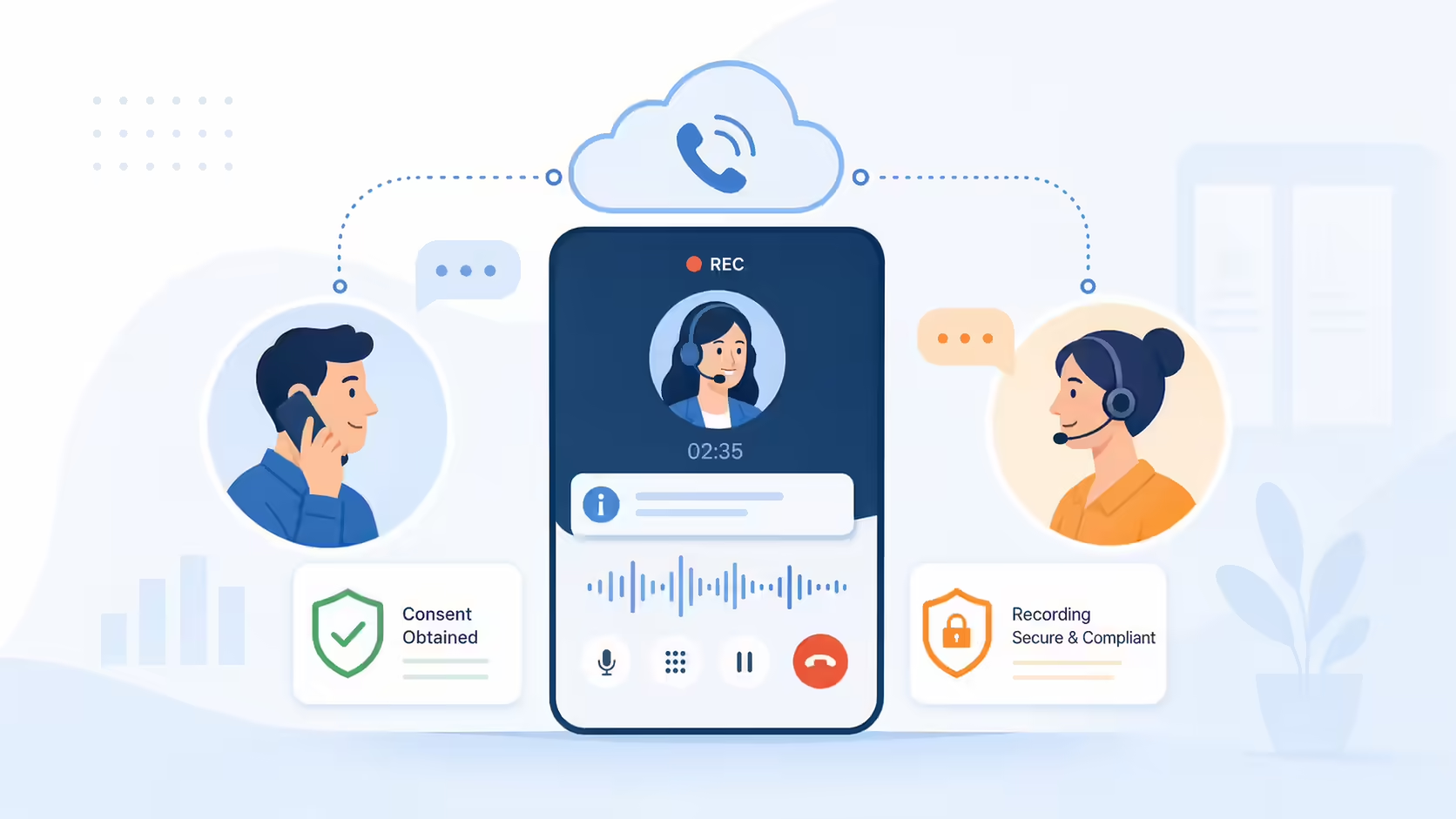
If your reps make outbound calling part of their daily workflow and your prospects sit in multiple states, you rarely know with certainty which state’s law applies to any given call. A prospect’s area code does not reliably tell you where they physically are. Phone numbers get ported, people travel, and mobile numbers move with their owners. The dependable path is not guessing jurisdictions call by call. It is adopting one policy that satisfies the strictest standard you might encounter:
- Disclose on every recorded call. Announce clearly at the start of the call that it is being recorded, before substantive conversation begins.
- Obtain and capture consent. Build the disclosure into your call flow and keep the disclosure itself in the recording. Do not assume that a person continuing to talk always establishes consent. Statutes and courts differ on what counts as consent, and some statutes set out specific requirements for how it must be obtained.
- Honor objections. If someone declines to be recorded, stop the recording or end the call. Train reps on exactly what to do in that moment, the same way you train them on making a great sales call.
- Put it in writing and have counsel review it. A written recording policy, reviewed by a qualified attorney who knows the jurisdictions you call into, is the backbone of compliance. This matters even more in regulated calling contexts such as debt collection call laws, where recording rules are only one layer of the requirements.
- Revisit the policy periodically. Statutes change and case law develops. A policy that was accurate when written can fall out of date.
The bottom line
Federal law under 18 U.S.C. § 2511 permits call recording with one party’s consent, but states can impose stricter rules. California, Florida, and Washington require all-party consent for covered communications, while Massachusetts prohibits secret interception. For a sales team calling across state lines, the practical standard is to disclose and obtain consent on every recorded call, document that practice in a written policy, and have counsel review it. That approach keeps your recording program on the strongest footing no matter where your next call connects.
Sources
- 18 U.S.C. § 2511, United States Code (uscode.house.gov)
- California Penal Code § 632 (leginfo.legislature.ca.gov)
- Florida Statutes § 934.03 (leg.state.fl.us)
- Revised Code of Washington 9.73.030 (lawfilesext.leg.wa.gov)
- Massachusetts General Laws ch. 272, § 99 (malegislature.gov)
How we researched this article
This article is based only on the primary legal sources listed above: the federal Wiretap Act as published in the United States Code, and the official statutory text published by the legislatures of California, Florida, Washington, and Massachusetts. We summarized those statutes in plain language for a sales audience and did not rely on secondary summaries or third-party compilations. The four state statutes were chosen as illustrative examples of stricter consent and anti-secret-recording requirements; they are not a complete survey of state recording laws. Laws change and their application depends on specific facts, so this article is general information, not legal advice. Consult a qualified attorney about your own recording practices.
Sources verified by Kixie Research Team on August 4, 2026.
Ready to close more deals with Kixie?
See how Kixie's AI-powered tools can transform your sales and support operations.
Start Free Trial