
A sales playbook is the written record of how your company sells: who you sell to, what you say, which objections come back, and what a good conversation looks like from open to next step. It exists so the way your company has decided to sell becomes the way everyone actually sells.
That is the theory. In practice, most playbooks are written once, read twice, and quietly ignored by month three.
This is not a discipline problem. It is a feedback problem. A playbook is a standard, and a standard nobody measures against is a suggestion.
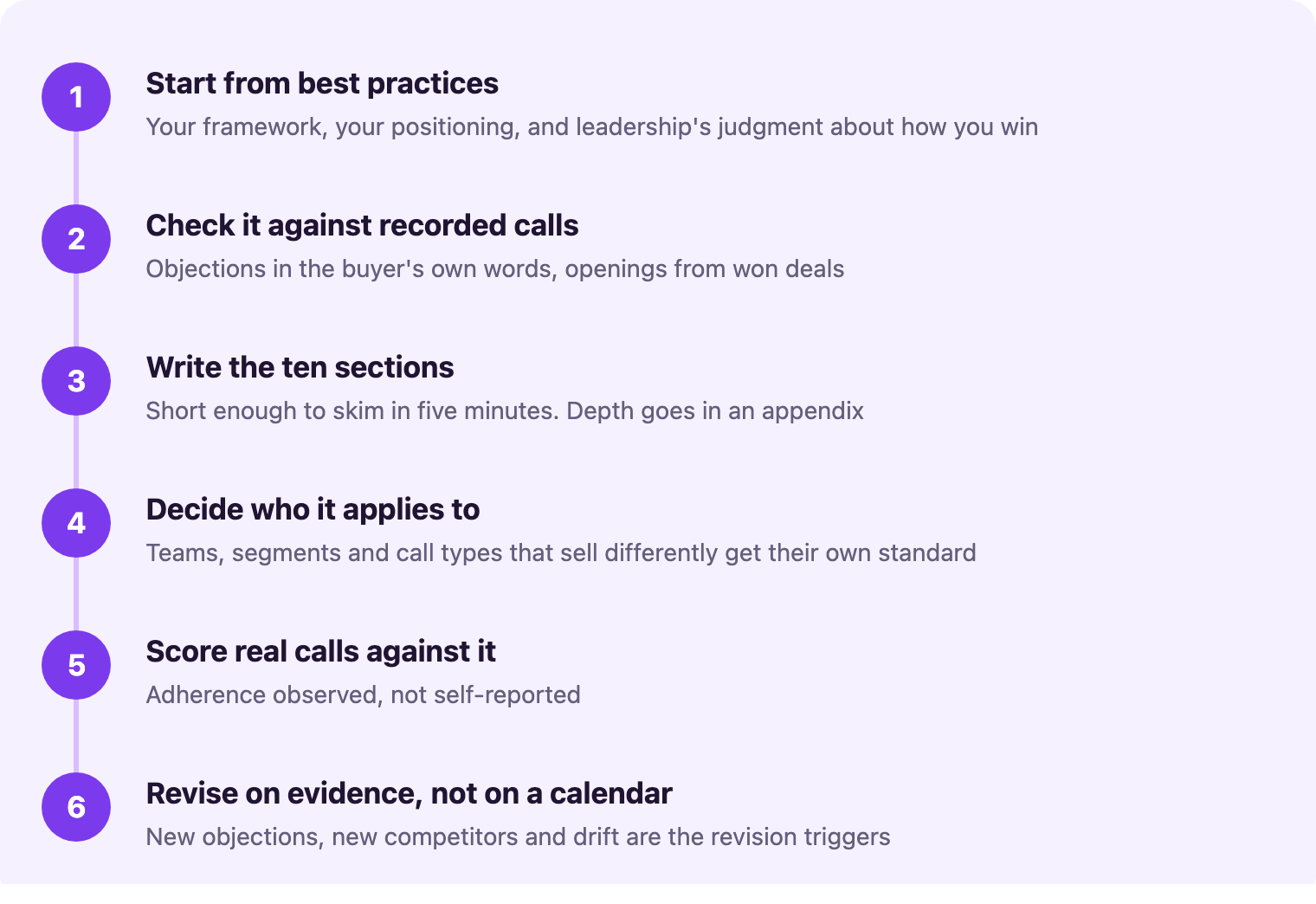
This guide walks through the whole build, in the order the work actually happens:
- Start from best practices: the framework your team sells with and leadership’s judgment about how you win.
- Check that standard against recorded calls, so it answers the objections buyers actually raise.
- Write the ten sections, short enough to skim in five minutes.
- Decide which teams and call types the standard applies to.
- Make it the standard your calls are actually measured against.
- Revise it when the conversations stop matching it, not on a calendar.
Each step has its own section below, and the FAQ at the end answers the questions that come up most.
Why You Need A Sales Playbook, And Why Most Stop Working
The case for having one is straightforward. Without a written standard, every rep improvises, new hires learn by shadowing whoever has time, coaching is one manager’s taste, and nobody can say which parts of the sales motion actually work. A playbook turns how you sell into something you can teach, measure, and improve.
Ask a VP of Sales whether they have a playbook and the answer is almost always yes. Ask whether they could tell you which reps followed it on yesterday’s calls, and the answer changes.
Four things kill a playbook, in roughly this order.
It was never checked against real conversations. The strategy was written down, which is the right starting point, and then nobody compared it to what buyers actually say on calls. The team drifts, the buyer responds to something else, and the document and the conversations diverge a little more every week.
It is too long to use. Forty pages covering every product line, every segment and every edge case. A rep in week two needs the six things that matter on the next call. They cannot find them, so they stop looking.
Nothing checks it. The manager reviews five calls a week. The team has hundreds of conversations. Coaching lands on whoever happened to get reviewed, which is rarely the person who needs it most.
It never updates. The market moves, a competitor changes its pricing, a new objection starts appearing. The playbook still describes last year’s conversation. Reps notice before the document does, and they trust their own judgment instead.
The fourth one is the quiet killer. A playbook that is visibly out of date does more damage than no playbook, because it teaches the team that written process is decoration.
What Goes In A Sales Playbook
A useful playbook answers the questions a rep actually has in the ninety seconds before a call, and the questions a manager has in the ninety seconds before a coaching conversation.
Ten sections cover it. The order matters: each one narrows the next.
1. What your company does, and which industry you are in. Two sentences, in the words a customer would use rather than the words the website uses. This is the section everything else inherits, so vagueness here is expensive. Many companies sell into more than one industry, and saying so is more useful than picking the tidiest one.
2. What you sell, and at what price. Products, services, plans and tiers, with rough price points. Teams leave the numbers out because they feel commercially sensitive internally, which is a mistake. Without price, nothing downstream can tell the difference between a rep handling a genuine budget objection well and a rep discounting on reflex.
3. Who buys from you, and who does not. Company size, the titles you sell to, and the personas who actually sign. Then the part almost everyone skips: what makes someone a bad fit. Weak version: “small to mid-sized businesses”. Usable version: “owner-operated home services companies with two to ten field technicians, bad fit below two because there is nobody to manage”.
4. Your sales process, stage by stage. Inbound follow-up, outbound calling, discovery, demo, proposal, negotiation, close, onboarding handoff. Use the stages you actually run rather than the ones your CRM shipped with. For each, say what has to happen before it can advance. A stage without an exit criterion is a folder, not a stage.
5. The kinds of calls your reps make and take. Prospecting, inbound leads, discovery and demos, follow-ups, renewals, appointment setting, customer service. Most playbooks quietly assume every call is a first conversation. A renewal call and a first outbound call have almost nothing in common, and a playbook that treats them alike is useless on both.
6. How your sales team is organized. One team, or SDRs setting appointments while AEs close. Account managers on existing customers. Territories, product lines, inside and field. Team sizes and quotas. This decides who a given standard applies to, and it is what tells you when you need more than one playbook.
7. What a great call looks like. The openings that work, the discovery questions reps should always ask, any disclosures they are required to make, and how a call should close. Be concrete. “Build rapport” is not coachable. “Establish who else has to approve this before you talk about pricing” is.
8. The objections you hear, and your best answer to each. Too expensive. Already using someone else. Not the right time. Send me some information. I need to check with someone. Happy as we are. Write down the objection in the buyer’s own words, then the answer that has actually worked. The polished version of an objection is easier to rebut and is not the one your reps get.
9. Who you compete against, and how you win. The competitors prospects genuinely bring up, not the ones in your market map. And an honest differentiator for each. A playbook that claims you win on everything teaches reps to sound like a brochure in the one moment a buyer is paying closest attention.
10. What managers should coach on. Discovery, objection handling, closing and next steps, tone and rapport, adherence, follow-up discipline. Pick the two or three that matter this quarter rather than all of them. A playbook that says everything matters produces scores that say nothing.
One more field is worth using even though it feels like an afterthought: anything else that governs how your team talks. Tone, compliance rules, required terminology, and the things reps must never say. That is usually where the genuinely company-specific judgment lives.
Where SPIN, MEDDIC And Challenger Fit
A framework is not a playbook, and the teams that get the most out of either are the ones that know the difference. SPIN, MEDDIC and Challenger each describe how selling should work in general. A playbook describes how selling works at your company: your buyers, your objections, your prices, your competitors. The framework supplies the judgment. The playbook makes that judgment concrete, in your customers’ own words.
Each of the well-known frameworks slots into specific sections of the ten above.
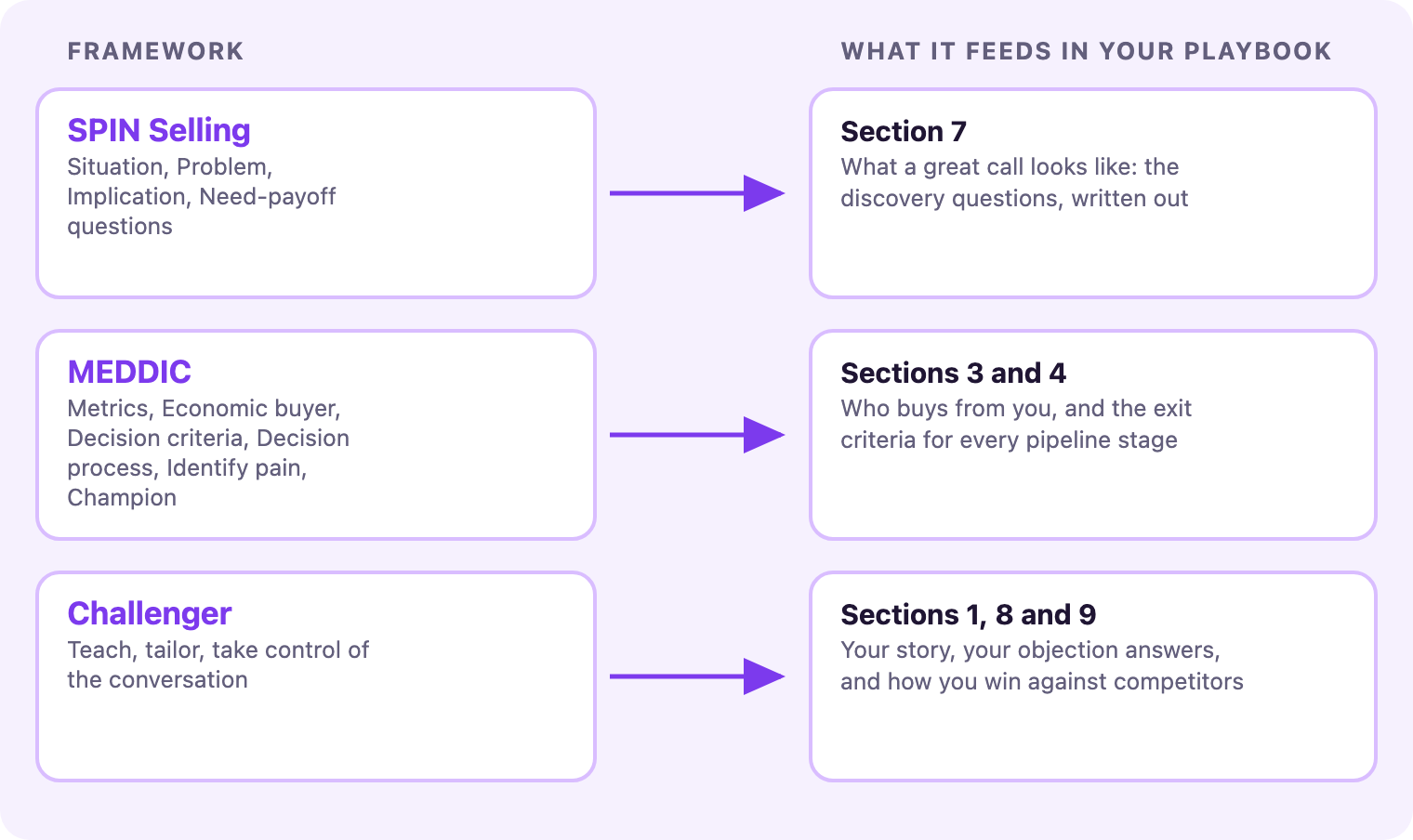
SPIN Selling feeds section 7, what a great call looks like. Neil Rackham’s research, published by McGraw-Hill in 1988, organized discovery around four kinds of questions: Situation, Problem, Implication, and Need-payoff. If your team sells with SPIN, your playbook should not say “use SPIN”. It should carry the actual Problem and Implication questions that work for your product, written out, so a new rep can use them on Tuesday and a scoring pass can check whether they were asked.
MEDDIC feeds sections 3 and 4, who buys and how deals advance. Developed at PTC in the 1990s, MEDDIC qualifies a deal on six checkpoints: Metrics, Economic buyer, Decision criteria, Decision process, Identify pain, and Champion. Those checkpoints are the natural exit criteria for your pipeline stages. A MEDDIC playbook names what counts as a metric for your product, which titles tend to be the economic buyer in your market, and what a real champion has actually done, not just said.
Challenger feeds sections 1, 8 and 9, your story, your objections and your competition. Matthew Dixon and Brent Adamson’s The Challenger Sale, built on CEB’s research into high performers, argues that the best reps teach the buyer something about their own business, tailor the message, and take control of the conversation. The teaching only works if there is something specific to teach. Your playbook is where that commercial insight lives, along with the reframes your team uses when a buyer pushes back.
The same logic applies to Sandler, GAP, value selling, or whatever your team grew up on. Pick one if it matches how your buyers buy, then spend your energy on the playbook that makes it specific. A rep cannot be coached against “be more Challenger”. They can be coached against “we teach buyers that their speed to lead is costing them deals, and you never got there on this call”.
One practical consequence: when calls are scored, a company-specific playbook outperforms a generic methodology as the grading standard, because it checks for the questions and claims that only make sense at your company. A framework-only standard grades every company’s calls the same way, which is exactly the problem playbooks exist to solve.
Grounding The Playbook In Real Conversations
The strategy itself comes from best practices: the framework your team sells with, your positioning, and leadership’s judgment about who you win against and why. Nobody should let individual reps define the sales strategy by example. But a strategy written without checking it against real conversations answers objections nobody raises, in language no buyer uses.
That is what your call recordings are for. They are not the author of the playbook. They are the reality check that keeps it honest, and the fastest way to run that check looks like this.
Test your opening against the deals you won. Not the biggest ones. The most typical ones. Pull ten or fifteen recent wins in your core segment and listen to the first three minutes. Where the winning calls diverge from the documented opening, that is a finding: either the document needs revising or the team needs coaching back to the standard. Decide which deliberately instead of letting the gap sit.
Take the objections verbatim. The objection your team gets is rarely the objection your playbook answers. Playbooks tend to carry the polished version of the objection, the one that is easy to rebut. Buyers use plainer and less convenient language. Write down what they actually say, word for word, and answer that.
Ask your two best reps different questions. Ask the top performer what they say. Then ask the rep who improved most this quarter what changed. The second answer is usually more teachable, because they can still remember not knowing. Treat both as input for leadership to weigh against the strategy, not as the strategy itself.
Write the disqualifiers before the qualifiers. Most playbooks describe the ideal customer at length and say nothing about who to walk away from. Reps waste more time on deals they should have exited than on deals they approached badly.
One constraint worth setting before you write anything: a playbook a rep cannot skim in five minutes will not be used. Put the depth in an appendix. Keep the working document short enough to read before a call.
How To Know Whether The Playbook Is Working
This is the part most guides skip, and it is the part that decides whether any of the previous work matters.
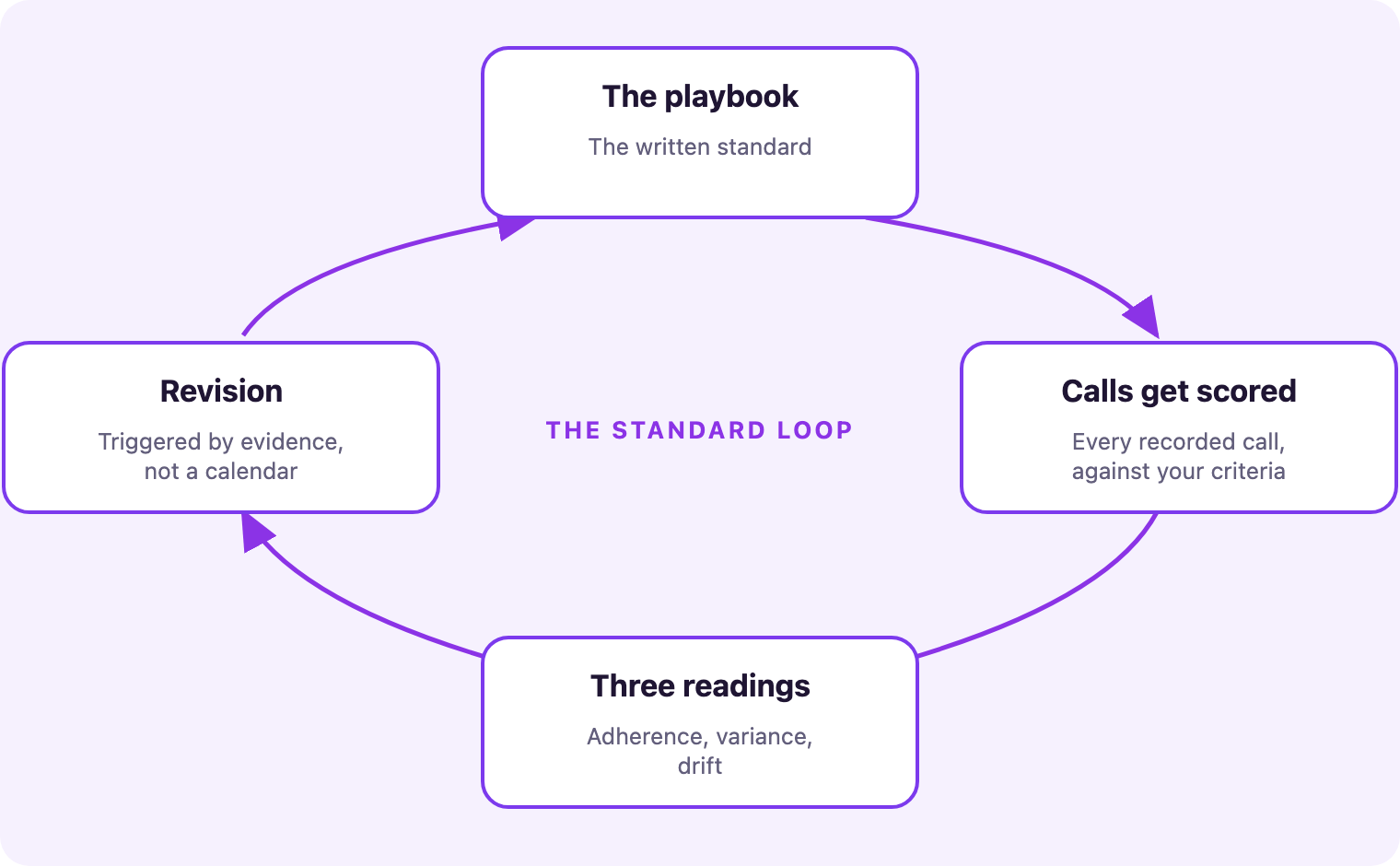
A playbook produces three measurable things. If you cannot see all three, you have a document rather than a standard.
Adherence. Are reps doing the things the playbook says, on real calls? Not self-reported. Observed.
Variance. Where does the team diverge most from the standard, and is that divergence costing deals or winning them? A rep who consistently departs from the playbook and consistently wins is telling you something worth investigating: either the playbook needs revising, or they have found an approach leadership should test before anyone else copies it. That call belongs to whoever owns the playbook, not to the scoreboard.
Drift. Which parts of the playbook stopped matching the conversations? A discovery question that stops getting asked, an objection that stops appearing, a competitor that starts appearing. That is the signal telling you to revise.
Historically, getting any of these meant a manager listening to calls by hand, which is why almost nobody had them. The constraint was never willingness. It was hours.
That constraint is what changed.
How Call Data Changes The Playbook
Recorded calls are the only honest record of how your team sells. The gap between them and the playbook has always existed. What is new is that the gap can be read without anyone listening to four hundred calls.
Three things become possible when the playbook is machine-readable rather than a document in a shared drive.
The playbook becomes the grading standard. Every recorded call gets scored against your criteria rather than against a generic sales methodology, and the priority a criterion carries in the playbook is the priority it carries in the score.
Coaching reaches the calls nobody was going to review. The five calls a manager reviews each week were never a representative sample. They were a convenience sample. Scoring every recorded call changes who gets coached, and usually the answer is not who was getting coached before. If you are building that coaching motion from scratch, coaching from call recordings is its own discipline, and worth setting up deliberately.
Revision gets a trigger. When the objections appearing on calls stop matching the objections in the playbook, that is visible rather than anecdotal. The playbook stops being updated on a calendar and starts being updated on evidence.
There is a caveat worth stating plainly, because it decides how you read the scores. A call is scored against one standard, and a change to that standard changes what the score means. Scores produced before a revision came from the version that was live then, not the one you are reading now.
Five Ways Playbooks Fail After Launch
It was rolled out in a meeting and never mentioned again. Adoption is two weeks of daily reference, not a launch.
It grades effort rather than outcome. A playbook that rewards asking twelve discovery questions produces reps who ask twelve discovery questions. Write criteria about what the buyer got, not what the rep performed.
One playbook covers segments that sell differently. If inbound and outbound conversations look nothing alike, one standard flatters one of them and punishes the other. Assign separately. The same split shows up in outbound sales automation workflows, where the cadence that works for inbound leads fails on a list-based outreach motion.
Managers quote the score instead of the call. A number in a 1:1 is an argument. The moment in the recording is a conversation. Coach from the recording.
Nobody owns it. A playbook without one named owner and a revision date is a document that will be out of date and nobody’s fault.
Making The Playbook Operational In Kixie
Everything above is true whatever software you run. This is the part that is specific to Kixie.
In the AI Dashboard at ai.kixie.com, a playbook is not a document you store. It is the context the product reads your calls against. Settings, Playbooks is where it lives, and it shapes chat analysis, call scoring, and the coaching in the report emails.
Four ways to build one:
- Answer questions. A guided wizard asks about the ten areas above, writes the full playbook from as few as three answers, and lets you edit the draft before it goes live. This is the fastest route and the one most teams should take.
- Upload documents. If you already have a playbook or a script, turn it into context rather than retyping it. This is also where an existing SPIN, MEDDIC or Challenger document belongs: upload it, and your calls get read against your version of the framework rather than a generic one.
- Start from scratch. Write each section yourself in the editor.
- Customize the default. Every business starts on Kixie Default, a general sales methodology, until you make your own.
Once a playbook is active, recorded calls are scored against it. The call page shows the score, which playbook produced it, each criterion with the evidence from the call that earned it, and the moment worth coaching with a note on what to do differently next time. Scores are frozen when a call is analyzed and stamped with the playbook that produced them, so a score always tells you which standard it came from.
Reports read your calls the same way. The Daily Call Report arrives before you ask for it, covering yesterday’s recorded calls with the objections that came up and the buyer’s own words attached to each one. It is included on every plan and on by default.
What this is not. Call Coaching scores calls and reports on them. There is no roleplay, no AI practice partner, and no live listen-and-whisper floor. It coaches from the conversations your team already had.
One honest limit. Only recorded calls are transcribed, and only transcribed calls are analyzed and scored. If your team’s recording coverage is patchy, fix that before you judge anything the scores tell you.
Frequently Asked Questions
What is a sales playbook?
A sales playbook is the written record of how a company sells: the ideal customer, the sales process stage by stage, the questions reps ask, the objections they hear, and what a good call looks like. Its job is to make the way your company has decided to sell repeatable by every rep on the team.
What should a sales playbook include?
At minimum: who you sell to and who you do not, the stages of your sales process with entry and exit criteria, discovery questions, the objections your buyers actually raise with answers to each, competitive positioning, and a definition of what a good call looks like. Depth belongs in an appendix. The working document should be readable in five minutes.
How long should a sales playbook be?
Short enough that a rep reads it before a call. Most teams are better served by a tight core document with detail held separately than by one long file that gets opened once.
How often should a sales playbook be updated?
When the conversations stop matching it, not on a fixed calendar. A competitor entering your deals, a new objection appearing, or a change in pricing are all revision triggers. Teams that update on evidence rather than on schedule end up revising more often and more usefully.
What is the difference between a sales playbook and a sales script?
A script is the words. A playbook is the judgment: who to talk to, what to establish, what to do when the conversation goes somewhere the script did not plan for. Scripts sit inside playbooks.
What is the difference between a sales playbook and a methodology like SPIN or MEDDIC?
A methodology is general and a playbook is yours. SPIN, MEDDIC and Challenger describe how selling works across companies: the kinds of questions to ask, the checkpoints that qualify a deal, the posture to take with a buyer. A playbook applies one of those to your company specifically, with your buyers’ objections in their own words, your prices, and your competitors. The methodology is a starting point for the playbook, not a substitute for it.
How do you get reps to actually use the playbook?
Make it short, ground it in conversations your team recognizes, and measure against it. A playbook that quotes the objections reps actually hear earns more trust than one written entirely from the conference room. Adherence you cannot observe is adherence you do not have.
Can AI help build a sales playbook?
It can do two useful things. It can draft the structure from a short set of questions about your business, which removes the blank-page problem. More usefully, it can read your recorded calls against the playbook once it exists, which is the part that has always been limited by a manager’s hours rather than by willingness.
How does Kixie use sales playbooks?
In the AI Dashboard, the active playbook is the standard your recorded calls are scored against, using your own criteria rather than a generic methodology. It also shapes the analysis you get when you ask questions about your calls and the coaching in the report emails. Build it with the guided wizard, upload one you already have, write it from scratch, or customize the built-in default.
A playbook is worth what it changes, and nothing changes until something checks whether reps follow it. If you want to see what your recorded calls look like scored against your own standard, see Kixie in action.
Ready to close more deals with Kixie?
See how Kixie's AI-powered tools can transform your sales and support operations.
Start Free Trial