
TL;DR: An SDR manager runs the frontline sales development team and every handoff attached to it, which in practice means coaching reps on live calls and written messages, setting the day’s priorities, holding the qualification bar, hiring and ramping new reps, and keeping marketing, account executives, and revenue operations honest about what a qualified meeting actually is. GitLab publishes its own version of this job description and lists its performance indicators as Sales Accepted Opportunity Attainment vs Goal, Net ARR Pipeline Generated, and Initial Qualification Meeting where applicable, a list with no dial count anywhere in it. Inbound teams push on response speed, routing, and lead quality. Outbound teams push on account selection, messaging, and call execution. The same title covers both, so read the responsibilities and ignore the name. A working day usually starts with dashboards and lead queues, moves through a short stand-up, call inspection, one-on-ones, a lead-flow conversation with marketing or revenue operations, and handoff feedback from AEs, and ends with a role-play block that is the first thing a busy quarter deletes. Track activity volume, connection rate, meeting conversion, held-meeting rate, meeting acceptance, pipeline contribution, goal attainment, ramp progress, and retention together, because every one of those numbers read alone will mislead you. There is no honest universal benchmark for team size, dials, conversion, quota, or ramp time, so build baselines from your own segment, channel, and written data definitions before you set a target. Coaching works when it names one behavior, shows what better sounds like, rehearses it, puts it into live work, and gets re-inspected a week later. Hiring should test listening, curiosity, preparation, resilience, writing, and whether a candidate applies feedback inside the same conversation. On pay, the Bureau of Labor Statistics reports a May 2025 median of $148,270 a year for sales managers as a whole, a category far broader than sales development, so treat that as context and not as an SDR manager figure. And if the team is dialing consumers, the Federal Trade Commission’s Telemarketing Sales Rule limits those calls to the hours between 8 a.m. and 9 p.m. in the consumer’s time zone and requires the seller or telemarketer to keep an entity-specific do-not-call list, so get your own counsel’s read on which of your calling actually falls under it before you set call windows and suppression rules.
Most sales development teams do not have an effort problem. They have a handoff problem, a definition problem, and a coaching-time problem, usually all three at once.
The dials happen. Meetings get booked. Then an account executive says half of them were not qualified, marketing says the leads were fine, and nobody can point at a shared definition to settle it. Meanwhile the manager who was supposed to spend the week listening to calls spent it in meetings about the calls.
That gap is the SDR manager job. Not the org chart version. The actual one.
This guide covers what the role owns, what a real day looks like, which numbers to inspect, how to coach without vague feedback, and how to tell whether you are ready to do it. Where a claim comes from a published source, that source is linked at the bottom.
What an SDR Manager Owns
An SDR manager is a frontline sales leader responsible for a team of sales development representatives. SDRs identify, contact, qualify, and schedule conversations with prospective customers, then hand qualified opportunities to account executives or another closing team.
So what does the manager add? Consistency. The manager is the reason two reps working the same list produce comparable work, the reason a qualified meeting means the same thing on Monday and Friday, and the reason a rep who is struggling in week three gets a diagnosis instead of a pep talk.
Titles are not standardized, and this causes real confusion in interviews. Some organizations use SDR manager and BDR manager interchangeably. Others reserve SDR for inbound qualification and BDR for outbound prospecting. GitLab, which publishes its job descriptions openly, files Manager Sales Development and Manager Business Development under one description and then splits it by specialty, including enterprise, public sector, and efficiency and strategy. That is the honest model. One role, several operating contexts.
Ask for the responsibilities in writing before you accept the title. Ask which funnel stages the team owns, who defines a qualified meeting, and who the team hands to.
What Does an SDR Manager Do
SDR manager responsibilities fall into five buckets.
- Team leadership: Set priorities, communicate expectations, recognize good work, and hold the standard when it slips.
- Coaching: Review calls and messages, name the skill gap, rehearse the fix, and check whether it stuck.
- Performance management: Inspect activity, conversion, meeting quality, pipeline contribution, and goal attainment together.
- Process management: Own lead routing, qualification criteria, handoff rules, follow-up cadence, and what has to be written in the CRM.
- Cross-functional coordination: Work with marketing, account executives, enablement, recruiting, and revenue operations.
The mix shifts with the business model. An inbound manager spends more time on response workflows, routing, and lead quality, because the leads arrive whether or not anyone is ready for them. An outbound manager spends more time on account selection, messaging, and call execution, because nothing happens until a rep picks a name and dials. Enterprise teams need account research and stakeholder mapping. High-volume teams need queue rules and fast feedback.
One thing does not shift. Somebody has to own the definition of a qualified meeting, and it should be this person, in writing, agreed with the team receiving the meetings.
SDR Manager Daily Work
There is no universal schedule, and anyone selling you one is selling you a template. The shape below is a common pattern, not a standard.
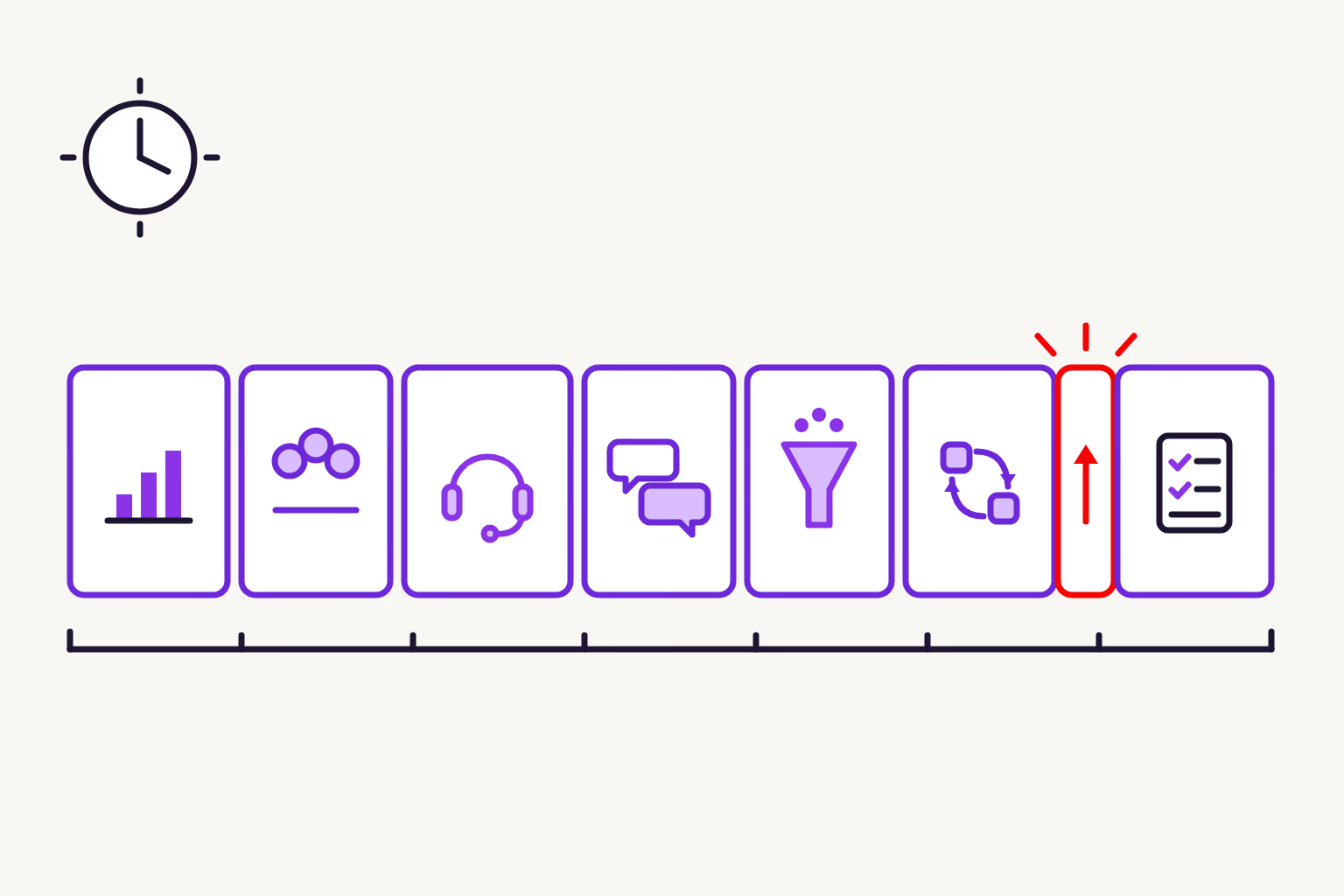
- 8:30 a.m.: Read dashboards, lead queues, attendance, and anything that moved overnight.
- 9:00 a.m.: Run a short stand-up on priorities, obstacles, campaign changes, and wins.
- 9:30 a.m.: Listen to call recordings or sit with live prospecting, and write coaching notes while the call is fresh.
- 11:00 a.m.: One-on-ones.
- 1:00 p.m.: Lead flow, targeting, data, or reporting with marketing or revenue operations.
- 2:00 p.m.: Meeting outcomes and handoff feedback with account executives.
- 3:00 p.m.: Role-play, messaging workshop, or targeted coaching.
- 4:00 p.m.: Clear workflow blockers, update forecasts, and set tomorrow’s priorities.
Now look at which block disappears first when the quarter gets tight. It is the 3 p.m. one, every time. Internal meetings and reporting expand to fill whatever is available, and coaching is the only item on that list with no external party waiting on it.
So defend it like a customer meeting. Put it on the calendar, tell the team it does not move, and measure whether it actually happened. A manager who coached twice this month has a capacity problem, not a discipline problem, and the fix is usually removing a recurring meeting rather than trying harder.
SDR Manager Responsibilities by Schedule
Daily SDR Manager Work
- Check lead coverage, prospecting activity, and meetings booked against what was expected.
- Answer rep questions and clear blockers before they cost a day.
- Inspect a small sample of calls, emails, or qualification notes.
- Watch for unusual movement in connection, conversion, or attendance data.
- Reinforce the current priority instead of introducing a new one.
Weekly SDR Manager Responsibilities
- Hold structured one-on-ones and at least one team coaching session.
- Review funnel performance by rep, channel, segment, and campaign.
- Work through meeting quality and follow-through with the receiving sales team.
- Line up upcoming campaigns with marketing and operations.
- Name strong execution publicly and address gaps privately.
Monthly and Quarterly SDR Manager Work
- Assess goal attainment and conversion trends against the prior period.
- Review hiring needs, capacity, territory coverage, and ramp progress.
- Rebuild coaching plans around the skill gaps you actually observed.
- Re-open the qualification criteria and handoff agreement with the AE team.
- Feed territory, campaign, and headcount planning.
The point of a cadence is not more meetings. It is making the recurring decisions predictable so they stop consuming unscheduled time.
SDR Manager KPIs to Track
Revenue tells you the quarter was bad. It does not tell you what to coach Monday morning. A useful SDR manager scorecard breaks the result into inputs somebody can actually change this week.

- Activity volume: Calls, emails, social touches, completed tasks. This shows effort and channel mix. It says nothing about whether the effort was aimed at the right accounts.
- Connection rate: The share of attempts that produce a live conversation or a real response. Write the definition down, because this is the metric teams most often calculate three different ways.
- Meeting conversion: Conversations or worked leads that turn into a scheduled meeting.
- Held-meeting rate: Booked meetings that actually happen. A falling number here is usually a confirmation or qualification problem, not a booking problem.
- Meeting acceptance: Whether the receiving team agrees the meeting met the written criteria. This is the number that settles the argument with the AE team.
- Pipeline contribution: Pipeline from SDR-sourced or SDR-influenced work, under your own attribution rules.
- Goal attainment: Individual and team performance against assigned goals.
- Ramp progress: How new hires move through training, certification, activity, and quality milestones.
- Retention and engagement: Turnover, attendance, and coaching participation. Team health is a leading indicator of next quarter’s output.
Read them as a chain, not a list. Activity feeds connection rate, connection rate feeds meeting conversion, meeting conversion feeds held meetings, and held meetings feed acceptance and pipeline. When pipeline drops, walk the chain backward and find the first link that moved. That link is what you coach.
GitLab’s published description is a useful sanity check on where the chain ends. It lists the role’s performance indicators as Sales Accepted Opportunity Attainment vs Goal, Net ARR Pipeline Generated, and Initial Qualification Meeting where applicable. Accepted, not booked. That is one company’s scorecard and not an industry standard, but the idea is worth borrowing: if your own scorecard stops at meetings booked, you are measuring the part of the process the SDR team controls and none of the part the business cares about.
There is no responsible universal benchmark for team size, activity, conversion, quota, or ramp time. Build baselines from your own segment, channel, written definitions, and history, then account for seasonality and any change in territory or lead quality before you call a trend a trend.
SDR Manager Coaching Responsibilities
Telling a rep to book more meetings is not coaching. It restates the problem at a higher volume.
Coaching starts with one observable behavior. A working sequence looks like this.
- Diagnose: Use call recordings, written messages, and funnel data to find where the conversation actually broke.
- Prioritize: Pick one behavior with a clear line to the problem. One.
- Demonstrate: Show what stronger execution sounds like, out loud.
- Practice: Role-play against a realistic prospect and a realistic objection.
- Apply: Have the rep use it in live work that week.
- Review: Pull the calls and check whether it happened.
Step six is the one teams skip, and skipping it turns coaching into advice. Advice does not change a call. Re-inspection does.
A few practical rules. Sample several calls before you conclude anything, because one unusually good or bad conversation will send you after the wrong behavior. Leave room in one-on-ones for the rep’s agenda, not just yours. Write down what was agreed and what you will both look at next week.
Did the rep earn permission to keep talking, find a real problem, adjust when the buyer pushed back, and leave with a defined next step? Those four questions cover most of what goes wrong on a sales development call, and all four are observable in a recording.
When performance stays below expectations, follow your company policy, document what you observed rather than how you felt about it, and bring in the right HR or leadership partners. This article is not legal or HR advice.
SDR Manager Hiring and Onboarding Work
Hiring an SDR is not a search for the most polished interviewer. The most polished interviewer is often the person who has practiced interviewing more than prospecting.
Test the things the job actually requires. Can the candidate listen without waiting to talk? Do they ask a curious question about your business unprompted? Did they prepare? Can they write four clear sentences? Most useful of all, give a piece of feedback mid-conversation and watch whether they apply it in the next five minutes. Coachability is not a claim a candidate makes. It is a behavior you can observe in the room.
A work sample or role-play adds real evidence when it is relevant to the job and run the same way for every candidate.
Onboarding should cover the customer, the market, the product, the qualification process, the messaging, the systems, the data standards, live call practice, and the handoff procedure. Stage it with certifications and observed practice rather than a week of presentations. A rep who has watched a demo is not ready. A rep who has run the motion in front of you and been corrected is closer.
Then watch ramp on two axes, output and capability. A new rep can complete a large number of activities and still be aiming at the wrong accounts. Another can hold excellent conversations and never build a repeatable work habit. Those are different problems with different fixes, and a single ramp percentage hides both.
SDR Manager Work With Other Teams
The SDR manager sits on top of the handoffs, which is exactly where revenue leaks.
- Marketing: Campaign context, lead quality, audience feedback, and what happens after a form fill.
- Account executives: Qualification, meeting preparation, acceptance, and honest outcome feedback.
- Revenue operations: Routing, reporting, attribution, territory, and data definitions.
- Enablement: Turning observed skill gaps into training that reinforces over time.
- Recruiting and HR: Hiring, onboarding, development, and formal performance processes.
Most cross-functional arguments in sales development are vocabulary arguments wearing a costume. Qualified meeting, accepted opportunity, connection, sourced pipeline. Write each of those down, get the receiving team to sign off, and put the definition next to the number on the dashboard. Then the weekly debate becomes a data question instead of an opinion contest.
SDR Manager Skills That Matter
- Communication: Say the priority plainly and adjust the feedback to the person receiving it.
- Coaching: Convert an observed call into a specific, repeatable change.
- Analytical judgment: Read a trend without mistaking activity for impact.
- Process discipline: Build consistency without adding steps nobody uses.
- Leadership: Hold a standard, and have the uncomfortable conversation early rather than at review time.
- Adaptability: Change the plan when the segment, messaging, systems, or market change.
- Operational fluency: Know how your CRM, reporting, and calling and texting workflows actually behave.
That last one is underrated. A manager who cannot tell whether a connection rate dropped because of list quality, caller reputation, or rep availability will coach the rep for a problem the rep did not cause.
Sales engagement software gives a manager more of the raw material to inspect. Per Kixie’s own product documentation, PowerDialer calls prospects at a 1:1 ratio with one agent assigned to one prospect at a time, auto-dials up to 4 numbers in parallel, and logs calls, texts, outcomes, and recordings in the CRM automatically, ConnectionBoost combines local presence, number monitoring, and progressive caller ID, and Voicemail Drop lets a rep leave a pre-recorded voicemail with the touch of a button when a prospect does not pick up. Those are publisher claims from Kixie product pages, not independent test results.
Tooling does not replace the judgment, though. A team still needs written definitions, correct permissions, clean data, and coaching tied to a behavior somebody watched. Check product capabilities, integrations, and calling requirements against your own systems and your own markets before you commit to a workflow.
On that last point, calling is a regulated activity and the manager is usually the one who finds out. The Federal Trade Commission’s Telemarketing Sales Rule limits calls to consumers to the hours between 8 a.m. and 9 p.m. in the consumer’s time zone, and requires that when a consumer asks not to be called again, the seller or telemarketer records that request on an entity-specific do-not-call list and stops calling that person. Whether and where that rule reaches your own calling is a question for your counsel, not for a blog. Get the answer, then build time-zone-aware call windows and a suppression list that every rep and every sequence respects.
How to Become an SDR Manager
Do the job before you get the title. That is the whole answer, and it is more concrete than it sounds.
Mentor a newer rep and be able to describe what changed in their calls. Run a call review for the team. Write down a process you use that works and hand it to someone else. Help onboard a new hire. Explain a funnel number to a room and be right.
Strong individual numbers help the case. They do not make it. The skill that got you to top performer is doing the thing well, and the skill the job needs is getting other people to do it well, which is not the same skill and sometimes runs against it.
A readiness checklist worth answering honestly.
- Can you coach someone to a result without requiring them to copy your style?
- Can you diagnose a funnel problem from evidence rather than instinct?
- Can you give direct feedback without damaging the relationship?
- Can you hold a team goal and an individual’s development in mind at once?
- Can you work with stakeholders whose priorities compete with yours?
- Can you make a plan and still be running it in week six?
Common next steps from the role include senior sales development leadership, sales management, enablement, revenue operations, or recruiting. GitLab’s published ladder for the role, for one concrete example, lists the next step up as Senior Manager Sales Development. Paths vary by company.
On compensation, be careful with the numbers you find. The Bureau of Labor Statistics reports a May 2025 median annual wage of $148,270 for sales managers, with a bachelor’s degree typically required and fewer than five years of related work experience, across about 650,100 jobs and a projected 4 percent growth from 2025 to 2035. That category covers all sales managers, which is much broader than sales development, so use it for orientation and get your real range from current postings in your market and level.
SDR Manager Interview Questions
These work in both directions. Hiring managers can ask them. Candidates should be ready for them.
- How do you tell whether a performance gap is skill, effort, process, or territory?
- What does a productive one-on-one actually contain?
- How do you evaluate meeting quality, and who agrees with your definition?
- Tell me about a process you changed after looking at data or listening to reps.
- How would you coach a former peer?
- What do you do when marketing and sales disagree about lead quality?
- Which metrics do you look at daily, weekly, and monthly, and why those?
- How do you protect coaching time in a quarter that is behind?
Candidates should push back with their own. How is success defined in the first 90 days? Which team owns each funnel stage? How is meeting acceptance calculated, and by whom? What coaching and operations support already exists? The answers tell you whether the job is the one in the posting.
SDR Manager FAQ
Who does an SDR manager report to
It varies. The role commonly sits under a director or vice president of sales development, sales, growth, or another revenue leader. In organizations where sales development reports into marketing rather than sales, expect the lead-quality conversation to look different, and ask about it before you take the job.
How many representatives does an SDR manager lead
There is no universal team size, and anyone quoting one is quoting their last company. Real capacity depends on rep experience, segment complexity, how much hiring you are doing, what operational support exists, and how much coaching the role is expected to deliver. Work it out from the coaching commitment. If you owe every rep a weekly one-on-one and a call review, count the hours and see what the number allows.
How much does an SDR manager earn
Compensation depends on location, company, seniority, team scope, and the base-to-variable split. For orientation only, the Bureau of Labor Statistics reports a May 2025 median annual wage of $148,270 for sales managers as a whole, a much broader occupation than sales development. Get your actual range from current, location-specific postings and pay data for your level.
What is the most important SDR manager priority
Consistent coaching against written standards. It sounds unexciting next to campaign strategy, but it is the item that changes what happens on calls tomorrow. Help reps see what good work looks like, inspect the evidence yourself, and improve one behavior at a time.
Is SDR manager a step up or a step sideways
It is a change of job, not a promotion inside the same one. The work moves from producing results to producing producers, and plenty of excellent SDRs find they prefer the first. Nothing wrong with that. Find out which one you want before the title makes the decision for you.
Sources
How this article was built: every figure, published job standard and regulatory requirement above comes from the primary documents linked below, reported with each document’s own scope and wording intact. The role definition, the specialties covered by one job description, the performance indicators and the next rung on the career ladder come from GitLab’s public job description library and describe GitLab’s own role, not an industry standard. The compensation, education, experience, employment and growth figures come from the Bureau of Labor Statistics Occupational Outlook Handbook entry for sales managers, an occupation considerably broader than sales development, and that scope is stated wherever the number appears. The calling window and entity-specific do-not-call requirement come from the Federal Trade Commission’s own business guidance on the Telemarketing Sales Rule. The three Kixie product descriptions come from Kixie’s current product pages and are labeled in the text as publisher documentation rather than independent testing. Everything else, including the daily shape, the KPI chain, the coaching sequence, the hiring signals and the readiness questions, is reasoned from those documented constraints and written so you can substitute your own segment, channel, definitions and volumes. Published wage data, job descriptions, regulatory requirements and product capabilities change, so check each against the linked source for your own market before acting on it. Nothing here is legal, HR or compensation advice; calling, recording, do-not-call and employment obligations depend on your contact types, markets and jurisdiction, and state law adds requirements federal rules do not. Kixie publishes this article and sells sales engagement software for business calling and texting.
- GitLab Handbook, Manager, Sales Development job description, for the single job description covering Manager Sales Development and Manager Business Development along with the enterprise, public sector, and efficiency and strategy specialties, for the stated performance indicators of Sales Accepted Opportunity Attainment vs Goal, Net ARR Pipeline Generated and Initial Qualification Meeting (where applicable), and for the career ladder step to Senior Manager, Sales Development, accessed September 3, 2026.
- U.S. Bureau of Labor Statistics, Occupational Outlook Handbook, Sales Managers, for the May 2025 median pay of $148,270 per year, the typical entry-level education of a bachelor’s degree, work experience in a related occupation of less than 5 years, 650,100 jobs in 2025 and a projected 4 percent employment change from 2025 to 2035, all reported for the sales managers occupation as a whole rather than for sales development management specifically, accessed September 3, 2026.
- Federal Trade Commission, Complying with the Telemarketing Sales Rule, for the restriction limiting telemarketing calls to consumers to the hours between 8 a.m. and 9 p.m. in the consumer’s time zone, and for the entity-specific do-not-call requirement that a seller or telemarketer record a consumer’s request not to be called again and refrain from calling that consumer, reported at the rule’s own scope without any conclusion about which callers or call types it reaches, accessed September 3, 2026.
- Kixie, PowerDialer, for the product descriptions that the power dialer calls prospects at a 1:1 ratio with one agent assigned to one prospect at a time, that it auto-dials up to 4 numbers in parallel, that calls, texts, outcomes and recordings are logged in the CRM automatically, and that ConnectionBoost combines local presence, number monitoring and progressive caller ID, cited as the publisher’s own product documentation rather than as independent testing, accessed September 3, 2026.
- Kixie, Voicemail Drop, for the product description that a rep can leave a pre-recorded voicemail with the touch of a button when a prospect does not pick up, instead of repeating the same message, cited as the publisher’s own product documentation rather than as independent testing, accessed September 3, 2026.
Sources verified and content reviewed by the Kixie Research Team on September 3, 2026. All source links checked on September 3, 2026.
Ready to close more deals with Kixie?
See how Kixie's AI-powered tools can transform your sales and support operations.
Start Free Trial