

 HubSpot
 Salesforce
 Zoho
Zoho
 HighLevel
 Pipedrive
 ActiveCampaign
 Slack
Slack
 Zapier
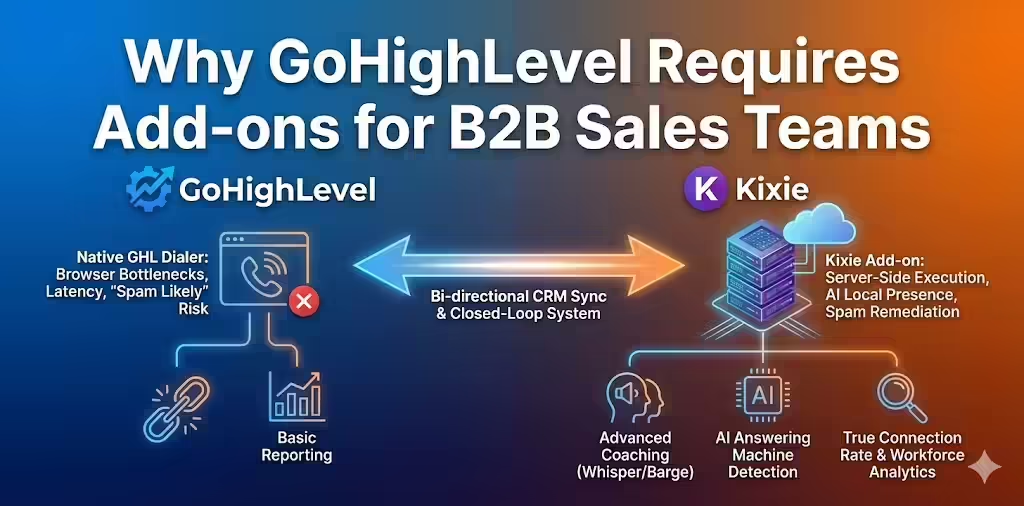
This report identifies the "Sales Operations Gap" within GoHighLevel (GHL) for B2B sales teams, arguing that while GHL excels at marketing automation, its native LeadConnector telephony requires enterprise-grade add-ons for outbound reliability. Technical limitations of GHL's native dialer include browser-based bottlenecks (memory leaks, jitter), audio latency, and shared IP reputation risks that trigger "Spam Likely" carrier filters. The proposed "Skyscraper" strategy integrates specialized sales infrastructure (specifically Kixie) to provide server-side call execution. It also offers AI-driven local presence (ConnectionBoost™) that uses a dynamic pool of 50,000 numbers to increase answer rates from 10% to 20%, along with automated spam remediation. Furthermore, add-ons resolve management deficiencies by enabling true sales team hierarchies, live coaching (listen, whisper, barge), workforce management metrics (idle time), and "True Connection Rate" reporting via Answering Machine Detection (AMD), creating a closed-loop system with bi-directional CRM synchronization.
- The Bifurcation of the Revenue Stack for B2B Sales Teams on GoHighLevel
- The Economic Case for Add-ons for B2B Sales Teams
- Why GoHighLevel Infrastructure Requires Add-ons for Reliability
- Why B2B Sales Teams Need Add-ons to Conquer Spam
- Why GoHighLevel Requires Add-ons for Team Hierarchy
- Data Darkness: Improving GoHighLevel Reporting for B2B Sales Teams
- Workflow Velocity: Optimizing UX for B2B Sales Teams on GoHighLevel
- The "Skyscraper" Strategy: Building the Hybrid Stack with GoHighLevel Add-ons
The Bifurcation of the Revenue Stack for B2B Sales Teams on GoHighLevel
In the structural history of business software, the trend has swung between two poles: the monolithic "All-in-One" suite and the specialized "Best-of-Breed" stack. As we operate within the commercial environment of 2025, this choice has crystallized for revenue leaders.
On one side stands the unified platform, characterized by a single login and bill. On the other lies the "Composable Enterprise," a methodology creating a custom ecosystem of best-in-class applications.
At the center of this debate is GoHighLevel (GHL). Since its inception, HighLevel has democratized marketing automation, allowing agencies to act as SaaS providers for local businesses. However, as organizations mature from simple lead generation into complex B2B sales teams, the "jack of all trades" reality of the all-in-one platform creates a "Sales Operations Gap".

While GoHighLevel excels at capturing interest, it was not designed to support the rigorous environment of a professional outbound sales floor. Users on platforms like Reddit frequently characterize GoHighLevel as a "marketing engine first and a sales engine second," noting it lacks the functionality required for scaling complex B2B sales teams.
For teams managing SDRs and Account Executives, the native telephony features of GoHighLevel (branded as "LeadConnector") are often insufficient. To bridge this gap without discarding GoHighLevel's powerful marketing automation, revenue strategists are choosing to integrate specialized, enterprise-grade communications add-ons like Kixie. This hybrid approach uses GoHighLevel for marketing and database management, while adding Kixie for sales execution.
The Economic Case for Add-ons for B2B Sales Teams
When B2B sales teams consider adding a specialized phone system to GoHighLevel, the decision is often met with financial resistance. "Why pay extra when GoHighLevel has a dialer?" is the common objection. The answer lies in the economics of the "Unanswered Call".
In B2B sales teams, the cost of the technology stack is negligible compared to the cost of human capital. An SDR's time is the most expensive resource on the sales floor. If a rep spends hours manually logging calls, struggling with clumsy UIs, or waiting for a browser-based dialer to load, the efficiency loss outweighs the subscription cost of a specialized power dialer add-on.
Furthermore, connection rates in 2025 hover around 10% for unoptimized dialing. Specialized add-ons like Kixie’s ConnectionBoost™ can increase that rate to 15% or 20% through AI-driven local presence. Doubling the connection rate effectively doubles the pipeline without requiring additional leads. Research suggests missed sales calls cost businesses hundreds of thousands annually, making the "free" nature of GoHighLevel's native dialer an economic illusion. It saves money on software but loses money on revenue.
Why GoHighLevel Infrastructure Requires Add-ons for Reliability
To understand the limitations of GoHighLevel’s native calling for high-volume sales, one must examine its technical foundation. GoHighLevel’s telephony system, "LeadConnector," is a wrapper built on top of Twilio. While this allows GoHighLevel to resell services easily, it introduces layers of abstraction that can impact performance.
The Browser-Based Bottleneck
The native GoHighLevel dialer operates as a widget within the web browser. This ties call quality directly to browser performance. If a sales rep has multiple tabs open, consuming memory, the browser’s available resources shrink, leading to robotic voice or dropped calls. Additionally, if the tab freezes, call logic may fail, resulting in lost call logs.

In contrast, enterprise sales add-ons like Kixie use a Server-Side Execution model. While the interface sits in the browser, the call routing is handled by dedicated servers, ensuring stability even if the CRM tab crashes.
The "Hello? Hello?" Latency
A common issue with GoHighLevel’s native VoIP is the delay between a prospect answering and the rep hearing the greeting. In sales psychology, if a prospect says "Hello?" and hears silence while the browser connects audio, they assume it is a robocall and hang up. Specialized sales add-ons optimize routing paths to minimize this latency, ensuring immediate engagement.
Shared IP Reputation
In the LeadConnector ecosystem, users may be grouped into shared pools of IP addresses. If one user spams from that pool, the "reputation score" of the entire group degrades, causing legitimate B2B sales teams to be labeled as "Spam Likely". GoHighLevel provides tools to register businesses, but the user must manage this complex process.
Why B2B Sales Teams Need Add-ons to Conquer Spam
In the current sales environment, the greatest barrier to a sale is the carrier algorithm. The implementation of STIR/SHAKEN protocols allows carriers like Verizon and AT&T to aggressively filter calls with erratic dialing patterns.
For B2B sales teams using GoHighLevel, simply buying a local number is no longer a viable strategy. If that number makes a short burst of 50-100 calls, algorithms may flag it as "Spam Risk," dropping answer rates to near zero. While GoHighLevel offers basic number purchasing, it lacks the automated intelligence to outmaneuver these filters at scale.
Advanced Local Presence
GoHighLevel has introduced features to support matching area codes, but specialized add-ons offer dynamic solutions. Kixie’s ConnectionBoost™ utilizes a pool of over 50,000 numbers. It employs "Progressive Caller ID," ensuring that if an SDR calls a prospect multiple times, a different local number is displayed each time to prevent mental blocking.

Automated Remediation
Crucially, specialized add-ons use AI to monitor number health. If a number accumulates spam flags, the system automatically retires and replaces it. This is a process that would be a full-time manual job in the native GoHighLevel environment.
Separation of Concerns
There is also a risk in coupling high-volume SMS marketing with sales calling on the same number. If a GoHighLevel marketing workflow sends 1,000 SMS blasts, carriers may flag the number. If the B2B sales teams use that same number for calls, they will be blocked. A decoupled architecture: using GoHighLevel for marketing and a dedicated Kixie add-on for voice protects the sales team from these reputational risks.
Why GoHighLevel Requires Add-ons for Team Hierarchy
A significant limitation of GoHighLevel for B2B sales teams is its database hierarchy, which was originally built for agencies rather than sales teams. The GoHighLevel structure consists of "Agencies" and "Sub-accounts" (typically physical locations).
However, B2B sales teams are organized by teams and roles (e.g., "Enterprise Team," "SDR Pod A"), not just locations. GoHighLevel does not natively possess a "Sales Team" object for routing and reporting. Managers are often forced to use manual tags to designate teams, which creates a high administrative burden.
The Team Overlay Solution
Add-ons like Kixie act as a "Team Layer" overlay, allowing for the creation of Ring Groups that exist functionally above the GoHighLevel database. This enables true team-based routing and reporting regardless of how users are tagged in the CRM.
Live Coaching Capabilities
Effective management of B2B sales teams requires live coaching features like "Listen" (manager hears call), "Whisper" (manager speaks to rep only), and "Barge" (manager joins call). GoHighLevel’s native system often lacks a seamless interface for this, sometimes requiring dial-in codes. Specialized add-ons provide a live dashboard where managers can toggle these features with a single click, which is critical for onboarding and quality assurance.
Workforce Management
Furthermore, GoHighLevel’s native reporting offers little visibility into workforce metrics like "Idle Time" (time available but not dialing) or "After Call Work". Add-ons track these states with precision, allowing managers to identify inefficiencies that native reporting cannot support.
Data Darkness: Improving GoHighLevel Reporting for B2B Sales Teams
GoHighLevel is a powerful platform, but its reporting engine is rooted in Marketing Attribution rather than sales performance. It is designed to track which ad campaign generated a lead, rather than the efficiency of the B2B sales teams.
When B2B sales teams rely solely on GoHighLevel's native reports, they encounter "Data Darkness". Critical sales metrics like connection rate and time-to-answer are often missing or difficult to filter.

The "Answered" vs. "Connected" Fallacy
A dangerous discrepancy in GoHighLevel native reporting is the definition of an "Answered" call. The system often flags a call as answered if any line picks up, including voicemail greetings or IVR systems. This inflates metrics; a manager might see a 30% answer rate when the rep actually spoke to zero people.
Specialized add-ons like Kixie utilize Answering Machine Detection (AMD) to distinguish between human voices and machines, logging a "Connection" only when a human is reached. This provides a "True Connection Rate," which is essential for accurate forecasting.
Granular Disposition Logging
In GoHighLevel, logging the outcome of a call (disposition) can be disjointed. A rep often has to hang up and click over to a notes section to manually select an outcome, leading to low compliance. Integrated add-ons force a "Disposition Modal" to appear immediately upon hang-up, preventing the rep from making the next call until the outcome is logged. These outcomes sync back to GoHighLevel to trigger automation, creating a closed-loop system.
Workflow Velocity: Optimizing UX for B2B Sales Teams on GoHighLevel
In high-volume sales, every additional click is a tax on the representative's time. The native GoHighLevel workflow can create friction. To make a call, a rep typically must open a contact record, wait for the page to load, click the phone icon, and wait for the browser dialer to initiate. This process keeps the rep trapped inside the CRM tab.
The "Heads-Up" Display
Enterprise sales add-ons utilize Chrome Extensions that act as a "Heads-Up Display," floating independently of the browser page. This allows for "Click-to-Call Everywhere". A rep can be on LinkedIn, see a phone number, and click it to dial immediately without switching back to GoHighLevel. The call is still logged automatically to the GoHighLevel contact record via backend sync.
Automating the Mundane
Leaving voicemails is a repetitive task that leads to burnout. While GoHighLevel supports automated voicemail drops in campaigns, doing so manually during a live calling session is cumbersome. With specialized add-ons, a rep can click one button to "Drop VM" and be instantly disconnected to dial the next lead while the server plays the message. This feature alone can save 30+ minutes of talk time per day per rep.
Bi-Directional Sync
The ideal workflow combines GoHighLevel’s automation with specialized execution. For example, a GoHighLevel workflow can trigger a webhook when a "Request Demo" form is filled, instantly pushing the lead to a Kixie "PowerList". The agent is connected immediately, and the outcome of the call syncs back to GoHighLevel to update the opportunity stage.
The "Skyscraper" Strategy: Building the Hybrid Stack with GoHighLevel Add-ons
For the revenue leader of B2B sales teams, attempting to force GoHighLevel to function as a standalone enterprise sales phone system is often a strategic error. It can result in frustrated reps and blind managers. However, abandoning GoHighLevel is also unnecessary, as its marketing automation is superior to many competitors in its price class.
The optimal path is the "Skyscraper" strategy: building upon a strong foundation.
* Foundation: GoHighLevel (Database, Marketing, Automation).
* Structure: Kixie (Telephony, Sales Execution, Coaching).

This results in a composable tech stack that rivals complex setups like Salesforce plus Outreach at a fraction of the cost.
Implementation Guide
To implement this hybrid stack, businesses should audit their GoHighLevel structure, ensuring one Kixie account integrates with one GoHighLevel sub-account. Teams should mandate the use of the PowerCall Chrome Extension as the primary interface. Additionally, "Brain" configuration is required: setting up webhooks to push high-value leads from GoHighLevel marketing funnels directly into Kixie PowerLists for immediate dialing. Finally, activating AI-driven spam remediation (like ConnectionBoost) and training managers on live dashboard coaching will drive performance improvements.
By adopting an add-on like Kixie, businesses move from an "All-in-One" limitation to a "Best-of-All" capability.