/* Scoped Variables and Reset */ #kixie-unique-embed { –brand-red: #F10606; –brand-blue: #0098C7; –brand-blue-light: rgba(0, 152, 199, 0.08); –brand-red-light: rgba(241, 6, 6, 0.08); –text-dark: #1F2937; –text-grey: #4B5563; –bg-white: #FFFFFF; –bg-off-white: #F9FAFB; /* Structural Reset for WP */ font-family: ‘Inter’, sans-serif; color: var(–text-dark); line-height: 1.75; background-color: var(–bg-off-white); margin: 0; padding: 0; box-sizing: border-box; width: 100%; display: block; text-align: left; } #kixie-unique-embed *, #kixie-unique-embed *::before, #kixie-unique-embed *::after { box-sizing: inherit; } /* Scoped Headings */ #kixie-unique-embed h1, #kixie-unique-embed h2, #kixie-unique-embed h3, #kixie-unique-embed h4 { font-family: ‘Montserrat’, sans-serif; margin-top: 2rem; margin-bottom: 1rem; color: var(–text-dark); line-height: 1.2; padding: 0; /* Reset WP defaults */ } #kixie-unique-embed h1 { font-size: 2.5rem; color: var(–brand-blue); } #kixie-unique-embed h2 { font-size: 1.8rem; border-left: 5px solid var(–brand-blue); padding-left: 15px; margin-top: 3rem; } #kixie-unique-embed h2.kixie-problem-header { border-left-color: var(–brand-red); color: var(–brand-red); } #kixie-unique-embed h3 { font-size: 1.35rem; /* Set explicit size for WP contexts */ } #kixie-unique-embed p { margin-bottom: 1.5rem; color: var(–text-grey); font-size: 1.05rem; } #kixie-unique-embed hr { margin: 2.5rem 0; border: 0; border-top: 1px solid #e5e7eb; } /* Lists */ #kixie-unique-embed ul { list-style: none; padding-left: 0; margin-bottom: 2rem; margin-left: 0; /* Reset WP indentation */ } #kixie-unique-embed ul li { position: relative; padding-left: 25px; margin-bottom: 10px; } #kixie-unique-embed ul li::before { content: “f058”; /* Check-circle icon */ font-family: “Font Awesome 6 Free”; font-weight: 900; color: var(–brand-blue); position: absolute; left: 0; top: 5px; /* Adjusted alignment */ line-height: 1; } /* Inner Container */ #kixie-unique-embed .kixie-inner-wrapper { max-width: 800px; margin: 0 auto; padding: 2rem; background-color: var(–bg-white); box-shadow: 0 4px 20px rgba(0,0,0,0.05); } /* Hero */ #kixie-unique-embed .kixie-hero { text-align: center; padding-bottom: 2rem; border-bottom: 1px solid #e5e7eb; margin-bottom: 2rem; } #kixie-unique-embed .kixie-hero-meta { font-size: 0.9rem; color: #6B7280; margin-bottom: 1rem; } /* TL;DR Box */ #kixie-unique-embed .kixie-tldr-box { background-color: var(–brand-blue-light); border: 2px solid var(–brand-blue); border-radius: 8px; padding: 1.5rem; margin: 2rem 0; } #kixie-unique-embed .kixie-tldr-box h3 { margin-top: 0; color: var(–brand-blue); display: flex; align-items: center; gap: 10px; } #kixie-unique-embed .kixie-tldr-box p:last-child { margin-bottom: 0; } /* Image Placeholders */ #kixie-unique-embed .kixie-img-placeholder { width: 100%; height: 300px; background: linear-gradient(135deg, #f3f4f6 0%, #e5e7eb 100%); display: flex; align-items: center; justify-content: center; color: #9CA3AF; font-weight: 600; border-radius: 8px; margin: 2rem 0; border: 2px dashed #D1D5DB; } /* Card Grid */ #kixie-unique-embed .kixie-card-grid { display: grid; grid-template-columns: 1fr; gap: 1.5rem; margin: 2rem 0; } @media (min-width: 768px) { #kixie-unique-embed .kixie-card-grid { grid-template-columns: repeat(3, 1fr); } } #kixie-unique-embed .kixie-stat-card { background: var(–bg-off-white); padding: 1.5rem; border-radius: 8px; border-top: 4px solid var(–brand-blue); text-align: center; } #kixie-unique-embed .kixie-stat-card p { font-size: 0.95rem; margin-bottom: 0; } #kixie-unique-embed .kixie-stat-number { font-size: 2rem; font-weight: 800; color: var(–brand-blue); display: block; margin-bottom: 0.5rem; line-height: 1; } /* Tables */ #kixie-unique-embed .kixie-table-wrapper { overflow-x: auto; margin: 2rem 0; border-radius: 8px; box-shadow: 0 4px 6px -1px rgba(0, 0, 0, 0.1); } #kixie-unique-embed table { width: 100%; border-collapse: collapse; font-size: 0.95rem; margin: 0; } #kixie-unique-embed th { background-color: var(–brand-blue); color: white; text-align: left; padding: 1rem; border: none; } #kixie-unique-embed td { padding: 1rem; border-bottom: 1px solid #e5e7eb; color: var(–text-dark); vertical-align: top; } #kixie-unique-embed tr:nth-child(even) { background-color: #f9fafb; } #kixie-unique-embed td:nth-child(3), #kixie-unique-embed th:nth-child(3) { background-color: var(–brand-blue-light); font-weight: 600; } #kixie-unique-embed th:nth-child(3) { background-color: #007fa8; color: white; } /* Warning Boxes */ #kixie-unique-embed .kixie-warning-box { background-color: var(–brand-red-light); border-left: 4px solid var(–brand-red); padding: 1rem; margin: 1.5rem 0; } #kixie-unique-embed .kixie-warning-title { color: var(–brand-red); font-weight: 700; display: flex; align-items: center; gap: 8px; margin-bottom: 0.5rem; font-size: 1.1rem; } #kixie-unique-embed .kixie-warning-box p:last-child { margin-bottom: 0; } /* CTA */ #kixie-unique-embed .kixie-cta-container { text-align: center; margin: 4rem 0; padding: 3rem; background: linear-gradient(135deg, var(–brand-blue) 0%, #007fa8 100%); border-radius: 12px; color: white; } #kixie-unique-embed .kixie-cta-container h2 { color: white; border: none; margin-top: 0; padding-left: 0; } #kixie-unique-embed .kixie-cta-container p { color: rgba(255,255,255,0.95); } /* Blockquotes */ #kixie-unique-embed blockquote { border-left: 4px solid var(–brand-blue); background: #f9fafb; margin: 1.5rem 0; padding: 1rem 1.5rem; font-style: italic; color: var(–text-dark); box-shadow: none; /* remove potential theme shadows */ } #kixie-unique-embed blockquote p { margin-bottom: 0; } /* Icons */ #kixie-unique-embed i.fas, #kixie-unique-embed i.fa-solid { display: inline-block; } /* Mobile Adjustments */ @media (max-width: 600px) { #kixie-unique-embed h1 { font-size: 1.8rem; } #kixie-unique-embed h2 { font-size: 1.4rem; margin-top: 2rem; } #kixie-unique-embed .kixie-inner-wrapper { padding: 1rem; } #kixie-unique-embed .kixie-cta-container { padding: 1.5rem; margin: 2rem 0; } }
TL;DR: HubSpot Calling Issues and Kixie ConnectionBoost
HubSpot native calling features frequently result in answer rates below 3% due to carrier-level “Spam Likely” filtering and shared-pool B-Level Attestation.
Kixie ConnectionBoost resolves these HubSpot calling issues by implementing A-Level Attestation, utilizing a pool of over 50,000 numbers, and employing AI-driven reputation management.
Technical analysis confirms that replacing the native single-line dialer with Kixie’s multi-line architecture allows for concurrent dialing and prevents volume-based spam flagging.
Validated performance data demonstrates significant operational gains: Fischer Homes increased outbound call volume by 300%, Canopy reduced lead response time from 35 minutes to 9 minutes, and Octopi improved lead-to-deal conversion rates by 45%.
This report outlines the STIR/SHAKEN regulatory framework, compares metered versus unlimited pricing models, and details the bi-directional integration required to restore connectivity.
Structural Failures Causing HubSpot Calling Issues

In the modern high-velocity sales environment, the Customer Relationship Management (CRM) platform acts as the central operating system for revenue generation. For thousands of organizations, HubSpot serves as this critical infrastructure by organizing marketing automation, sales pipelines, and customer service ticketing.
However, a significant gap exists in the operational capability of native CRM telephony systems.
Sales development representatives (SDRs) and account executives (AEs) utilizing HubSpot’s native calling features frequently encounter a silent crisis: the rapid degradation of call answer rates due to aggressive carrier-level filtering and “Spam Likely” labeling.
This report provides a technical analysis of the systemic causes behind these HubSpot calling issues. It identifies specific architectural limitations within standard VoIP integrations that lead to low Answer Seizure Ratios (ASR).
The problem is not merely one of unqualified leads or poor salesmanship; it is a fundamental misalignment between traditional CRM dialing infrastructure and the STIR/SHAKEN regulatory framework.
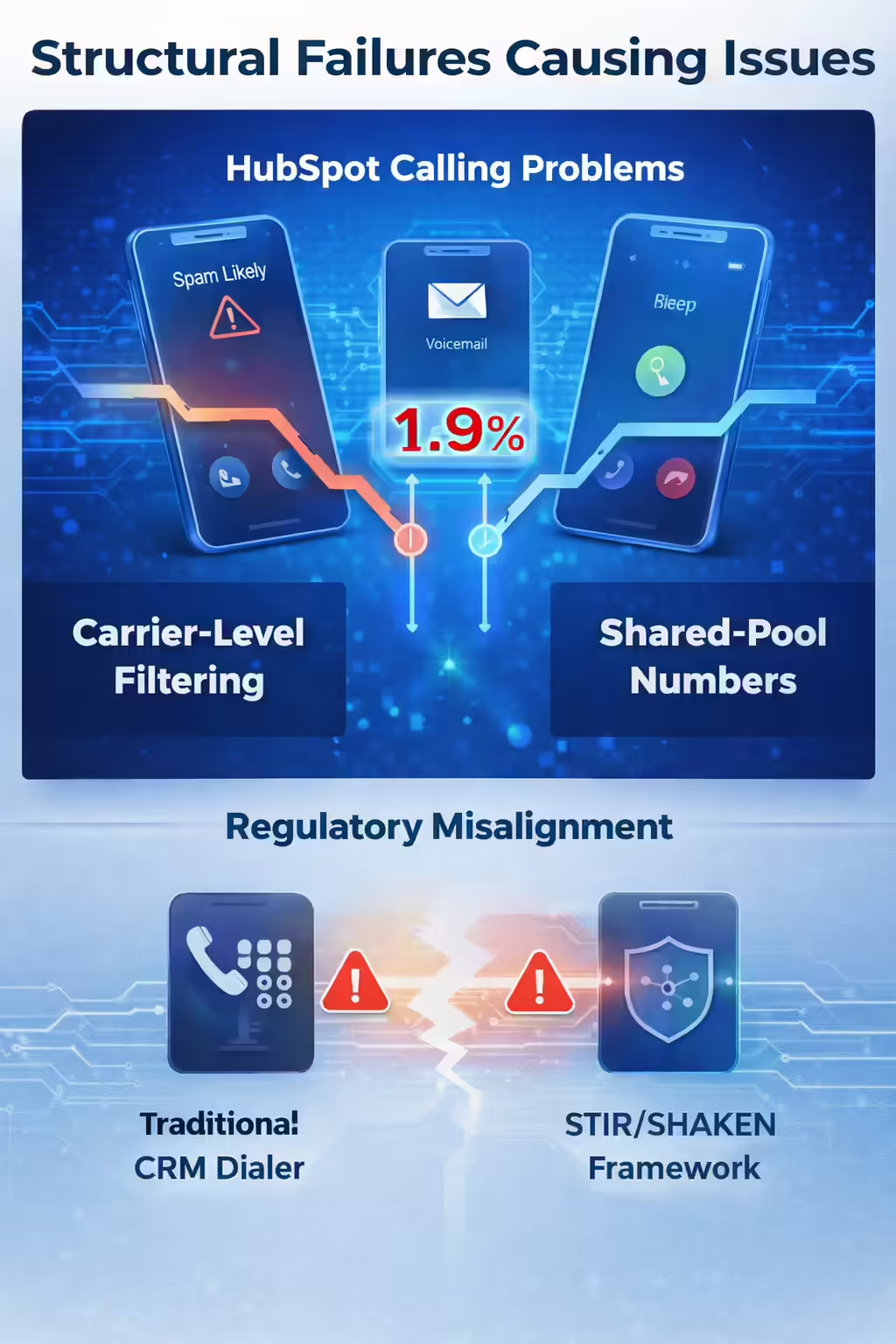
We demonstrate how Kixie ConnectionBoost technology resolves these structural deficits. By shifting from a shared-pool model to an A-Level Attestation framework supported by AI-driven reputation management, Kixie offers a definitive fix for the “Spam Likely” epidemic.
This document supports Revenue Operations (RevOps) leaders, Sales Directors, and technical decision-makers conducting due diligence on telephony upgrades. It examines the regulatory mechanisms of trust, compares the economic models of metered versus unlimited calling, and validates the performance impact through rigorous case study analysis.
Addressing HubSpot Calling Issues and Connectivity Failures
The phone call remains a fundamental unit of outbound sales. While it was once a reliable channel for initiating business conversations, it now faces interference from algorithms, regulations, and consumer distrust. Understanding the magnitude of this shift is essential for any organization attempting to scale its outbound operations and mitigate HubSpot calling issues.
The “Spam Likely” Label

The primary complaint among high-volume sales teams using HubSpot’s native calling features is the sudden drop in connection rates. Operational data suggests that answer rates, which historically hovered between 15% and 30% for warm leads, have collapsed to single digits (often below 3%) in many sectors.
The cause is rarely the quality of the prospect list or the timing of the call. Instead, the intervention of the carrier network creates these HubSpot calling issues.
Digital Interception
When a sales representative initiates a call from HubSpot, they anticipate a binary outcome: the prospect answers, or the call goes to voicemail. However, a third outcome is now dominant: the digital interception of the call by the terminating carrier (such as AT&T, Verizon, or T-Mobile).
Carriers have deployed sophisticated analytics engines to filter traffic, driven by consumer demand to eliminate robocalls and enforced by the FCC’s TRACED Act. These engines (provided by third-party analytics firms like Hiya, First Orion, and TNS) analyze call metadata in real-time.
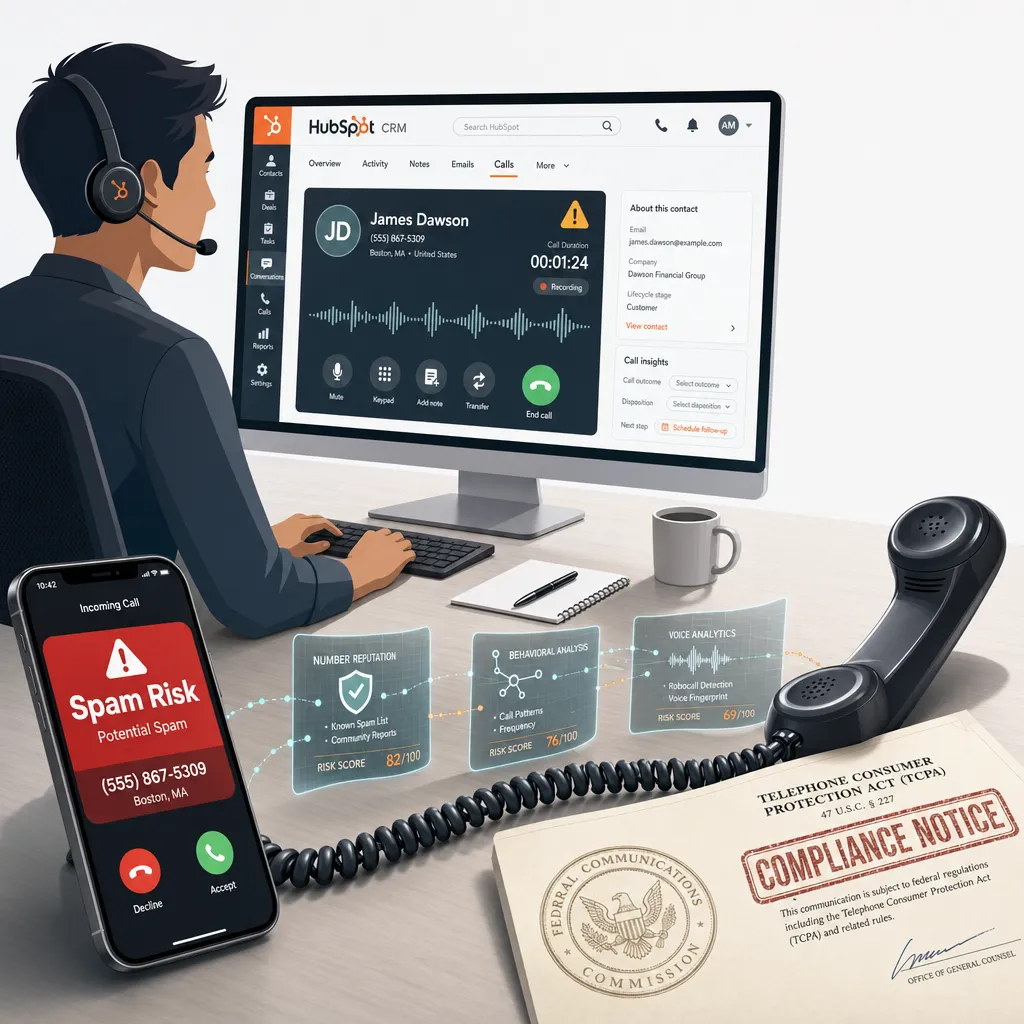
If a call exhibits specific risk characteristics, it is flagged. The manifestation of this flag varies but is universally destructive to sales productivity. On the recipient’s device, the call may be labeled as “Spam Risk,” “Scam Likely,” “Potential Spam,” or “Fraud Risk.” In severe cases (particularly on iOS devices with “Silence Unknown Callers” enabled), the call is blocked entirely and sent directly to voicemail without the phone ringing.
Invisible Blockades in HubSpot Calling Issues
One of the most problematic aspects of HubSpot calling issues is the information asymmetry. The warning label appears solely on the recipient’s screen; it remains invisible to the caller.
A sales representative working in the HubSpot interface hears a standard ringback tone. When the call eventually rolls to voicemail, the rep attributes the failure to the prospect’s unavailability. They log the outcome as “No Answer” or “Left Voicemail,” unaware that their call was digitally blocked before the prospect could answer.
This invisibility leads to a misdiagnosis of sales performance. Sales managers may observe low connection rates and conclude that the team needs better scripts, different calling hours, or higher volume. In reality, increasing volume often worsens HubSpot calling issues by triggering velocity-based spam filters. This creates a cycle of declining performance where the “No Answer” disposition becomes a catch-all for technical failure rather than prospect behavior.
Economic Impact of HubSpot Calling Issues and Churn
The economic consequences of HubSpot calling issues are significant. When calls are mislabeled as spam, the effective Cost Per Lead (CPL) rises sharply.
- Consider a business that generates leads at a cost of $50 each.
- If the telephony infrastructure fails to connect with 70% of these leads due to spam flagging, the effective cost to acquire a conversation triples.
This “silent churn” goes unnoticed in standard CRM reporting because calls are technically “completed” at the network level, even though they failed to achieve their business purpose.
The morale of the sales team also suffers. High-volume outbound sales roles require resilience. When rejection is compounded by the technical futility of blocked calls, burnout rates increase. Reps effectively spend their days talking to voicemail boxes, which erodes both their skills and their motivation.
Technical Causes Behind HubSpot Calling Issues and Blocked Calls

To solve the spam problem, one must examine the mechanisms that cause it. The “Spam Likely” label is not applied randomly. It results from specific algorithmic triggers and architectural decisions within the telephony stack that exacerbate HubSpot calling issues.
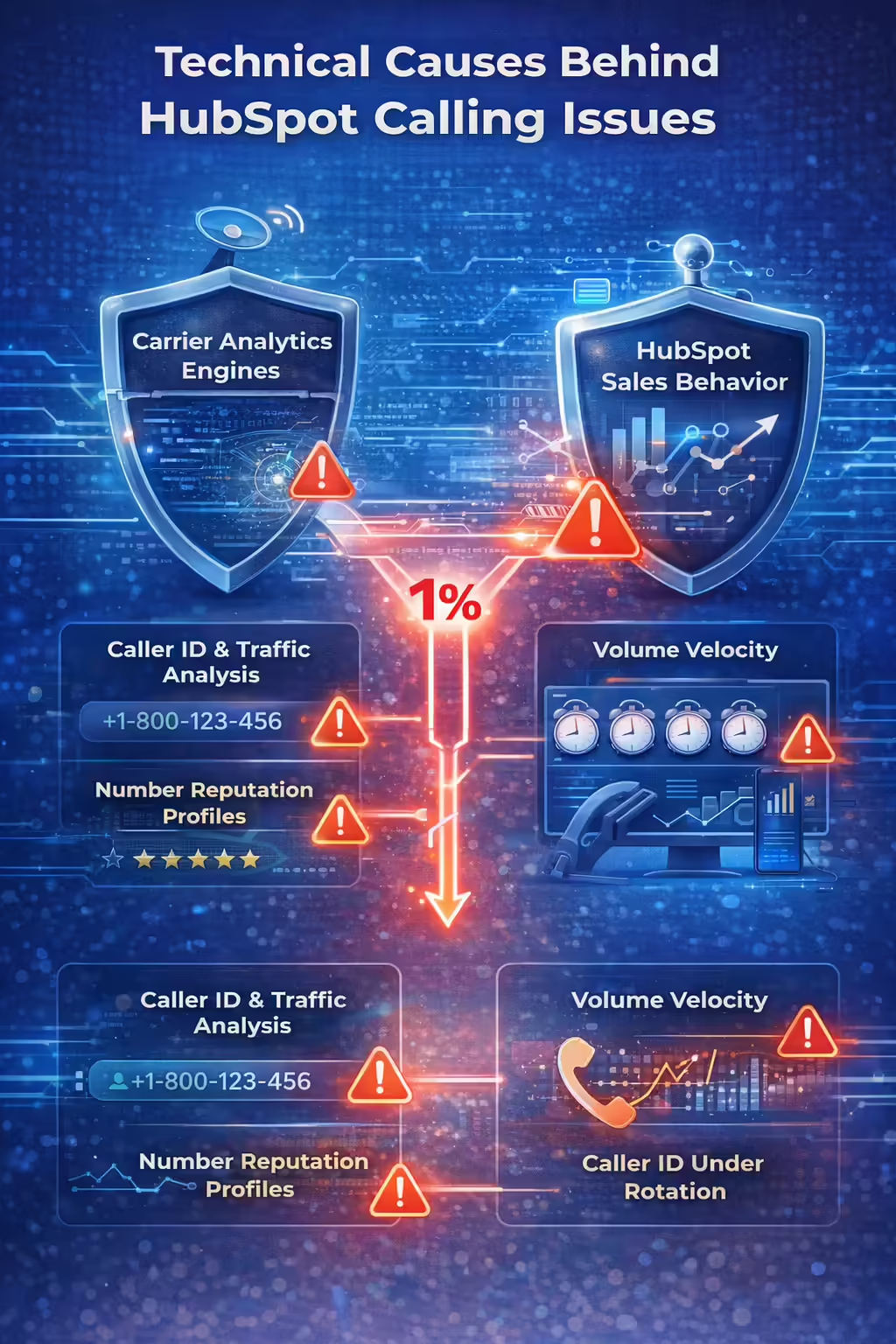
Carrier Analytics Engines
The determination of whether a call is legitimate or spam is made by analytics engines integrated into the carrier networks. These systems (chiefly Hiya for AT&T, First Orion for T-Mobile, and TNS for Verizon) ingest vast amounts of data to build reputation profiles for every phone number traversing the network.
These engines operate on a zero-trust basis for unknown numbers. They analyze traffic patterns in real-time to detect anomalies that resemble robocalling or bot behavior. Once a number is flagged by one carrier, that data is shared across the ecosystem. This leads to a cascading effect where a number becomes useless across all networks within days or hours, directly contributing to HubSpot calling issues.
Behavioral Triggers in HubSpot Calling Issues

Even with a clean phone number, legitimate sales behavior on HubSpot can trigger spam filters. The native HubSpot dialer does not include sophisticated safeguards to regulate these behaviors, leaving teams vulnerable to behavioral flagging.
- 1. Volume Velocity: Analytics engines monitor Volume Velocity (the number of calls placed by a single Caller ID or DID per hour). This is a primary metric for identifying robocallers. While specific thresholds are proprietary, industry analysis suggests that making more than 60 to 100 calls per hour from a single number is a major risk factor. Sales teams utilize power dialers to increase efficiency, enabling reps to place 50-60 calls per hour. However, without technology to rotate the outbound number (which HubSpot lacks natively), this tool becomes a liability. The sudden burst of traffic from a single DID mimics the footprint of a robocall campaign and triggers an immediate flag.
- 2. Short Duration Calls (ACD): Carriers analyze the Average Call Duration (ACD). Legitimate business conversations typically last several minutes, whereas robocalls are often rejected immediately. If a high percentage of calls last less than 15 seconds, the analytics algorithm assumes the caller is a bot. As more calls are flagged as spam, more consumers reject the call immediately. This lowers the ACD further and reinforces the spam flag, creating a downward spiral for the phone number’s reputation.
- 3. Sequential Dialing: Analytics engines also look at the disposition of calls. A streak of 30 to 50 consecutive “No Answer” or “Left Voicemail” outcomes without a live conversation acts as a strong indicator of a burnt number. In the HubSpot environment, where reps might work through a list of cold leads, this pattern is common. The native system does not alert the user that their number’s reputation is degrading.
Neighborhood Spoofing Risks
In an attempt to increase answer rates, some legacy systems use neighbor spoofing (displaying a number that looks very similar to the prospect’s own number). Carriers have become aggressive in blocking this specific pattern. If a call is detected as using neighbor spoofing without proper attestation, it is almost guaranteed to be blocked.
While legitimate local presence (matching just the area code) is a valid strategy, it requires strict adherence to number ownership rules to avoid being categorized as a spoofer and exacerbating HubSpot calling issues.
STIR/SHAKEN Regulations Impacting HubSpot Calling Issues

The environment of outbound calling changed fundamentally with the implementation of the STIR/SHAKEN framework. Mandated by the FCC to combat caller ID spoofing, this protocol serves as the foundation of modern telephony trust. Understanding it is critical for any HubSpot user attempting to troubleshoot calling issues.
Decoding STIR/SHAKEN
STIR (Secure Telephone Identity Revisited) and SHAKEN (Signature-based Handling of Asserted Information Using toKENs) are technical standards that allow the originating carrier to cryptographically sign a call. This signature verifies that the caller ID displayed is legitimate.
When a call is initiated, the originating service provider creates an encrypted digital token (known as a PASSporT) that includes information about the caller’s identity and the number they are using. This token travels with the call through the network. The terminating carrier (the prospect’s provider) decrypts this token to verify the call’s origin. This verification process is central to diagnosing HubSpot calling issues.
Attestation Hierarchy
A-Level (Full Attestation): The provider has authenticated the customer and verified they are authorized to use the specific calling number. This is required for trust. Calls are least likely to be blocked.
B-Level (Partial Attestation): The provider has authenticated the customer but cannot verify their exclusive right to use the number. This is high risk and common with shared pool setups. It often triggers analytics flags.
C-Level (Gateway Attestation): The provider can only verify the entry point of the call, not the source or the number. This results in guaranteed failure and “Scam Likely” labels.
The HubSpot Calling Issues Created by the Twilio Attestation Gap
The structural limitation of HubSpot’s native calling tool lies in its reliance on a shared infrastructure (typically powered by Twilio). In this model, the HubSpot customer is effectively renting access to a number from a massive pool managed by the underlying provider.
Because the HubSpot user does not have a direct, verified relationship with the carrier for that specific number, the system often defaults to B-Level Attestation. The carrier states they know the call is coming from their platform, but they cannot fully vouch for the specific user’s ownership of the number.
When terminating carriers see B-Level attestation, their trust score for the call drops. If this lower trust score combines with any other risk factor (such as a slight spike in call volume), the probability of a spam flag increases dramatically. This “Attestation Gap” is a primary reason why HubSpot calling issues persist.
Architectural Flaws Creating HubSpot Calling Issues

To understand why Kixie ConnectionBoost is necessary, one must objectively analyze the limitations of the native HubSpot calling architecture. While HubSpot offers a robust CRM, its telephony capabilities are designed for generalist use cases rather than high-velocity sales.
- Shared Pool Liability: HubSpot’s calling feature utilizes a shared pool model for its numbers, which introduces a significant reputation risk. Analytics engines maintain long-term memory. A number assigned to a sales team today may have been used by a political polling firm or a spammer last week. If the previous user destroyed the number’s reputation, the new team inherits that negative reputation equity. Sales representatives may be flagged as “Scam Likely” on their very first dial.
- International Limitations: The platform supports native calling and number provisioning for a limited list of approximately 30 countries. Critical markets are often excluded or have severe restrictions.
- Metered Cost Implications: Sales Hub Professional includes a cap of 2,000 calling minutes per user per month. An active SDR making 60 calls a day with an average duration of 2 minutes will consume roughly 2,400 minutes in a month, pushing the user into overage territory.
- Single-Line Bottlenecks: HubSpot does not natively support multi-line power dialing. Reps must manually click “call,” wait for the ring, and wait for voicemail. This linear process is inefficient.
Resolving HubSpot Calling Issues with Kixie ConnectionBoost

Kixie acts as an enhanced telephony layer that integrates directly into HubSpot. It replaces the native dialing infrastructure while keeping the user experience within the CRM. Its primary defense against HubSpot calling issues and spam labeling is a proprietary technology suite called ConnectionBoost.
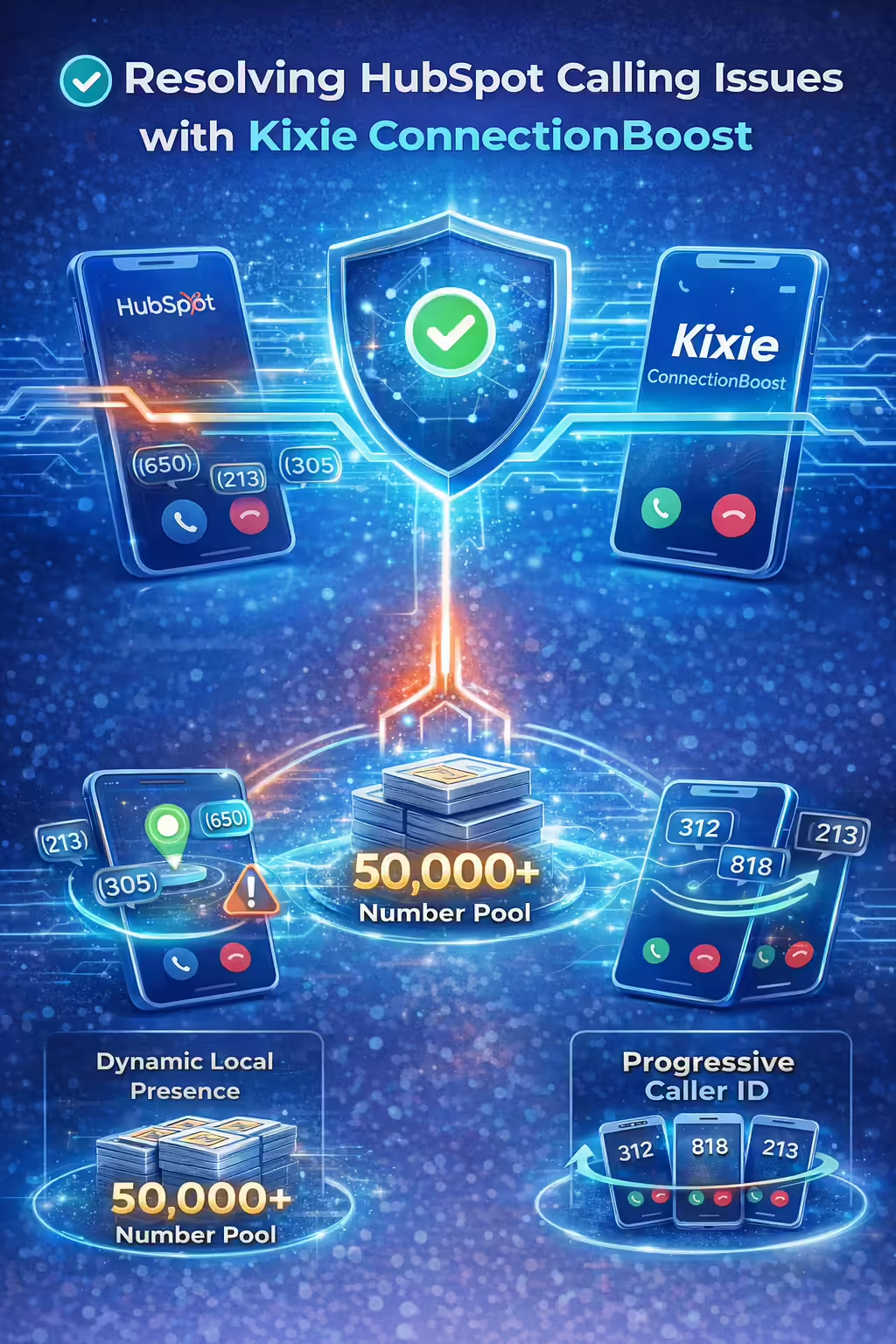
Dynamic Local Presence via Kixie ConnectionBoost
Local presence is the practice of displaying a caller ID with an area code matching the prospect’s location. While basic local presence tools exist, Kixie’s approach differs in architecture and scale to solve HubSpot calling issues.
The 50,000 Number Pool: Kixie utilizes a pool of over 50,000 real, registered numbers rather than spoofing random digits. Every number displayed is a real line capable of receiving a callback. This is critical for compliance and customer experience. If a prospect misses the call and dials back, the call is routed correctly to the agent who placed it. By spreading call volume across this vast pool, no single number accumulates the high call velocity that triggers carrier algorithms.
Progressive Caller ID: Kixie employs a feature called Progressive Caller ID. This logic ensures that if a sales rep calls the same prospect or region multiple times, the system automatically rotates to a different local number for each attempt. If a prospect ignores a call from Number A, calling back immediately from Number A again is likely to be ignored or blocked. Calling back from Number B (also local) increases the probability of an answer.
AI-Powered Reputation Management
Manual remediation of spam flags (filing dispute tickets with carriers) is a slow and reactive process. Kixie automates this entirely via AI-Powered Spam Detection & Remediation to eliminate HubSpot calling issues.
Kixie’s system continuously monitors the health of every number in its pool using live carrier feedback loops and metrics like the Answer Seizure Ratio (ASR). The AI tests numbers against carrier databases to check for flags. If a number shows signs of being flagged (such as a sudden drop in answer rate), the system immediately retires and quarantines that number. It is then automatically replaced with a fresh, clean number. This process happens in the background without user intervention.
Achieving A-Level Attestation
Unlike the bridged call model of HubSpot/Twilio which results in B-Level attestation, Kixie manages the registration of its number pool directly with analytics providers. Kixie handles the registration of numbers with the Analytics Triopoly: First Orion (T-Mobile), Hiya (AT&T), and TNS (Verizon). By registering these numbers as legitimate business lines before they are used, Kixie secures A-Level Attestation.
Kixie ConnectionBoost Integration Architecture
Implementing Kixie upgrades the entire sales workflow within HubSpot. The integration is bi-directional and designed to support high-velocity sales motions, transforming HubSpot from a passive database into an active revenue engine that is free of HubSpot calling issues.
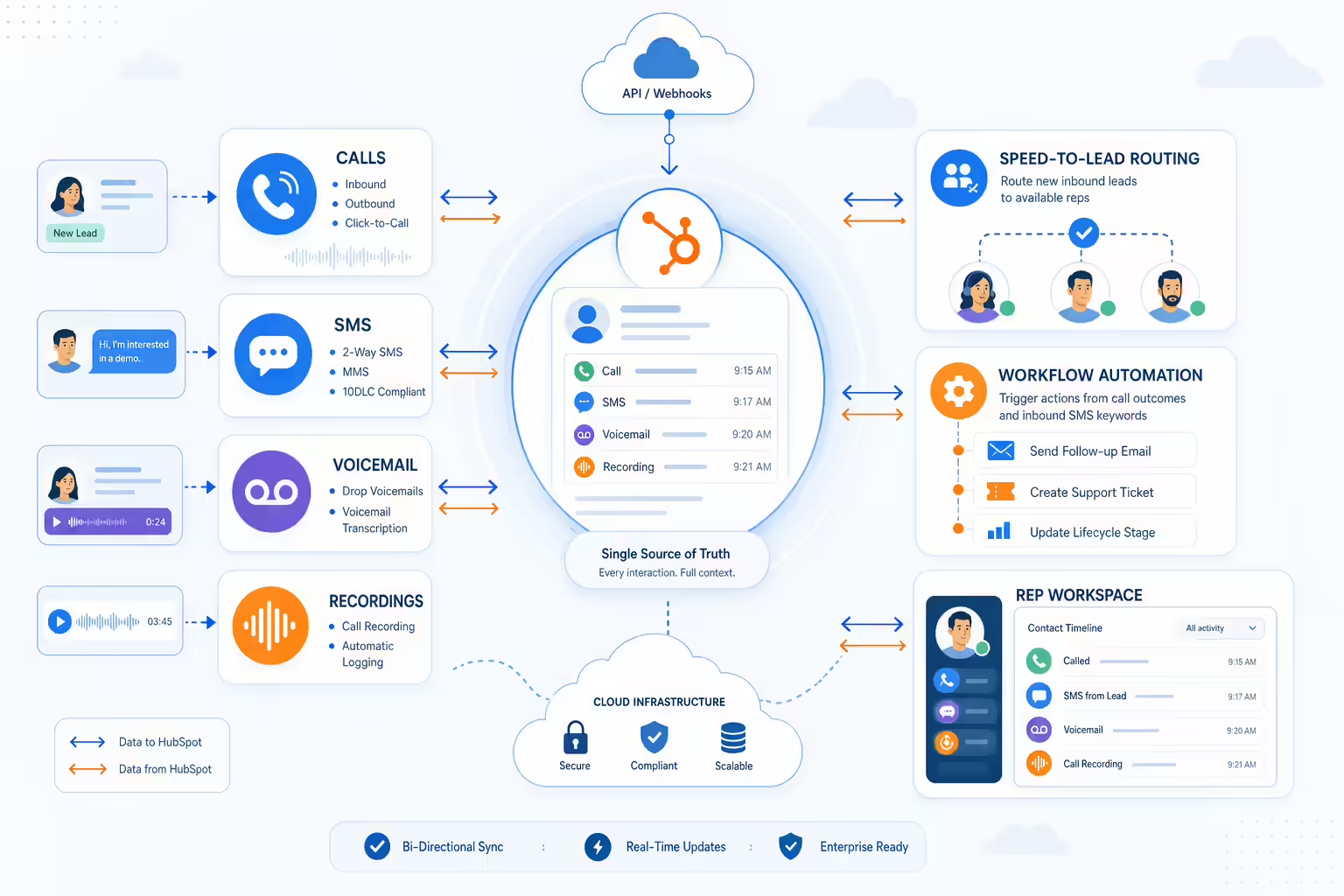
- Bi-Directional Sync: Kixie integrates at the API level with HubSpot. Every call, text message, and recording is logged automatically to the HubSpot contact record as a native Call or SMS activity.
- Speed-to-Lead: Kixie enables instant click-to-call from any HubSpot list view. Kixie’s Intelligent Lead Routing can instantly direct a new inbound lead to an available rep’s cell phone or Kixie PowerCall app.
- SMS Capabilities: Kixie integrates full 2-way SMS directly into the sales workflow. All SMS conversations are logged in the HubSpot timeline. Kixie manages 10DLC registration, ensuring compliance.
Automation Strategies
A powerful capability provided by Kixie ConnectionBoost is the ability to trigger complex HubSpot workflows based on telephony events. Since native calling often lacks granular triggers, Kixie fills this gap.
The “Left Voicemail” Workflow:
- Trigger: Enrollment trigger in HubSpot Workflow set to Activity property: Call Outcome is equal to Left Voicemail.
- Action: Send Email (Select a pre-templated “Sorry I missed you” email).
- Result: The rep clicks one button in the dialer (“Left Voicemail”). The call ends, the voicemail is dropped automatically, the call is logged in HubSpot, and the follow-up email is sent instantly.
Support Ticket Automation: For Service Hub users, missed calls represent a major pain point. Kixie allows for the automation of ticket creation based on missed call events. If a call is missed or a voicemail is received, a workflow automatically opens a Ticket in HubSpot and embeds the call recording.
SMS Triggers: Inbound SMS keywords (like “DEMO”) can trigger workflows to change lifecycle stages or notify managers.
Economic Analysis of Kixie ConnectionBoost
The decision to adopt Kixie includes economic factors. RevOps leaders must justify the investment. The ROI case is built on two pillars: the hard cost savings of unlimited calling versus metered plans, and the soft cost gains of increased productivity and conversion.

| Feature | HubSpot Native Calling (Sales Hub Pro) | Kixie ConnectionBoost | The Kixie Advantage |
|---|---|---|---|
| Spam Remediation | Passive. Manual dispute filing; no active monitoring. | Active. AI-powered detection, quarantine, and auto-replacement. | Zero administrative burden; higher connection rates. |
| Attestation Level | B-Level (Partial). Higher risk of blocking due to shared pools. | A-Level (Full). Direct carrier registration. | “Verified” caller status on supported devices. |
| Dialing Architecture | Single Line. Manual click-to-dial or sequential auto-dial. | Multi-Line Power Dialer. Dial up to 10 lines simultaneously. | 3x – 10x increase in dialing productivity. |
| Local Presence | Limited. Basic area code matching; high risk of spam flags. | Dynamic & Progressive. Rotates 50k+ numbers; progressive ID. | Prevents velocity flagging; boosts pickup by 400%. |
| International Coverage | Restricted. Limited to ~30 countries. | Global. Numbers available in 65+ countries. | Supports global sales teams without fragmented systems. |
| Cost Model | Metered. Limited minutes; overages apply. | Unlimited. Flat rate for US/Canada calling. | Predictable billing; no penalty for high activity. |
The Unlimited Advantage
HubSpot’s pricing model for calling is based on minute caps (such as 2,000 minutes for Sales Hub Pro). For a high-volume SDR, these minutes can be exhausted in less than two weeks. Kixie offers unlimited calling minutes for the US and Canada. This shifts the economic incentive from conserving minutes to maximizing conversations.
Performance Proof: Kixie ConnectionBoost Case Studies

300%
Fischer Homes
Increase in outbound call volume by replacing manual dialing with Kixie’s Multi-Line Power Dialer.
9m
Canopy
Reduced lead response time from 35 minutes to 9 minutes, driving a 3% increase in lead-to-deal conversion.
45%
Octopi
Improvement in conversion rate by utilizing Kixie’s HubSpot Workflow integration to automate follow-ups.
Global Compliance and Solutions
For organizations operating across borders, the challenges of telephony multiply. The “Spam Likely” problem is not unique to the United States. Similar regulatory frameworks are emerging globally, such as the stringent anti-spoofing measures in the UK and Australia.
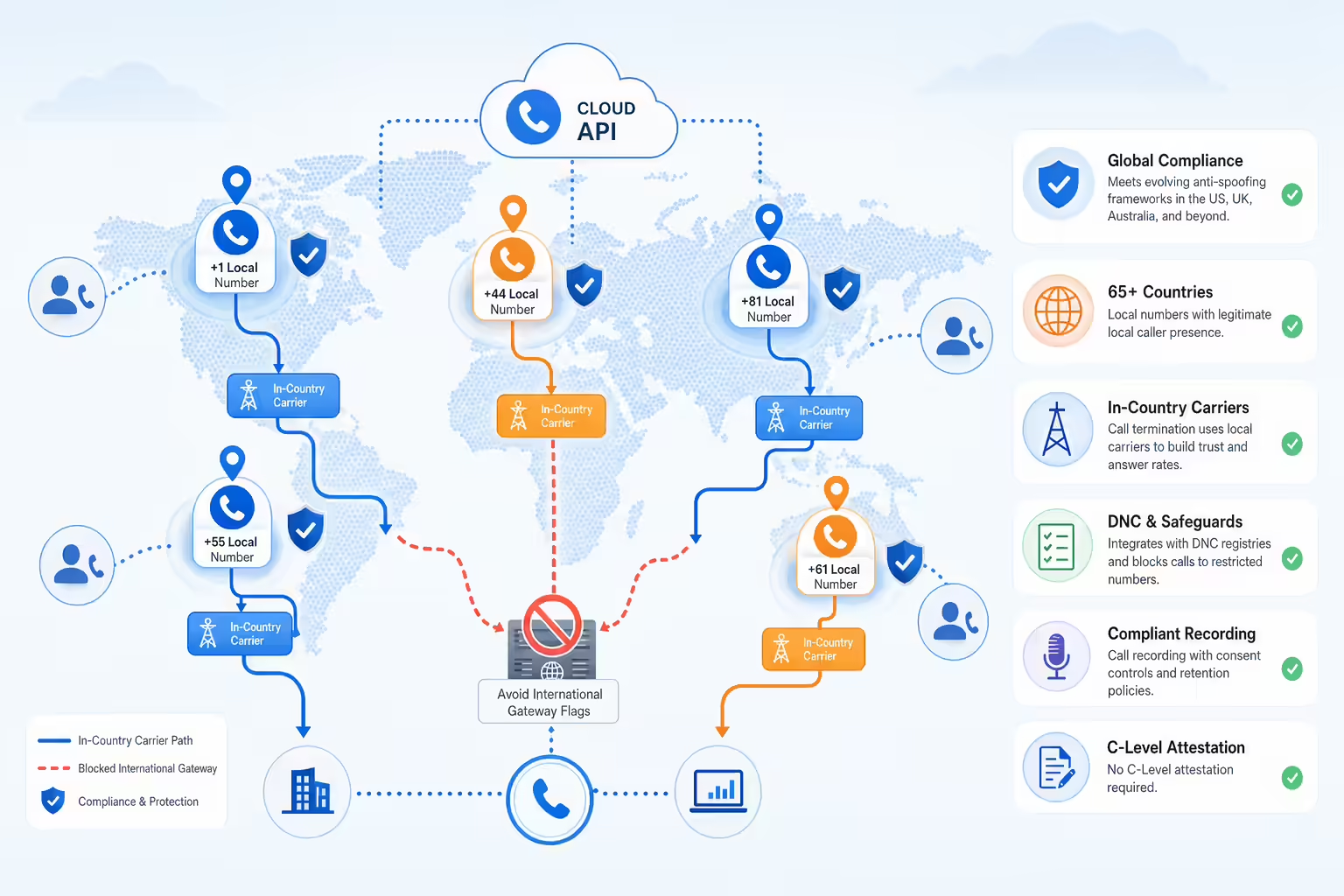
Kixie offers local numbers in over 65 countries. By utilizing in-country carriers for call termination, Kixie avoids the international gateway flags (C-Level Attestation) that often block calls from US-based VoIP providers. This ensures that a rep in New York calling a prospect in London appears as a legitimate local caller.
TCPA Compliance: Kixie integrates with DNC registries to automatically block calls to numbers on the list, protecting the organization from fines. Kixie also allows for granular control over call recording ensuring legal compliance.
Eliminating HubSpot Calling Issues
The “Spam Likely” crisis is not a temporary glitch; it is the standard of the regulated telephony sector. The time of unregulated cold calling is over, replaced by a system of algorithmic gatekeepers and strict attestation protocols.
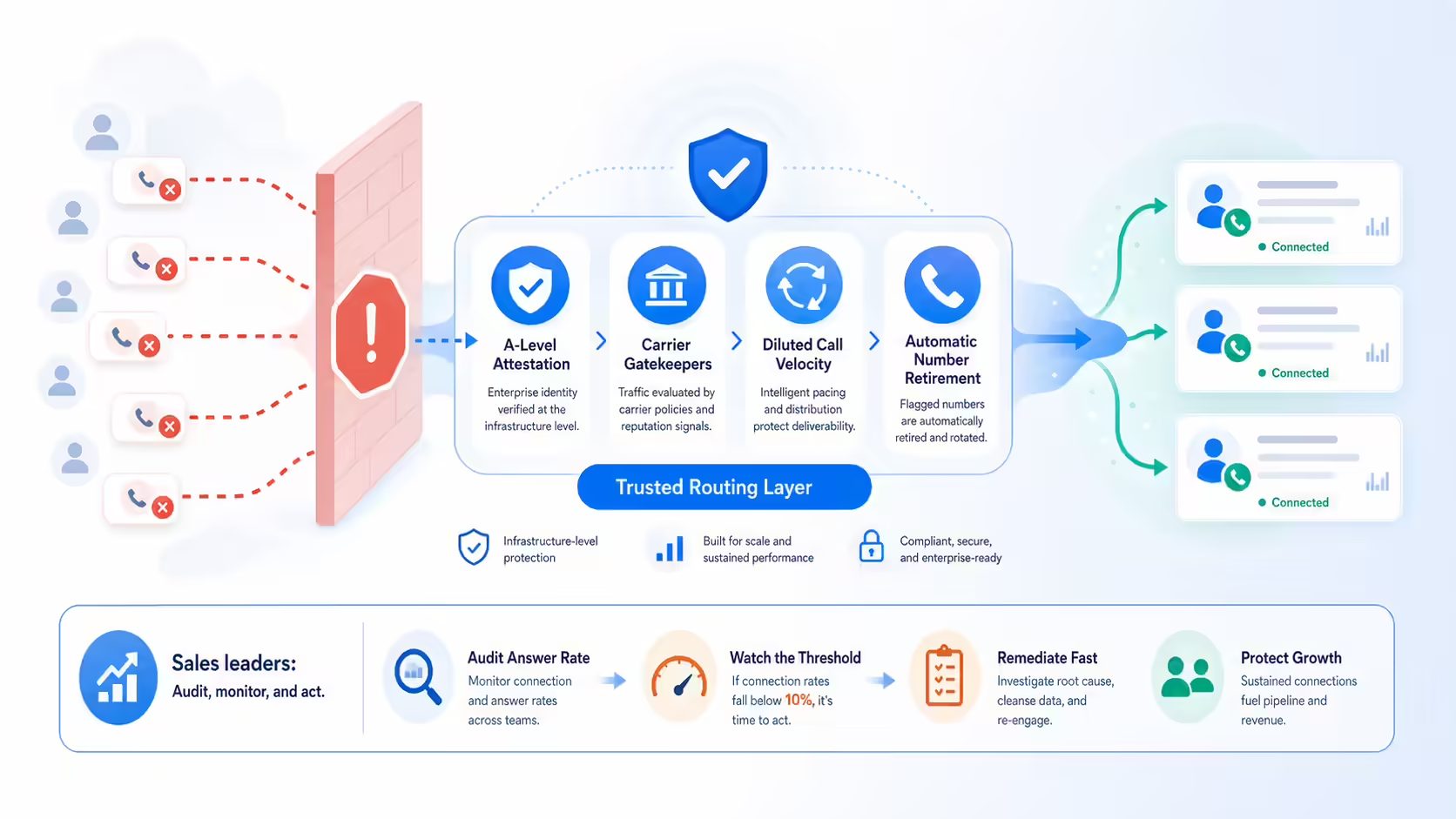
Kixie’s ConnectionBoost does not merely mask the problem; it resolves it at the infrastructure level. By securing A-Level Attestation, diluting call velocity, and automating the retirement of flagged numbers, Kixie restores the channel of communication.
Sales leaders should audit their answer rates. If connection rates have dipped below 10%, immediate remediation is required.
Ready to close more deals with Kixie?
See how Kixie's AI-powered tools can transform your sales and support operations.
Start Free Trial