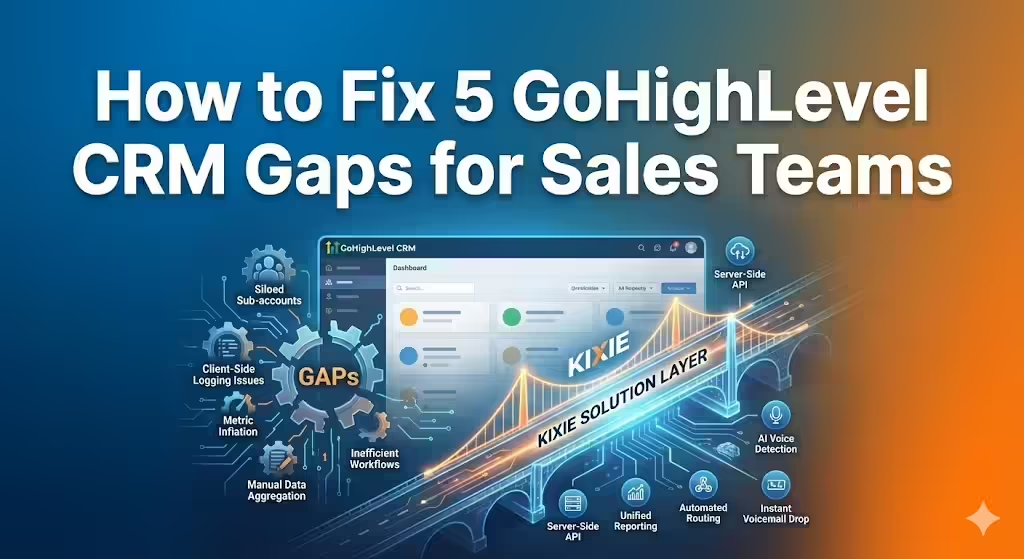
TL;DR: Technical Analysis of GoHighLevel Sales Constraints
This report analyzes the structural friction points multi-location organizations face within GoHighLevel (GHL), specifically the operational silos created by its sub-account architecture and the absence of a native “Team” database object. Critical deficiencies identified include unreliable client-side call logging caused by browser latency and timeout configurations, metric inflation where voicemails register as completed calls, and the inability to aggregate user-level performance data across disparate sub-accounts without manual CSV extraction. The proposed remediation involves integrating a specialized sales layer, such as Kixie, to implement server-side API synchronization for guaranteed data capture, AI voice detection to distinguish human interactions from machine pickups, and centralized “Ring Groups” for cross-location reporting. Furthermore, the architecture replaces manual transfer workflows with automated webhook routing triggered by specific call dispositions to preserve data context between sub-accounts, while deploying in-dialer assets for instant voicemail drops and SMS templates to optimize rep efficiency.
The Architecture Gap in GoHighLevel Sales
To understand the friction sales teams face, one must analyze how GoHighLevel is built. The platform uses a sub-account structure designed for marketing agencies. In this model, keeping data separate is a feature, not a bug, because it is intended to keep Client A’s leads rigorously separate from Client B’s. This architecture is perfect when “Client A” is a dentist and “Client B” is a chiropractor.
However, for a single entity managing 25 sales locations, such as a franchise or insurance brokerage, this separation creates silos that slow down sales velocity. A major database limitation contributing to this gap is the lack of a native “Team” object. The database hierarchy recognizes an “Agency” (admin) and a “Sub-account” (location), but it does not natively recognize “Sales Team A” within a single location, nor can it aggregate data across multi-location environments into a unified “Department” view.
Sales managers are often forced into workarounds, such as using tags or custom fields to assign team membership. This requires manual maintenance. If a rep moves from Team A to Team B, the tag must be updated on every historical contact record to preserve reporting accuracy.
Inconsistent Call Logging in GoHighLevel Sales
For any sales operation scaling on GoHighLevel, data integrity is critical. However, users frequently report that calls are not logged consistently in the native system. This issue stems from three specific technical limitations inherent to browser-based dialing:
- Browser Reliance: GoHighLevel’s native dialer operates within the browser environment. If a sales rep has too many tabs open or the internet fluctuates, the software responsible for logging the “call end” event may fail to execute. This leads to calls that occur but never appear in the contact’s timeline.
- Timeout Misalignment: If the system timeout is set higher than the carrier’s voicemail pickup time, which is typically 20 to 30 seconds, the carrier may intercept the call before the software registers it. This causes the CRM to miss the log or record incorrect metadata.
- False Positives: Native reporting often counts voicemails as “Completed” calls. This inflates metrics, making it appear that a rep who left 50 voicemails had 50 actual conversations, which destroys the accuracy of connection rate metrics.
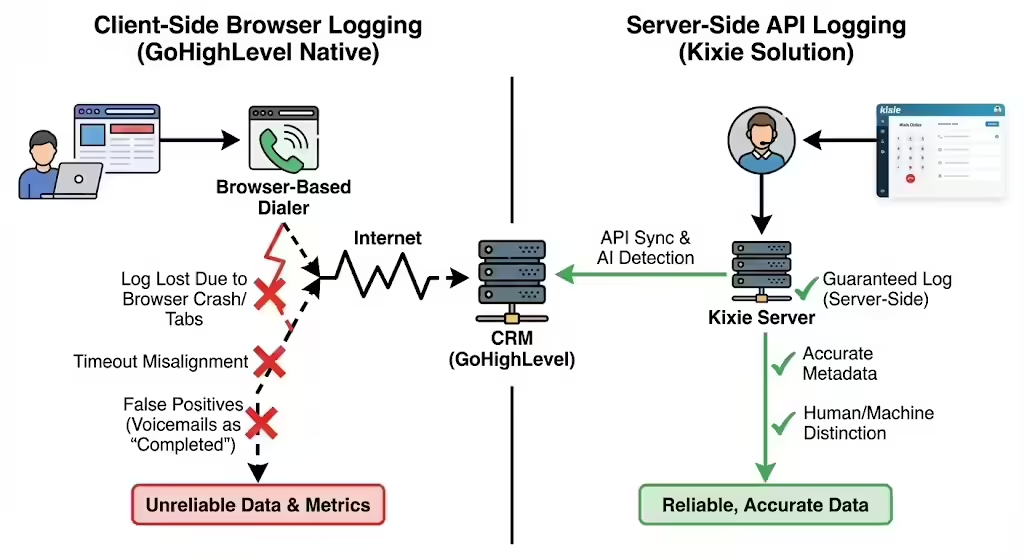
The Solution: Integrating a dedicated telephony layer like Kixie addresses these logging inconsistencies by bypassing the browser limitations.
- Server-Side Sync: Calls are processed through Kixie’s servers and pushed to GoHighLevel via API. This ensures the call data is preserved even if the user’s browser crashes.
- AI Detection: The system utilizes AI voice detection to distinguish between a human answer and a machine. This ensures that “Connection” metrics in reports reflect actual human interactions.
Fragmented Reporting Across Multi-Location Sales
For a manager overseeing 25 sales locations on GoHighLevel, the ability to view performance per user is essential. However, the platform’s native reporting is biased towards marketing attribution rather than sales activity.
- The Aggregation Problem: Because each location exists as a separate sub-account, there is no centralized “Command Center” to view user-level call data across all multi-location sub-accounts. To see top performers across the entire franchise, a manager must manually log into each sub-account, export data to CSV, and merge the files in Excel.
- Data Mismatches: Reporting discrepancies frequently arise due to timezone differences between the user’s local machine and the server settings. This can cause calls made on Friday afternoon to appear on Saturday reports, rendering daily leaderboards inaccurate.
The Solution: A centralized manager dashboard can overlay the disparate GoHighLevel sub-accounts. By using “Ring Groups” that exist within the integration layer (Kixie), a manager can filter by “Sales Team A” and instantly aggregate metrics for those agents, regardless of which sub-account they work in. This creates a unified view of performance without manual exports.
The Transfer Gap Between GoHighLevel Sub-Accounts
In multi-location setups on GoHighLevel, lead routing is dynamic. A lead might be generated in a central “Marketing” sub-account, qualified by an SDR in a “Call Center” sub-account, and then need to be transferred to a “Closer” in a specific “Location” sub-account.
- Sub-Account Silos: Because the database treats sub-accounts as distinct businesses, moving an opportunity is not a simple action. The native “Copy Contact” function is basic and often fails to carry over the full context, such as call notes or specific custom field mapping.
- Lost Attribution: Even if the contact is copied, the opportunity card and its history do not automatically transfer with owner logic intact. Often, the “Source” attribution is lost, confusing marketing ROI calculations.
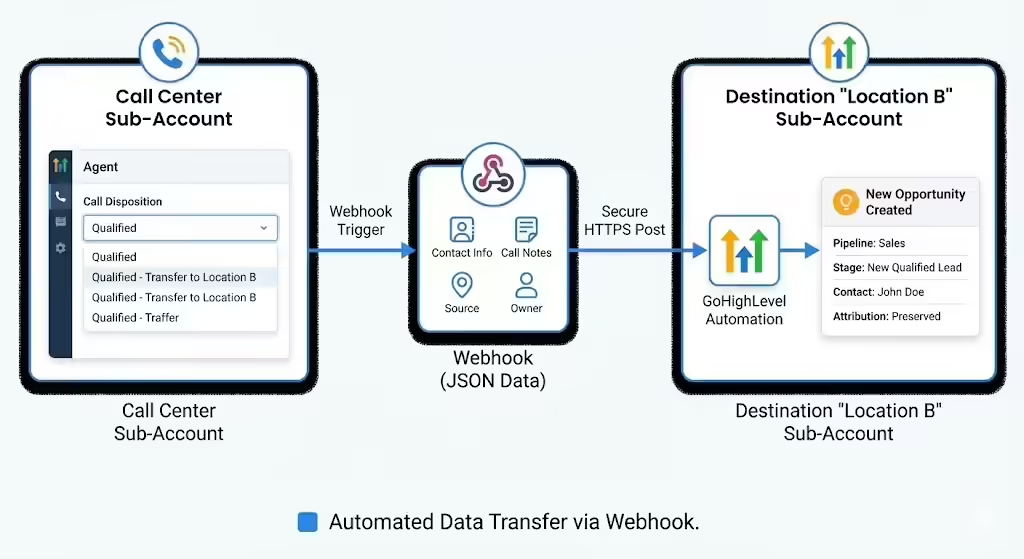
The Solution: Automated Webhook Routing bridges this gap allowing for seamless transfers between the siloed sub-accounts.
- The Trigger: The agent selects a call disposition, such as “Qualified – Transfer to Location B”.
- The Action: This disposition triggers a webhook that sends the contact data to the destination sub-account.
- The Result: An automation in the destination account receives the webhook and automatically creates a new Opportunity card in the correct pipeline stage. This turns a manual administrative task into a seamless sales action.
Inefficient Manual Outreach in Scaling Sales
Sales representatives engaged in high-volume prospecting on GoHighLevel often need to send one-off, context-specific SMS or emails. They cannot afford to build a complex automation for every single message.
- Buried Templates: While GoHighLevel provides “Snippets” (templates), accessing them requires multiple clicks through the UI. A rep has to click the SMS icon, then the template icon, and then search for the snippet.
- Context Switching: To send a templated message, the rep often has to navigate away from the dialer interface or contact view, breaking their workflow and focus.
- Manual Copy-Pasting: Reps often resort to copy-pasting scripts from external documents, which leads to formatting errors and wasted time.
The Solution: Using a browser extension like Kixie PowerCall brings the tools directly to the rep.
- Voicemail Drops: A rep can click one button to leave a pre-recorded voicemail while the system stays on the line, allowing the rep to immediately move to the next call.
- In-Dialer Library: Reps can select SMS templates from a dropdown directly inside the dialer window, without navigating away from the contact record.
Bridging the Gap for Scaling Sales on GoHighLevel
The challenges of inconsistent logging, opaque reporting, difficult transfers, and inefficient manual outreach are structural byproducts of using a marketing-first platform for high-volume sales operations. GoHighLevel’s architecture is optimized for agency marketing and sub-account isolation.
However, the solution is not to abandon GoHighLevel, which remains best-in-class for marketing automation. The cost and disruption of migrating to a different CRM ecosystem are often prohibitive. The strategic solution is to upgrade GoHighLevel by integrating a specialized “Sales Layer”. By layering enterprise-grade telephony and sales engagement tools on top of the marketing infrastructure, organizations can bridge the gap between marketing automation and sales execution.
Comparison of Capabilities
| Feature | GoHighLevel Native | Integrated Sales Layer (Kixie) |
|---|---|---|
| Call Logging | Variable; dependent on browser/timeout settings | High; server-side API synchronization |
| Reporting | Individual user focus; requires manual export | Team-based focus; aggregates across multi-location sub-accounts |
| Transfers | Manual “Copy Contact” or administrative transfer | Automated Webhooks triggered by call disposition |
| Answering Rate | Low; shared IPs lead to “Spam Likely” flags | High; uses AI-driven Local Presence |
Ready to close more deals with Kixie?
See how Kixie's AI-powered tools can transform your sales and support operations.
Start Free Trial