TL;DR
Operational inefficiency regarding “unknown callers” in Salesforce results in sales representatives spending only ~28-30% of their time on revenue-generating activities, with manual data entry consuming over one hour daily for 32% of staff. Kixie resolves this friction via an API-level integration that executes a specific logic tree upon inbound call initiation; if a Salesforce number query returns no existing Lead or Contact, the system triggers Automatic Lead Creation in milliseconds. This solution further augments new records by scraping web databases and utilizing CNAM (Caller Name Delivery) protocols to automatically populate Lead Name and Company fields, transforming anonymous numbers into contextualized prospects. Implementation of this automated workflow eliminates the standard 60-90 second manual entry time per call, prevents “shadow data” gaps, enables immediate downstream Salesforce Flows, and is projected to reclaim approximately 260 selling hours annually for a 20-person sales team.
Executive Summary of Automating Salesforce Leads from Unknown Callers
The integration of telephony infrastructure with Customer Relationship Management (CRM) systems represents a critical frontier in sales operations efficiency. For Salesforce users, a persistent operational inefficiency exists surrounding the handling of “unknown callers,” inbound inquiries from phone numbers not yet indexed within the organization’s database. This report analyzes the friction caused by manual lead creation and the strategic necessity of automating this workflow. It identifies Kixie as a technical solution that bridges this gap through two distinct mechanisms: (1) the automatic generation of Salesforce Lead objects upon call initiation, and (2) the real-time augmentation of these records via web database scraping and CNAM (Caller Name Delivery) lookups. By automating the capture and identification of unknown callers, organizations can reclaim approximately 15-20% of sales representative time currently lost to administrative data entry, while simultaneously improving data hygiene and speed-to-lead metrics.
Key Findings Regarding Unknown Callers and Salesforce Leads
- Operational Inefficiency: Research indicates that sales representatives spend only ~28-30% of their time on revenue-generating activities, with manual data entry consuming over one hour daily for 32% of reps.
- The “Unknown Caller” Deficit: Inbound calls from unrecognized numbers create a “blind” interaction, forcing reps to multitask between conversation and manual data entry, increasing cognitive load and error rates.
- Kixie’s Automation Logic: Kixie’s integration utilizes a logic tree that checks Salesforce for the incoming number; if no match is found, it triggers the immediate creation of a new Lead record.
- Data Augmentation Capability: Beyond simple record creation, Kixie uses external web databases and CNAM protocols to “scrape” and populate the Lead Name and Company fields, converting an anonymous number into a contextualized prospect automatically.
- Strategic Impact: This automation transforms the CRM from a passive system of record into an active data capture engine, ensuring 100% of inbound voice traffic is logged and actionable.
The Economic Impact of Manually Entering Unknown Callers into Salesforce
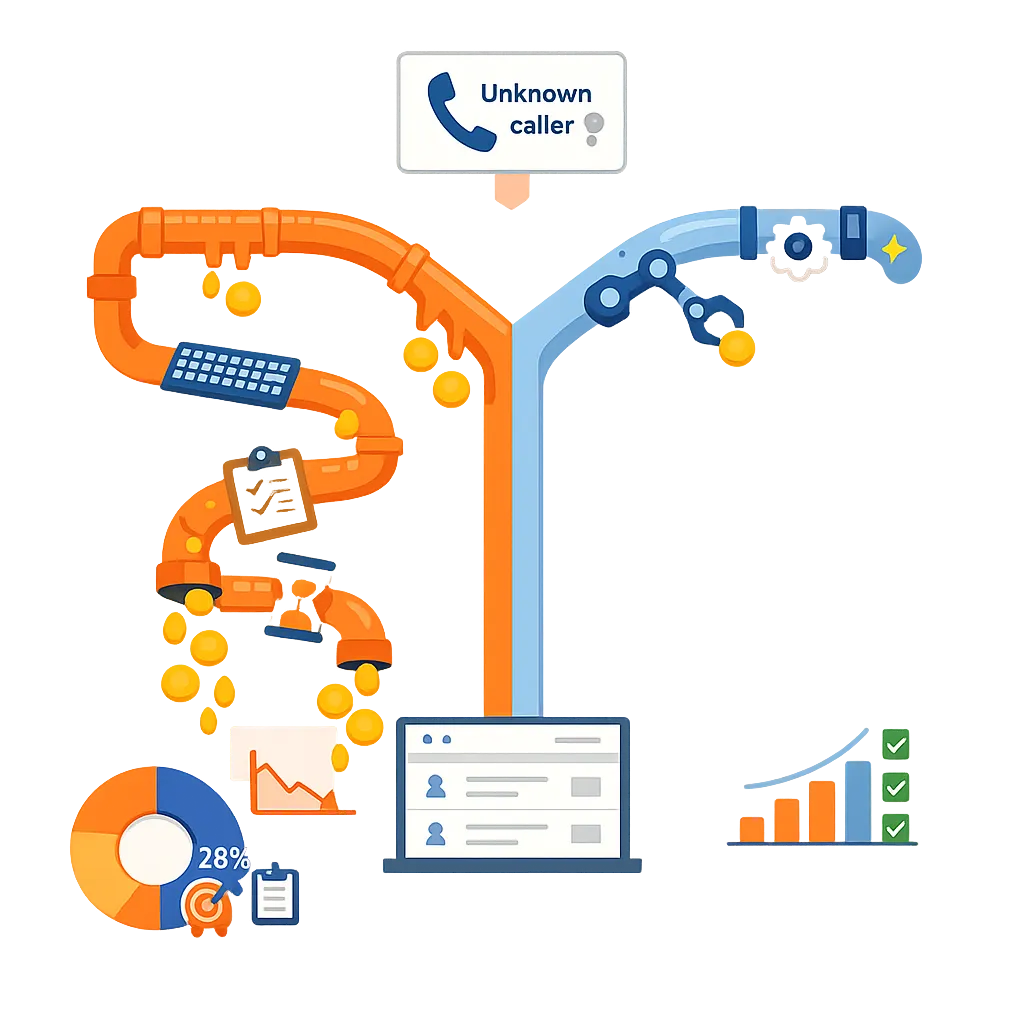
In high-velocity sales environments, the manual transcription of caller data into Salesforce is not merely an annoyance; it is a significant revenue leak. To assess the necessity of automation, organizations must quantify the cost of manual workflows.
Time Allocation Statistics for Managing Salesforce Leads
The modern sales representative is increasingly burdened by administrative overhead. According to Salesforce’s own State of Sales research, reps spend only 28% of their week actually selling. The remaining 72% is consumed by non-selling tasks, with data entry and CRM management being primary culprits.
- Daily Time Loss: A HubSpot study reveals that 32% of sales reps spend an hour or more every day manually entering data into their CRM.
- Weekly Aggregation: This equates to approximately 5 hours per week, or 12.5% of a standard 40-hour work week, dedicated solely to data input rather than prospect engagement.
- Opportunity Cost: For a sales team of 10 reps, this inefficiency totals 50 hours of lost selling time weekly, equivalent to more than one full-time employee.
The Workflow Friction of Creating Salesforce Leads from an Unknown Caller
When an unknown number calls a Salesforce user without an automated solution like Kixie, the workflow is disjointed and prone to error. The representative must:
- Answer the call with zero context (no name, no company history).
- Switch to the “Create New Lead” screen in Salesforce while simultaneously attempting to build rapport.
- Manually ask for and type the caller’s name, company, and contact details.
- Save the record.
This process typically takes 60 to 90 seconds per call. During this interval, the rep’s attention is split. Cognitive science suggests that this “context switching” degrades the quality of the conversation, as the rep is focused on spelling and field inputs rather than active listening. Furthermore, if the call is short or does not result in a qualified opportunity, reps often skip the data entry entirely, leading to “shadow data,” interactions that occur but are never recorded in the CRM, distorting marketing attribution and pipeline analytics.
Technical Architecture for Automatically Creating Salesforce Leads from Unknown Callers
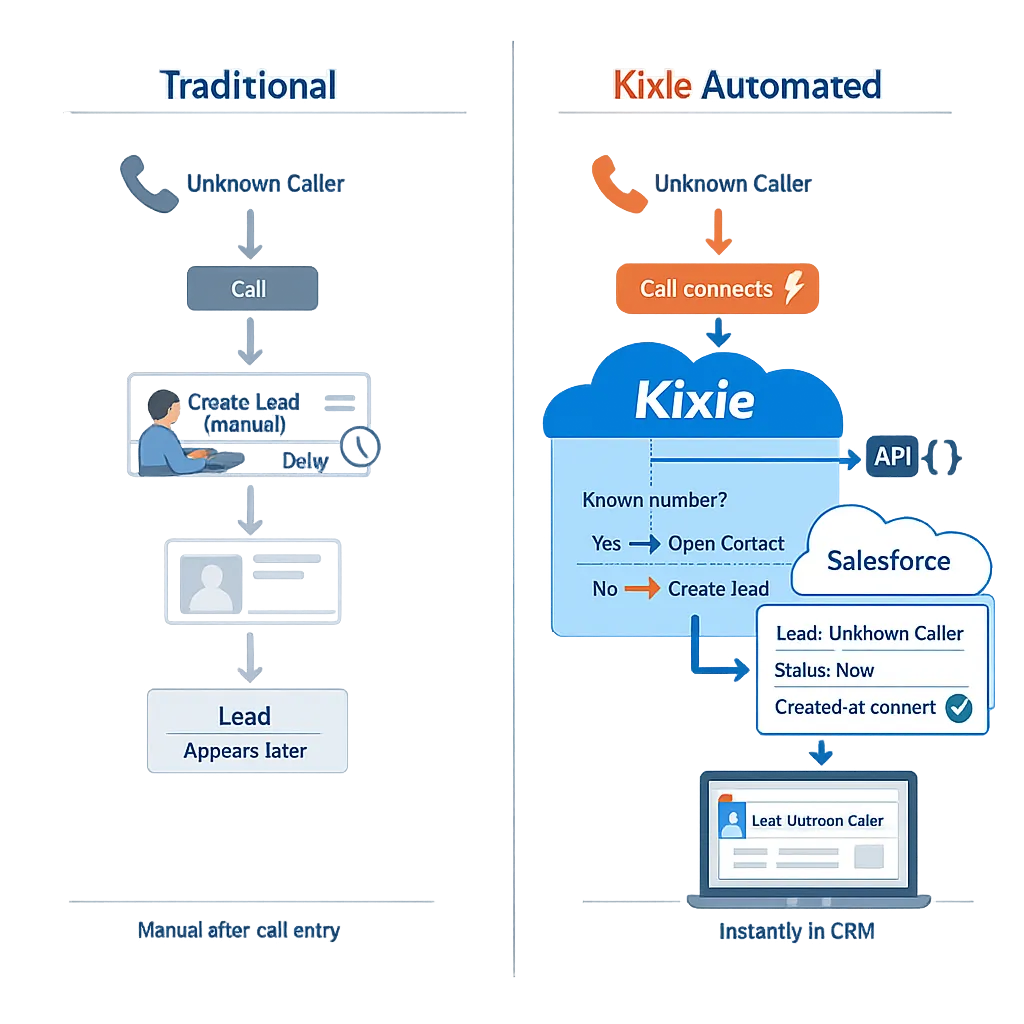
Kixie addresses the “unknown caller” problem by inverting the workflow used in traditional telephony integrations. Instead of the rep manually creating a record after or during the call, the Kixie system creates the record instantaneously as the call connects. This section details the technical logic and API interactions that enable this feature.
The Logic Tree for Handling Unknown Callers as Salesforce Leads
Kixie’s integration connects with Salesforce at the API level, interacting primarily with the Lead, Contact, and Task objects. When an inbound call is detected, the system executes a specific logic tree to determine the appropriate action:
- Number Query: The system queries the Salesforce database for the incoming phone number.
- Match Identification:
- Scenario A (Single Match): If the number matches an existing Lead or Contact, the call activity is logged to that record.
- Scenario B (Multiple Matches): If duplicates exist, the system prioritizes the Contact object over the Lead object, or defaults to the most recently referenced record.
- Scenario C (No Match – The “Unknown Caller”): If the number does not exist in Salesforce, the Automatic Lead Creation protocol is triggered.
Automatic Record Generation of Salesforce Leads for Unknown Callers
In instances where the number does not exist in Salesforce (Scenario C), Kixie automatically generates a new Lead object. This process occurs in near real-time (milliseconds), ensuring that by the time the representative answers or the “screen pop” appears, a record already exists.
- Default Behavior: This feature is typically enabled by default but can be toggled at the account level for organizations with strict data governance policies.
- Ownership Assignment: The agent who answers the call is automatically assigned as the Lead Owner, ensuring clear accountability and immediate routing of subsequent tasks.
Data Augmentation via Scraping Web Databases and CNAM for Salesforce Leads
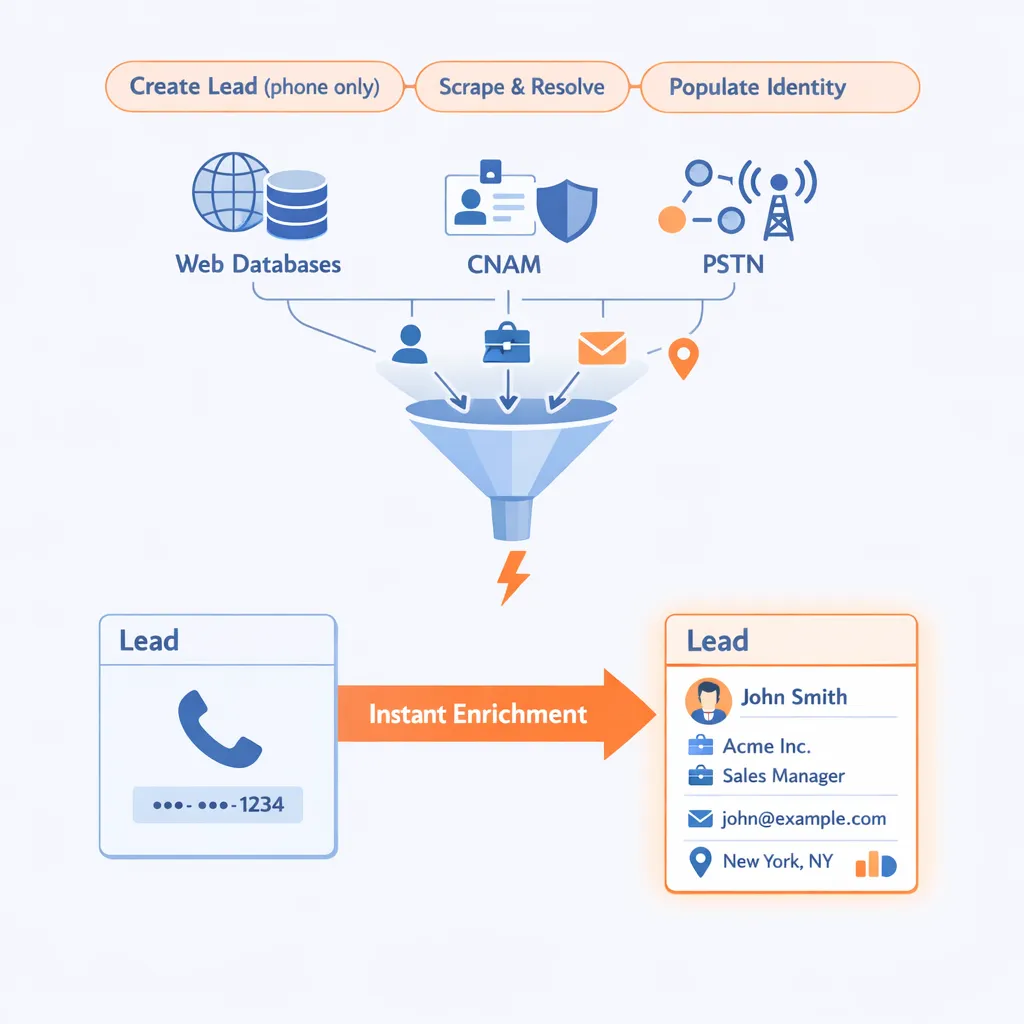
Creating a blank Lead record with only a phone number offers limited value. The critical differentiator in Kixie’s solution is its ability to populate this new record with identity data derived from external sources immediately upon creation.
The Mechanism for Scraping Data to Identify Unknown Callers
Kixie utilizes functionality to scrape public and proprietary data layers to resolve the identity associated with a Public Switched Telephone Network (PSTN) number. This transforms an anonymous number into a named entity.
- CNAM (Caller Name Delivery): The primary mechanism for this identification is a “CNAM dip.” When a call is received, Kixie queries Line Information Databases (LIDB) to retrieve the registered name associated with the calling number.
- Web Database Aggregation: Kixie scrapes contact and company data from web databases to populate the record. This involves cross-referencing the number against business directories or public web data to identify the associated Company Name.
Automated Field Population for New Salesforce Leads
Upon successfully retrieving this data, Kixie populates the following fields in the newly created Salesforce Lead:
- First Name / Last Name: Derived from the CNAM/Web lookup.
- Phone Number: The incoming CLI (Calling Line Identification).
- Company: Derived from the associated business registry or web scrape.
Result: The representative is presented with a “New Lead” screen that is already partially filled. Instead of asking “Who is this?” and “What company are you with?”, the rep can verify the information: “Am I speaking with [Name] from [Company]?” This shift from interrogation to verification establishes immediate professionalism and authority.
The PowerCall Interface as a Single Pane of Glass for Unknown Callers
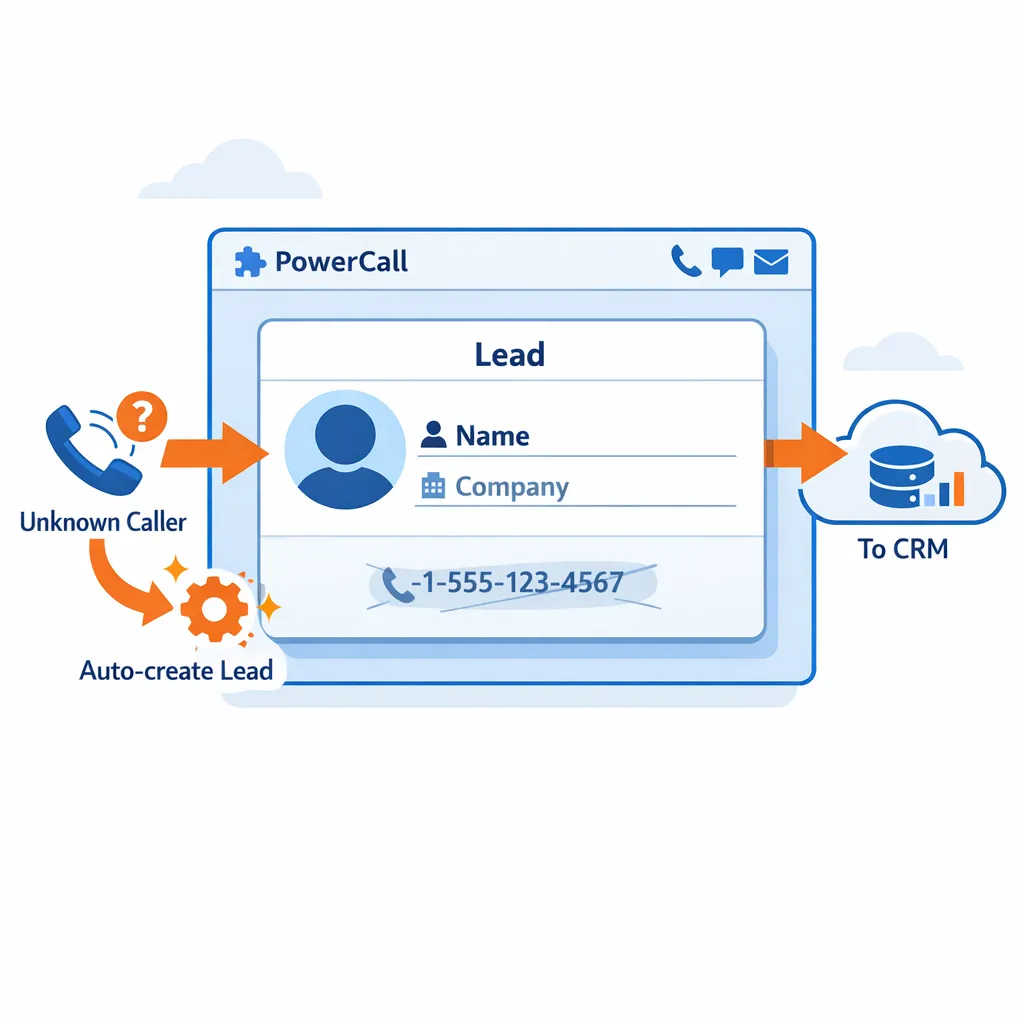
The user experience of Kixie’s automated lead creation is delivered through the PowerCall dialer, a Chrome extension that acts as a bridge between the telephony layer and Salesforce.
The Screen Pop Experience for Unknown Salesforce Leads
When an unknown caller rings, the PowerCall dialer triggers a “screen pop.” Because the system has automatically created the Lead record in the background, the screen pop displays the newly generated Lead’s details (Name, Company) rather than just a raw phone number.
- Contextual Awareness: The rep sees “New Lead: John Doe, Acme Corp” immediately.
- One-Click Access: The dialer provides a direct link to the new Salesforce record, allowing the rep to open the full Lead page with a single click for deeper note-taking.
Real-Time Editing of Salesforce Leads Created from Unknown Callers
If the scraped data is incomplete or requires correction (e.g., the CNAM returns “WIRELESS CALLER” or a parent company name), the rep can edit the contact details directly inside the Kixie dialer during the call. These edits sync back to Salesforce in real-time, updating the Lead record without the rep ever needing to leave the dialer interface or search through complex Salesforce menus.
Strategic Implications of Automating Salesforce Leads from Unknown Callers

Implementing automated lead creation for unknown callers moves an organization from a reactive data posture to a proactive one. This shift has measurable impacts on data hygiene, speed-to-lead, and overall return on investment (ROI).
Data Hygiene and Completeness for Salesforce Leads
Manual data entry is the primary cause of “dirty data.” Reps often enter minimal information or make typographical errors. Kixie’s automated creation ensures:
- Standardization: Phone numbers are entered in a consistent format.
- Completeness: Every inbound interaction results in a record. There are no “lost” calls where a prospect inquired but no record was made because the rep was too busy.
- Attribution: Marketing teams can accurately track inbound call volume against specific campaigns, as every call creates a trackable object.
Speed-to-Lead and Automation Triggers for Unknown Callers
The immediate creation of the Lead object enables downstream Salesforce automation. Once the Lead exists, it can trigger Salesforce Flows or Process Builder workflows.
- Example Workflow: An unknown number calls -> Kixie creates Lead -> Salesforce Flow detects new Lead -> Flow triggers an automated “Welcome” SMS or email to the prospect immediately after the call ends.
- Reduced Latency: Without this automation, the “Welcome” communication would be delayed until the rep manually finished entering the data, which might be hours later.
ROI Calculation for Automated Salesforce Lead Creation
For a sales team of 20 reps receiving an average of 10 unknown inbound calls per week each:
- Manual Entry: 20 reps * 10 calls * 1.5 minutes (entry time) = 300 minutes (5 hours) lost per week.
- Automated Entry: 0 minutes lost.
- Annual Savings: ~260 hours of selling time reclaimed per year.
Final Thoughts on Managing Salesforce Leads from Unknown Callers
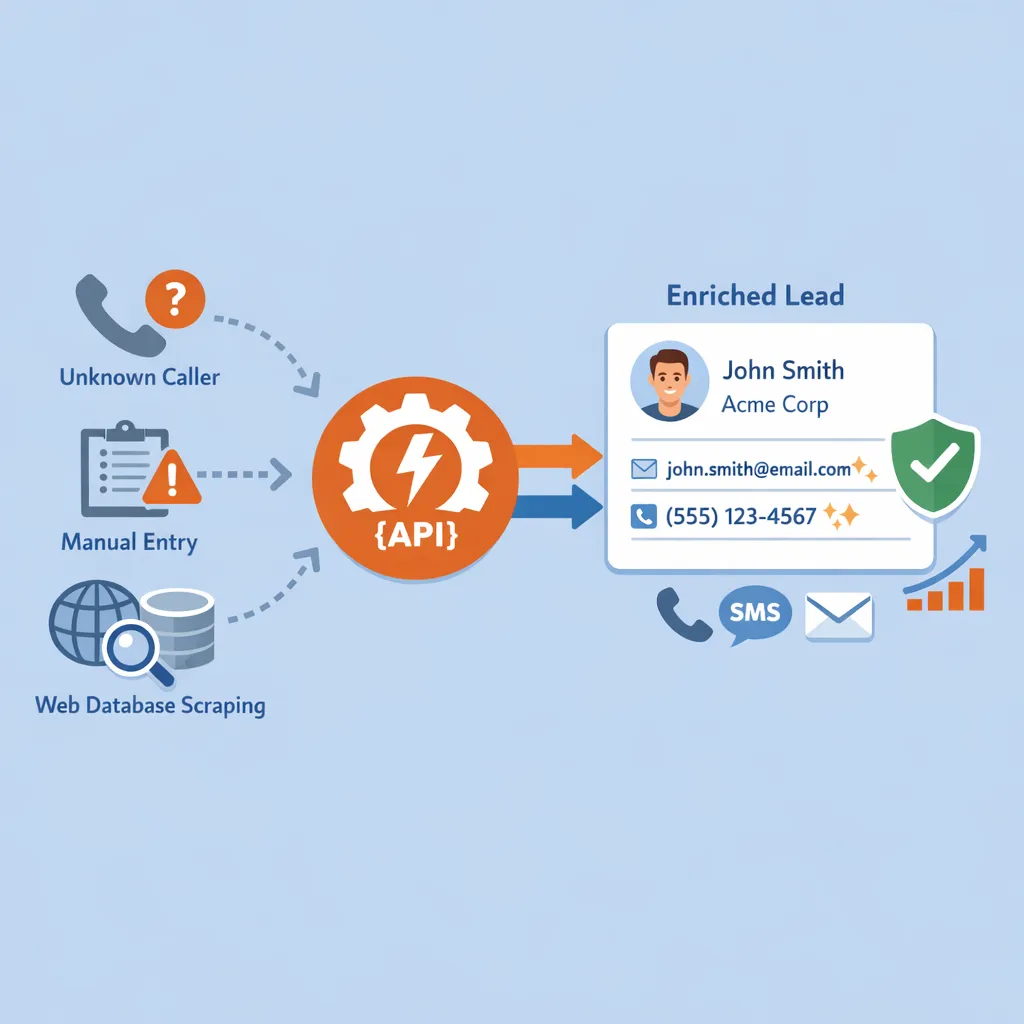
For Salesforce users, the “unknown caller” represents a significant leak in productivity and data integrity. The manual process of creating leads is slow, error-prone, and distracts from the core objective of selling. Kixie’s solution, Automatic Lead Creation combined with Web Database Scraping, offers a definitive remedy. By using API-level integration to instantly generate and enhance Lead records, Kixie transforms the unknown caller from an annoyance into an immediate, actionable asset. This capability not only saves valuable representative time but also ensures that the CRM remains a pristine, comprehensive source of truth for all sales interactions.
Ready to close more deals with Kixie?
See how Kixie's AI-powered tools can transform your sales and support operations.
Start Free Trial