

 HubSpot
 Salesforce
 Zoho
Zoho
 HighLevel
 Pipedrive
 ActiveCampaign
 Slack
Slack
 Zapier

GoHighLevel Calls Going to Spam? Here’s the Fix
TL;DR: The Fix for GoHighLevel Spam
This report analyzes the "Spam Likely" labeling of GoHighLevel (GHL) outbound calls, attributed to carrier analytics engines (Hiya, First Orion, TNS) targeting high-velocity, short-duration traffic patterns. While GHL offers native compliance tools like the Trust Center for A2P 10DLC and SHAKEN/STIR registration, these provide static defense and fail to prevent behavioral flagging caused by automation spikes. Manual remediation strategies, including Free Caller Registry submission and number cycling ("burn and replace"), are operationally resource-intensive. The recommended technical fix involves integrating Kixie to utilize Connection Boost technology, which employs Dynamic Local Presence to increase answer rates by up to 400%, Progressive Caller ID to rotate numbers, and AI-driven monitoring to automatically replace flagged numbers. Implementation requires bi-directional API integration at the sub-account level and adoption of reputation-conscious protocols, such as list validation and immediate voice activity upon connection.
The Silent Revenue Killer: An Introduction to the Modern Spam Call Crisis
In the high-velocity world of modern sales and marketing, the most dangerous threat to revenue is the silence of an unanswered phone. For businesses utilizing CRM platforms like GoHighLevel (GHL) for outreach, a disturbing trend has emerged: the "Spam Likely" label. This digital scarlet letter is affixed by carriers to business phone numbers, effectively quarantining them from their intended audience.

The scenario is common for agency owners: A campaign captures high-intent leads via ads, and GHL triggers an immediate call. While the technology works perfectly, the consumer's screen glows red with "Potential Spam," leading them to ignore the call. This guide addresses this crisis within the GoHighLevel ecosystem, detailing why standard VoIP implementations fail and how specialized telephony intelligence, specifically Kixie’s Connection Boost, restores connectivity.
The Economic Physics of Unanswered Calls
For businesses facing "Spam Likely" labels on their GoHighLevel calls, the urgency to fix the issue becomes clear when quantifying the financial damage. The degradation of answer rates is exponential, not linear. Industry data suggests that a call labeled as "Spam Likely" has an answer rate of less than 10%, compared to upwards of 30-40% for a clean, local number.
For a sales team making 1,000 dials a day, this disparity results in the difference between 300 conversations and fewer than 100. If a business generates leads at $50 each, and the telephony infrastructure fails to connect with 70% of them due to spam flagging, the effective Cost Per Acquisition (CPA) skyrockets. This "silent churn" goes unnoticed in standard CRM reporting because calls are technically "completed," even though they fail to achieve human connection. Furthermore, when reps face constant rejection due to spam labels, burnout accelerates, creating a hostile work environment.
The Evolution of Trust in Business Calls
The "Spam Likely" crisis affecting GoHighLevel users stems from a fundamental shift in the telecommunications environment. Historically, the telephone network was a trusted environment, but Voice over Internet Protocol (VoIP) allowed bad actors to generate millions of calls cheaply. This weaponization necessitated a harsh response from carriers (Verizon, AT&T, T-Mobile) and regulators via the TRACED Act and STIR/SHAKEN protocols.
Carriers now deploy analytics engines, powered by aggregators like Hiya and TNS, to analyze call patterns in real-time. These algorithms look for patterns resembling spam: high velocity, short duration, and low attestation. Unfortunately for GHL users, legitimate high-volume sales outreach often mimics these exact patterns. The platform’s design for speed and scale can become a liability, requiring a shift from static telephony to dynamic, intelligent systems to maintain deliverability.
Inside the Black Box: How Carrier Algorithms Flag Your Calls
To stop GoHighLevel calls from being marked as spam, one must understand how carrier algorithms assign the "Spam Likely" label. These proprietary and opaque algorithms govern call deliverability. By analyzing system behaviors, we can identify the specific triggers that affect GHL users.

The Triad of Analytics: Hiya, First Orion, and TNS
When a call is placed from a GHL sub-account, it is scored by the recipient's carrier using three major analytics engines: First Orion (T-Mobile), Hiya (AT&T/Samsung), and TNS (Verizon). These entities maintain databases of phone number reputations. A major issue for GHL users is that "new" numbers purchased from pools often have a toxic history from previous users, causing immediate flagging.
The Velocity Trap and Behavioral Fingerprinting
Algorithms also monitor real-time behavior, acting as traffic cops for speeding violations.
- Volume vs. Time: A GHL workflow utilizing a power dialer might initiate 100 calls in 10 minutes, a "super-human" velocity that signals a robocall to algorithms.
- Call Duration: If a number makes 1,000 calls and 90% end within 6 seconds (common with cold leads), algorithms downgrade the reputation score.
- The "Neighbor" Spoofing Fallacy: Algorithms aggressively police spoofing. If a number generates calls to hundreds of different area codes rapidly, or if the routing suggests an international origin despite a local area code, the call is blocked.
The Role of Consumer Feedback
Smartphone users can report numbers as "Spam" or "Scam" with a single tap, feeding data directly to analytics engines. For GHL users, aggressive workflows or rude agents can lead to manual reports that poison a number's reputation across the network.
Attestation Levels
The SHAKEN/STIR framework attaches a digital certificate to calls. "Attestation A" confirms the provider knows the customer and the number. Many GHL numbers, often procured through aggregators, may only achieve "Attestation B" or "C" (the "trust gutter"), making them highly likely to be blocked.
The GoHighLevel Telephony Framework: Opportunities and Liabilities
GoHighLevel is a powerful marketing automation tool, but regarding telephony, it acts primarily as a user interface layer on top of providers like Twilio. This architecture creates specific vulnerabilities regarding spam prevention for its users.
The Shared Pool Risk
In many agency setups, numbers are managed in pools. Even with sub-account isolation, numbers provided by upstream carriers may be adjacent to "bad" numbers used by other tenants. Critically, number management in GHL is often static; a business uses a set of numbers permanently. If a number is flagged as spam, the user has no automated mechanism to sense the flag and swap the number, often realizing the issue only after days of failed calls.
The "Speed-to-Lead" Paradox
GHL workflows are designed for "Speed-to-Lead," often triggering calls immediately after a form submission. However, if 500 leads arrive simultaneously (e.g., after a webinar), the system attempts to initiate 500 outbound calls instantly. This massive spike in Calls Per Second (CPS) is detected by carrier algorithms as a "robocall attack," triggering spam labels.
Limitations of Native Tools
GHL offers features like "Number Intelligence," but they are primarily defensive.
| Feature | Function | Limitation |
|---|---|---|
| Spam Detection | Flags incoming calls to the business as spam. | Protects the agent from spam, not the outbound reputation. |
| Name Lookup | Identifies the name of the caller. | Helpful for context, but irrelevant to outbound deliverability. |
| Number Validation | Checks if a number is valid before SMS. | Primarily for SMS deliverability; does not validate if a number is on a DNC list or a litigator trap. |
Trust Center Compliance ensures A2P and SHAKEN/STIR registration, which is necessary for the call to connect, but does not guarantee a clean reputation or prevent "Spam Likely" labels based on aggressive calling patterns.
The Manual Fix for Spam (The Hard Way)
For GoHighLevel users relying solely on native telephony features, fixing "Spam Likely" labels is a manual, reactive process. It involves a constant cycle of monitoring, appealing, and replacing numbers.
The Regulatory Gauntlet
Users must first ensure rigorous adherence to Trust Center requirements, including EIN verification and precise Brand & Campaign registration that avoids vague descriptions. CNAM registration (Caller ID text) is helpful but does not overwrite a "Spam Risk" overlay.
Voice Integrity Registration
Users can submit their numbers to the "Free Caller Registry," which feeds into analytics engines like Hiya and TNS. However, vetting takes days, and whitelisting is conditional. If calling behavior remains aggressive, the number will be re-flagged, putting the user essentially on probation.
The "Burn and Replace" Cycle
When remediation fails, users must "burn" the flagged number. This involves diagnosing the drop in answer rates, removing the number from GHL, purchasing a new one, and "warming it up" over weeks. The new number must then be manually updated in every GHL workflow and ad extension.
Carrier Disputes
Filing individual disputes with carriers (Verizon, AT&T) is the final resort. These forms often enter a "black hole" of support queues with rare responses, making it an unviable strategy for sales teams needing to hit immediate quotas.
The Kixie Fix: Dynamic Presence and AI Defense
Integrating Kixie with GoHighLevel offers a "smart" alternative to manual spam remediation. Kixie is a Sales Engagement Platform that layers over GHL to bypass the limitations of shared pools and static numbers.
The Core Technology: Connection Boost
Kixie’s Connection Boost technology addresses spam labeling through two main mechanisms:
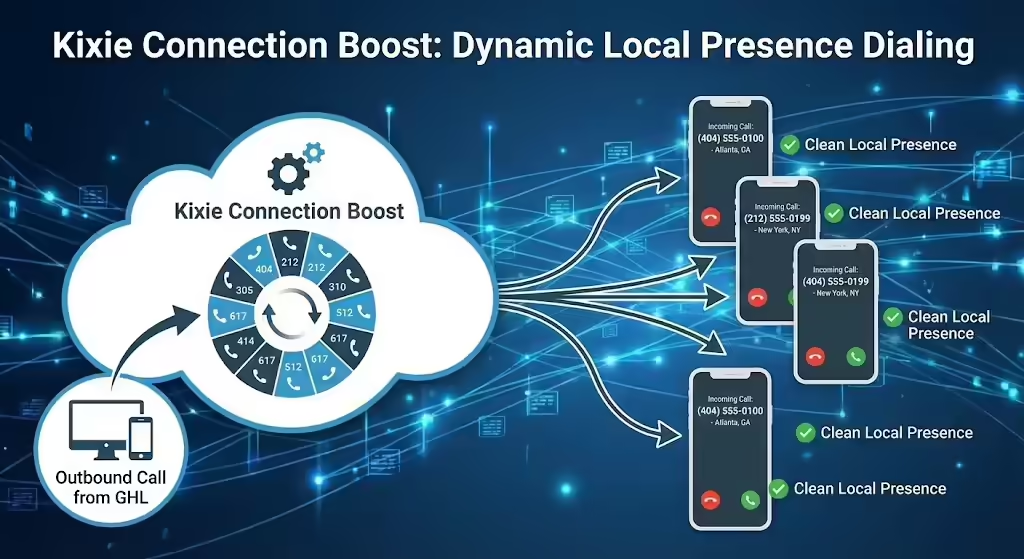
- Dynamic Local Presence Dialing: When a user calls a specific area code (e.g., 404), Kixie automatically displays a clean, local number from a proprietary pool. This increases answer rates by up to 400% and blends usage patterns across thousands of businesses, diluting the velocity risk.
- Progressive Caller ID: Kixie rotates the displayed number for every call, even within the same area code. This keeps call volume on any single number below the thresholds that trigger carrier spam alerts.
AI-Powered Spam Detection and Replacement
Unlike manual monitoring, Kixie’s AI monitors the health of numbers in real-time using metrics like Answer Seizure Ratio and carrier feedback codes. If a number is flagged, the system immediately quarantines it and automatically provisions a fresh replacement. This "Zero-Touch" fix ensures agents always dial from healthy numbers without administrative intervention.
Network-Level Trust
Kixie operates as a registered carrier partner, ensuring calls are signed with "Attestation A" (the gold standard). Internal teams also proactively handle whitelisting with analytics providers at scale. While Kixie carries a per-seat cost, the ROI is realized through recovered leads, operational savings from eliminated manual management, and the certainty of call connection.
Step-by-Step GoHighLevel Integration Guide
Merging Kixie with GoHighLevel transforms the CRM into a sales powerhouse capable of bypassing spam filters. The integration is bi-directional, ensuring seamless data flow.
The Connection
Admins should create a Kixie account (Professional tier) and integrate it via the API settings to the specific GHL Sub-Account where the sales team operates. It is essential to map every GHL user to their corresponding Kixie user email to ensure accurate call logging.
Configuring The "Smart" Workflow
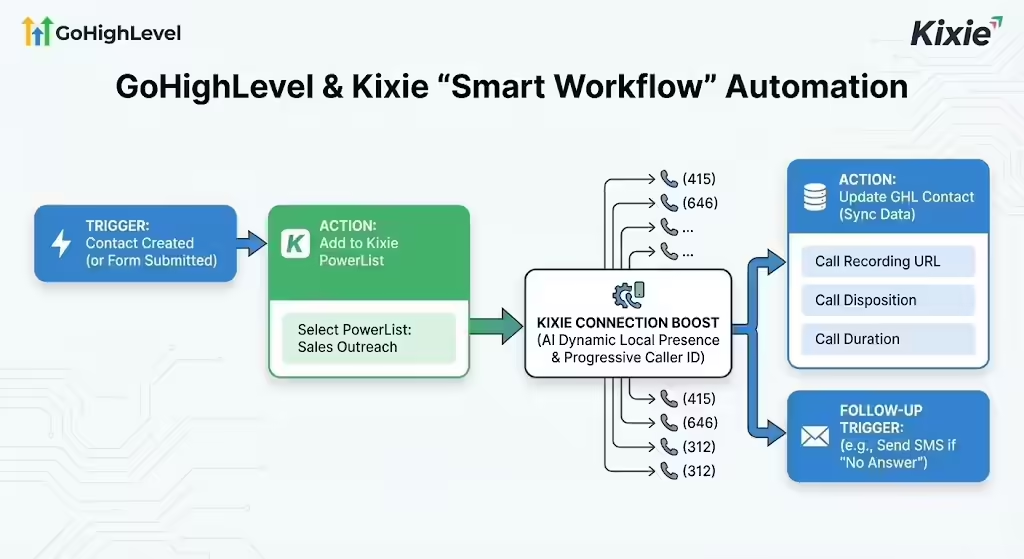
To automate dialing with clean numbers, set up a GHL trigger (e.g., "Contact Created") that fires the action "Add to PowerList" in Kixie. This instantly places the lead in the agent's PowerCall queue. When the agent dials, Kixie uses Connection Boost to display a local number. Upon completion, Kixie syncs the recording and disposition (e.g., "Demo Scheduled") back to GHL, which can trigger further automation.
Advanced Routing and Stickiness
To handle callbacks to dynamic numbers, Kixie employs Dynamic Call Routing. The system remembers which agent called which lead. If a lead calls back the random local number displayed on their ID, Kixie routes the call directly to the original agent, bypassing the IVR and popping the GHL contact record on the screen.
Strategic Best Practices to Avoid Spam in 2026
To defeat the "Spam Likely" label on GoHighLevel calls, technology must be paired with "Reputation-Conscious" behaviors by the sales team.
The Human Protocol
Carriers look for robocall signatures like silence or instant hang-ups. Agents must follow the "Hello" Rule, speaking immediately upon connection. They must also avoid "churning" lists with frequent short calls (under 5 seconds), which hurts reputation.
List Hygiene is Non-Negotiable
Calling invalid numbers (triple tones) signals to carriers that a business is using "dirty" data, a hallmark of spammers. Users should use GHL’s Number Validation or tools like NeverBounce before importing lists. Implement a "Three Strike" rule: if a number doesn't answer after three attempts, move it to email-only nurturing rather than hammering it with calls.
Scripting and Talk Time
Voicemails should avoid "urgent" bait, which leads to angry callbacks and spam reports; transparency regarding the business name is crucial. Additionally, teams should optimize for "Talk Time," the clearest signal of legitimacy. Mixing short cold calls with longer follow-up calls to existing clients helps dilute "bad traffic" and improves the overall health score of the number pool.
Conclusion: The Future of Calls is Trusted Connection
The era of "spray and pray" telephony has ended, with "Spam Likely" labels acting as a wall erected by carriers. GoHighLevel users face a choice: accept the financial loss of unanswered leads and the burden of manual number management, or adapt to the new landscape.
The solution is to align with carrier algorithms by moving from static infrastructure to dynamic systems. Integrating Kixie with GoHighLevel provides a sophisticated telephony backbone featuring Connection Boost, AI monitoring, and zero-touch number replacement. These tools allow sales teams to focus on conversations and closing deals rather than fighting for connection.
Appendix: Frequently Asked Questions about GoHighLevel Spam
Q: Can I just buy 100 numbers in GHL to solve the spam issue?
A: Buying more numbers only temporarily dilutes volume. Without AI monitoring to detect burned numbers and automated rotation, you merely increase management workload and will eventually burn through the new numbers as well.
Q: Does Kixie replace my GHL phone number?
A: Kixie replaces the outbound dialing function, but you can keep your GHL number for inbound SMS and marketing. The integration ensures all Kixie calls are logged centrally in GHL.
Q: Is "Local Presence" legal?
A: Yes, provided the business is legitimate and not spoofing with malicious intent. Kixie’s numbers are fully registered and compliant, designed to increase familiarity rather than deceive.
Q: How fast is the setup?
A: Technical integration takes less than 15 minutes. While porting existing numbers can take days, teams can start dialing immediately using Kixie’s pool numbers.