TL;DR
Core Subject
Technical reliability comparison between GoHighLevel (GHL) Native Dialer (LC Phone) and Kixie CTI.
Architecture
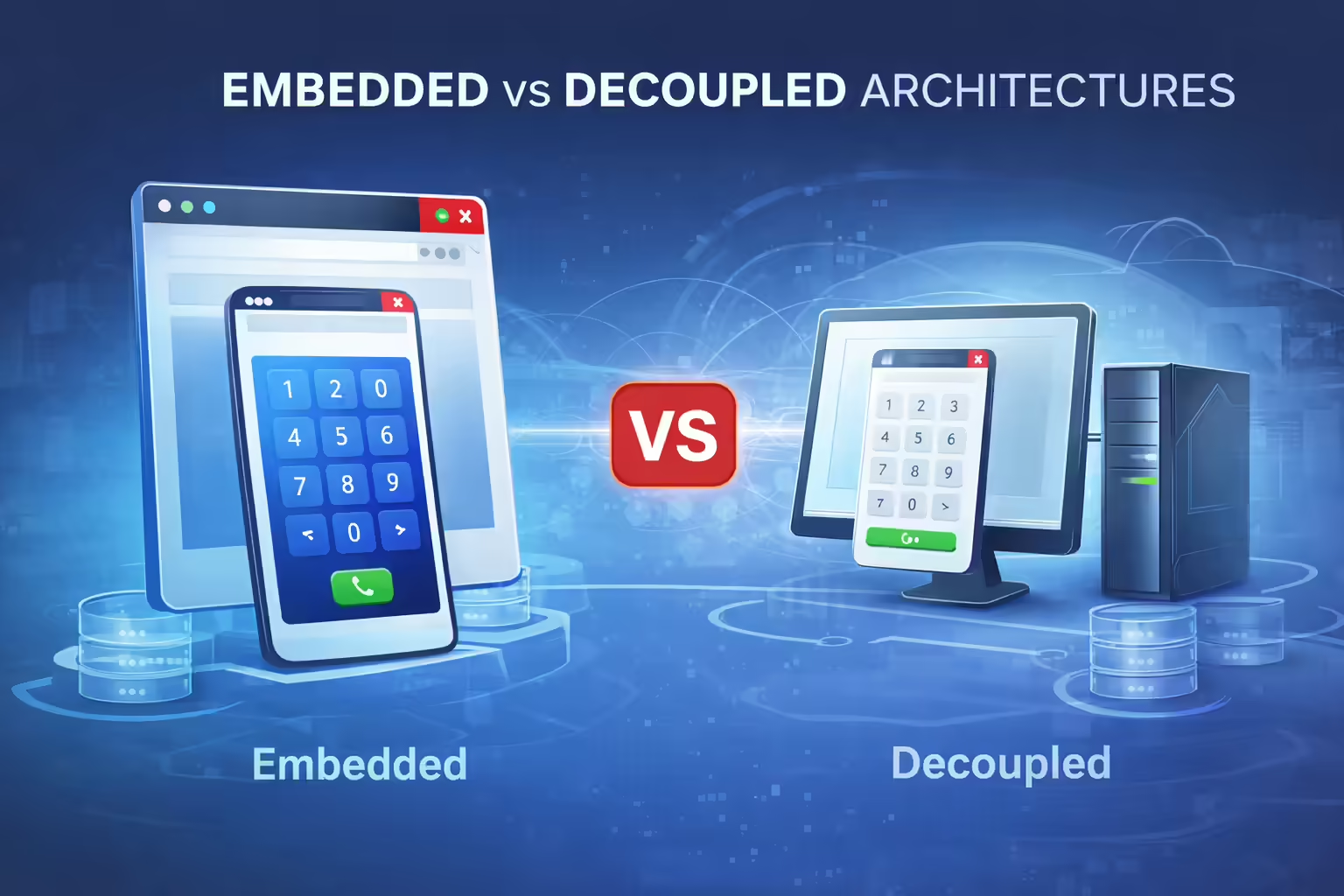
GHL: Embedded Twilio wrapper dependent on DOM.
Kixie: Decoupled architecture via Chrome Extension & Apps.
Failure Mode A (Wrong Number)
GHL: Session volatility causes default line dialing.
Kixie: Fixed via persistent local storage.
Failure Mode B (One-Ring)
GHL: Browser background throttling.
Kixie: Solved via Service Workers & Simultaneous Ring.
Economics
GHL: Metered (per min/storage).
Kixie: Flat-rate, unlimited minutes.
Key Statistic
Browser resource contention can delay VoIP packets >150ms in GHL (audio jitter); Kixie’s isolated process prevents this.
The integration of telephony into Customer Relationship Management (CRM) platforms represents a functional shift in sales operations. This transition moves voice communication from standalone hardware to software-defined infrastructure. GoHighLevel (GHL) offers a native telephony tool known as “LC Phone.” This system operates as a functional interface around Twilio’s programmable voice API. It provides immediate accessibility and direct UI integration.
However, as agencies and sales teams scale their operations, distinct reliability patterns emerge. These patterns suggest fundamental limitations in the “Embedded” browser-based architecture.
GoHighLevel Native Dialer and Kixie CTI Reliability Analysis
This research report provides an exhaustive, comparative technical analysis of the GoHighLevel Native Dialer versus Kixie, a dedicated Computer Telephony Integration (CTI) platform. The scope of this study focuses strictly on call reliability, technical stability, and architectural robustness.
It analyzes the engineering mechanisms behind documented failure modes. These include the “Wrong Number” bug, the “One-Ring” inbound failure, and the implications of browser resource throttling on Voice over IP (VoIP) signaling.
The analysis reveals a split in performance characteristics driven by architectural design. GoHighLevel’s native solution inherits the instabilities of the browser environment due to its embedded nature. These instabilities include session state dependencies, aggressive memory management, and process contention. In contrast, Kixie’s “Decoupled” architecture uses persistent extensions and independent network execution to offer a stability profile consistent with enterprise telecommunications requirements.
Technical Divergence of Voice Architectures
The modern sales stack has converged on the browser as the universal operating system. CRM, email, calendar, and telephony all reside within the tabs of Chrome or Edge. While this offers UI unification, it introduces significant challenges for real-time communication protocols. Voice differs from data. It is intolerant of latency, jitter, or process suspension. A delayed email goes unnoticed. A delayed voice packet results in a dropped call.
The Evolution of Browser-Based Telephony in GoHighLevel
The genesis of browser-based calling lies in WebRTC (Web Real-Time Communication).This open-source project enables real-time media communication directly between browsers and devices. GoHighLevel’s LC Phone utilizes this technology to turn the dashboard into a softphone. The theoretical advantage is zero-install deployment. The practical reality is that the browser was designed primarily for document rendering and asynchronous request-response cycles. It was not designed for the sustained, high-priority socket connections required by telephony.
CRMs have become more complex. They load heavy JavaScript frameworks, execute complex automation triggers, and manage dynamic DOM (Document Object Model) updates. Consequently, the browser tab has become a resource-constrained environment. The “Embedded” telephony model places the critical voice function in direct competition for these constrained resources.
The Wrapper Paradox
GoHighLevel’s native phone system functions as a “wrapper.” It does not build its own telephony network. Instead, it utilizes the API of Twilio to facilitate calls.
Reliability Gap: If the GHL tab freezes due to a memory leak in a separate marketing module, the phone functionality degrades. Even if Twilio is online, the interface is subject to the fragilities of the front-end web environment.
The Stability Solution
Kixie mitigates the wrapper paradox through complete decoupling. It ensures the “Control Panel” (Dashboard) is separate from the “Engine” (Dialer).
Result: Users gain carrier-level stability regardless of CRM heaviness, creating a fracture-free user experience.
Methodology of Comparison
This report compares the two systems across four primary reliability vectors:
- Outbound Logic Integrity: The ability to consistently dial the correct number with the correct caller ID.
- Inbound Connectivity: The ability to successfully route incoming calls to an available agent without premature termination.
- Network Architecture: The resilience of the connection against browser throttling and carrier filtering.
- Operational Compliance: Adherence to regulatory standards (STIR/SHAKEN, A2P 10DLC) and cost predictability.
Architectural Analysis: Embedded vs. Decoupled
To understand the specific bugs affecting GHL users, one must first deconstruct the divergent architectures of the two systems.
The GoHighLevel Native Dialer “Embedded” DOM Dependency
GoHighLevel’s dialer is injected directly into the Document Object Model (DOM) of the CRM’s web page.
- Session State Vulnerability: The dialer relies on browser session storage. Switching tabs (e.g., Contacts to Automations) triggers a DOM repaint, potentially resetting transient variables like outbound lines.
- Resource Contention: The dialer runs on the same thread as the CRM. Heavy analytics or workflows deprioritize the JavaScript thread responsible for voice packets, causing robotic voice quality.
- Lifecycle Coupling: If the browser crashes or the tab is closed, the call terminates instantly.
Kixie’s “Decoupled” Extension Architecture
Kixie operates visually via DOM injection but executes via a persistent Chrome Extension.
- Process Isolation: Extensions run in a separate process space (“sandbox”). GHL script errors do not crash the Kixie WebSocket connection.
- Persistent State Management: Configurations reside in the extension’s local storage or are fetched from the backend, surviving page reloads and tab closures.
- Carrier-Level Control: The extension instructs the switch to bridge the call, using an optimized media stack tuned specifically for VoIP.
Critical Failure Mode I: The “Wrong Number” Bug
A technically documented failure in the GoHighLevel native dialer is the “Wrong Number” bug. This phenomena undermines trust: Agents cannot be certain that the number they intend to call from is the number actually presented to the prospect.
Root Cause: The API Race Condition
The failure is best understood as a “Race Condition” in the GHL API retrieval logic:
- Trigger Event: Agent clicks “Call”.
- State Retrieval Attempt: System checks User Preference -> User Profile -> Fallback Default.
- The Latency Gap: In a heavy browser environment, the Step 2 API call lags due to network/script congestion.
- The Fallback Execution: To prevent hanging, the system executes the “Fallback” logic immediately (System Default Number).
- The Result: The call connects via a generic number while the UI may still show the agent’s direct line.
Operational Impact
Thread Splitting: Connection built via SMS (direct line) is severed when the voice call arrives from a generic 800 number.
Compliance Verification: Default numbers may lack proper Attestation (STIR/SHAKEN), increasing “Spam Risk” labels.
The Kixie Resolution: Persistent Configuration Governance
Kixie eliminates the “Wrong Number” bug via Decoupled Logic. Configuration data is downloaded to the extension upon login and remains resident in memory. When a user clicks-to-call, Kixie uses local, verified preferences. There is no API race condition, ensuring 100% outbound logic integrity.
Critical Failure Mode II: The “One-Ring” Inbound Failure
While outbound bugs hinder efficiency, inbound bugs destroy revenue. The “One-Ring” bug occurs when inbound calls ring once and disconnect. The culprit is often Chrome’s “Budget-Based Background Timer Throttling.”
Why “Ghost Calls” Happen
If the GHL tab is in the background, Chrome restricts its CPU usage. GHL’s WebSocket “keep-alive” pings get suppressed. When a call packet arrives, the browser must “wake up” the tab—a process taking 2-3 seconds. By the time the tab wakes, the carrier network (expecting a response in milliseconds) has already terminated the request or sent it to voicemail.
Mobile Impact
iOS/Android Restrictions: Mobile OS aggressively kills background processes. Unless using CallKit, the GHL app loses signal in the background, leading to missed calls.
Kixie Reliability Resolution
- Service Workers: Kixie uses Manifest V3 Service Workers which run independently of tabs, avoiding Chrome throttling.
- Simultaneous Ring: Kixie forks the call at the carrier level to Desktop App, Chrome Extension, Mobile App, and Cell simultaneously.
- Native OS Integration: Kixie Mobile App uses Apple CallKit/Android ConnectionService to bypass battery optimization.
Network Connectivity and Carrier Redundancy
The Risk of Single-Carrier Dependency
GoHighLevel is a wrapper for Twilio. A localized Twilio outage or “noisy neighbor” issue on a shared sub-account shard creates a Single Point of Failure.
Kixie’s Multi-Carrier Routing
Kixie maintains interconnections with multiple Tier-1 carriers with automatic Failover Logic. If one route degrades, traffic is re-routed instantly at the network layer. Furthermore, Kixie forces UDP transport (favored for VoIP) via its dedicated app, whereas browsers often force TCP (causing jitter).
Reputation Management: Avoiding “Spam Likely”
GoHighLevel: Shared Risk
Numbers purchased via API are often recycled. A number used by a spammer yesterday may be assigned to you today. Attestation is often Level B or C (Partial) due to the disconnect between number owner and caller.
Kixie: Trusted Center
Kixie acts as a Voice Service Provider, handling CNAM and A2P 10DLC registration directly. This ensures Level A Attestation. Kixie’s ConnectionBoost also utilizes AI to monitor number health, automatically rotating out numbers that get flagged.
Economic Analysis: The “Iceberg” Model
GHL is marketed as low-cost, but its metered model hides significant variable fees for active teams.
GHL Variable Costs (Per Minute/Month)
Base Outbound Rate
$0.014 / min
Call Recording
+ $0.0025 / min
AI Transcription
+ $0.0240 / min
Agency Markup (Avg)
+ $0.0040 / min
True 10-Minute Call Cost
~$0.45
*Cost creates operational drag: The more successful the sales team, the higher the penalty.
Kixie’s Flat-Rate Model
Kixie employs a flat user license including Unlimited Minutes (US/Canada), storage, and recording. This makes OpEx predictable and removes the financial penalty for high-volume prospecting.
Integration, Automation, and Workflow Engineering
The Kixie-GHL integration offers bi-directional sync without the latency.
- PowerList Architecture: Unlike GHL’s manual campaigns, Kixie triggers auto-dialing via webhooks, supporting Multi-Line PowerDialing (up to 10 lines at once).
- Bi-Directional Triggers: Call dispositions in Kixie (e.g., “Demo Booked”) instantly fire GHL automation workflows.
- Disaster Recovery: Decoupling Voice (Kixie) from SMS (GHL) ensures that if SMS compliance shuts down a GHL account, the voice lines remain active.
Choosing Between Embedded Convenience and Reliability
The selection of a telephony infrastructure for GoHighLevel users is a strategic choice.
Conclusion: The Enterprise Requirement
GoHighLevel (LC Phone) is sufficient for casual, low-volume use. However, the “Embedded” browser model introduces unavoidable volatility—The “Wrong Number” bug and “One-Ring” failures are symptoms of this architecture.
Kixie CTI provides the requisite “Decoupled” stability. By moving voice processing to isolated extensions and independent apps, it delivers:
- Immunity to CRM page freezes.
- Persistent Governance over Caller IDs.
- Carrier Redundancy for 99.999% uptime.
For mission-critical sales operations, decoupling voice from the browser tab is not just an upgrade—it is a necessity.
Ready to close more deals with Kixie?
See how Kixie's AI-powered tools can transform your sales and support operations.
Start Free Trial