
Context for HubSpot STIR/SHAKEN Registration
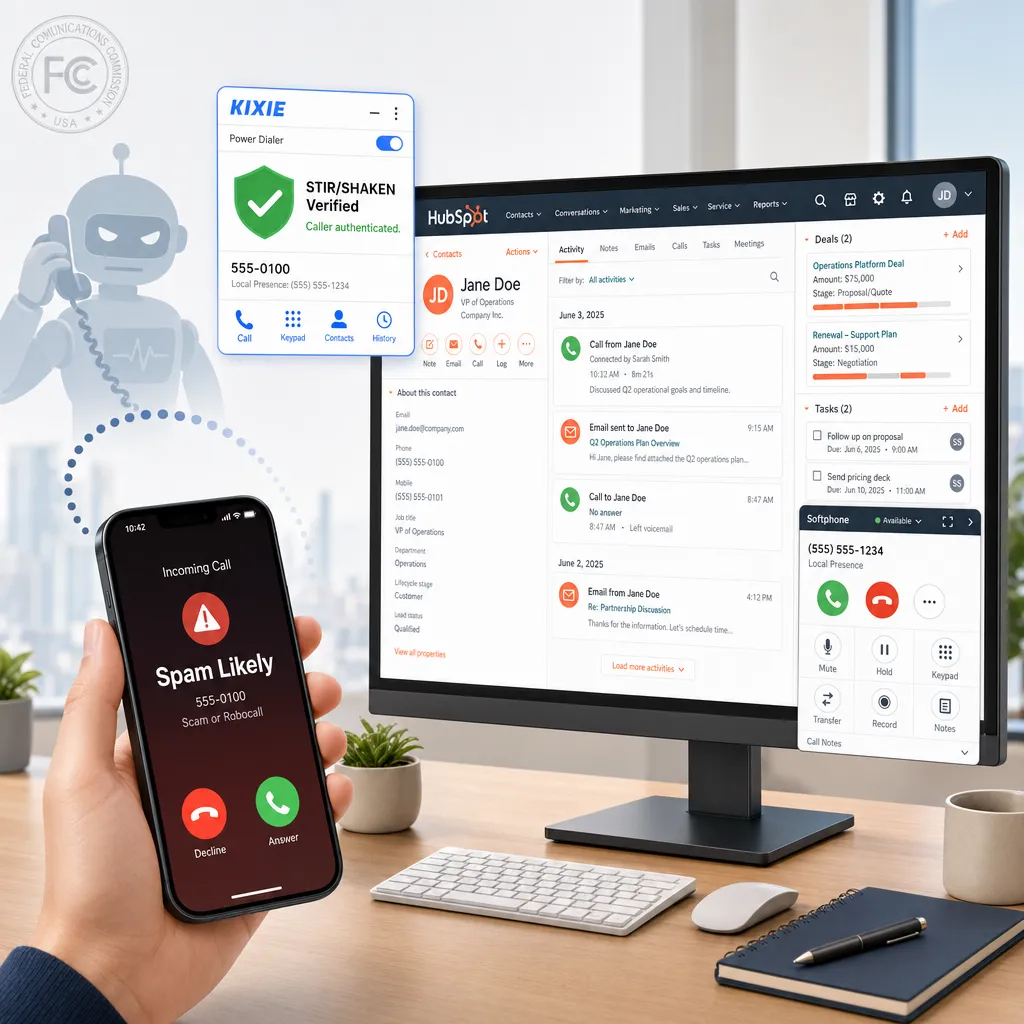
The telecommunications sector is currently undergoing a structural transformation comparable to the transition from analog to digital switching. For decades, the Public Switched Telephone Network (PSTN) operated on a presumption of implicit trust. In this system, the metadata accompanying a voice packet (specifically the Caller ID) was assumed to be an accurate representation of the call’s origin. This architecture lacked a fundamental authentication layer, creating a vulnerability that malicious actors exploited. The result was a proliferation of “spoofed” calls, where robocallers could masquerade as legitimate entities.
In response, the Federal Communications Commission (FCC) mandated the implementation of the STIR/SHAKEN caller ID authentication framework pursuant to the TRACED Act of 2019. While this regulatory intervention aims to protect consumers, it creates complex compliance requirements for legitimate businesses, particularly those using Voice over Internet Protocol (VoIP) systems integrated with Customer Relationship Management (CRM) platforms. For researchers and administrators managing STIR/SHAKEN registration for HubSpot numbers, the “Spam Likely” label on legitimate business calls signifies a failure of identity verification within the network path. This report analyzes the framework as it applies to the HubSpot ecosystem and presents a methodology for achieving compliance through the Kixie telephony platform integration. By establishing a root of trust through proper registration, organizations can secure their digital identity.
Technical Framework of STIR/SHAKEN Registration for HubSpot Numbers

To manage the STIR/SHAKEN registration process effectively for HubSpot numbers, administrators must understand the underlying protocols. STIR/SHAKEN is a suite of technical standards that alters how call data is transmitted and verified across the IP-based telephone network.
Cryptographic Identity in STIR/SHAKEN Registration for HubSpot Numbers
STIR (Secure Telephony Identity Revisited) and SHAKEN (Signature-based Handling of Asserted information using toKENs) define how service providers implement authentication protocols within carrier networks. When a call is initiated in a compliant STIR/SHAKEN registration setup for HubSpot numbers, the Originating Service Provider (OSP) must cryptographically sign the call signaling information. This occurs through a SIP (Session Initiation Protocol) header manipulation where an encrypted token, known as a PASSporT (Personal Assertion Token), is inserted.
This token contains critical metadata, including the attestation level, the origination identifier (verified phone number), the destination identifier, and a timestamp to prevent replay attacks. The OSP signs this token using a private key associated with a digital certificate issued by a trusted Certificate Authority (CA). As the call moves to the Terminating Service Provider (TSP), the token remains intact. The TSP uses the OSP’s public key to verify that the data is unaltered and that the OSP is an authorized participant in the governance framework.
Attestation Levels in STIR/SHAKEN Registration for HubSpot Numbers
The success of the verification process is communicated to the network through “Attestation Levels.” These levels are technical assertions regarding the identity of the caller. Understanding the distinction between these levels is critical for STIR/SHAKEN registration for HubSpot numbers, as the CRM configuration dictates the assigned level.
Full Attestation (A-Level)
This represents the highest standard of trust. For a carrier to sign a call with A-Level attestation during STIR/SHAKEN registration, the carrier must authenticate the customer initiating the call and verify that the customer is authorized to use the specific HubSpot number displayed. Calls with A-Level attestation are the least likely to be blocked.
Partial Attestation (B-Level)
This level indicates partial verification. The carrier can confirm the identity of the customer originating the call but cannot verify that the customer is authorized to use the specific phone number. This frequently occurs in “Bring Your Own Carrier” (BYOC) setups common in basic VoIP integrations. B-Level calls are more susceptible to negative labeling.
Gateway Attestation (C-Level)
This is the lowest level, assigned when a carrier acts as a conduit for a call entering the network from an unverified source. In the context of STIR/SHAKEN registration for HubSpot numbers, a C-Level attestation effectively ensures the call will likely be blocked.
Analytics Engines and STIR/SHAKEN Registration for HubSpot Numbers
STIR/SHAKEN is an identity framework rather than a caller ID reputation framework. An A-Level attestation proves who is calling but does not guarantee the recipient wants the call. Major US carriers employ third-party analytics engines (First Orion, Hiya, and Transaction Network Services) to monitor traffic. These engines ingest STIR/SHAKEN registration data alongside behavioral metrics for HubSpot numbers.
Even a call with A-Level attestation can be flagged if the analytics engine detects specific anomalies. Triggers include high volume velocity (sudden spikes in calls from a single number), a low Answer Seizure Ratio (many short or unanswered calls), or neighbor spoofing patterns. Therefore, a solution for STIR/SHAKEN registration for HubSpot numbers must address both the technical identity (achieving A-Level attestation) and the behavioral reputation (managing analytics profiles).
Structural Vulnerabilities in HubSpot Numbers and STIR/SHAKEN Registration

The “Spam Likely” Problem
“Spam Likely” labels on calls originating from HubSpot are often a byproduct of the platform’s native telephony architecture. Native HubSpot calling utilizes a technical structure that often precludes the assignment of A-Level attestation, complicating STIR/SHAKEN registration for HubSpot numbers.
Bridged Call Architecture Affecting STIR/SHAKEN Registration for HubSpot Numbers
Native HubSpot calling typically relies on a “click-to-call” functionality powered by backend providers like Twilio. This architecture is often a “bridged” system. When a user initiates a call, the system places an outbound call to the user’s phone and simultaneously places an outbound call to the prospect. The system then bridges these two legs together.
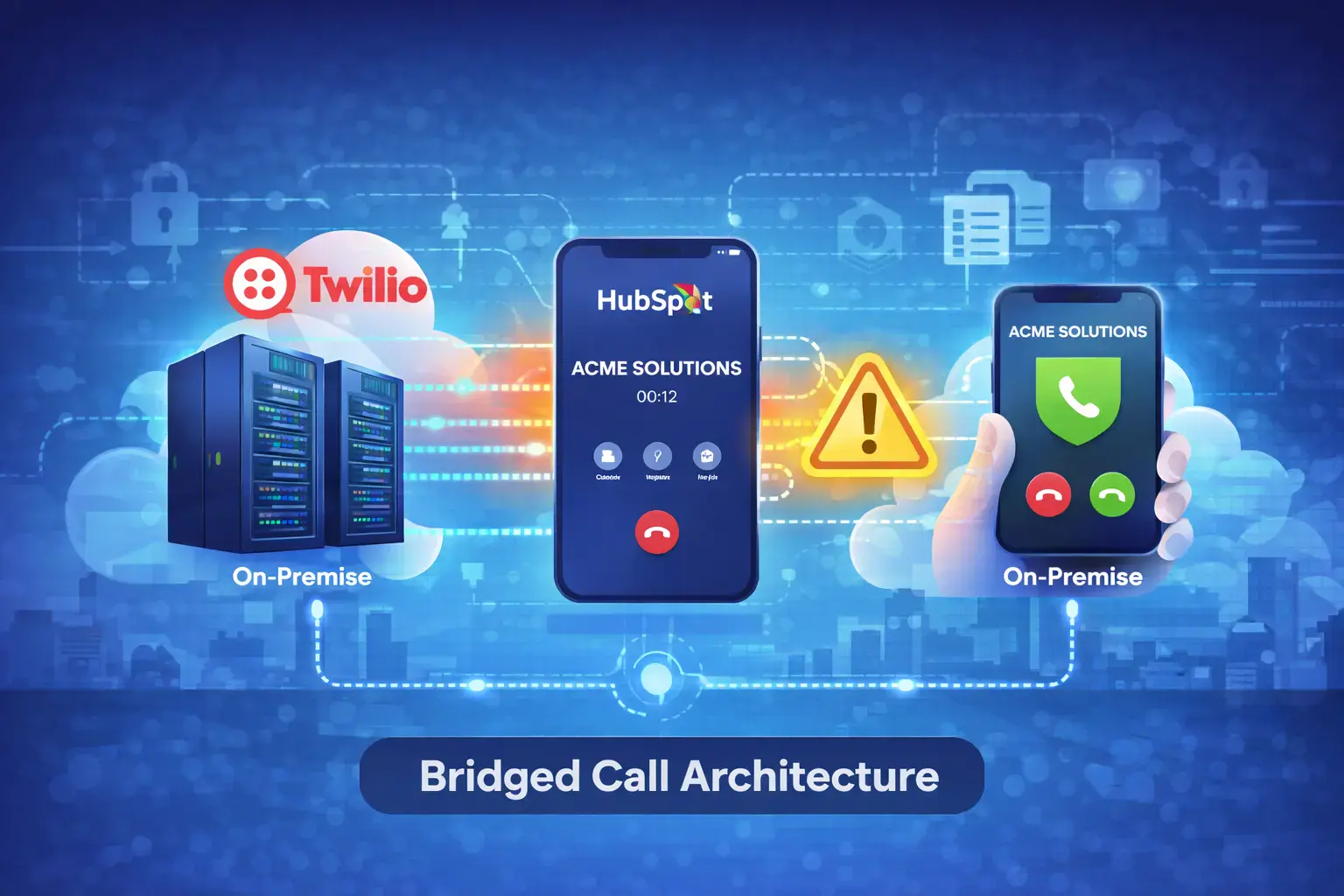
In this configuration regarding STIR/SHAKEN registration, the entity technically originating the call to the prospect is the backend carrier. However, the Caller ID presented is often the user’s business HubSpot number, which may not be held directly in that specific carrier’s inventory. Because the carrier acts as a transit point for a call initiated by a software application using a number not strictly owned in the carrier’s immediate database, the carrier cannot cryptographically assert full ownership. Consequently, the call is signed with B-Level Attestation. This limitation creates a ceiling for trust, as calls remain in the “Partial Trust” category.
User Reports on STIR/SHAKEN Registration Failures for HubSpot Numbers
User experiences on HubSpot community forums confirm technical analysis regarding STIR/SHAKEN registration issues. Users report that HubSpot numbers frequently appear as “scam likely” despite legitimate business use. HubSpot, as a CRM platform, does not have direct control over the labeling decisions made by the recipient’s network.
This lack of control affects the STIR/SHAKEN registration strategy for HubSpot numbers. Remediation often involves manual registration with services like the Free Caller Registry, but these are reactive measures. Once a number is flagged, discarding it and acquiring a new one becomes a common tactic. This “Burn and Replace” cycle disrupts sales continuity and degrades brand equity.
Kixie Integration for STIR/SHAKEN Registration of HubSpot Numbers

To resolve the attestation deficit in bridged calling, organizations require a shift in telephony architecture. Integrating Kixie into the HubSpot environment replaces the bridged mechanism with a direct-origination model engineered to satisfy STIR/SHAKEN registration requirements for HubSpot numbers.
Achieving A-Level STIR/SHAKEN Registration for HubSpot Numbers
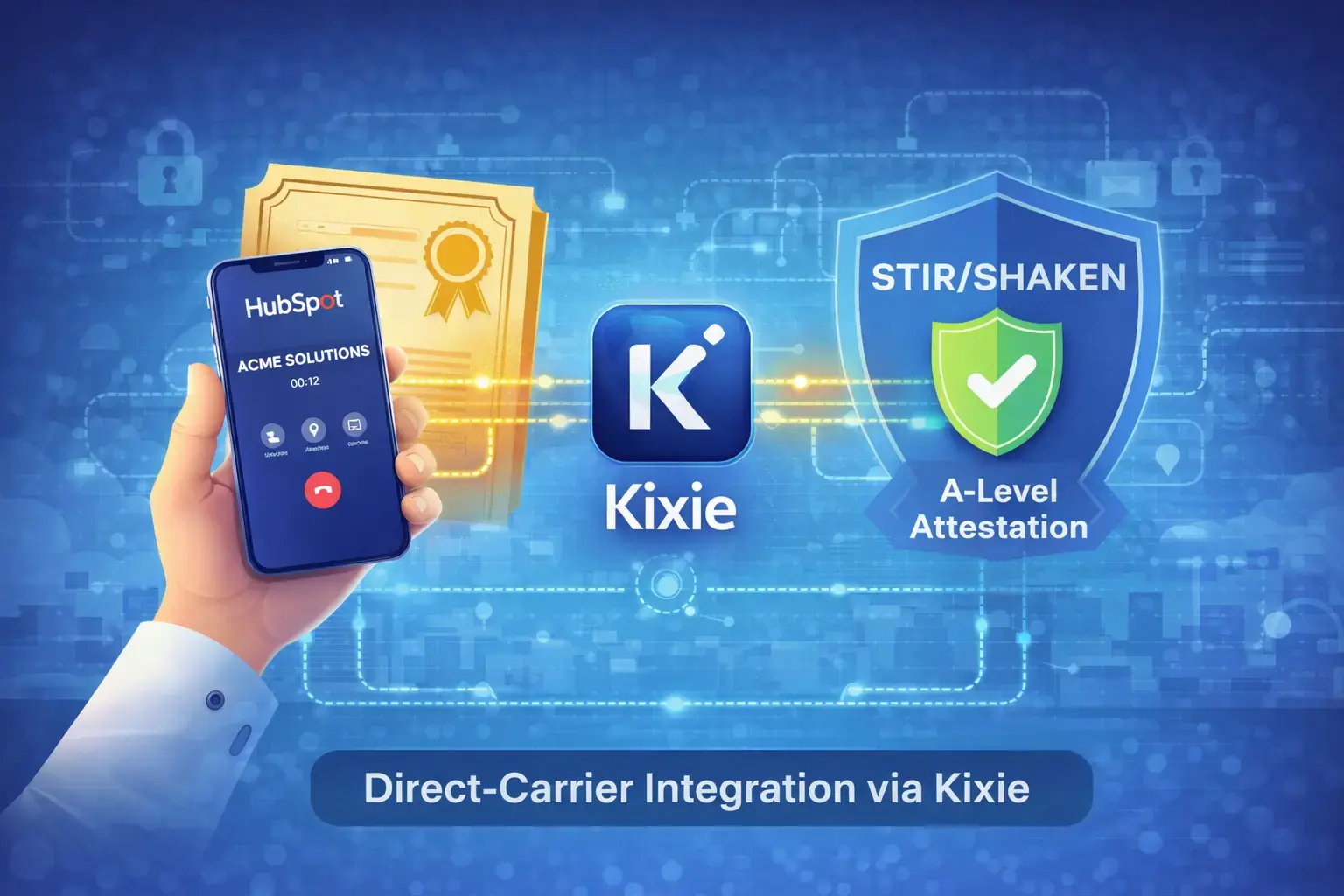
Kixie operates as a registered carrier interface rather than just a software extension. Unlike the bridged model where the CRM acts as middleware, Kixie manages the number inventory directly. When a user initiates a call via the Kixie integration for STIR/SHAKEN registration, Kixie manages the HubSpot numbers through direct upstream peering relationships.
Kixie authenticates the specific agent initiating the call through user credentials. Because Kixie has verified both the identity of the caller and the ownership of the number, it satisfies the conditions for A-Level Attestation. The call is signed with a “Full Attestation” token before entering the PSTN. This architectural distinction ensures that calls leave the network with an A-Level signature, raising the threshold required for a spam flag to be applied in the context of STIR/SHAKEN registration for HubSpot numbers.
Centralized STIR/SHAKEN Registration Management for HubSpot Numbers
Kixie provides a centralized interface for managing regulatory data called the Kixie Trust Center. This module automates the disparate processes for Voice (CNAM and STIR/SHAKEN registration) and SMS (A2P 10DLC). The Trust Center acts as compliance middleware, translating business data into formats required by the FCC and carrier databases.
Centralization ensures that the digital identity of the business remains consistent across all channels. This prevents discrepancies that could trigger compliance audits or blocking of HubSpot numbers during the STIR/SHAKEN registration process.
Step-by-Step Guide to STIR/SHAKEN Registration for HubSpot Numbers
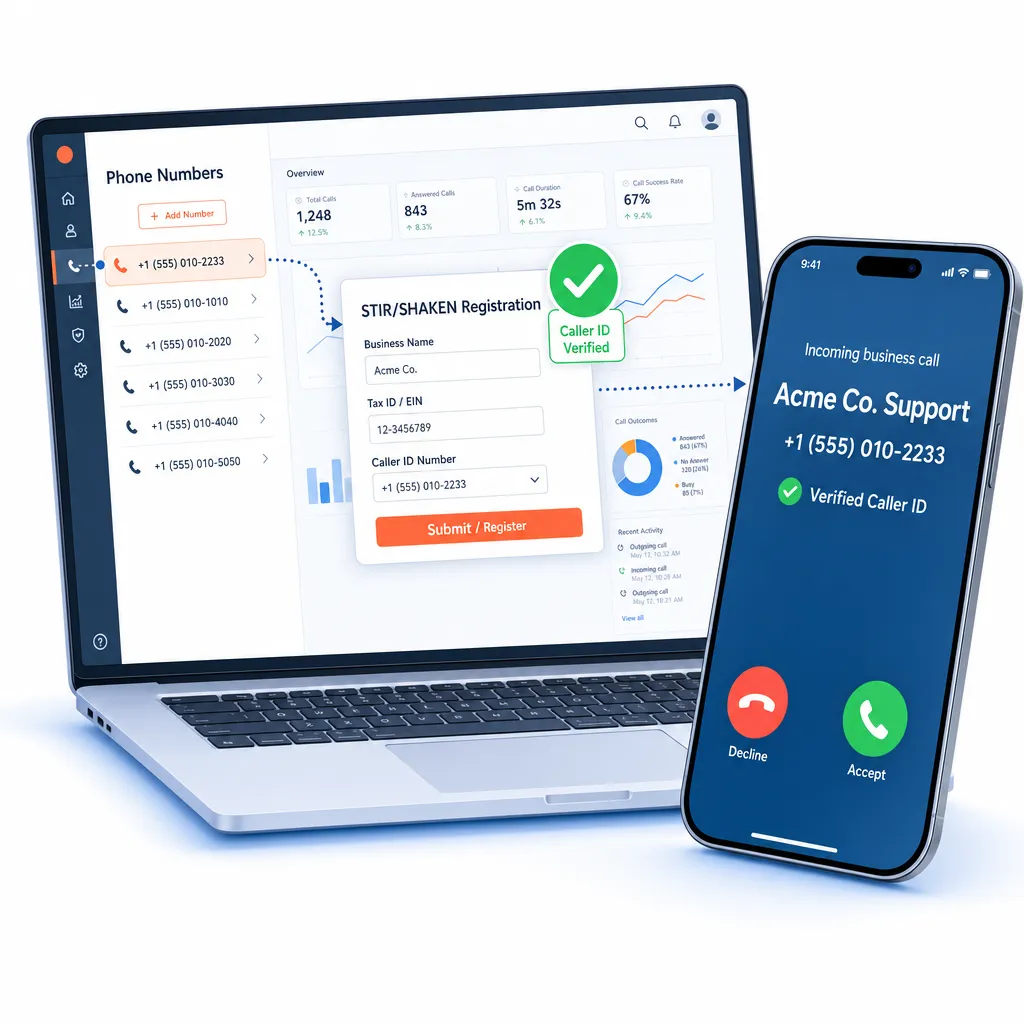
For users transitioning to this architecture, the STIR/SHAKEN registration process for HubSpot numbers involves three distinct phases: Entity Vetting, Voice Registration, and SMS Registration. The following guide details the procedure.
Entity Vetting for STIR/SHAKEN Registration of HubSpot Numbers
The legal existence of the business entity must be established before phone numbers are verified. This acts as the root of trust for STIR/SHAKEN registration.
Prerequisites: Users need the Legal Business Name (matching IRS records), Employer Identification Number (EIN), physical address (matching tax address), and a functional, HTTPS-secured business website.
Workflow: Access the Kixie Dashboard, open the Trust Center, and select the Business Profile tab. Input the Legal Business Name and EIN.
Critical Constraint: The entry must be the Legal Name associated with the EIN. A mismatch between a “Doing Business As” (DBA) name and the Legal Name is a common failure point in STIR/SHAKEN registration for HubSpot numbers.
Voice Profile and STIR/SHAKEN Registration for HubSpot Numbers
Once the entity is vetted, the next layer is the Voice Profile. This step links specific HubSpot numbers to the vetted entity, enabling A-Level signing for STIR/SHAKEN registration.
CNAM Definition: In the Trust Center, locate the “Voice” section to define the Caller ID Name.
Constraints: The name is limited to 15 characters, including spaces. It must be closely related to the Legal Business Name. Generic names like “Insurance Agent” are rejected; specific names like “StateFarm Agent” are required.
Propagation: Submitting this profile triggers a propagation event. While cryptographic signing is active immediately, the external CNAM display typically requires 2–5 business days to propagate across the network, completing this phase of STIR/SHAKEN registration for HubSpot numbers.
SMS and STIR/SHAKEN Registration for HubSpot Numbers
SMS compliance for HubSpot is integral to the broader STIR/SHAKEN registration ecosystem for HubSpot numbers. The 10-Digit Long Code (10DLC) framework regulates SMS traffic.
Workflow: In the Trust Center, select “SMS Brands & Campaigns.” Most users select “Standard Brand” and a campaign classification like “Low Volume Mixed.”
Content Declaration: Users must provide sample SMS templates.
Compliance Mandate: Every sample must include clear opt-out language (e.g., “Reply STOP to unsubscribe”). Users must also explicitly describe how consent is obtained. Vague descriptions are a leading cause of rejection in the SMS component of STIR/SHAKEN registration.
Advanced Reputation Management for HubSpot Numbers and STIR/SHAKEN Registration
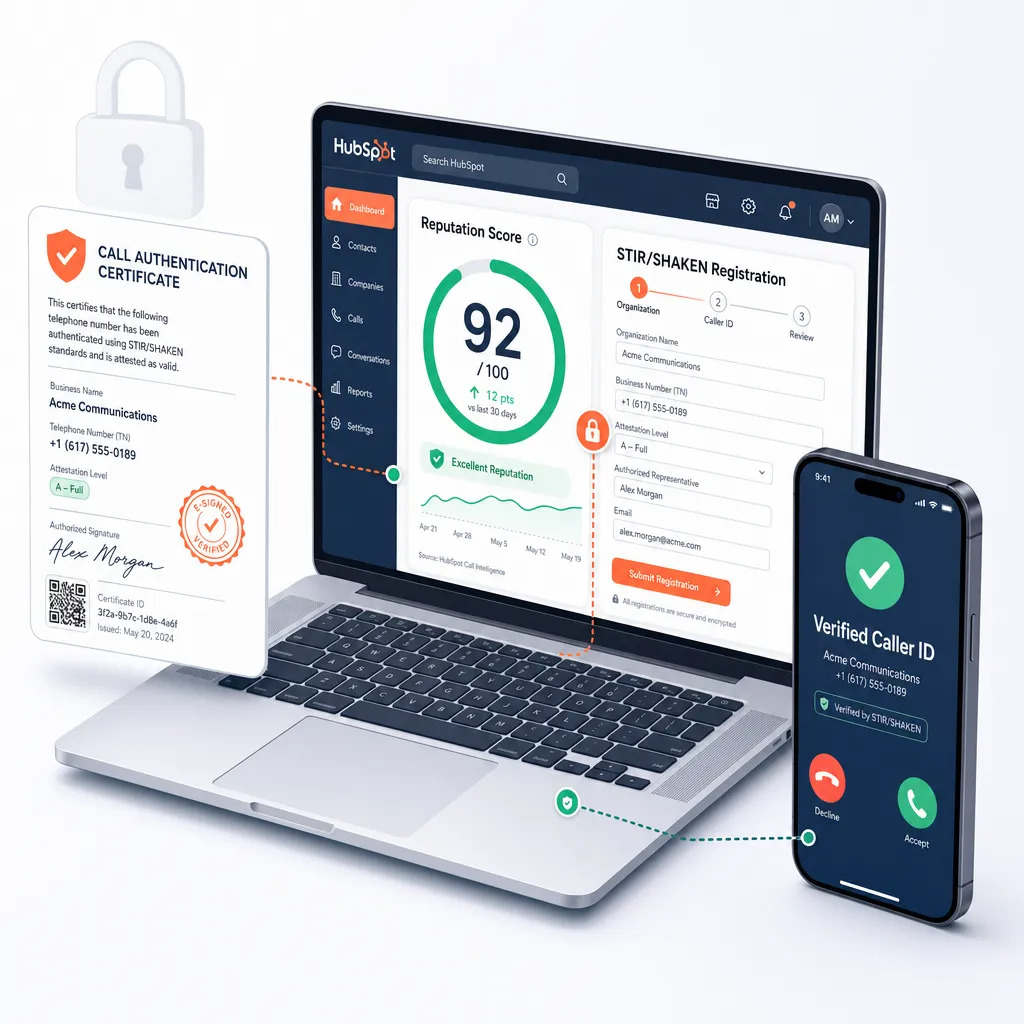
Compliance does not strictly guarantee delivery. A HubSpot number can possess A-Level Attestation via STIR/SHAKEN registration and still be flagged if calling behavior triggers anomaly detection algorithms. For high-volume users, Kixie employs reputation management technology known as ConnectionBoost.
ConnectionBoost Mechanics for STIR/SHAKEN Registration of HubSpot Numbers
ConnectionBoost addresses the “Volume Velocity” trigger that affects STIR/SHAKEN registration outcomes for HubSpot numbers. Analytics engines monitor the number of calls from a single Caller ID per hour. If an agent makes 100 calls in an hour from a single number, the velocity exceeds human thresholds, triggering a flag.
ConnectionBoost utilizes a dynamic number pool. When a call is initiated, the system selects a number from a pool of over 50,000 local presence numbers. The system rotates these numbers to ensure no single number is over-utilized. It also monitors the health of the pool; if a number shows a drop in live connections and answer rates, it is automatically cycled out. This automated logic protects the integrity of the STIR/SHAKEN registration for HubSpot numbers.
Automated Carrier Integration for STIR/SHAKEN Registration of HubSpot Numbers
Kixie integrates directly with First Orion, the primary analytics provider for T-Mobile. Through ConnectionBoost, Kixie automatically registers numbers in its pool as legitimate business lines within the First Orion database. This API-driven process supports the STIR/SHAKEN registration for HubSpot numbers by ensuring numbers are “allow-listed” by the carrier’s analytics engine. This automation replaces the manual process of uploading spreadsheets to registries, which is operationally difficult for teams managing large volumes of numbers.
ROI of Enhanced STIR/SHAKEN Registration for HubSpot Numbers
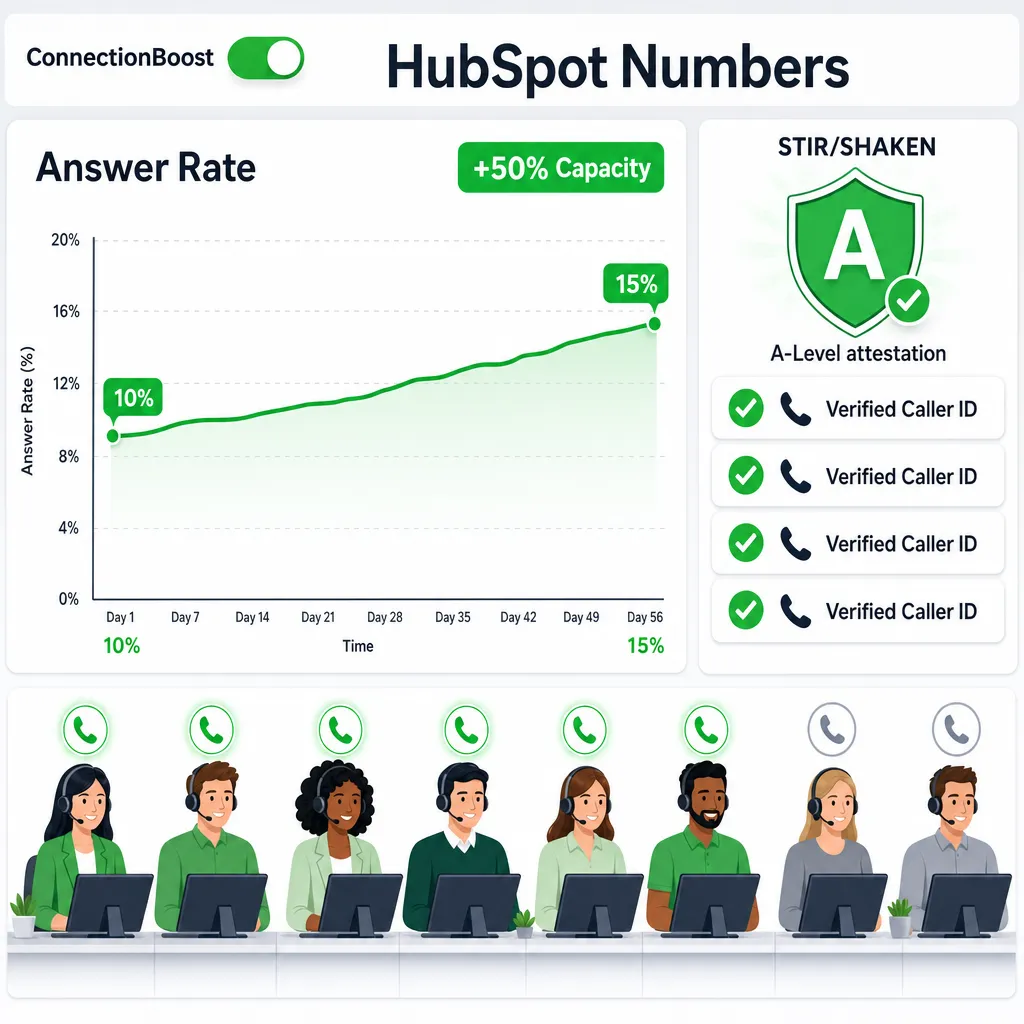
Implementing ConnectionBoost involves investment beyond standard costs. Researchers analyzing STIR/SHAKEN registration for HubSpot numbers should consider the return on investment (ROI). The ROI is derived from the Answer Rate.
+50% Capacity
If A-Level attestation and reputation management increase the answer rate from 10% to 15%, the effective capacity of the sales team increases by 50% without adding headcount. This efficiency gain validates the cost in high-velocity environments dependent on successful STIR/SHAKEN registration.
Migration Protocol: Porting HubSpot Numbers for STIR/SHAKEN Registration
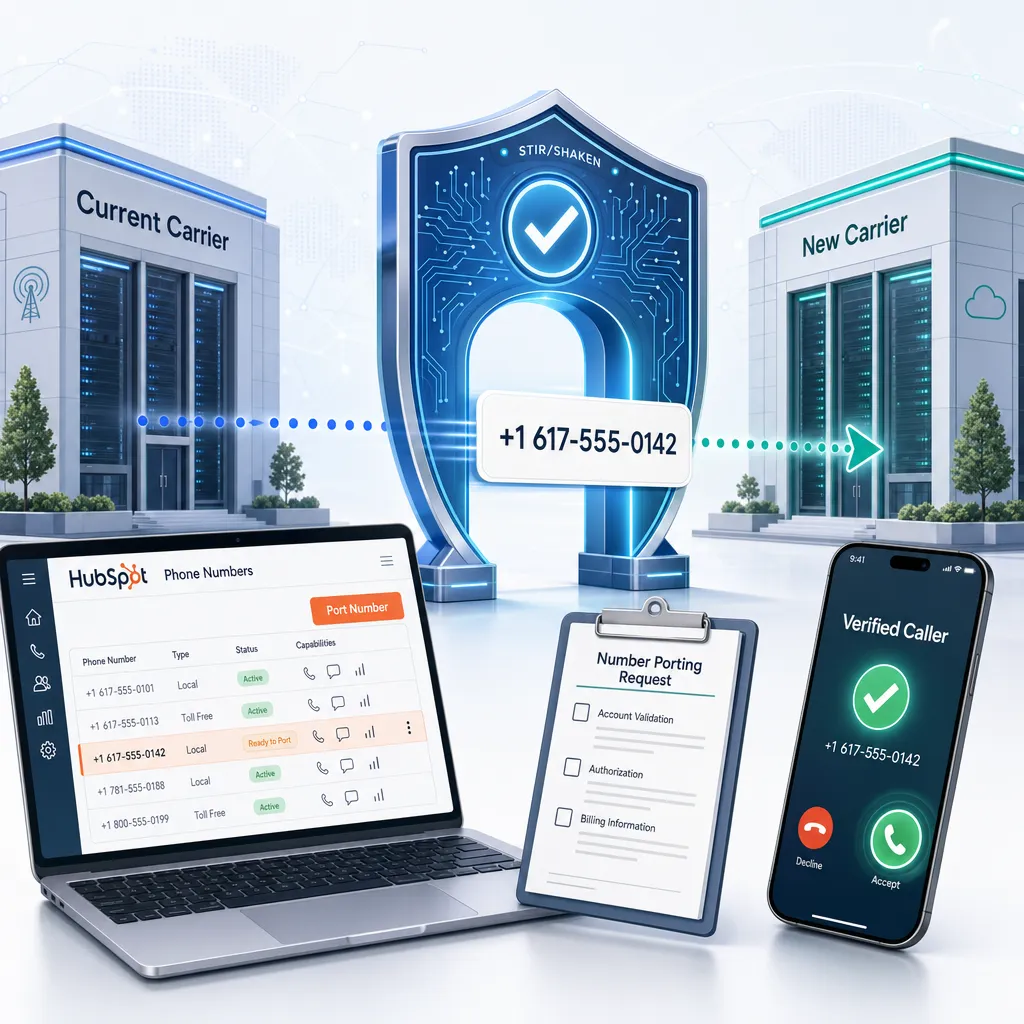
Local Number Portability (LNP) allows users to transfer established numbers from one carrier to another. The migration from HubSpot (Twilio) to Kixie is a precise procedure within the STIR/SHAKEN registration for HubSpot numbers transition.
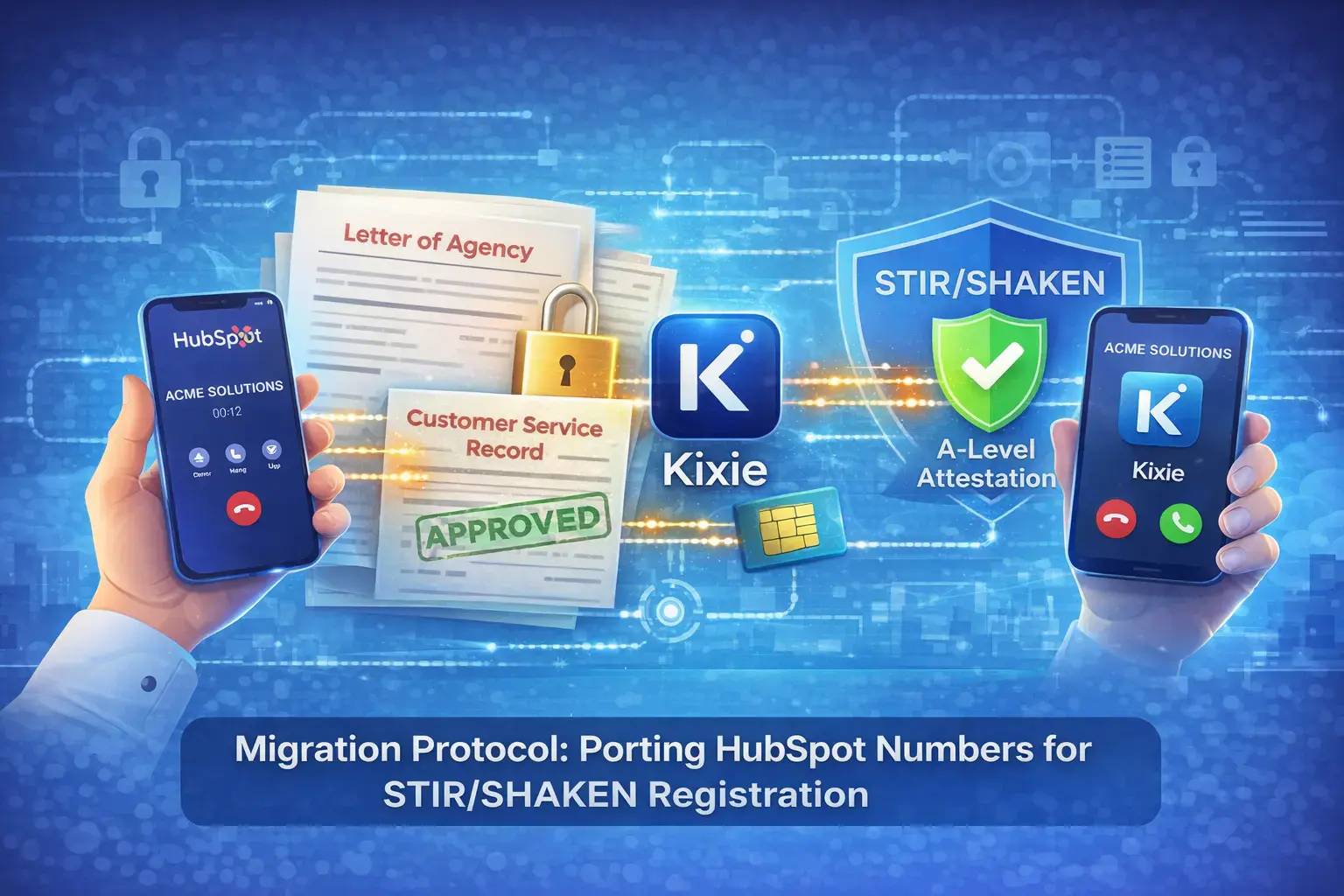
Documentation for Porting HubSpot Numbers and STIR/SHAKEN Registration
Success relies on data accuracy. A single mismatch will cause the losing carrier to reject the request, stalling the STIR/SHAKEN registration migration.
- Documentation: Obtain a Customer Service Record (CSR) or the most recent billing statement. This document serves as proof of ownership and must be dated within the last 30 days.
- PIN Requirement: Twilio numbers are often protected by a port-out PIN. Users may need to contact support specifically to request the “CSR and Port-Out PIN” to proceed with the HubSpot numbers transfer.
Submission Workflow for Porting HubSpot Numbers
Users must complete a Letter of Agency (LOA), a legal document authorizing the transfer. This must be signed by the authorized contact listed on the CSR. Once submitted with the CSR and PIN, the HubSpot numbers appear in the Kixie Dashboard with an “In Progress” status. Users must assign these numbers to their respective agents or call queues before the port completes. If a number transfers without assignment, inbound calls will fail until the configuration is updated in the STIR/SHAKEN registration system.
Managing HubSpot Seats During STIR/SHAKEN Registration Transition
A critical operational dependency exists between HubSpot paid seats and HubSpot number access during STIR/SHAKEN registration migration. Users often attempt to reduce costs by canceling their HubSpot Sales Hub seats immediately. If the paid seat associated with a phone number is removed before the port is complete, HubSpot may release the number back to the general pool. This causes the port request to fail and the number to be lost. Users must maintain all HubSpot Sales Hub seats until Kixie confirms that the HubSpot numbers have successfully ported.
Strategic Value of STIR/SHAKEN Registration for HubSpot Numbers
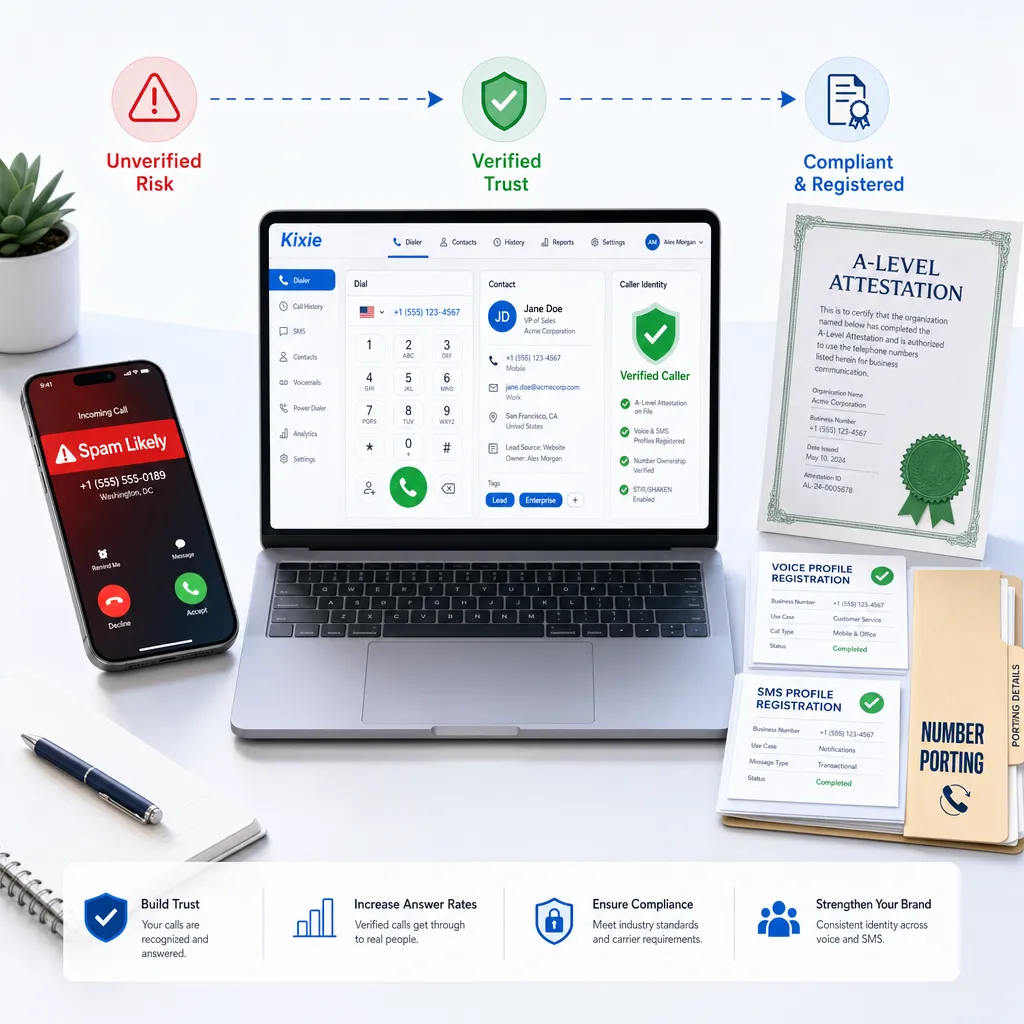
The implementation of STIR/SHAKEN has altered the economics of sales telephony. The “Spam Likely” label is a systemic penalty applied to unverified calling architectures. For users, the native calling model inherently struggles to meet the cryptographic standards required for A-Level Attestation in STIR/SHAKEN registration for HubSpot numbers.
The transition to Kixie represents a strategic migration to a verified identity infrastructure. By establishing a direct carrier relationship, securing A-Level Attestation, and utilizing advanced reputation management tools, organizations can insulate themselves from spam algorithms. The path involves precise entity vetting, sequential registration of voice and SMS profiles, and careful management of number porting. By following these protocols, administrators can ensure their organizations manage the STIR/SHAKEN registration for HubSpot numbers effectively, preserving the efficacy of their outreach.
Ready to close more deals with Kixie?
See how Kixie's AI-powered tools can transform your sales and support operations.
Start Free Trial