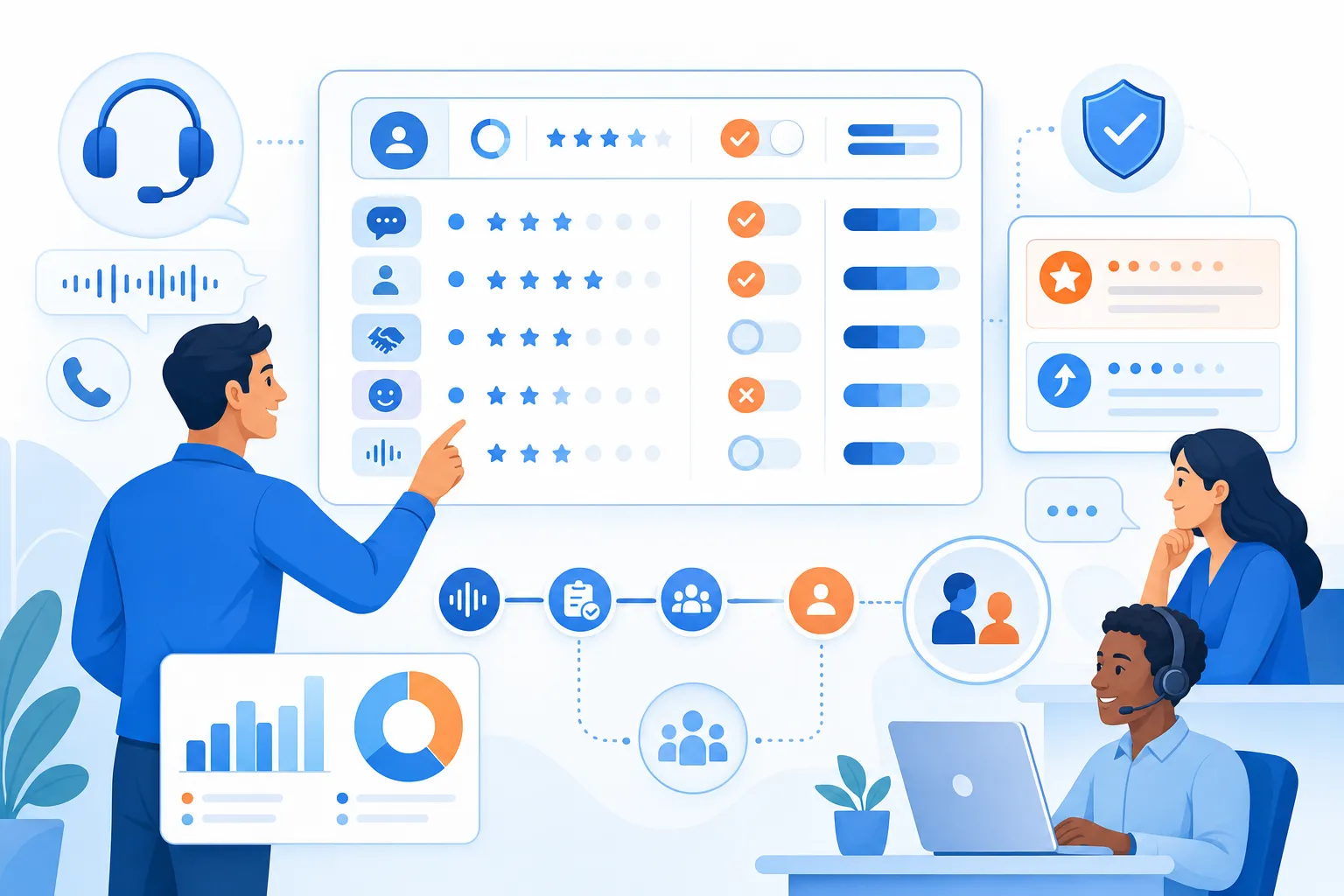
TL;DR: Call quality assurance scorecard template is a structured call review form for managers, QA reviewers, and team leads that turns subjective feedback into observable behaviors, points or pass fail ratings, and coaching across greeting, communication, discovery, policy adherence, resolution, closing, and documentation. Core scoring options are pass fail for compliance and required steps, 1 to 5 rating scales for soft skills, weighted scoring using weighted score equals category score percentage x category weight, and hybrid scoring where critical misses can trigger automatic review. The general template weights Opening 10%, Verification or process steps 10%, Discovery or issue identification 20%, Communication 15%, Empathy and rapport 10%, Knowledge and accuracy 15%, Resolution or next step 15%, and Documentation 5%, plus coaching notes with one strength, one improvement area, and one action before the next review. The sales template weights Opening 10%, Qualification and discovery 25%, Value presentation 20%, Objection handling 15%, Closing and next steps 20%, and Documentation 10%, and evaluates controllable behaviors rather than conversion alone. The support template weights Opening and verification 15%, Issue diagnosis 20%, Empathy and communication 20%, Accuracy and process knowledge 20%, Resolution or escalation 15%, and Documentation and follow-up 10%. A worked weighted example scores Opening 90% x 10% for 9 points, Discovery 80% x 25% for 20, Value presentation 70% x 20% for 14, Objection handling 75% x 20% for 15, Closing 100% x 15% for 15, Documentation 90% x 10% for 9, totaling 82/100. Rollout guidance is to set a clear QA goal, pick high impact criteria, keep the first version simple, define automatic failure rules clearly, calibrate reviewers, and capture external blockers like pricing, product limits, staffing, or system issues in notes instead of unfairly penalizing agents.
A call quality assurance scorecard gives managers, QA reviewers, and team leads a consistent way to evaluate calls. Instead of relying on subjective impressions like “good call” or “needs work,” a scorecard breaks the conversation into observable behaviors, assigns points or pass/fail ratings, and turns the review into coaching.
This guide explains what to include in a call quality assurance scorecard, how to score calls fairly, and how to use QA results to improve sales and customer service conversations. You will also find copy-ready scorecard structures for sales calls and support calls.
What is a call quality assurance scorecard?
A call quality assurance scorecard is a structured evaluation form used to assess how well an agent, rep, or advisor handled a phone conversation. It typically includes categories such as greeting, communication, discovery, policy adherence, resolution, closing, and documentation.

The goal is not just to grade calls. A useful call QA scorecard helps teams identify what happened on the call, what should happen differently next time, and what coaching or process changes are needed.
For example, a sales manager might use a scorecard to evaluate whether a rep confirmed the prospect’s needs, explained relevant value, handled objections, and set a clear next step. A support manager might use a scorecard to evaluate empathy, issue diagnosis, resolution accuracy, and follow-up expectations.
Why call QA scorecards matter
Without a shared scoring framework, call reviews can become inconsistent. One reviewer may focus on tone, another may focus on script adherence, and another may focus only on the outcome. That makes feedback feel subjective and hard to act on.

A well-designed call center QA scorecard helps teams:
- Evaluate calls consistently: Reviewers use the same criteria for every call.
- Coach specific behaviors: Managers can point to observable moments instead of giving vague feedback.
- Improve customer and prospect conversations: Teams can identify patterns that affect the caller experience.
- Support process adherence: Scorecards can include required steps, disclosures, verification, or documentation items.
- Reduce evaluator bias: Clear definitions and calibration sessions make scoring more consistent.
- Track improvement over time: Scores can show whether coaching is changing behavior.
Scorecards are most effective when they focus on behaviors the agent can control. If a call went poorly because of pricing, product limitations, staffing, or system issues, that context should be captured in notes rather than unfairly counted against the agent.
Call QA scorecard vs agent performance scorecard
A call QA scorecard and an agent performance scorecard are related, but they are not the same thing.

A call QA scorecard evaluates the quality of a specific conversation. It answers questions like: Did the rep open the call professionally? Did they ask useful questions? Did they communicate clearly? Did they follow the required process?
An agent performance scorecard usually tracks broader performance metrics across a period of time. These may include call volume, conversion rate, meetings booked, average handle time, customer satisfaction, first contact resolution, or revenue influenced.
Both views can be useful. QA scores explain how calls are being handled. Performance metrics show what outcomes are happening. When used together, they can help managers understand whether coaching should focus on activity, process, conversation quality, or external blockers.
What to include in a call scorecard
The right criteria depend on your team’s call type, industry, and workflow. However, most effective scorecards include a mix of conversation skills, process requirements, and outcome-oriented behaviors.

Call opening
The opening sets the tone for the conversation. Score whether the agent greeted the caller or prospect professionally, introduced themselves when appropriate, confirmed the purpose of the call, and created a smooth transition into the conversation.
- Used an appropriate greeting
- Introduced self and company when relevant
- Confirmed the caller’s or prospect’s name when needed
- Set a clear agenda or reason for the call
Call verification steps
Some teams need agents to confirm identity, account details, consent, or required internal steps. These items are often best scored as pass/fail because missing them can be more serious than a minor soft-skill issue.
- Completed required verification steps
- Followed required call handling process
- Captured required information accurately
- Used approved language where required
Call discovery and issue details
For sales calls, this category evaluates whether the rep uncovered the prospect’s needs, pain points, buying context, timeline, and decision process. For support calls, it evaluates whether the agent diagnosed the issue before offering a solution.
- Asked relevant open-ended questions
- Listened without interrupting unnecessarily
- Confirmed understanding before moving forward
- Identified the main need, issue, or opportunity
Call communication skills
Communication criteria should be specific. Instead of scoring “professionalism” in a vague way, define the behaviors that demonstrate it.
- Spoke clearly and at an appropriate pace
- Avoided confusing jargon unless appropriate for the audience
- Maintained a helpful and respectful tone
- Explained next steps in simple language
Call empathy and rapport
Empathy matters in both support and sales. The agent does not need to over-apologize or force friendliness, but they should acknowledge the other person’s situation and respond in a human way.
- Acknowledged the caller’s concern or goal
- Matched tone appropriately
- Showed patience during difficult moments
- Built trust without sounding scripted
Call product and process knowledge
This category evaluates whether the agent provided accurate information and used available resources appropriately. If the agent did not know the answer, the scorecard can assess whether they handled that gap correctly.
- Provided accurate information
- Set realistic expectations
- Used internal resources when needed
- Avoided guessing or overpromising
Call problem solving
For sales teams, this category often focuses on objections such as price, timing, authority, fit, or competing priorities. For support teams, it focuses on troubleshooting and resolution steps.
- Listened to the objection or issue fully
- Clarified the underlying concern
- Responded with relevant information
- Kept the conversation moving toward a useful next step
Call closing and next steps
A strong call ending should make it clear what happens next. This is especially important for sales teams, where a promising conversation can lose momentum if the rep fails to confirm a meeting, follow-up action, or decision timeline.
- Summarized the conversation accurately
- Confirmed next steps or resolution
- Set expectations for timing and ownership
- Ended the call professionally
Call documentation and follow-up
Call quality does not end when the call ends. If notes, dispositions, CRM updates, tickets, or follow-up tasks are inaccurate, the next interaction can suffer.
- Logged accurate notes
- Selected the correct disposition or status
- Created required follow-up tasks
- Included enough context for the next person or next interaction
How to score a call QA scorecard
There are several common ways to score a call monitoring scorecard. The best method depends on how simple or detailed your QA process needs to be.

Pass or fail scoring
Pass/fail scoring works well for required behaviors. For example, identity verification, required disclosures, or mandatory documentation may be marked as either completed or not completed.
Best for: compliance items, process requirements, required call steps, or critical errors.
Rating scale scoring
A rating scale, such as 1 to 5, allows reviewers to evaluate quality with more nuance. For example, communication clarity could be scored from 1 for unclear to 5 for excellent.
Best for: soft skills, discovery quality, rapport, explanation clarity, and objection handling.
Weighted scoring
Weighted scoring gives more importance to the criteria that matter most. For example, a sales call scorecard may give more weight to discovery and next-step setting than to the opening greeting.
A simple weighted formula is:
Weighted score = category score percentage x category weight
Then add the weighted category scores together to calculate the total QA score.
Example:
- Opening: 90% score x 10% weight = 9 points
- Discovery: 80% score x 25% weight = 20 points
- Value presentation: 70% score x 20% weight = 14 points
- Objection handling: 75% score x 20% weight = 15 points
- Closing and next steps: 100% score x 15% weight = 15 points
- Documentation: 90% score x 10% weight = 9 points
Total QA score: 82 out of 100
Hybrid scoring
Many teams use a hybrid model. Soft-skill categories are scored on a scale, while critical requirements are pass/fail. In some cases, a failed critical item may trigger an automatic review even if the total score is otherwise high.
If you use automatic failure rules, define them clearly and review them with agents before using the scorecard in performance conversations.
Call quality assurance scorecard template
Use the following copy-ready structure as a starting point. Because every team’s call flow is different, treat this as a template to customize rather than a universal standard.

General call QA scorecard template
- Call details: Agent name, reviewer name, call date, call type, customer or prospect segment, call outcome.
- Opening: Greeting, introduction, purpose of call, tone. Suggested weight: 10%.
- Verification or process steps: Required verification, approved language, required internal steps. Suggested weight: 10%.
- Discovery or issue identification: Questions asked, active listening, understanding confirmed. Suggested weight: 20%.
- Communication: Clarity, pace, professionalism, simple explanations. Suggested weight: 15%.
- Empathy and rapport: Acknowledgement, patience, trust-building. Suggested weight: 10%.
- Knowledge and accuracy: Correct information, realistic expectations, proper resource use. Suggested weight: 15%.
- Resolution or next step: Clear answer, action plan, ownership, timeline. Suggested weight: 15%.
- Documentation: Notes, disposition, follow-up tasks. Suggested weight: 5%.
- Coaching notes: One strength, one improvement area, one specific action before the next review.
Keep the first version simple. If reviewers struggle to finish evaluations or agents cannot remember what they are being measured on, the scorecard may be too complex.
Sales call scorecard example
Sales conversations need a slightly different scorecard than general customer service calls. The evaluation should focus on the behaviors that create a better buying conversation, not just whether the prospect converted.

Sales call scorecard categories
- Professional opening: Rep introduced themselves, confirmed the reason for the call, and earned permission to continue when appropriate.
- Qualification and discovery: Rep asked questions about needs, pain points, current process, timeline, budget context, stakeholders, and decision criteria where relevant.
- Active listening: Rep responded to what the prospect said instead of moving mechanically through a script.
- Value presentation: Rep connected the product or service to the prospect’s stated needs rather than giving a generic pitch.
- Objection handling: Rep clarified the objection, acknowledged it, and responded with relevant information.
- Call control: Rep kept the conversation focused while allowing the prospect to share useful context.
- Closing and next steps: Rep confirmed a clear next action, timeline, and owner.
- Call notes and follow-up: Rep documented the conversation and created the appropriate follow-up task.
Sales call scorecard weighting
- Opening: 10%
- Qualification and discovery: 25%
- Value presentation: 20%
- Objection handling: 15%
- Closing and next steps: 20%
- Documentation: 10%
For sales QA, avoid scoring only the result of the call. A rep can run a strong discovery call with a prospect who is not a fit. Another rep can book a meeting despite skipping important steps. The scorecard should evaluate controllable behaviors, while pipeline and conversion metrics can be reviewed separately.
Customer service call scorecard example
Customer service scorecards should emphasize issue understanding, accuracy, empathy, resolution, and follow-up. The exact criteria will vary depending on whether the team handles billing, technical support, account management, or general inquiries.

Customer service call scorecard categories
- Greeting and verification: Agent opened the call professionally and completed required verification steps.
- Issue diagnosis: Agent asked relevant questions and confirmed the customer’s main concern.
- Empathy: Agent acknowledged frustration, urgency, or confusion appropriately.
- Accuracy: Agent gave correct information and avoided unsupported promises.
- Resolution or escalation: Agent resolved the issue when possible or escalated with clear context.
- Expectation setting: Agent explained timing, next steps, and ownership.
- Closing: Agent confirmed whether the customer had any remaining questions and ended professionally.
- Documentation: Agent captured notes, ticket updates, and follow-up requirements.
Support call scorecard weighting
- Opening and verification: 15%
- Issue diagnosis: 20%
- Empathy and communication: 20%
- Accuracy and process knowledge: 20%
- Resolution or escalation: 15%
- Documentation and follow-up: 10%
How to roll out your QA scorecard
Building the scorecard is only the first step. The implementation process determines whether it becomes a useful coaching tool or just another form.

Set your scorecard goal
Start by deciding what the scorecard is meant to improve. Examples include more consistent sales discovery, better support resolution, improved documentation, stronger objection handling, or more consistent process adherence.
If the goal is unclear, the scorecard will often become too broad.
Pick high-impact call criteria
It is tempting to score every possible behavior. Resist that urge. A shorter scorecard with clear definitions is usually more useful than a long scorecard that reviewers rush through.
As a starting point, use six to eight categories and define each one with observable behaviors.
Test the scorecard on real calls
Before rolling the scorecard out to the whole team, test it on a small sample of calls. Look for criteria that are unclear, redundant, or difficult to score.
During the pilot, ask reviewers:
- Were any criteria confusing?
- Did reviewers interpret the same item differently?
- Did the score reflect the actual quality of the call?
- Were any important behaviors missing?
- Did the scoring process take a reasonable amount of time?
Align scorecard reviewers
Calibration is the process of having multiple reviewers score the same call, compare results, and align on scoring standards. This step is essential if more than one person will evaluate calls.
A simple calibration workflow looks like this:
- Select one call that includes a mix of strong and weak moments.
- Have each reviewer score it independently.
- Compare scores by category, not just total score.
- Discuss why reviewers scored differently.
- Update definitions or examples where needed.
- Repeat regularly, especially after scorecard changes.
Calibration helps reduce bias and gives agents more confidence that QA scores are fair.
Explain the scorecard to agents
Agents should know how they will be evaluated before scores are used in coaching or performance conversations. Walk through each category, explain what strong performance looks like, and share examples.
Position the scorecard as a coaching tool, not a surprise audit.
Turn scorecard scores into coaching
The most important part of QA is what happens after the review. Every scored call should lead to a clear coaching takeaway.
A simple coaching note structure is:
- Strength: What did the agent do well?
- Opportunity: What should improve?
- Moment: Where did it happen in the call?
- Practice: What role-play, script adjustment, or example will help?
- Follow-up: When will the manager review progress?
For example: “Strong opening and tone. Opportunity: discovery ended too early after the prospect mentioned timing concerns. Practice: role-play three follow-up questions for timing objections. Follow-up: review two calls next week.”
Update the scorecard regularly
Call flows change. Products change. Customer expectations change. A scorecard that worked last year may not reflect the conversations your team is having today.
Review the scorecard on a regular schedule, such as quarterly or after major process changes. Remove criteria that no longer matter and add criteria only when they support a clear business or customer experience goal.
Common QA scorecard mistakes to avoid
Vague scorecard criteria
Criteria like “good attitude” or “professionalism” can mean different things to different reviewers. Define the observable behaviors behind each category.

An overlong scorecard
If the form has too many items, reviewers may score inconsistently or focus on completing the form instead of understanding the call. Keep the scorecard focused on what matters most.
Flat scorecard weighting
Not every behavior has the same impact. A weak greeting should not always carry the same weight as inaccurate information, poor discovery, or missing a required next step.
Scoring call outcomes instead of behaviors
Conversion rate, customer satisfaction, and resolution rate can be useful metrics, but they are influenced by factors outside the agent’s control. QA criteria should focus primarily on what the agent did during the call.
Unaligned scorecard reviewers
If reviewers are not aligned, agents may receive different scores for similar calls. Calibration makes the process more consistent and credible.
Scorecard scores without coaching
A score without coaching is just a number. The value of a call quality scorecard comes from the behavior change it supports.
An outdated scorecard
Review your scorecard regularly to make sure it reflects current scripts, policies, products, and customer expectations.
FAQs about call quality assurance scorecards
What should a call scorecard include?
A call quality assurance scorecard usually includes call opening, verification or required process steps, discovery or issue identification, communication, empathy, knowledge accuracy, resolution or next steps, closing, documentation, and coaching notes. Sales teams may also include qualification, value presentation, and objection handling.

What is the best call scoring scale?
There is no single best scale. Pass/fail works well for required steps, while a 1 to 5 scale works well for soft skills and conversation quality. Many teams use a hybrid model with weighted categories and pass/fail critical items.
How many calls should managers review?
The right number depends on call volume, team size, risk level, and coaching goals. The key is to review enough calls to identify patterns, not just isolated moments. Teams with limited QA capacity can start with a small, consistent sample and increase coverage over time if resources allow.
How often should a scorecard be updated?
Review the scorecard whenever your call flow, product, policy, customer expectations, or sales process changes. Many teams also schedule a regular quarterly review to keep criteria current.
How do you reduce bias in call scoring?
Use clear definitions, focus on observable behaviors, calibrate reviewers, compare category-level scoring differences, and document examples of strong, average, and weak performance. When possible, avoid letting the final call outcome overly influence the quality score.
Can AI help with call quality assurance?
Some call center and sales technologies may support automation, transcription, analytics, or QA workflows. Capabilities vary by provider, so teams should verify what their tools can actually do before relying on automated scoring or broad call coverage.
Final thoughts on call QA scorecards
A strong call quality assurance scorecard should be simple enough to use consistently and specific enough to drive better coaching. Start with the behaviors that matter most, define them clearly, test the scorecard on real calls, calibrate reviewers, and turn every review into an action plan.
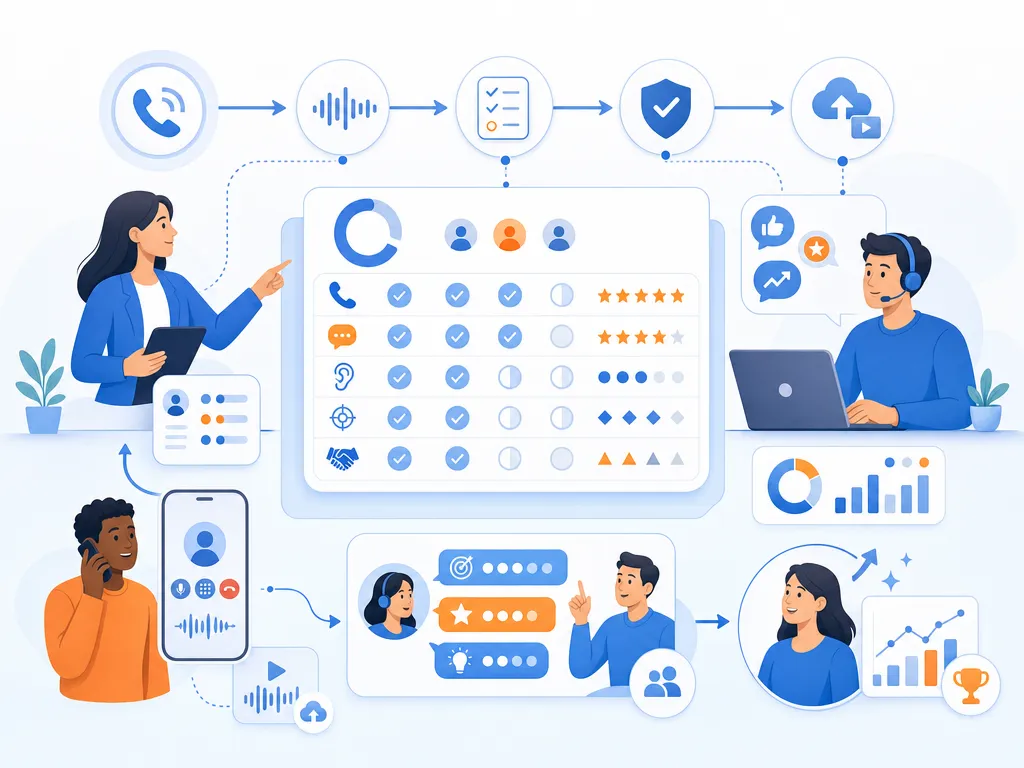
When QA is treated as a coaching system rather than a grading exercise, scorecards become much more useful. They help managers give fair feedback, help agents understand what good looks like, and help teams improve the conversations that matter most.
Ready to close more deals with Kixie?
See how Kixie's AI-powered tools can transform your sales and support operations.
Start Free Trial