TL;DR: Technical Analysis of HubSpot Spam Labeling and Remediation
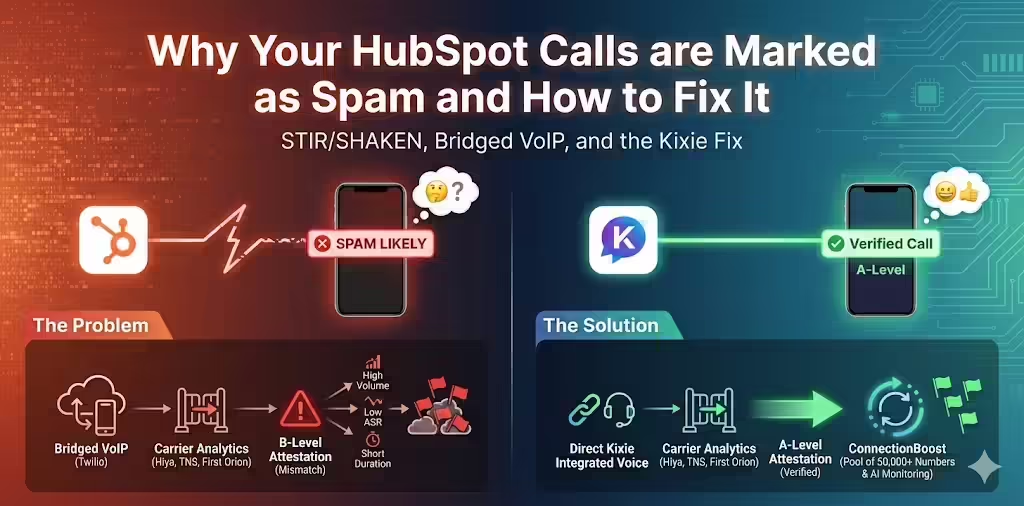
HubSpot outbound calls face “Spam Likely” labeling due to the interaction between the FCC’s STIR/SHAKEN caller ID authentication framework and the “bridged” VoIP architecture used by native CRM dialers. Because bridged calls create an identity mismatch between the Originating Service Provider (Twilio) and the Caller ID owner, they often receive B-Level Attestation rather than the trusted A-Level Attestation, triggering blocks from analytics engines like Hiya, TNS, and First Orion. Carrier algorithms further penalize numbers exhibiting high “Volume Velocity,” low Answer Seizure Ratios (ASR), and short call durations. While manual registration with the Free Caller Registry offers temporary relief, a permanent fix requires replacing the native dialer with Kixie Integrated Voice. Kixie bypasses bridging to secure A-Level Attestation and employs ConnectionBoost to rotate through a pool of 50,000+ numbers, neutralizing volume triggers via AI-driven health monitoring.
Why Your HubSpot Calls Are Failing
In the high-velocity world of modern sales development, the Customer Relationship Management (CRM) platform serves as the central nervous system of operations. For thousands of organizations, HubSpot is that system: a powerful tool for tracking interactions, managing pipelines, and executing inbound marketing strategies.
However, as sales teams increasingly rely on HubSpot’s native dialing features to execute outbound campaigns, a critical failure point has emerged that threatens to undermine the entire efficacy of the voice channel: the “Spam Likely” label. Sales leaders and Revenue Operations (RevOps) professionals are reporting a precipitous decline in connection rates, often unaware that their outbound phone numbers have been flagged by carrier algorithms as potential spam, scam, or fraud.
This phenomenon is not merely a nuisance; it represents a structural degradation of the sales infrastructure. When a legitimate business call is labeled as “Spam Likely” on a prospect’s device, the answer rate drops to near zero, causing a cascade of negative effects: lowered morale among Sales Development Representatives (SDRs), inaccurate data regarding lead quality, and ultimately, a significant loss of potential revenue.
This report provides an analysis of the technical, regulatory, and architectural factors driving this crisis. It dissects the STIR/SHAKEN attestation framework mandated by the FCC, analyzes the “bridging” architecture used by native CRM dialers that leads to low-trust attestation, and evaluates the role of third-party analytics engines like Hiya, TNS, and First Orion. Furthermore, this document serves as a manual for remediation, detailing steps for registering numbers and introducing Kixie as a robust solution designed to secure A-Level Attestation and automate reputation management.
The Mechanics of Why Calls Are Marked as Spam
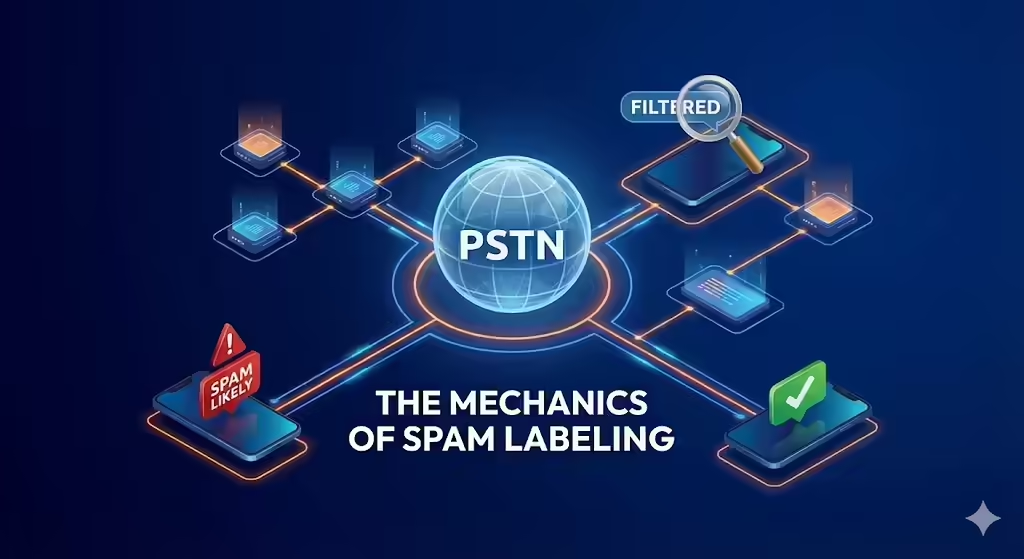
To understand the complexities of spam labeling, one must first understand the seismic shifts that have occurred in the telecommunications industry over the past decade. The Public Switched Telephone Network (PSTN), once a neutral conduit for voice traffic, has transformed into a highly filtered ecosystem where every call is scrutinized, analyzed, and adjudicated before it ever rings on the recipient’s device.
The Rise of the Robocall and the Regulatory Response
The genesis of the current “Spam Likely” epidemic lies in the explosion of illegal robocalls. Advances in Voice over Internet Protocol (VoIP) technology lowered the cost of placing calls to fractions of a cent, enabling bad actors to flood networks with billions of automated calls.
In response, consumer trust in the phone channel collapsed. Data suggests that more than half of all calls are now ignored, and the vast majority of consumers refuse to answer calls from unknown numbers. The regulatory response to this crisis was the Telephone Robocall Abuse Criminal Enforcement and Deterrence (TRACED) Act, signed into law in 2019, which mandated that the Federal Communications Commission (FCC) require all voice service providers to implement caller ID authentication technology known as STIR/SHAKEN.
STIR/SHAKEN: The Digital Fingerprint
STIR/SHAKEN is not a spam filter itself; rather, it is a protocol for establishing the identity of the caller. It provides the technical foundation upon which reputation decisions are made.
- STIR (Secure Telephony Identity Revisited): Developed by the Internet Engineering Task Force (IETF), STIR defines the protocols for creating a digital signature for a call. When a call is initiated, the originating provider creates a SIP (Session Initiation Protocol) Identity header containing an encrypted token that certifies the caller’s identity.
- SHAKEN (Signature-based Handling of Asserted information using toKENs): This framework defines how service providers implement the STIR protocols within their networks, establishing rules for how calls are signed by the originating carrier and verified by the terminating carrier.
The goal is to prevent “spoofing,” or the practice of falsifying Caller ID to mask the origin of the call. By attaching a digital certificate to call metadata, the originating carrier effectively vouches for the caller.
The Hierarchy of Trust: Attestation Levels Explained
The effectiveness of a call’s digital signature is communicated through its “Attestation Level”. This is a grade assigned by the Originating Service Provider (OSP) that tells the terminating carrier (e.g., Verizon, AT&T, T-Mobile) how much they trust the caller’s identity. Understanding these levels is critical for HubSpot users, as the architecture of the native dialer directly impacts which level is assigned.
| Attestation Level | Technical Designation | Definition | Impact on Spam Labeling |
|---|---|---|---|
| A-Level | Full Attestation | The service provider has authenticated the calling customer and verified that they are authorized to use the specific telephone number. | Trust Established. The carrier certifies, “I know this customer, and I know they own this number.” This is the gold standard required to avoid spam labels. |
| B-Level | Partial Attestation | The service provider has authenticated the customer but cannot verify that the customer is authorized to use the calling number. | Suspicion Triggered. The carrier certifies, “I know who this customer is, but I don’t know if they have the right to use this Caller ID.” This is common in bridged call scenarios. |
| C-Level | Gateway Attestation | The service provider has originated the call onto the network but cannot authenticate the call source (e.g., international gateway). | High Risk. The carrier certifies, “I have no idea who this is; I’m just passing the call along.” These calls are prime targets for blocking or labeling. |
The Role of Analytics Engines: The Judge, Jury, and Executioner
While STIR/SHAKEN handles authentication (who are you?), it does not handle reputation (are you a nuisance?). That task falls to third-party analytics engines like Hiya, TNS, and First Orion, which partner with major carriers to analyze call traffic in real-time and apply labels like “Spam Likely” based on behavioral patterns.
- AT&T & Hiya: AT&T utilizes Hiya to power its “ActiveArmor” service. Hiya analyzes billions of call events and prioritizes user reports heavily; if enough users mark a number as spam, Hiya’s global database is updated.
- Verizon & TNS: Verizon partners with TNS for its “Call Filter” service. TNS specializes in analyzing “Volume Velocity,” looking for numbers that are dialing aggressively across multiple networks simultaneously.
- T-Mobile & First Orion: T-Mobile utilizes First Orion for its “Scam Shield” suite. First Orion focuses on “Scam Likely” identification and offers specific programs for businesses to register their numbers.
Why Native HubSpot Calls Fail the Trust Test
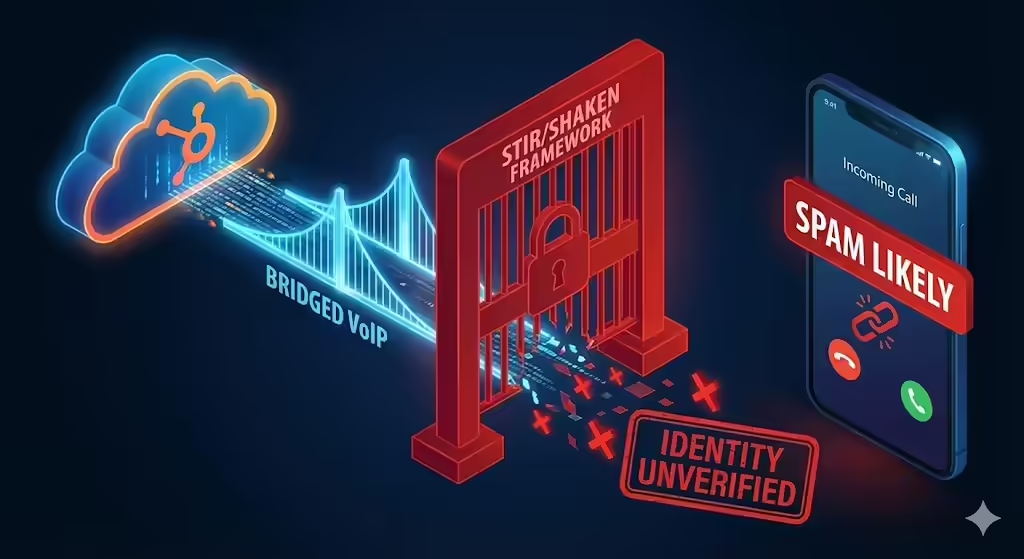
To understand why the native HubSpot calling tool is structurally predisposed to receiving spam labels, we must analyze the conflict between “Bridged VoIP” architecture and the STIR/SHAKEN regulatory framework. The issue is rarely malicious intent; it is a technical mismatch regarding identity verification.
The “Bridge” Architecture and Identity Mismatch
HubSpot is a CRM, not a telecommunications carrier. To provide calling functionality, it integrates with third-party providers, most notably Twilio. When a user initiates a call from HubSpot using a personal mobile or office number, the system uses a bridging technique.
The Technical Flow of a Bridged Call:
- Initiation: The sales rep clicks “Call” in HubSpot.
- Leg A (The Rep): Twilio’s server initiates an outbound call to the rep.
- Leg B (The Prospect): Simultaneously, Twilio initiates a call to the prospect.
- The Bridge: Twilio bridges the audio streams together.
The Attestation Gap:
In this scenario, the call originates from Twilio’s server, but the Caller ID displays the sales rep’s Verizon (or other carrier) number. This creates a critical mismatch in the STIR/SHAKEN framework: Twilio is the Originating Service Provider, but the number belongs to Verizon. Because Twilio cannot cryptographically prove the user has the exclusive right to use that Verizon number, it must downgrade the signature to B-Level Attestation. When terminating carriers see B-Level Attestation (verified source, unverified number), their analytics engines flag the discrepancy as potential “neighbor spoofing,” significantly increasing the probability of a “Spam Likely” label.
The Risk of Recycled Inventory
For users purchasing new phone numbers directly through HubSpot (provisioned by Twilio), a different risk emerges: “Dirty” inventory. Carriers recycle phone numbers, meaning a newly purchased number may have been previously owned by a debt collector or high-volume telemarketer. Since analytics engines maintain long-term memory, a user may inherit a number with “negative reputation equity” and be flagged as “Scam Likely” on their very first call.
Algorithmic Triggers: Volume and Behavior
Even with a clean number, the native HubSpot dialer can trigger spam filters by mimicking bot behavior:
- Volume Velocity: Analytics engines monitor calls per hour from a single number. If a rep makes 50-60 calls in an hour (common with power dialers), the sudden burst of traffic mimics robocalling, triggering flags.
- Answer Seizure Ratio (ASR): ASR is the percentage of calls that result in a connection. While legitimate calls have an ASR of 40-60%, spam-labeled numbers drop to 3%. This low answer rate feeds back into the analytics engine, confirming the caller is unwanted and reinforcing the spam label.
- Short Duration Calls: If a high percentage of calls last less than 15 seconds (e.g., immediate hang-ups or voicemail drops), carriers flag the number for suspicious behavior.

Diagnosing If Your HubSpot Calls Are Marked as Spam
One of the most insidious aspects of the “Spam Likely” problem is its invisibility to the caller; the warning label appears on the recipient’s screen, not the caller’s. Sales reps may attribute failure to “bad leads” when, in reality, their calls are being digitally blockaded.
Key Performance Indicators of a Flagged Number
To determine if your HubSpot numbers are compromised, you must audit your call logs for specific anomalies:
- The Cliff Drop in Connect Rate: Analyze your connection rate over a 30-day period. If a healthy benchmark of 10-15% suddenly plummets to 2-3% within 48 hours, this is a strong indicator of a spam flag.
- Sequential “No Answer” Dispositions: Filter HubSpot activity for call outcomes. Streaks of 30 to 50 consecutive “No Answer” or “Left Voicemail” outcomes without a live conversation suggest the number is burnt.
- The “Silenced Call” Phenomenon: On iOS 13 and later, the “Silence Unknown Callers” feature may send flagged numbers directly to voicemail without ringing. If reps report calls going straight to voicemail, this is the likely cause.
Carrier-Specific Labels
Feedback from prospects can confirm which carrier is flagging you:
- “Scam Likely”: Typically indicates T-Mobile / First Orion.
- “Spam Risk” / “Fraud Risk”: Typically indicates AT&T / Hiya.
- “Potential Spam”: Typically indicates Verizon / TNS.
Manual Remediation to Fix Spam Labels
For organizations currently experiencing spam labeling issues, there are immediate, manual steps to attempt to restore a number’s reputation by registering with centralized carrier databases. Note: These steps are often temporary if the underlying dialing behavior (high velocity) continues, but they are necessary for cleaning existing assets.
The Free Caller Registry (FCR)
The Free Caller Registry acts as a single submission point for the three major analytics partners: Hiya, TNS, and First Orion.
- Access: Navigate to the Free Caller Registry website.
- Entity Verification: Provide legal business details, including company name, address, and URL to prove legitimacy.
- Number Submission: Upload numbers individually or via Excel template, including all numbers used for outbound sales in HubSpot.
- Data Points: Provide a display name (CNAM), call category (e.g., “Customer Service” or “Sales”), and monthly volume estimates.
- Verification & Submission: After phone or email verification, data is distributed to the analytics engines, with approval typically taking 24-72 hours.
Carrier-Specific Dispute Portals
If FCR does not resolve the issue, file direct disputes with the specific carriers blocking your calls:
- AT&T (Hiya): Visit the Hiya Help Center and select “The number is wrongly identified as spam”. You must explain why the calls are legitimate.
- Verizon (TNS): Visit the Voice Spam Feedback portal to report incorrect categorization. Note that Verizon treats this as feedback and does not guarantee a permanent whitelist if user reports continue.
- T-Mobile (First Orion): Visit the T-Mobile Call Reporting portal to contest “Nuisance” or “Blocked” labels.
The Structural Solution to Fix HubSpot Calls
While manual remediation provides a temporary fix, it does not solve the fundamental architectural flaws of attestation gaps and volume triggers inherent in standard CRM dialers. For a scalable solution, businesses must upgrade their telephony infrastructure to a platform like Kixie, which is engineered to handle the complexities of STIR/SHAKEN and carrier analytics.
Pillar 1: Securing A-Level Attestation
Kixie bypasses the “bridge” architecture used by native tools. Because Kixie acts as the authoritative entity managing the phone number and verifies the business customer (Know Your Customer), it can cryptographically sign calls with A-Level (Full) Attestation. When a carrier receives a Kixie call, they see a valid token certifying that the business owns the number. This proof bypasses the identity-mismatch triggers that plague bridged calls, reducing the baseline risk score.
Pillar 2: ConnectionBoost and AI-Driven Reputation Management
To combat “Volume Velocity” triggers (where high call volumes flag a number as a bot), Kixie uses ConnectionBoost.
- Dynamic Number Rotation: Instead of a single static number, Kixie utilizes a pool of over 50,000 verified numbers, automatically selecting a number that matches or neighbors the prospect’s area code.
- AI Health Monitoring: Kixie’s AI monitors number performance in real-time. If a number’s connection rate drops (indicating a spam flag), it is immediately pulled from rotation and replaced with a fresh, clean number. This prevents the “death spiral” of low answer rates.
Pillar 3: Progressive Caller ID
ConnectionBoost ensures a prospect never sees the same number twice. If a rep calls a prospect on Tuesday and again on Thursday, Kixie selects a different local number for the second call. This “freshness” increases the likelihood of an answer without violating compliance, as all numbers are legitimately registered to the business.
Implementing Kixie for Your HubSpot Calls
Integrating Kixie with HubSpot allows sales teams to replace the native dialer, along with the associated spam risks, without disrupting their workflow. The integration relies on a bi-directional sync API to ensure data fidelity.
Integration Architecture
- The Chrome Extension (PowerCall): This extension injects the Kixie dialer directly into the HubSpot browser, turning phone numbers on any record into “Click-to-Call” links.
- Automated Activity Logging: Kixie automatically logs every interaction into the HubSpot Timeline, including call outcomes (e.g., Connected, Busy), duration, and a URL to the call recording.
Workflow Automation
Kixie uses HubSpot’s Workflow engine to automate sales tasks:
- Trigger-Based SMS: When a rep marks a call as “Left Voicemail,” HubSpot can trigger an automatic Kixie SMS to the prospect (“Hey, just left you a voicemail…”), increasing engagement.
- Speed-to-Lead: When a prospect submits a “Request Demo” form, HubSpot can trigger an immediate Kixie “Auto-Call” to the sales rep; upon answering, the system dials the prospect instantly.
Conversation Intelligence
Calls made via Kixie are transcribed and analyzed by HubSpot’s Conversation Intelligence (CI) tools. Managers can search transcripts for keywords and identify coaching opportunities based on sentiment and objection handling, turning voice data into actionable intelligence.
Comparative Market Analysis for HubSpot Users
HubSpot users facing spam issues often evaluate multiple solutions. It is crucial to distinguish between basic “Call Logging” apps and comprehensive “Reputation Management” platforms that solve the specific issue of spam labeling.
Kixie vs. Quality Voice & Data (QVD)
Quality Voice & Data (QVD) focuses on “Trusted Call Completion” via static number registration.
| Feature Category | Quality Voice & Data (QVD) | Kixie Integrated Voice |
|---|---|---|
| Primary Focus | Monitoring & Compliance (registering static numbers). | Action & Remediation (preventing flags via rotation). |
| Spam Solution | 1-to-1 mapping. If your static number gets flagged, you must intervene. | ConnectionBoost. A dynamic pool of numbers rotates to dilute volume velocity triggers. |
| User Suitability | Best for Enterprise Support or low-volume compliance environments. | Best for Outbound Sales and high-growth teams needing maximum connection rates. |
Verdict: Kixie is the superior solution for aggressive outbound sales because its ability to rotate numbers protects against the “spike” triggers (high call volume) that static models like QVD cannot easily mitigate.
Kixie vs. Native HubSpot (Twilio)
Comparing Kixie to the default HubSpot calling tool highlights the architectural differences.
| Feature | Native HubSpot Calling | Kixie |
|---|---|---|
| Attestation | B-Level / C-Level (Due to bridging architecture). | A-Level (Direct carrier integration). |
| Local Presence | Manual; must buy individual numbers. | Automated; AI selects from 50k+ pool. |
| Support | Self-serve knowledge base. | Dedicated US-based support. |
Verdict: Native calling is insufficient for cold outreach due to the spam labeling risks inherent in its bridged architecture.
Strategic Best Practices for Your Calls
While upgrading to a platform like Kixie solves technical challenges like Attestation, human behavior remains a variable. To maintain long-term number health and avoid spam flags, sales teams must adopt “Hygiene Protocols”.
The “Spam Trap” Prevention Protocol
- List Hygiene: Do not call “dirty” lists. High bounce rates (calling disconnected numbers) destroy reputation scores. Use verification tools like NeverBounce before loading leads.
- Disconnect Rule: If a rep encounters a “Disconnected” number, a HubSpot workflow should immediately set that contact to “Non-Marketing” to prevent future calls.
- Rational Call Pacing: Avoid “blasting”. Even with ConnectionBoost (Kixie’s dynamic number rotation feature), spacing calls out creates a human cadence that avoids “machine-gun” alerts.
- Voicemail Etiquette: Avoid generic “Call me back” messages, which are easily identified as spam by consumers. Ensure messages are specific and relevant.
- Respect the DNC: Calling a number on the Do Not Call registry is the fastest way to generate a formal complaint, which carrier analytics weigh heavily. Use scrubbing tools to prevent accidental dials.
The Future of Trusted HubSpot Calls
The battle between legitimate sales and illegal spam is driving the telecommunications industry toward a “Zero Trust” model. While current solutions focus on avoiding negative labels, the future lies in Rich Call Data (RCD), or Branded Calling.
Beyond Caller ID: The Branded Call
Carriers are evolving beyond simple number displays to allow businesses to transmit rich metadata along with the call:
- Company Logo: Displayed on the recipient’s lock screen.
- Verified Badge: A checkmark indicating the carrier has authenticated the caller with A-Level Attestation.
- Reason for Call: A short text string (e.g., “Regarding your account upgrade”) displayed before the user answers.
Partners like Hiya and First Orion are currently rolling out this technology. Kixie is preparing infrastructure to support RCD as it becomes standard, shifting the paradigm from “Avoiding Spam Labels” to “Projecting Brand Authority”.
Conclusion: How to Fix It Permanently
The “Spam Likely” label is a structural threat to the outbound sales model, resulting from the collision of the STIR/SHAKEN regulatory framework and the technical limitations of legacy CRM dialing architectures. For HubSpot users, the default “bridged” calling setup is a liability, generating low-trust attestation signals that invite algorithmic blocking.
While manual registration with the Free Caller Registry is a necessary hygiene step, it is insufficient for high-velocity sales teams. The solution requires a fundamental upgrade to the telephony stack.
Kixie Integrated Voice provides this upgrade. By replacing the bridged architecture with a direct carrier connection, Kixie secures the A-Level Attestation required for trust. By implementing ConnectionBoost, Kixie neutralizes the volume velocity triggers that plague sales teams, using AI to rotate and refresh numbers dynamically.
For the modern sales organization, the choice is binary: continue to struggle with burnt numbers or invest in a reputation-first voice platform. The era of blind trust is over; the era of verified, authenticated reputation has arrived.
Immediate Action Plan
To reverse the damage of spam labeling today:
- Audit: Review HubSpot call logs for the “Cliff Drop” in connection rates.
- Register: Submit all current business numbers to the Free Caller Registry immediately.
- Upgrade: Evaluate Kixie to replace the native dialer, specifically for SDRs making >30 calls per day.
- Automate: Configure HubSpot workflows to remove “Disconnected” numbers from dial lists instantly.
Ready to close more deals with Kixie?
See how Kixie's AI-powered tools can transform your sales and support operations.
Start Free Trial