TL;DR
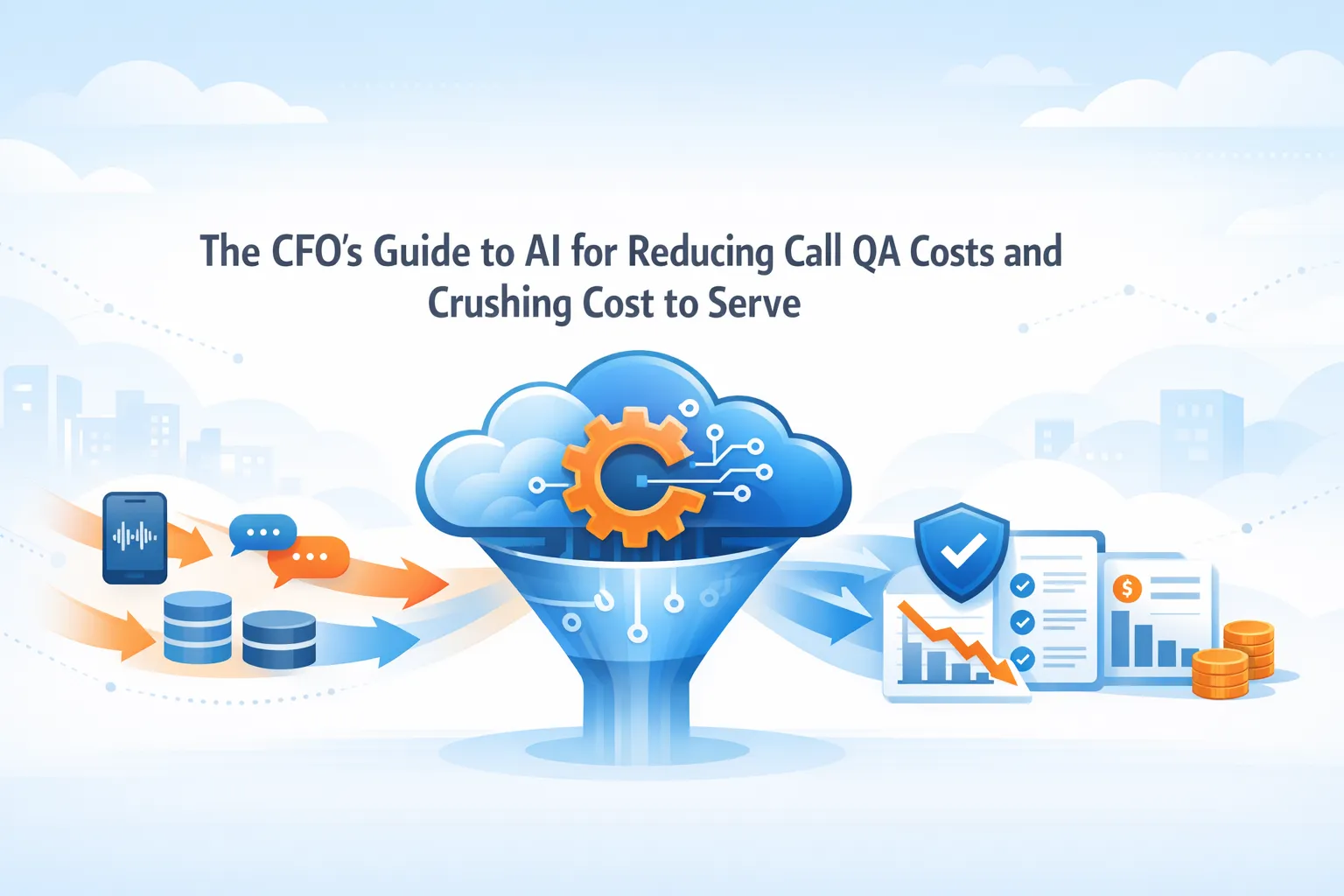
This guide outlines financial strategies for reducing Contact Center Cost to Serve (CTS) and Call QA expenses by pivoting from traditional headcount reduction to AI-driven operational efficiency. Traditional support models incur high costs ($2.70–$5.60 per basic call, $8.00–$15.00 for complex issues) and high attrition (>40%), while outsourcing adds 15-60% in hidden management overhead. Implementing Retrieval-Augmented Generation (RAG) chatbots can deflect 60-80% of routine queries, while Automated QA systems reduce monitoring costs from $2.00-$4.00 per manual review to $0.10-$0.30 per interaction, enabling 100% coverage. Advanced Agentic AI capable of autonomous workflows can achieve up to 70% resolution rates for transactional tasks. Verified case studies demonstrate significant ROI: Klarna’s AI handled 2.3 million conversations (equivalent to 700 FTEs) for a $40 million profit improvement; Vodafone’s TOBi assistant achieved 70% First Call Resolution (FCR) across 1 million monthly interactions; and Alibaba saved $150 million annually via AI-assisted coaching. Strategic implementation involves twelve core steps, including adopting Voice AI for workforce scheduling (92% admin reduction), prioritizing FCR over Average Handle Time (AHT), and utilizing Conversation Intelligence to automate CRM data entry. Organizations adopting these architectures typically realize positive ROI within 8-14 months and 150-300% returns over three years.
TL;DR
This guide outlines financial strategies for reducing Contact Center Cost to Serve (CTS) and Call QA expenses by pivoting from traditional headcount reduction to AI-driven operational efficiency. Traditional support models incur high costs ($2.70–$5.60 per basic call, $8.00–$15.00 for complex issues) and high attrition (>40%), while outsourcing adds 15-60% in hidden management overhead. Implementing Retrieval-Augmented Generation (RAG) chatbots can deflect 60-80% of routine queries, while Automated QA systems reduce monitoring costs from $2.00-$4.00 per manual review to $0.10-$0.30 per interaction, enabling 100% coverage. Advanced Agentic AI capable of autonomous workflows can achieve up to 70% resolution rates for transactional tasks. Verified case studies demonstrate significant ROI: Klarna’s AI handled 2.3 million conversations (equivalent to 700 FTEs) for a $40 million profit improvement; Vodafone’s TOBi assistant achieved 70% First Call Resolution (FCR) across 1 million monthly interactions; and Alibaba saved $150 million annually via AI-assisted coaching. Strategic implementation involves twelve core steps, including adopting Voice AI for workforce scheduling (92% admin reduction), prioritizing FCR over Average Handle Time (AHT), and utilizing Conversation Intelligence to automate CRM data entry. Organizations adopting these architectures typically realize positive ROI within 8-14 months and 150-300% returns over three years.
Analyzing the Economics of Call Centers and Cost to Serve
To understand why AI cost reduction is necessary, we must diagnose the economic sickness plaguing traditional call center setups. The prevailing metrics used to manage performance often hide the actual drivers of expense.
Why Traditional Cost-Cutting Increases Cost to Serve
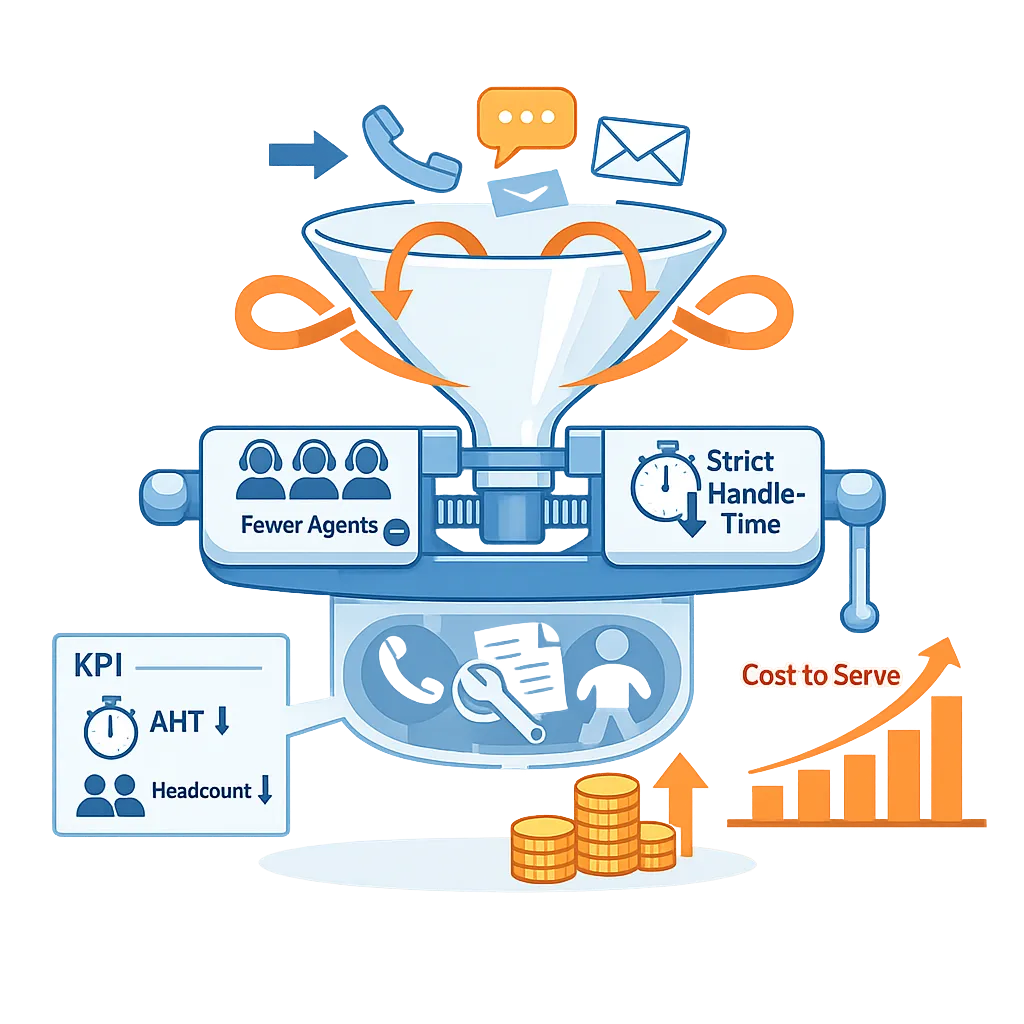
The “paradox of CX” suggests that initiatives designed to cut costs through brute force, such as reducing agent count or imposing strict handle-time limits, often lead to higher long-term expenses. When frontline staffing is reduced by 20-30% without a commensurate reduction in workload via effective automation, wait times balloon and resolution rates drop. This leads to a spike in churn risk and brand damage, which ultimately costs more to repair than the initial savings yielded.
Furthermore, relying exclusively on financial accounting to measure success can hide the root causes of overspending. For example, hiring less experienced technicians or agents to lower the cost per interaction often drives up the error rate, generating repeat calls that inflate the total Cost to Serve (CTS).
Understanding Real Agent Expenses Versus AI Investments
The industry benchmark for Cost per Call in a traditional setup ranges significantly, typically falling between $2.70 and $5.60 for basic inquiries, but scaling up to $8.00–$15.00 for complex technical support. These figures include direct labor, infrastructure, and technology, but they often exclude the “soft costs” of agent churn and retraining.
In the US, standard support services cost between $26 and $30 per hour. When you factor in that attrition rates in the call center industry can exceed 40%, the constant cycle of recruiting and onboarding new agents (who take months to reach full productivity) represents a massive, often uncalculated tax on operations.
What is Cost to Serve (CTS) and Why Must it be Reduced?
Cost to Serve (CTS) is an analytical framework that calculates the total cost incurred to fulfill customer demand for a service or product. Unlike simple Cost of Goods Sold (COGS), CTS includes the supply chain, logistics, and specifically the customer service overhead required to maintain that relationship.
In a contact center context, CTS is driven up by high-volume channels (like voice) handling low-value transactions. If a customer calls a live agent to reset a password or check an order status (tasks that generate zero revenue but incur a $5.00 cost), the CTS for that customer spikes, eroding profitability. Reducing CTS requires migrating these transactional interactions to lower-cost automated channels while reserving high-cost human capital for complex, high-value interactions.
The Hidden Impact of Outsourcing on Call QA Costs
Outsourcing to offshore BPOs (Business Process Outsourcing) is the classic move to lower CTS, often promising rates as low as $6–$9 per hour. However, recent analysis suggests that the hidden costs of outsourcing can add 15% to 60% to the base contract value.
These hidden costs manifest in several ways:
- Management Overhead: Managing an offshore team often requires 15-25% more oversight hours from internal management to ensure quality and alignment.
- Training and Knowledge Transfer: Outsourced teams often lack deep brand knowledge, leading to longer training periods (20-40% more time) and creating “knowledge silos” where critical customer feedback does not reach product teams.
- Service Level Penalties & Transition Fees: Setup fees, transition costs, and penalties for volume fluctuations can erode the sticker-price savings.
How Rigid Scripts Mask Actual Call QA Costs
To manage these outsourced or low-cost teams, organizations often implement rigid efficiency rules, such as strict Average Handle Time (AHT) targets. While this lowers the theoretical cost per minute, it frequently destroys First Call Resolution (FCR). Agents rushed to get off the phone will transfer calls unnecessarily or provide incomplete answers, forcing the customer to call back.
Research shows that a 1% improvement in FCR reduces operating costs by 1%, yet rigid efficiency rules often drive FCR down. Modern call center solutions, such as Kixie, emphasize metrics that balance efficiency with outcome, utilizing conversation intelligence to score calls based on successful resolution rather than just speed.
AI and RAG Chatbot Implementation Strategies
The solution to the economic pressure of the contact center is not cheaper labor, but smarter technology. The emergence of RAG chatbots represents a paradigm shift from the frustrating, scripted bots of the past.
How AI and RAG Chatbots Revolutionize Customer Service
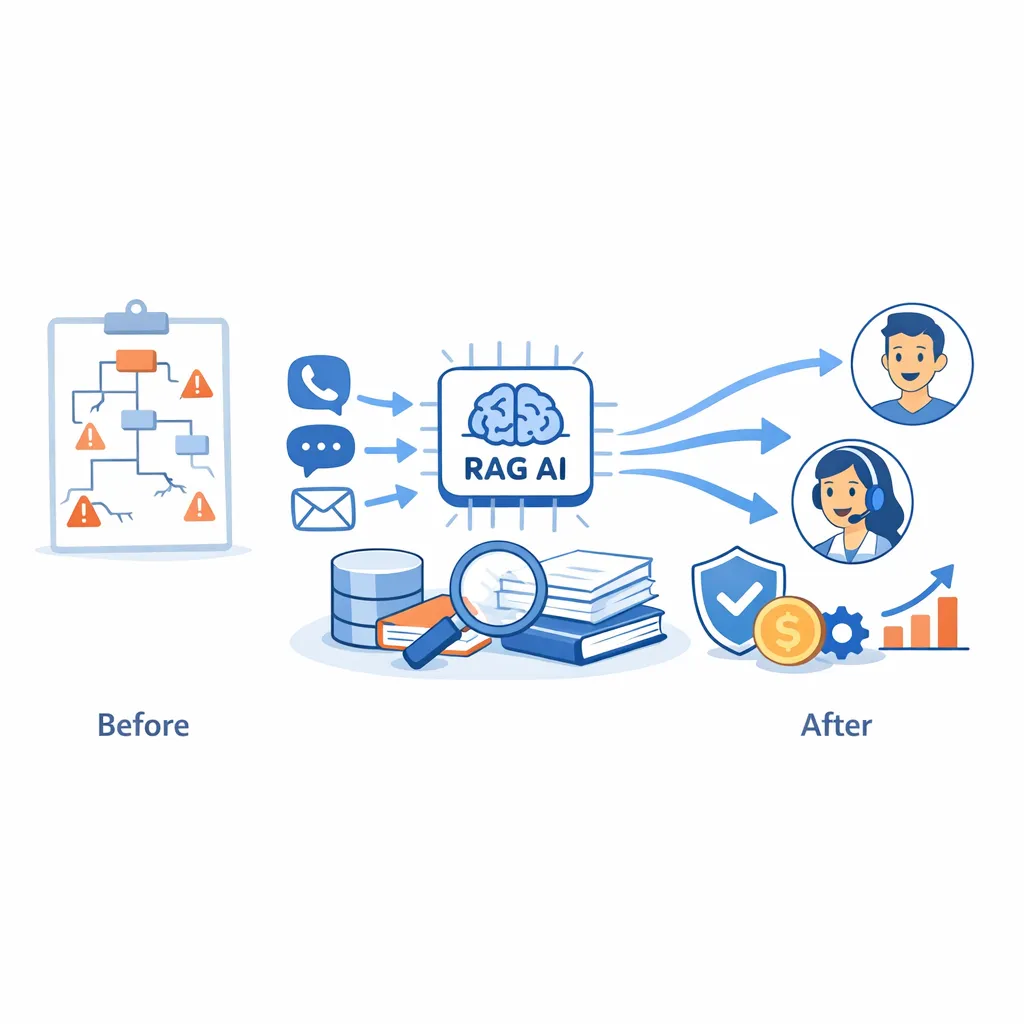
Standard chatbots operate on decision trees: “If user says X, say Y.” They are fragile; if a user deviates from the script, the bot fails. Retrieval-Augmented Generation (RAG) chatbots differ fundamentally. They combine the conversational fluency of Large Language Models (LLMs) with a retrieval system that looks up real-time data from a company’s trusted knowledge base (FAQs, product manuals, CRM data).
This transforms the bot from a “scripted helper” into a “smart problem solver.” RAG bots can interpret complex intent, retrieve specific policy details, and generate a natural response without hallucinating facts, provided they are grounded in the company’s data.
Real World ROI in Action for AI Cost reduction
Vodafone Lowers Cost to Serve with TOBi
Vodafone’s AI assistant, TOBi, handles approximately 1 million interactions per month across 15+ markets. The implementation of generative AI and RAG technologies allowed Vodafone to reduce the turnaround time for testing new conversational sequences by 99%, from 6.5 hours to less than one minute per sequence. TOBi now achieves a 70% first-time resolution rate, drastically reducing the volume of calls reaching human agents and allowing Vodafone to scale support without linear headcount growth.
Klarna Demonstrates Massive AI Efficiency
In perhaps the most famous recent case study, Klarna’s AI assistant managed 2.3 million conversations in its first month, equivalent to the workload of 700 full-time agents. The AI maintained customer satisfaction scores on par with human agents while reducing repeat inquiries by 25% due to higher accuracy. This efficiency is estimated to drive a $40 million profit improvement for Klarna in a single year.
Alibaba Reduces Call QA Costs via Automation
Alibaba utilized AI chatbots to outperform human agents in customer satisfaction during high-volume events. Their AI implementation not only provided quicker responses but also reduced the training time for human personnel by 20% through AI-assisted coaching, saving the company over $150 million annually.
Moving from Self-Service to AI-Assisted Agents
The goal of AI is not solely to replace agents but to augment them. Human agent-facing AI assistants listen to live calls and provide real-time suggestions, policy lookups, and objection-handling scripts. This reduces the cognitive load on agents, allowing them to focus on empathy and complex problem-solving. Platforms like Kixie integrate these capabilities directly into the dialer, utilizing Conversation Intelligence to provide automated call summaries and keyword tracking that feed back into the CRM.
Strategic Approaches to Reducing Cost to Serve
Reducing call QA costs and Cost to Serve (CTS) requires a strategic approach. Based on deep research, here are 12 methods to reduce costs immediately while preserving CX.
Smart Tips for Lowering Call QA Costs
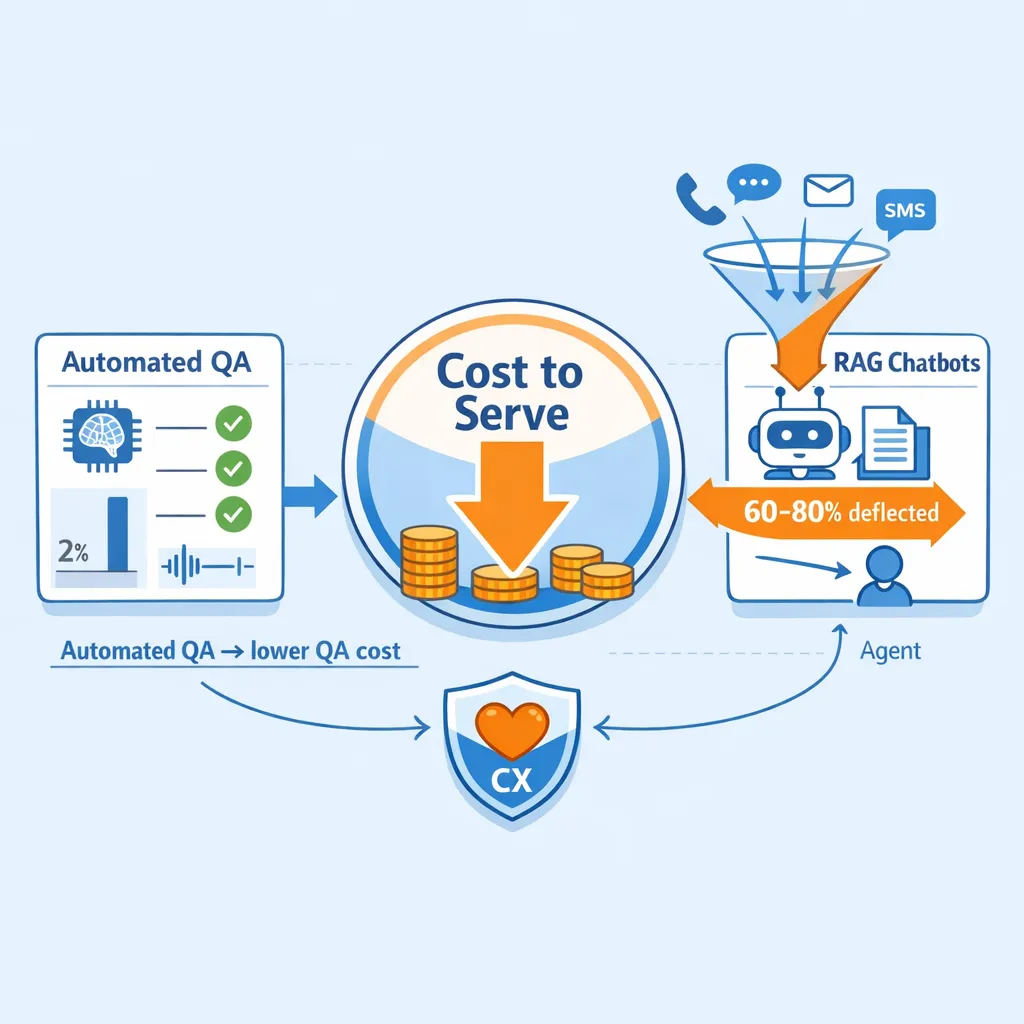
- Automate Quality Assurance (QA): Move from manual monitoring of 2% of calls to AI-driven automated QA that scores 100% of interactions. This eliminates the need for large QA teams and provides unbiased performance data.
- Deploy RAG Chatbots for Deflection: Use RAG bots to handle the 60-80% of routine queries (order status, FAQs) that clog phone lines. This can reduce support costs by 30%.
- Implement Skill-Based Routing: Stop “round-robin” routing. Use data to route specific problems to the agents with the highest success rate for those topics. This increases FCR and lowers AHT.
- Utilize Agentic AI for Workflows: Go beyond chat. Use Agentic AI to autonomously execute tasks like processing refunds or updating billing addresses without human intervention.
- Adopt Voice AI for Scheduling: Use Voice AI to manage workforce scheduling, handle shift swaps, and predict staffing needs, reducing administrative overhead by up to 92%.
- Transition to Cloud-Based Solutions: Cloud platforms like Kixie eliminate the maintenance costs of on-premise hardware and allow for flexible scaling (up or down) based on demand.
- Optimize Workforce Management (WFM): Use AI forecasting to align staffing levels precisely with predicted call volumes, minimizing idle time and overtime costs.
- Apply Unified Conversation Intelligence: Integrate tools that transcribe and analyze calls automatically. This reduces After Call Work (ACW) by automating note-taking and CRM data entry.
- Focus on First Call Resolution (FCR): Train agents specifically on FCR. Reducing repeat calls is the single most effective way to lower total call volume and costs.
- Implement Callback Automation: Instead of paying for hold time (telephony costs) and frustrating customers, use automated callbacks to smooth out peak volume spikes.
- Strategic Outsourcing: Only outsource non-core, highly repetitive tasks that AI cannot yet handle. Keep high-value, complex, or empathetic interactions in-house to protect brand value.
- Reduce Attrition through AI Coaching: Use AI to provide instant, objective feedback to agents. Supported agents are less likely to churn, saving thousands in recruitment and training costs.
Balancing AI Automation with Service Quality
The danger of cost reduction is the “Technology Replacement Trap,” where companies cut staff before the AI is fully capable. To avoid this, leaders must treat AI as a Complement, not just a substitute. For example, Kixie’s ConnectionBoost technology improves answer rates for outbound sales teams by using local presence dialing, ensuring that when agents do dial, they are more likely to connect, maximizing the value of their time.
Advanced AI Applications in Support
The frontier of cost reduction lies in Advanced AI Applications that fundamentally change how work is done.
Automated QA as a Game Changer for Call QA Costs
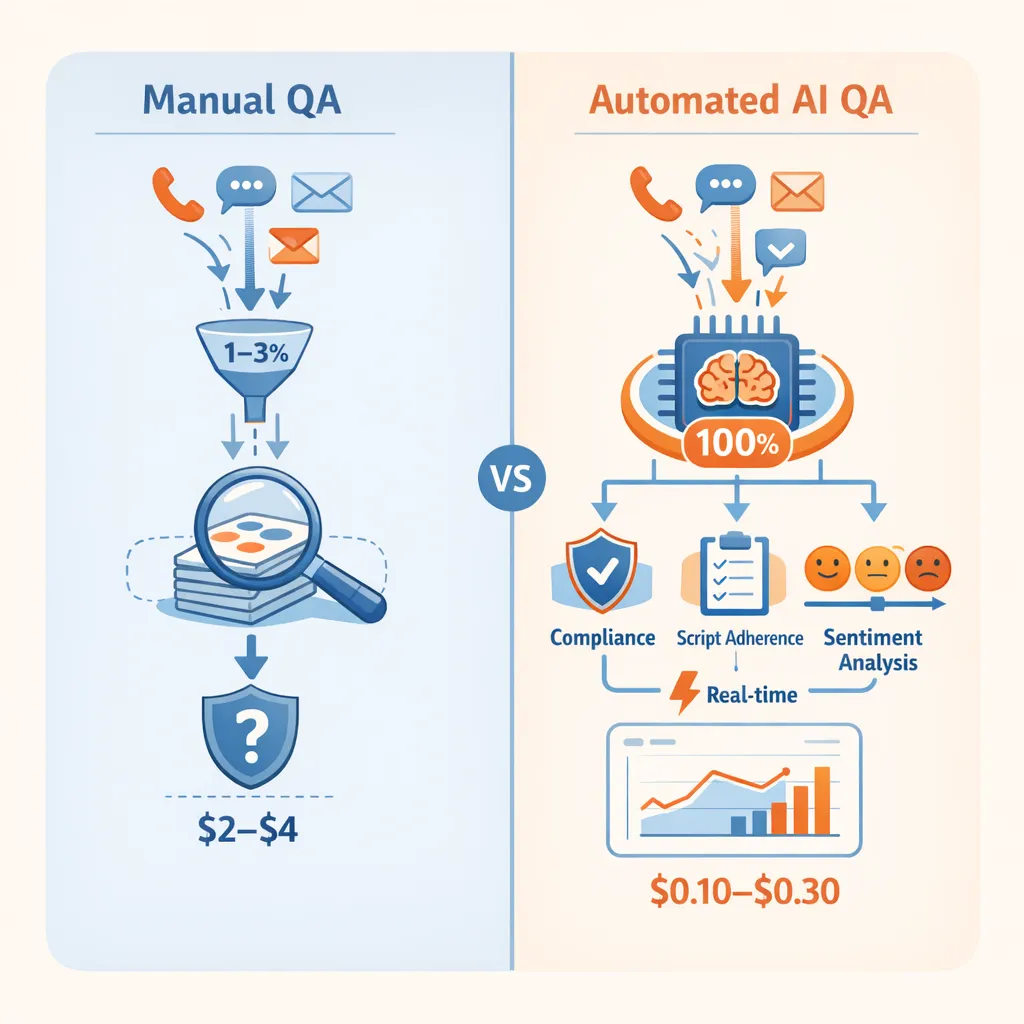
Traditional QA is reactive and statistically insignificant, covering only 1-3% of calls. Automated QA analyzes 100% of calls, identifying compliance risks, script adherence, and sentiment shifts in real-time.
- Cost Impact: The cost per interaction for QA drops from $2-$4 (manual) to $0.10-$0.30 (AI).
- Performance Impact: Contact centers using AI QA achieve 15-20% higher FCR and 20-25% lower escalation volumes.
- Kixie Implementation: Kixie’s Conversation Intelligence platform automates this process by tracking specific keywords (e.g., “cancel,” “refund,” “manager”) and generating sentiment scores for every call. This data is instantly available in the dashboard, allowing managers to spot trends across thousands of calls without listening to hours of audio.
Using Agentic AI for Customers
Agentic AI differs from Generative AI in that it is “goal-oriented” and capable of “acting.” While Generative AI creates content (text/images), Agentic AI plans and executes workflows.
- Example: A customer asks for a refund. A Generative bot explains the policy. An Agentic AI agent authenticates the user, checks the CRM for eligibility, processes the refund transaction via API, sends a confirmation email, and updates the support ticket—all autonomously.
- Strategic Value: By handling end-to-end resolution, Agentic AI breaks the “deflection plateau” of standard bots, which often stall at 30-40% containment. Agentic systems can achieve up to 70% resolution for transactional workflows.
Implementing Voice AI for Workforce Optimization
Voice AI is now being applied to internal operations. AI agents can manage complex scheduling tasks, such as handling sick calls and finding replacements, by calling staff and negotiating shift swaps based on pre-set rules and labor laws. This reduces the administrative burden on supervisors, allowing them to focus on coaching rather than logistics.
Streamlining Call Routing to Reduce Cost to Serve
AI-driven routing replaces static IVR menus. By analyzing the caller’s history (from the CRM) and intent (via voice recognition), the system can route the call to the most appropriate agent or self-service flow. Kixie’s Intelligent Call Routing uses CRM fields to connect callers to their dedicated account manager automatically, bypassing the queue entirely and improving the personal connection.
Measurement and ROI of AI Investments
Implementing AI requires strict financial discipline to ensure the investment yields actual savings.
Measuring ROI Benchmarks for Cost to Serve
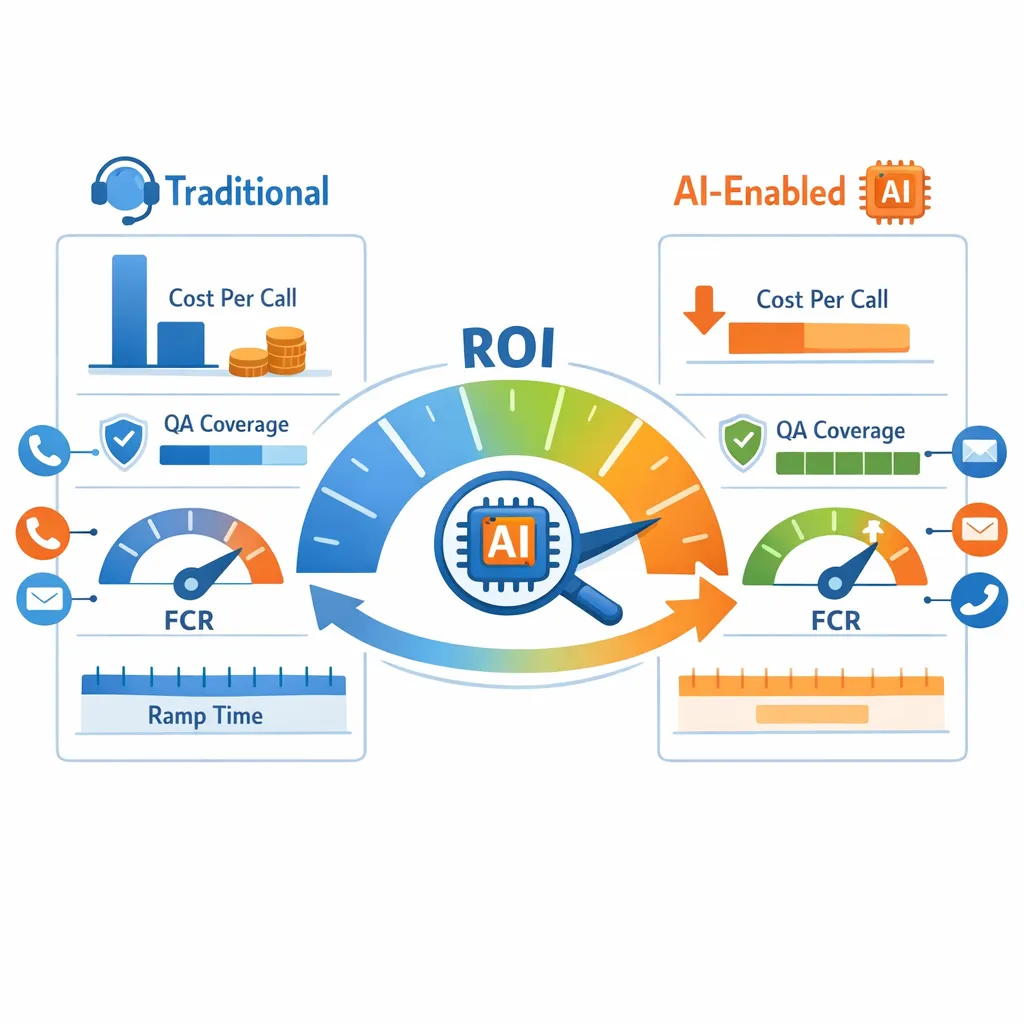
To calculate the ROI of AI cost reduction initiatives, compare the “Before” and “After” of key financial metrics:
| Metric | Traditional Benchmark | AI-Enabled Target |
|---|---|---|
| Cost Per Call | $2.70 – $5.60+ | $0.50 – $2.00 (blended) |
| QA Coverage | 1% – 3% | 100% |
| QA Cost/Call | $2.00 – $4.00 | $0.10 – $0.30 |
| First Call Resolution | 70% | 85%+ |
| Agent Ramp Time | 3-6 Months | 1-2 Months (AI Assist) |
Data Sources: , , .
Key Metrics to Track Call QA Costs Reduction
Deflection Rate: The percentage of inbound inquiries resolved fully by RAG chatbots or Agentic AI without human intervention.
Average Handle Time (AHT) vs. Sentiment: Monitor if lower AHT correlates with lower sentiment. If AHT drops but sentiment holds steady (or rises), the AI tools are working effectively.
QA Automation Rate: The percentage of calls scored automatically.
Agent Churn Rate: A decrease in churn indicates that AI tools (like automated summaries and coaching) are successfully reducing burnout.
Evaluating Long Term Cost Implications of AI
While AI requires upfront investment, the long-term cost implications are deflationary. Organizations that implement comprehensive AI QA typically achieve positive ROI within 8-14 months, with returns ranging from 150-300% over three years. Furthermore, companies like Vodafone have proven that AI architectures allow for rapid vendor swapping (e.g., switching between Google and Microsoft LLMs) to continuously lower technical costs while increasing capacity.
Final Thoughts on Reducing Call QA Costs with AI
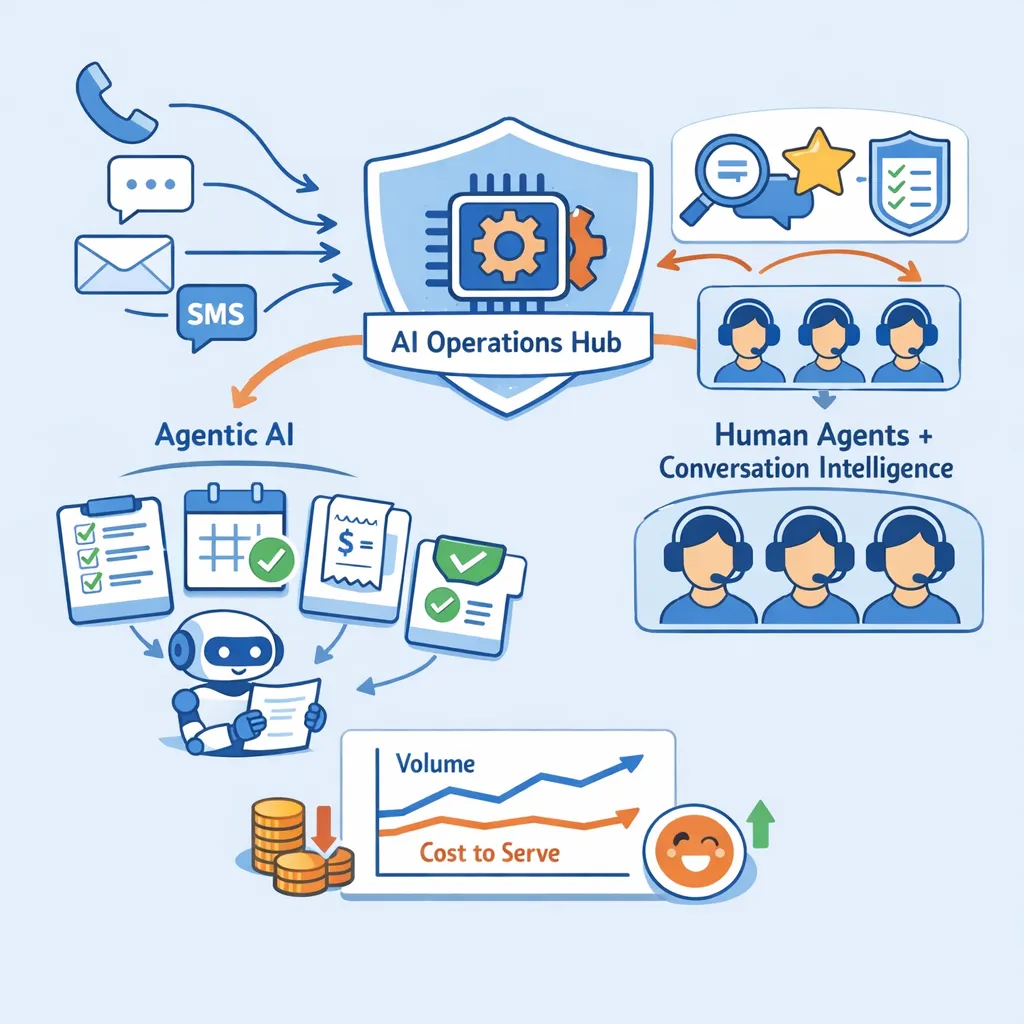
The era of reducing call center costs by sacrificing quality is over. The new economic reality, driven by call center solutions like Kixie, RAG chatbots, and Automated QA, allows businesses to decouple volume growth from cost growth. By implementing Agentic AI to handle transactional tasks and Conversation Intelligence to monitor and coach human agents, organizations can crush their Cost to Serve while simultaneously improving the customer experience.
For sales and support leaders, the mandate is clear: Stop managing costs by cutting heads, and start managing efficiency by adding intelligence.
- Learn more about Kixie’s PowerCall and how it integrates with your CRM.
- See how Conversation Intelligence can automate your QA process today.
- Read more about AI automation strategies for the modern sales team.
Ready to close more deals with Kixie?
See how Kixie's AI-powered tools can transform your sales and support operations.
Start Free Trial