
TL;DR: AI SMS templates pair high open rates (90-98%) with strict TCPA compliance. Express written consent is required, sending hours run 8 a.m.-9 p.m. in the recipient’s local time zone, fines run $500-$1,500 per message, and 10DLC registration is mandatory for application-to-person texts in the United States. Keep each message under 160 characters, include a “Reply STOP” opt-out, and use AI to personalize templates across inbound lead response, outbound prospecting, meeting reminders, and post-sale upsell stages. Sales engagement platforms like Kixie pair 10DLC-registered SMS, MMS, and Team SMS with native CRM logging in HubSpot, Salesforce, Pipedrive, and Zoho so every text gets tied to the right contact record automatically.
Research suggests that integrating text messaging into business-to-business sales workflows can significantly improve engagement metrics when compared to traditional email and cold calling. This report details how revenue operations leaders and sales development representatives can deploy text messaging securely and effectively. It appears likely that adopting structured messaging frameworks supported by artificial intelligence will help teams scale their outreach. However, operating within the strict regulatory framework of business texting requires careful attention to compliance laws.
Key Findings
- Text messages currently achieve an average open rate of 98 percent, vastly outperforming the 20 percent average open rate of email.
- Adhering to the Telephone Consumer Protection Act is mandatory, as non-compliance can result in legal fines ranging from $500 to $1,500 per text message.
- Senders must honor quiet hours, generally restricted to between 8 a.m. and 9 p.m. in the recipient’s local time zone.
- Implementing artificial intelligence allows sales teams to generate personalized, contextually relevant text messages at scale while maintaining a natural, human tone.
- Major carriers now require 10-Digit Long Code registration for all application-to-person business messaging in the United States to prevent spam filtering.
The Role of Automation in Outreach Sales professionals are increasingly adopting artificial intelligence to draft, schedule, and test their messaging. Artificial intelligence reduces the manual burden on representatives, allowing them to focus on live conversations while software manages initial lead qualification and meeting reminders.
Balancing Personalization and Compliance While automation offers scale, revenue operations managers must prioritize compliance. Unsolicited text messages face aggressive filtering by mobile carriers and present severe legal liabilities. Express written consent and clear opt-out mechanisms must be integrated into every automated texting campaign.
The Current State of Sales SMS
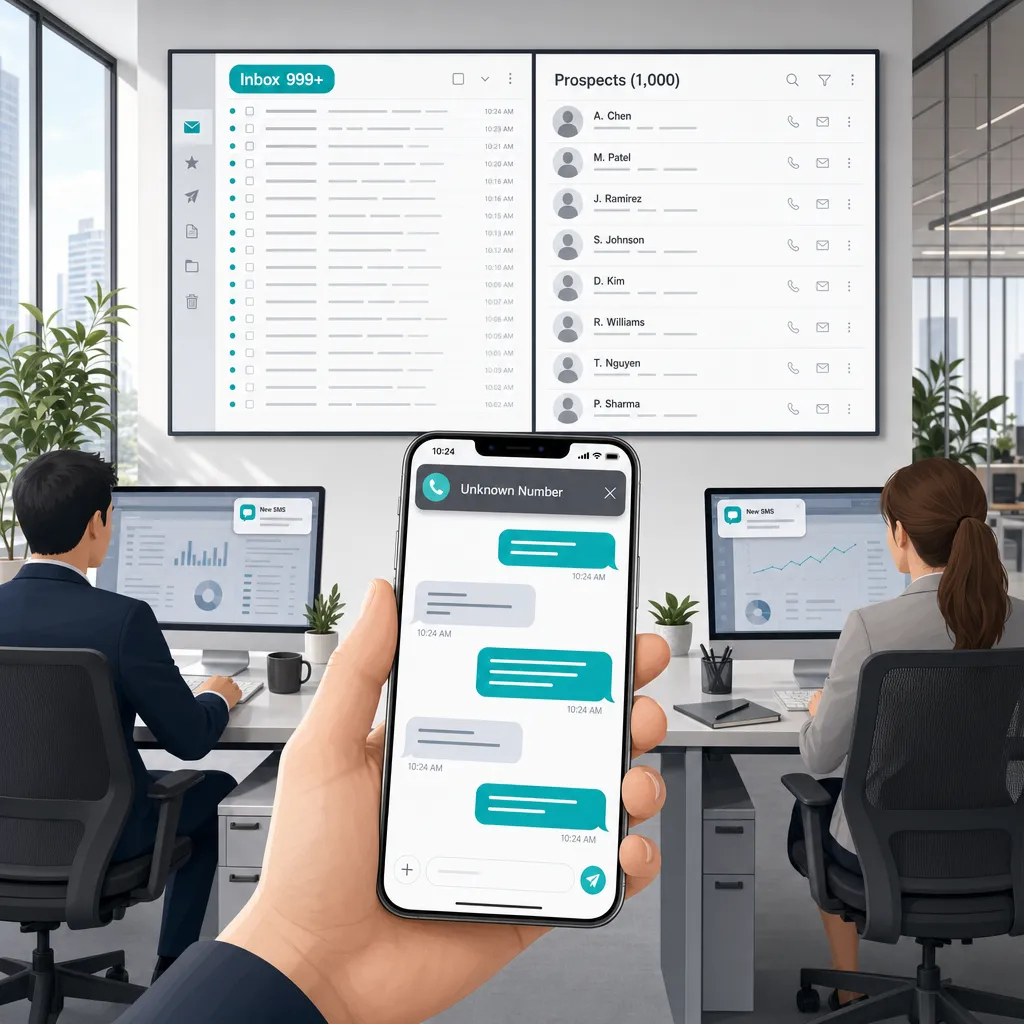
The market of business-to-business sales outreach is shifting. Buyers are overwhelmed by flooded email inboxes and are increasingly screening phone calls from unknown numbers. A recent study noted that 80 percent of people do not pick up the phone for numbers they do not recognize. This dynamic makes SMS an attractive channel for direct communication.
Data highlights the effectiveness of text messaging for business outreach. SMS messages achieve an average open rate between 90 percent and 98 percent. Furthermore, 90 percent of text messages are read within three minutes of being received. This rapid engagement is currently unmatched by any other digital marketing or sales channel.
The response rates for text messaging also show clear advantages. SMS campaigns achieve an average response rate of 45 percent, which is roughly seven times higher than the typical 6 percent response rate seen in email marketing. When analyzing conversion rates, an effective SMS campaign typically converts at a rate between 21 percent and 40 percent, depending heavily on the industry. For example, the technology sector often sees conversion rates between 31 percent and 40 percent, while consumer services generally achieve 11 percent to 20 percent.
Worked Example: Email vs. SMS
Consider a sales team with 1,000 qualified prospects.
- Email: 1,000 emails × 20% open rate = 200 opens. 6% response rate on opens = 12 total responses.
- SMS: 1,000 texts × 98% open rate = 980 opens. 45% response rate on opens = 441 total responses.
This mathematical difference illustrates why sales teams are adopting SMS platforms. However, reaching these benchmarks requires strict adherence to legal and carrier guidelines to ensure messages are delivered and not blocked as spam.
TCPA Compliance for Sales SMS
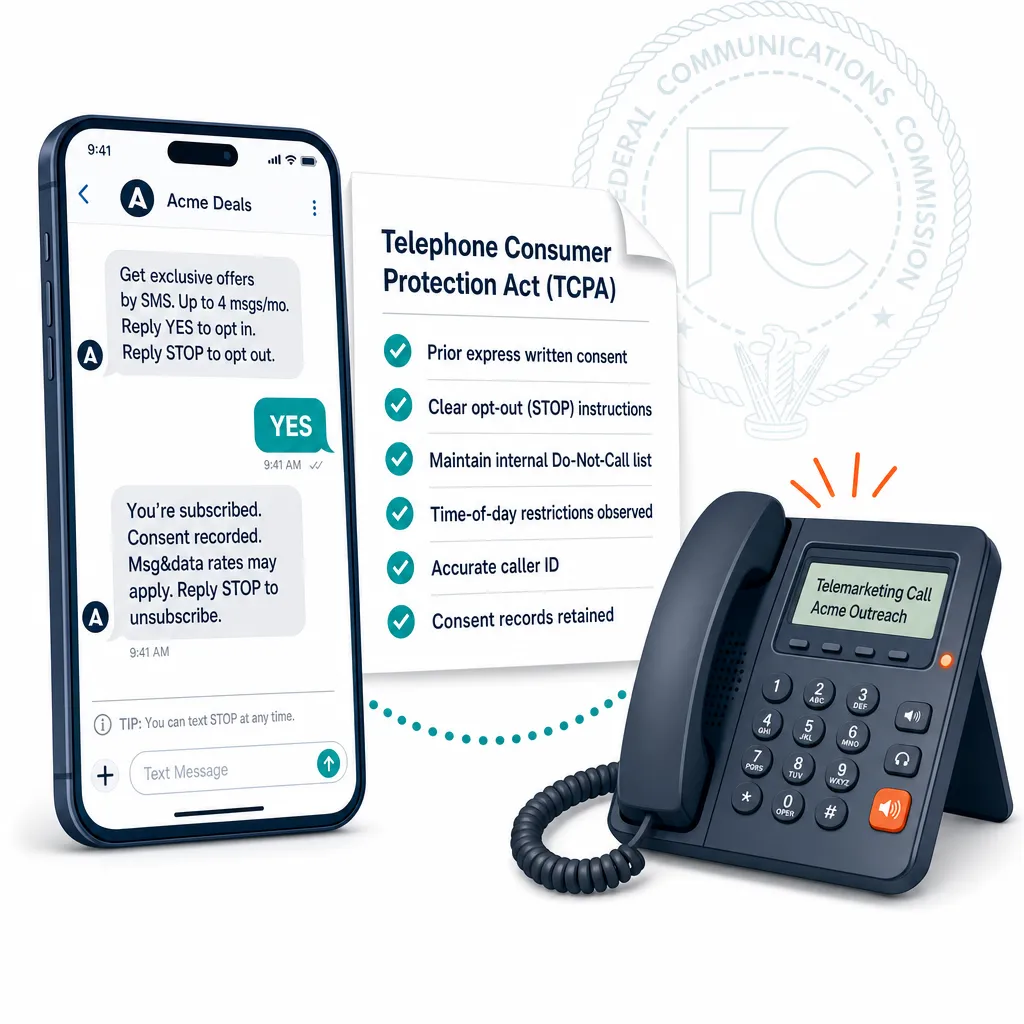
The most critical aspect of any sales texting program is legal compliance. The Telephone Consumer Protection Act was enacted in 1991 to protect consumers from unwanted telemarketing communications. The Federal Communications Commission interprets this statute to treat text messages as calls, making SMS outreach subject to strict federal restrictions.
Express Written Consent for SMS
The foundation of compliant texting is obtaining prior express written consent before sending any promotional or marketing messages. This rule applies equally to business-to-consumer and business-to-business communications. A recipient’s business status does not exempt the sender from consent requirements.
Consent must be clear and conspicuous. If a prospect fills out a form on a company website, the form must include a specific checkbox for SMS marketing consent. This checkbox cannot be pre-checked by default, and the form must be submittable even if the user declines SMS consent. Additionally, upcoming updates taking effect in January 2026 mandate one-to-one consent, meaning consent cannot be shared across different brands or sold to third-party data providers. Each sending entity must obtain its own direct permission from the consumer.
Time of Day Restrictions for SMS
Federal law strictly regulates the hours during which a business can send marketing text messages. The Telephone Consumer Protection Act prohibits sending messages outside of designated quiet hours. Outreach must be restricted to between 8 a.m. and 9 p.m. in the recipient’s local time zone.
Failing to account for time zones is a common error in automated sales campaigns. A text message dispatched at 9 a.m. Eastern Standard Time reaches a prospect in California at 6 a.m. Pacific Standard Time, directly violating federal quiet hours. Sales software must automatically align sending times with the local time zone of the recipient’s area code or known address. Kixie’s scheduled SMS and automated cadences let revenue teams set send windows by local time zone, so messages going to a California area code never fire before the recipient’s 8 a.m. cutoff.
Financial Cost of SMS Violations
The penalties for violating the Telephone Consumer Protection Act are severe and are calculated on a per-message basis. A business can be fined $500 for a single unintentional text message sent without proper consent or outside approved hours. If the courts determine the violation was willing or knowing, the damages can triple to $1,500 per message.
Worked Example: TCPA Liability
A sales development representative uploads an unverified list of 2,000 cold prospects and sends one message to each without prior consent.
- 2,000 messages × $500 per violation = $1,000,000 potential statutory penalty
- If the act is deemed intentional, liability triples to $3,000,000
Class action lawsuits are common in this space, making compliance a mandatory operational priority rather than an afterthought.
State-Level SMS Regulations
Many states have implemented their own telemarketing laws that are stricter than federal regulations. These are commonly referred to as mini-TCPA laws.
| State | Allowed Hours (Local Time) | Key Restriction |
|---|---|---|
| Connecticut | 9 a.m. – 8 p.m. | Bans all marketing outreach without express written consent. Statutory damages up to $20,000 per violation. |
| Florida | 8 a.m. – 8 p.m. | Requires clear opt-out methods. Businesses must stop texting within 15 days of an opt-out request. |
| Oklahoma | 8 a.m. – 8 p.m. | Limits commercial texts to a maximum of three per day on the same topic. |
Revenue operations leaders must configure their software platforms to default to the most restrictive state laws to minimize legal risk.
10DLC Registration for Business SMS
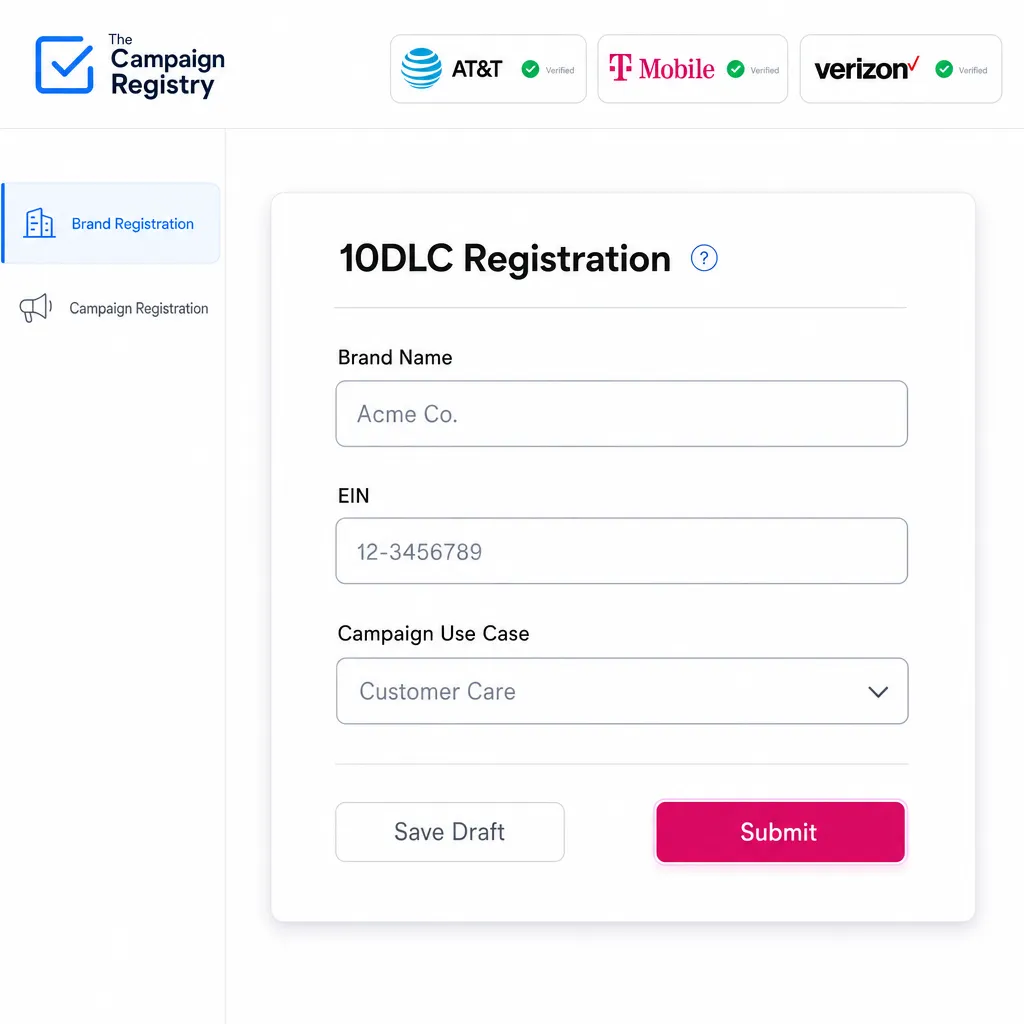
Beyond government laws, cellular network carriers enforce their own rules to protect users from spam. In the United States, carriers such as AT&T, T-Mobile, and Verizon require businesses to complete 10-Digit Long Code registration before sending application-to-person messages.
If a business sends text messages using a standard ten-digit phone number through software, it must register its brand and its specific messaging campaigns with The Campaign Registry. This industry-wide database verifies the identity of the sender and evaluates the purpose of their messages. Kixie walks customers through 10DLC brand and campaign registration during onboarding, including the privacy policy, terms of service, and sample message documentation carriers require for approval.
10DLC SMS Registration Workflow
Completing this registration involves submitting detailed documentation about your business and your texting practices. Carriers review this data to assign a trust score, which dictates the volume of messages the business is allowed to send per day.
To achieve approval, businesses must submit clear examples of how they obtain consent. They must provide links to their website’s privacy policy and terms of service. The terms must state explicitly what types of messages the user will receive, the expected frequency of the messages, and a disclosure stating that message and data rates may apply.
During the registration process, businesses must also submit sample text messages. These examples must demonstrate how the brand identifies itself and how it offers an opt-out mechanism. A compliant sample message for the registry would look like this: “Hi [Name], this is [Rep Name] from [Company Name]. We received your request for a software demo. Are you available tomorrow at 2 PM? Reply STOP to opt out”.
Failure to complete this registration results in carriers aggressively filtering and blocking the messages. Even if a business has legal consent under federal law, the carrier will refuse to deliver the text if the 10-Digit Long Code registration is incomplete or rejected.
Essential Components of a Sales SMS
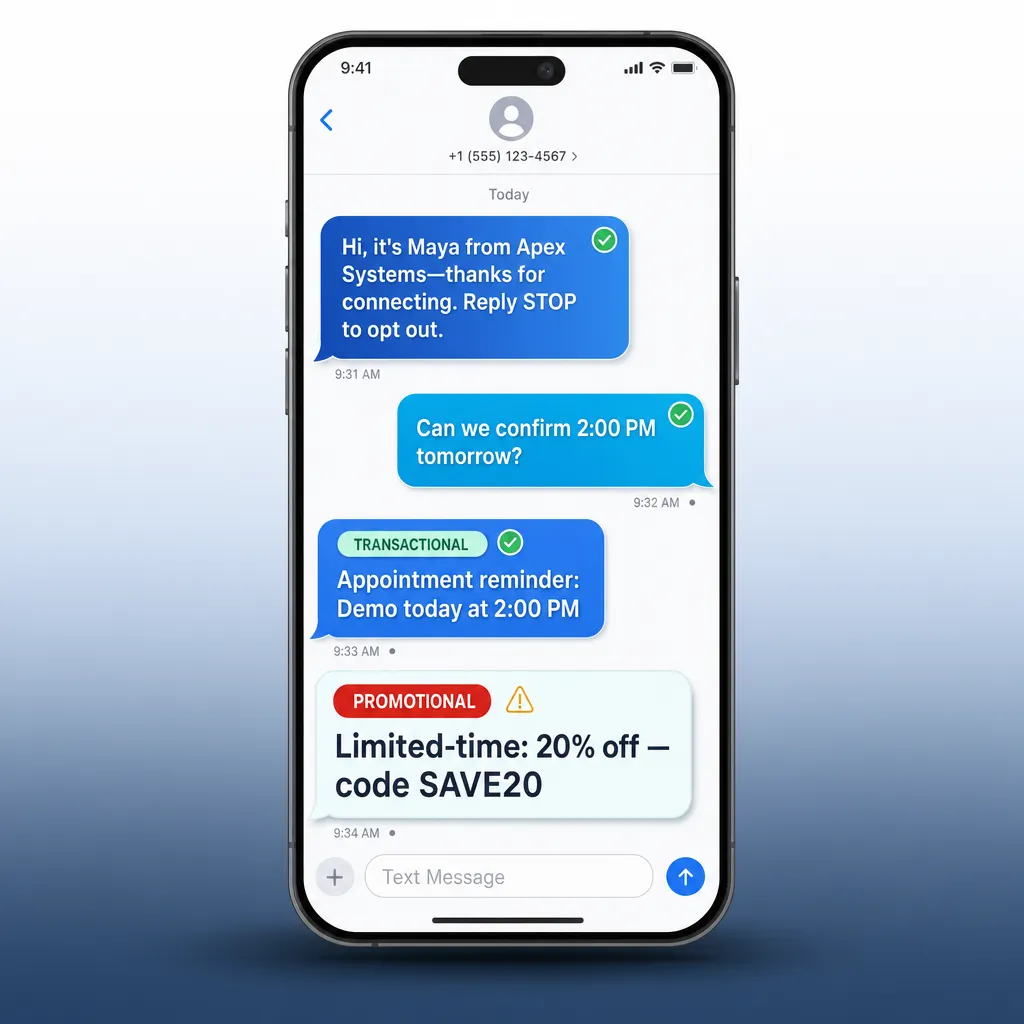
Whether crafted manually by a representative or generated by artificial intelligence, every sales text message must follow a specific structural framework to ensure deliverability and compliance.
First, the message must clearly identify the sender and the organization. Recipients must know immediately who is contacting them. Second, the first message sent to any new contact must include clear opt-out instructions. Standard industry language includes phrases such as “Reply STOP to opt out” or “Text STOP to unsubscribe”.
Third, the message should contain a single, clear call to action. Because text messages are read quickly on mobile screens, they must be concise. Asking a prospect to read a long paragraph, click a link, and answer multiple questions creates friction. A strong sales text focuses on one specific objective, such as confirming a meeting time or answering a single qualification question.
Furthermore, businesses must separate their transactional messages from their promotional messages. Transactional texts, such as appointment reminders or shipping updates, require a lower standard of consent. However, adding promotional content, such as a discount code, to a transactional message immediately reclassifies it as a marketing message. If the recipient only consented to transactional updates, sending a promotional message is a direct compliance violation.
Using AI to Generate Sales SMS
Artificial intelligence is changing how sales teams approach copywriting. Instead of writing every message from scratch, teams use large language models to generate contextual, personalized AI SMS templates for sales outreach.
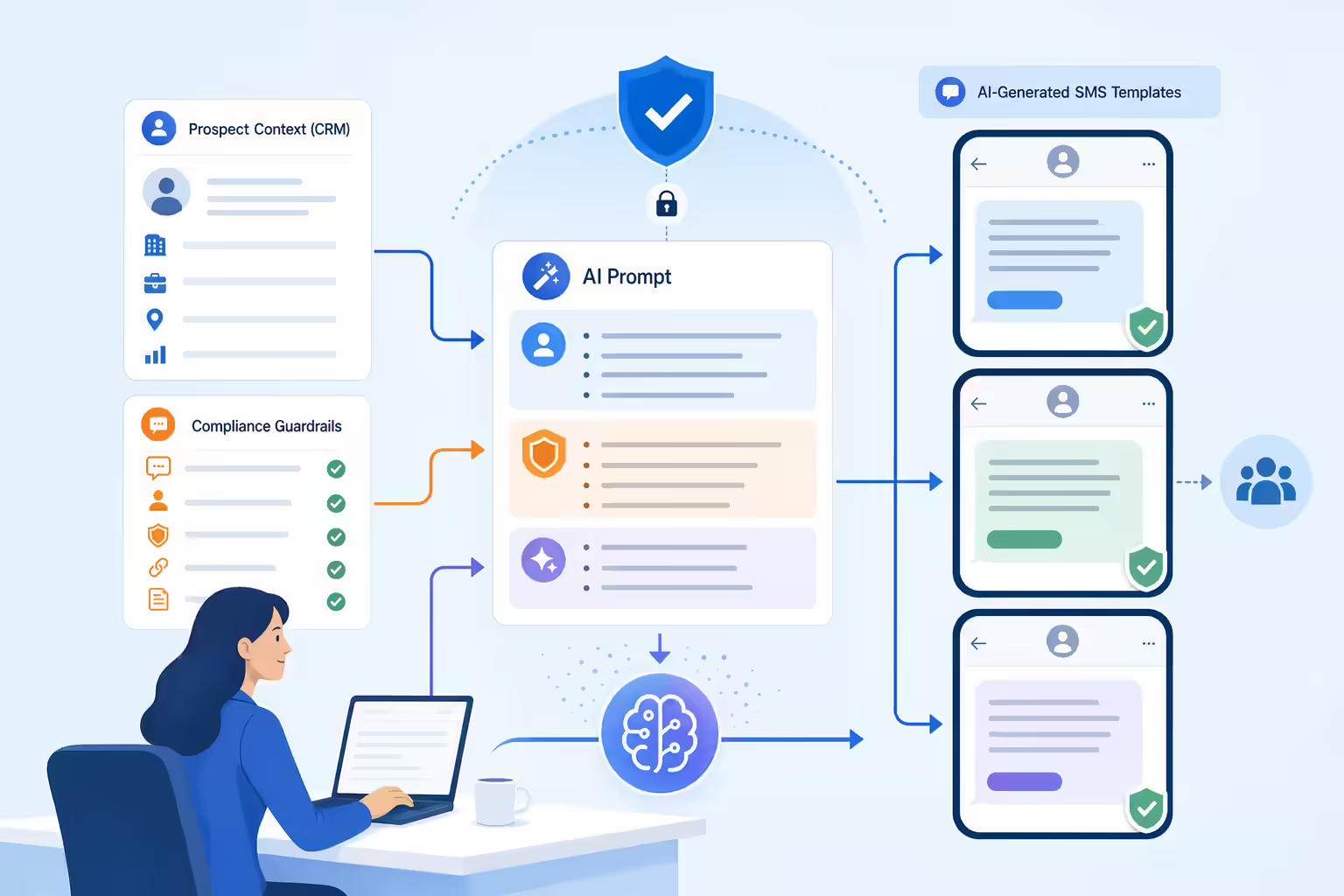
However, artificial intelligence models can generate inaccurate or non-compliant text if they are not given proper instructions. This is known as hallucination. To prevent this, revenue operations managers must use structured prompts that include specific guardrails and context.
A highly effective prompting structure follows a specific formula outlining the role, the inputs, the output format, and the constraints. For example, an SDR manager might use the following prompt to generate templates:
“Act as a Business-to-Business Sales Development Representative. Given the prospect’s name, their company name, and their recent request for a product demonstration, generate three text message templates. The messages must acknowledge their request, suggest two specific meeting times, identify our company name, and include the exact phrase ‘Reply STOP to opt out’ at the end. Keep each message under 160 characters. Maintain a friendly, professional tone.”
This level of detailed prompting ensures the artificial intelligence produces templates that are ready for immediate use, legally compliant, and appropriately sized for cellular networks.
Evaluating AI SMS Tools for Sales Teams
The software market offers dozens of tools designed to facilitate automated, multi-channel outreach. Revenue operations leaders must evaluate these platforms based on their ability to handle compliance, integrate with existing customer relationship management systems, and use artificial intelligence effectively.
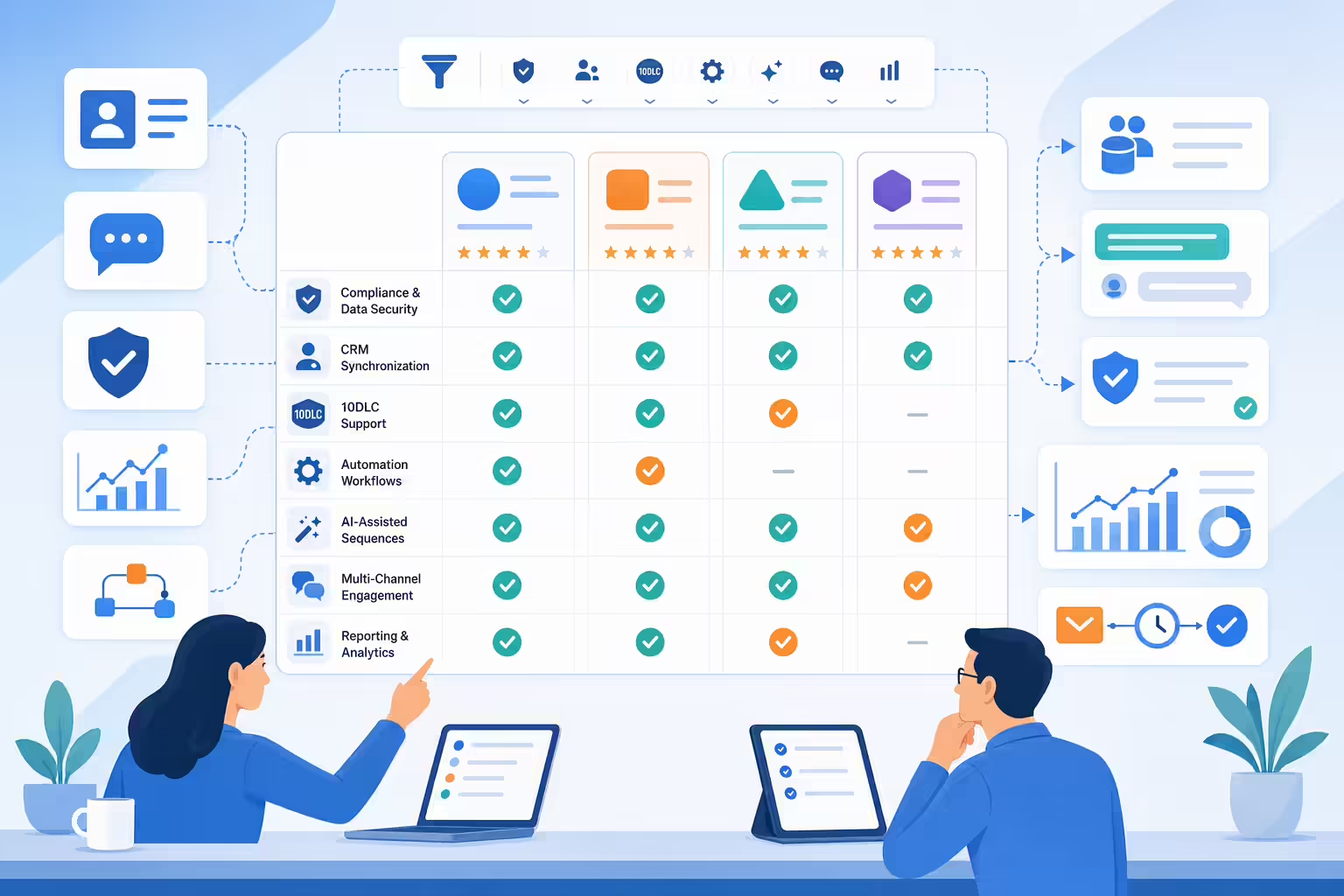
Many basic tools only sequence emails. For effective SMS outreach, a platform must support native texting, 10-Digit Long Code registration management, and CRM synchronization.
AI SMS Platform Comparison for Sales
The following table compares several notable platforms that incorporate artificial intelligence and support multi-channel sales engagement.
| Platform Name | Target Audience Focus | Standout Capabilities |
|---|---|---|
| Kixie | Sales and support teams that need a dialer and SMS in one platform with deep CRM integration | 10DLC-registered SMS, MMS, and Team SMS; SMS templates with merge fields; AI-powered automation cadences with scheduled sends; native HubSpot, Salesforce, Pipedrive, and Zoho integrations that log every text to the contact record; AI Analytics and Conversation Intelligence for reply tracking |
| Outplay | Small to mid-sized sales teams needing multi-channel sequencing | AI-guided outreach timing across email, phone, and SMS; native CRM sync |
| MarketBetter | Full-stack sales development teams | Combines visitor identification, contact data lookups, and AI-prioritized daily tasks |
| Default | Revenue operations teams focusing on inbound routing | Visual drag-and-drop routing logic; real-time B2B contact data lookups |
| Regie.ai | Enterprise teams requiring strict brand governance | Persona-based sequence builder; trains on existing company content |
| Apollo.io | High-volume outbound prospectors | 275 million contact database combined with multi-step sequence automation |
Kixie consolidates the dialer and SMS workflow into one platform purpose-built for outbound and inbound sales teams. Reps send 10DLC-registered SMS and MMS from the PowerCall dialer or directly inside HubSpot, Salesforce, Pipedrive, or Zoho, and every message logs to the contact record automatically. Automation cadences and HubSpot workflow actions handle inbound lead response and meeting reminders without manual sends, while AI Analytics and Conversation Intelligence surface which templates actually drive replies. See pricing for current plan details.
Outplay focuses heavily on affordability and workflow management. At a starting price between $35 and $49 per user per month, it allows representatives to engage prospects across email, phone calls, and SMS from a single dashboard. The platform uses artificial intelligence to optimize follow-up sequences based on historical performance data.
MarketBetter positions itself as a comprehensive alternative to buying multiple separate tools. For roughly $99 per user per month, it includes website visitor identification, automatic contact data lookups for inbound leads, and a prioritized daily playbook for representatives. It integrates natively with platforms like Salesforce and HubSpot, ensuring all text messages are logged to the appropriate contact records.
Regie.ai operates at the enterprise level, with pricing generally starting around $35,000 annually. It trains its artificial intelligence on a company’s existing sales collateral to generate messaging that strictly adheres to the organization’s brand voice. This is particularly valuable for large teams where maintaining message consistency across hundreds of representatives is a challenge.
AI SMS Templates by Sales Stage
To effectively drive pipeline, sales teams require different templates for different stages of the buyer process. Below are worked examples of AI SMS templates designed for specific scenarios. These templates follow best practices by being brief, identifying the sender, offering clear opt-out language in initial contacts, and focusing on a single call to action.

Inbound Lead Response Templates
When a prospect submits a form on a website, speed is critical. Data shows that leads contacted within five minutes of an inquiry convert at a significantly higher rate than those contacted an hour later.
Template 1: General Inquiry Response
“Hi [Prospect Name], this is [Your Name] from [Company Name]. I saw you requested more information about our software. Do you have 5 minutes for a quick call this afternoon? Reply STOP to opt out.”
Template 2: Content Download Follow Up
“Hi [Prospect Name], [Your Name] here with [Company Name]. Thanks for downloading our guide on revenue operations. Are you currently evaluating new tools for your team? Reply STOP to unsubscribe.”
Template 3: Pricing Inquiry
“Hello [Prospect Name], thanks for checking out our pricing page. I am [Your Name] from [Company Name]. I can walk you through the plans to see what fits your setup. Want me to send over a few times to chat? Reply STOP to opt out.”
These inbound templates work because they strike while the prospect’s intent is high. They provide immediate utility without demanding a heavy commitment.
Outbound Prospecting SMS Templates
Outbound texting requires extreme caution. Reaching out to prospects who have not explicitly requested contact carries high compliance risks. If a company legally sources B2B mobile numbers and has the necessary consent frameworks in place, the messaging must be highly personalized.
Template 4: Reference to a Mutual Connection
“Hi [Prospect Name], [Your Name] from [Company Name] here. [Mutual Connection Name] mentioned we should connect. I help teams streamline their billing. Open to a brief chat next Tuesday?”
Template 5: Competitor or Industry Shift Mention
“Hi [Prospect Name], it is [Your Name] at [Company Name]. I noticed your team is expanding the outbound sales division. We help growing teams reduce dialer latency. Is this a priority for you right now? Reply STOP to opt out.”
Meeting Confirmation and Reminder SMS Templates
One of the most effective uses of text messaging is reducing no-show rates for scheduled meetings. An SMS reminder is far more likely to be seen than an email buried under a pile of internal communications.
Template 6: Next Day Meeting Reminder
“Hi [Prospect Name], just confirming our demo tomorrow at 2:00 PM EST. Let me know if you need to adjust the time. Looking forward to it! – [Your Name] from [Company Name].”
Template 7: Same Day Reminder with Value Add
“Hello [Prospect Name]. We are on for our call in 30 minutes. I have prepared a custom dashboard example for your team. Talk soon! – [Your Name], [Company Name].”
Template 8: Rescheduling a Missed Call
“Hi [Prospect Name], looks like we missed each other. I understand things get busy! Would you like to pick a new time this week? Here is my link: [Calendar URL]. – [Your Name]”
These templates remove the friction of rescheduling. By providing a direct calendar link or a polite offer to adjust, the representative maintains a helpful posture rather than an accusatory one.
Post-Sale and Upsell SMS Templates
The relationship does not end when the contract is signed. Account executives and customer success managers can use text templates to ensure smooth onboarding and find opportunities for account expansion.
Template 9: Welcome and Onboarding Check In
“Hi [Prospect Name], you are one week into using [Product Name]! How is everything going so far? Reply here if you have any quick questions. – [Your Name] from [Company Name].”
Template 10: Feature Announcement
“Hello [Prospect Name]. [Company Name] just launched the new reporting feature we discussed last month. Would you like a 10-minute walkthrough to see how it works? – [Your Name].”
Template 11: Requesting a Referral
“Quick question, [Prospect Name], do you know anyone else in your network dealing with [Specific Problem]? I would love an introduction. Happy to return the favor! – [Your Name].”
SMS Best Practices for High Reply Rates
Owning a library of well-crafted templates is only part of the equation. Revenue operations teams must deploy these messages strategically to avoid triggering carrier spam filters and alienating prospects.
SMS Cadence and Timing
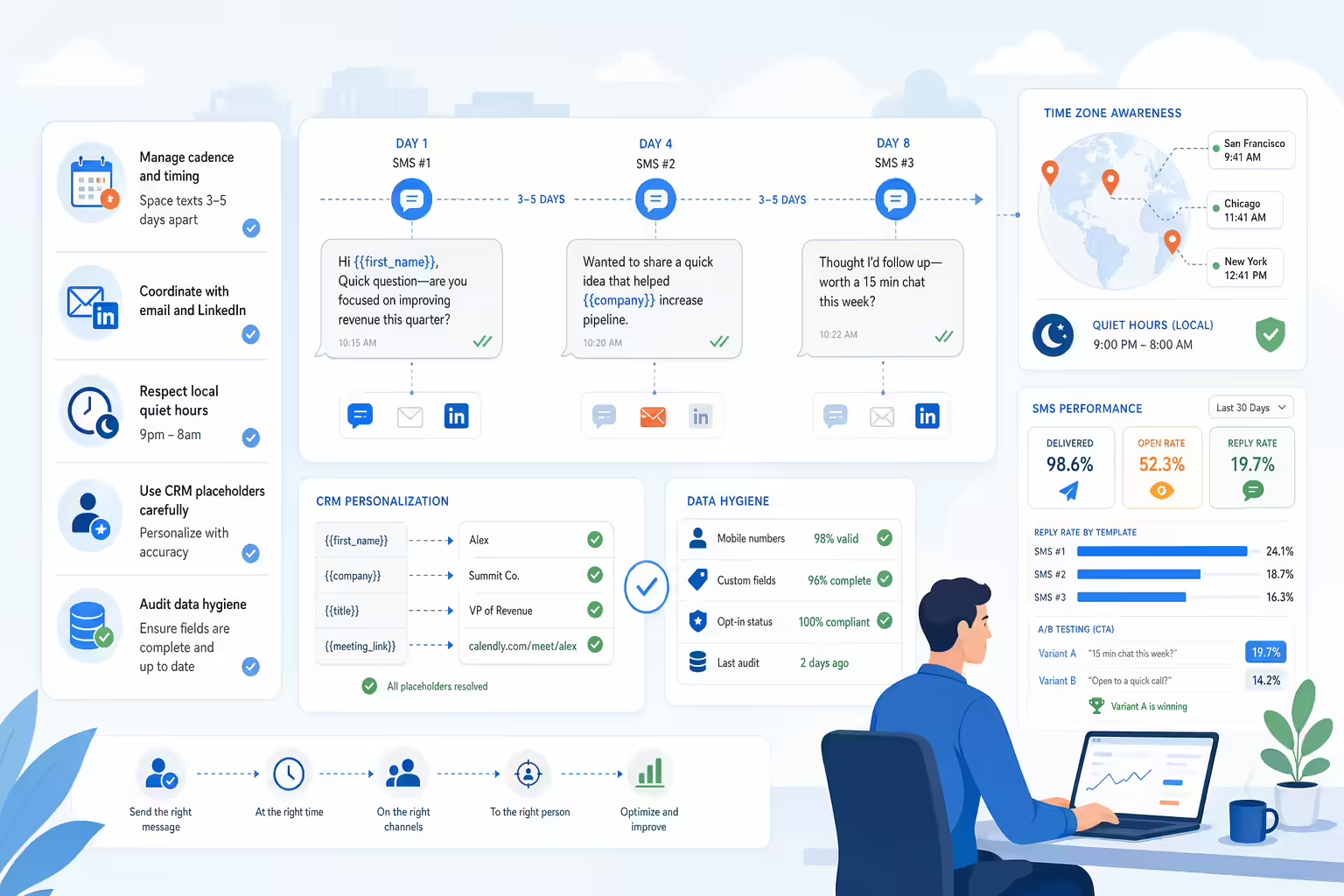
Bombarding a prospect with daily text messages will immediately lead to opt-outs and spam reports. Cadence is the frequency and spacing of outreach efforts. A strong multi-channel sequence spaces text messages three to five days apart, interweaving them with emails and LinkedIn connections.
Data suggests that certain days and times yield higher engagement. Wednesday tends to peak with click-through rates around 27.4 percent. Late afternoon windows, particularly between 5 p.m. and 8 p.m. local time, often see high engagement as professionals wrap up their workday. However, teams must strictly verify that they do not cross the 9 p.m. federal boundary or stricter state boundaries, such as Connecticut’s 8 p.m. cutoff.
SMS Placeholders and Custom Fields
To achieve personalization at scale, templates must utilize custom fields connected to the customer relationship management database. A template might look like this in the software: “Hi {{FirstName}}, congratulations on your recent promotion to {{JobTitle}}.”
Before launching a campaign, teams must audit their data hygiene. If a prospect’s name is entered into the database in lowercase letters, the text will output “Hi john,” immediately revealing that the message is an automated broadcast. Furthermore, if a placeholder fails to populate, the prospect receives a message saying “Hi {{FirstName}},” which damages credibility instantly.
Tracking SMS Engagement
Modern sales telephony platforms provide detailed analytics on delivery rates, open rates, and reply rates. Kixie’s AI Analytics dashboards and Conversation Intelligence track template-level reply rates alongside dialer outcomes, so revenue ops leaders can see which messages move pipeline and which ones go nowhere. Revenue operations leaders should treat their SMS templates as living documents. If a specific template achieves a delivery rate below 95 percent, it is highly likely that cellular carriers are flagging the language as promotional spam.
Teams should conduct A/B testing on their calls to action. Testing a direct ask, such as “Can we speak at 2 PM?”, against an open-ended ask, such as “Is this a priority right now?”, allows teams to follow data rather than intuition. Over time, poorly performing templates should be retired, and high-performing structures should be adapted for different buyer personas.
Integrating AI SMS into Revenue Operations

To maximize efficiency, SMS tools cannot exist in a vacuum. They must integrate seamlessly with a company’s central customer relationship management platform, such as Salesforce or HubSpot.
When a sales representative sends a text from their mobile app or desktop interface, that activity must log automatically to the prospect’s contact record. This synchronization provides the entire revenue team with full visibility into the communication history. If an account executive takes over a deal from a sales development representative, they can read the exact text message thread to understand the prospect’s pain points and preferences. Kixie’s native integrations with HubSpot, Salesforce, Pipedrive, Zoho, and HighLevel handle this two-way sync out of the box, including auto-SMS triggered by CRM workflows, call outcome syncing, and shared inboxes via Team SMS.
Furthermore, marketing and sales teams must coordinate their texting efforts. If a prospect receives a marketing text promoting a webinar on Tuesday morning, the sales representative should not send a cold prospecting text on Tuesday afternoon. Integrated software systems prevent this collision by establishing centralized rules and communication limits across all departments.
Sales SMS Frequently Asked Questions
What is the fine for violating TCPA text message rules? Violating the Telephone Consumer Protection Act carries a federal statutory fine of $500 per individual text message. If the violation is proven to be willful or intentional, the fine can triple to $1,500 per message. Due to the per-message structure, automated campaigns sent without consent can easily trigger millions of dollars in legal liability through class-action lawsuits.
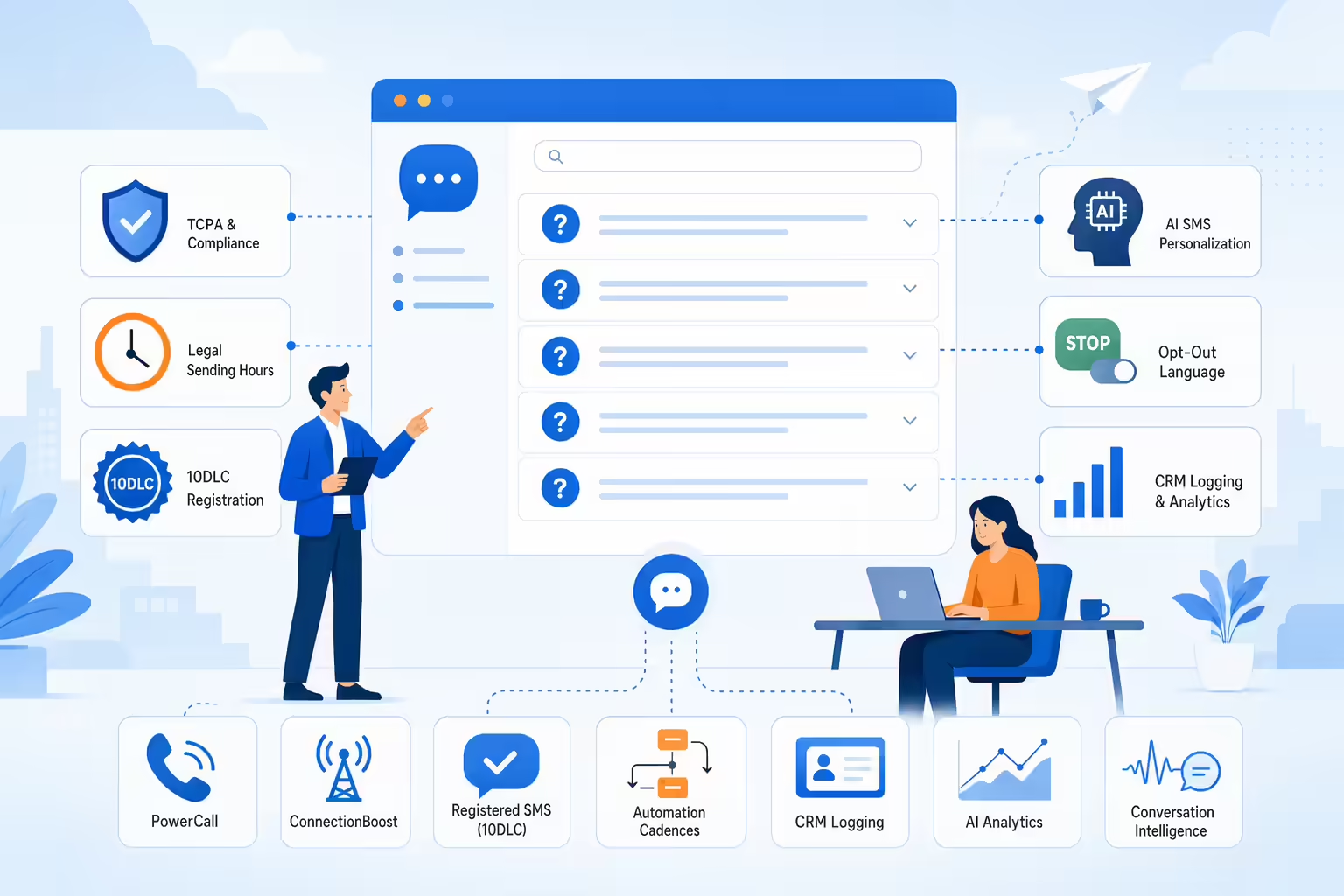
What hours are legal for sending sales text messages? Under federal regulations, businesses may only send promotional or sales text messages between 8 a.m. and 9 p.m. in the recipient’s local time zone. Several states enforce even stricter windows; for example, Florida and Connecticut restrict messaging to between 8 a.m. and 8 p.m., and 9 a.m. and 8 p.m., respectively.
What is 10DLC registration and why is it necessary? 10-Digit Long Code (10DLC) registration is a mandatory process for any business sending application-to-person text messages in the United States. Managed by The Campaign Registry, it requires businesses to verify their brand identity and submit details about their texting campaigns, including opt-in methods. Carriers require this to filter spam and protect consumers. Unregistered traffic is typically blocked or heavily throttled.
How do AI SMS templates improve sales response rates? Artificial intelligence helps representatives craft highly personalized, contextually relevant messages at scale. Instead of sending a generic script to fifty prospects, AI can analyze a prospect’s industry and recent interactions to generate customized text. Furthermore, AI platforms optimize send times based on historical data to ensure messages arrive when prospects are most likely to read them.
What must be included in a compliant opt-in message? A compliant initial text message must clearly state the name of the business or brand sending the message. Crucially, it must also provide a clear, unambiguous mechanism for the recipient to unsubscribe, such as the phrase “Reply STOP to opt out”. Without these two elements, the message violates both legal statutes and carrier compliance standards.
Teams looking for a practical way to deploy AI SMS templates often turn to Kixie. The PowerCall dialer, ConnectionBoost local presence, and 10DLC-registered SMS run inside one platform, with automation cadences that combine calls and texts based on lead behavior or CRM triggers. Native HubSpot, Salesforce, Pipedrive, Zoho, and HighLevel integrations log every message and call outcome to the contact record, while AI Analytics and Conversation Intelligence show which templates and cadences are actually generating replies. See Kixie pricing or book a demo to see it in action.
Sales SMS Takeaways
Integrating text messaging into a business-to-business sales strategy provides an unparalleled opportunity to capture prospect attention. With open rates near 98 percent and response rates routinely hitting 45 percent, SMS easily outperforms traditional cold email channels. However, this high level of engagement comes with significant regulatory responsibilities and operational complexities.
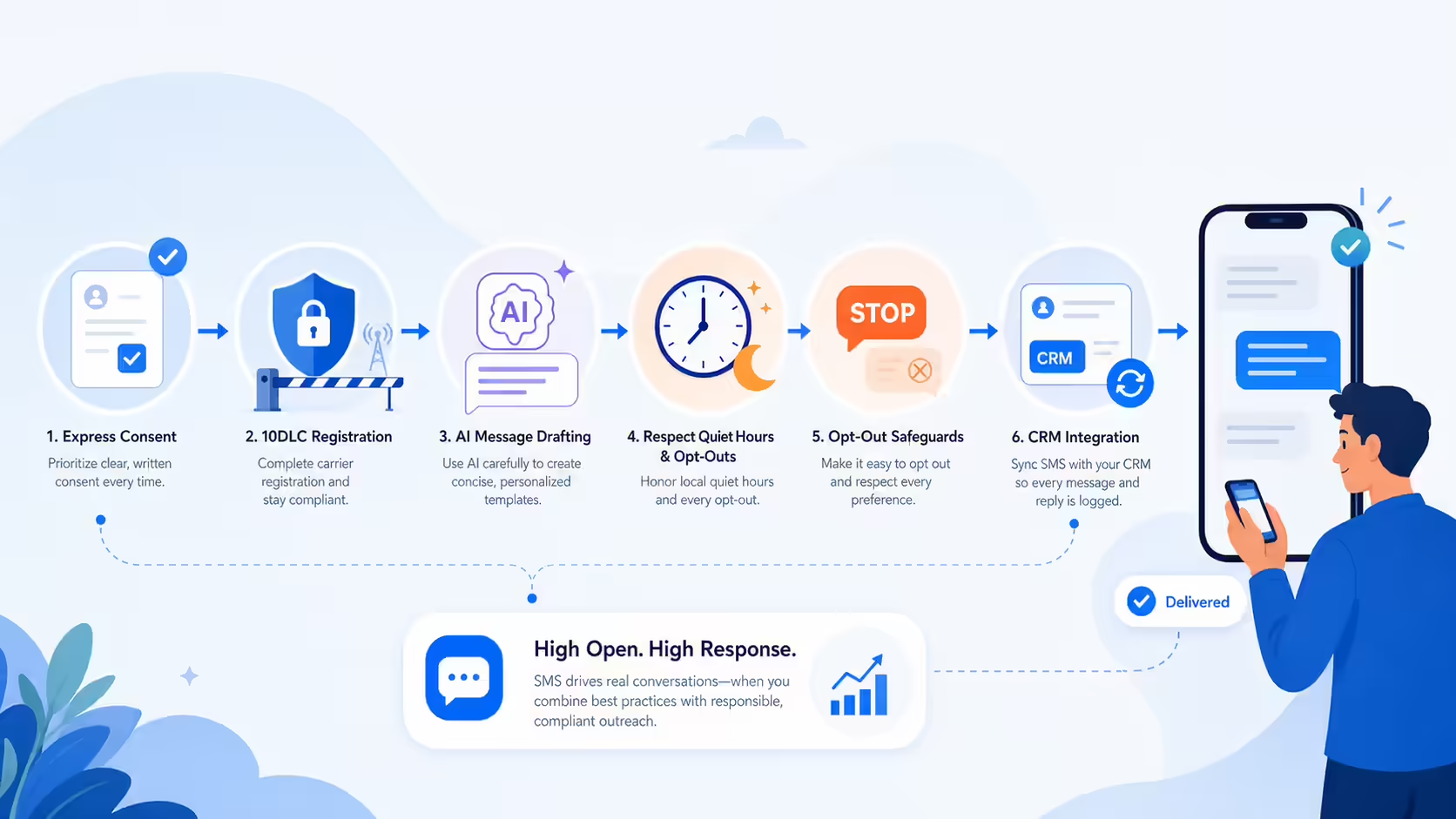
The key takeaways for executing a successful sales text messaging strategy are:
- Prioritize Legal Consent: Never bypass the requirement for express written consent. The financial penalties of the Telephone Consumer Protection Act are too severe to risk utilizing unverified contact lists.
- Master Carrier Compliance: Complete 10-Digit Long Code registration thoroughly. Ensure your website features accessible privacy policies, terms of service, and clear SMS consent checkboxes to pass carrier vetting.
- Use Artificial Intelligence Wisely: Use structured prompts to guide AI models in generating concise, personalized text message templates. Keep messages under 160 characters and ensure they contain a single, clear call to action.
- Respect the Prospect: Always include opt-out language in your initial communications, honor quiet hours strictly according to the recipient’s local time zone, and immediately remove opted-out numbers from all future campaigns.
- Integrate Systems: Utilize sales platforms like Kixie that synchronize natively with your customer relationship management software. This ensures data hygiene, prevents duplicate outreach, and provides management with accurate analytics on campaign performance.
By combining the speed and visibility of text messaging with the scale of artificial intelligence, while strictly adhering to consumer protection laws, sales teams can significantly increase their pipeline generation and close rates.
Ready to close more deals with Kixie?
See how Kixie's AI-powered tools can transform your sales and support operations.
Start Free Trial