
TL;DR: CRM statistics for 2026 point to a larger, more AI-assisted, and more data-dependent sales stack. Fortune Business Insights forecasts the CRM market growing from about USD 126 billion in 2026 to about USD 321 billion by 2034, while Salesforce’s 2026 State of Sales report says reps still spend only 40% of the workweek selling. Freshworks’ 2024 survey of 600 U.S. business professionals found 73% CRM adoption, and HubSpot’s 2025 sales survey found only 8% of reps reported no AI use. The takeaway for revenue teams is practical: CRM value depends less on owning a database and more on capturing clean call, SMS, follow-up, and activity data that managers can act on.
CRM statistics can be surprisingly hard to use well. Some pages mix forecasts, vendor survey findings, old ROI benchmarks, and software rankings as if they all carry the same weight. They do not.
For a sales leader, the better question is not simply whether CRM is growing. It is whether your CRM is giving reps more selling time, managers better coaching data, and RevOps a clearer view of pipeline reality.
This guide separates forecasts from observed survey data, calls out source dates, and keeps the focus on what sales and revenue teams can do with the numbers.
CRM Statistics That Define The 2026 Market
The clearest 2026-specific number is market size. Fortune Business Insights reported that the global customer relationship management market was valued at about USD 113 billion in 2025 and is expected to grow from about USD 126 billion in 2026 to about USD 321 billion by 2034, a projected 12% CAGR for 2026 through 2034.

That is a forecast, not an observed 2026 revenue total. It is still useful because it shows how analysts expect CRM to remain one of the core operating systems for customer-facing teams.
Adoption data tells a more immediate story. Freshworks surveyed 600 U.S. business owners and professionals in April 2024 and found that 73% of businesses used CRM software. The same survey reported CRM usage among 94% of technology businesses and 71% of small businesses.
Those figures should be read as vendor survey data, not a universal census. Still, they match what many sales teams see day to day: CRM is no longer optional infrastructure. The competitive gap is shifting from “Do we have a CRM?” to “Do we have reliable data inside it?”
CRM Adoption Is High But Usage Quality Still Decides Outcomes
High adoption does not mean high-quality usage. A CRM can become a source of truth, or it can become a place where deal records, call notes, and follow-up history decay.

Freshworks found that businesses using CRM software were 86% more likely to exceed sales goals than businesses without CRM software. That is a correlation from a vendor survey, not proof that CRM alone caused better results. The more useful lesson is that teams with a CRM often have a better chance of standardizing follow-up, tracking account history, and spotting lost opportunities.
Salesforce’s State of Sales, 7th Edition, based on a survey of 4,050 sales professionals in 22 countries conducted in August and September 2025, shows why data quality matters. The report says sales reps spend 40% of an average workweek selling and 60% on non-selling work such as meetings, prospecting, quotes, planning, manual data entry, training, and other tasks.
That split should make every sales leader question the CRM workflow around reps, not just the CRM fields themselves. If activity capture is manual, if call outcomes are inconsistent, or if SMS and phone data sit outside the CRM, the system creates reporting friction instead of reducing it.
This is where CRM integration matters. Sales teams using a power dialer or structured calling workflow should care about whether calls, dispositions, recordings, SMS activity, and follow-up tasks make it back into the customer record. The CRM becomes more useful when it reflects actual buyer conversations, not only deal-stage updates.
AI Is Becoming Part Of The CRM Workflow
AI now shows up across CRM and sales workflows, but the strongest teams treat it as a layer on top of clean data rather than a shortcut around data hygiene.

HubSpot’s 2025 State of Sales report, based on a survey of more than 1,000 sales professionals, reported that only 8% of surveyed reps said they were not using AI at all. HubSpot also reported that 37% of reps use AI tools, 84% say AI saves time and optimizes processes, 83% say it personalizes prospect interactions, and 82% say it surfaces better data insights.
Salesforce’s 2026 report adds a more agent-focused view. It reports that 94% of sales leaders with agents say they are critical for meeting business demands, and that 84% of sales teams without an all-in-one platform plan to consolidate technology. Those numbers come from Salesforce research, so they should be interpreted with the source in mind. The directional point is still important: CRM, AI, and sales engagement tools are converging.
The risk is that AI can only reason over the data it can access. If a rep’s best calls, objections, SMS replies, and no-show follow-ups are missing from the CRM, AI summaries and forecasts will miss the same context. If data is duplicated or stale, automation can amplify messy records.
For Kixie users, this is the practical role of communications intelligence. Kixie AI Insights is designed to turn call and SMS activity into operational signals, but the broader lesson applies to any sales team: make sure the data stream feeding CRM and AI reflects the work reps actually do.
CRM ROI Comes From Selling Time And Follow-Up
CRM ROI is easy to overstate when it is reduced to one headline number. A better way to think about ROI is to look at the behaviors CRM should improve.

The most direct lever is selling time. If Salesforce’s surveyed reps spend 60% of the week outside direct selling activity, every workflow that removes unnecessary data entry, routing confusion, or repeated follow-up setup has potential value. That does not mean every automation pays for itself. It means sales leaders should measure recovered time against actual outcomes such as meetings booked, faster first response, healthier pipeline movement, and cleaner forecasts.
Freshworks’ 2024 survey found that 43% of businesses said CRM systems saved employees 5 to 10 hours per week on average, and that respondents pointed to automating repetitive tasks, centralizing customer data, and streamlining communication as common reasons. Again, that is vendor survey data, but it maps to the day-to-day problems sales teams usually feel.
Follow-up is another practical ROI path. A CRM cannot close a deal by itself, but it can help teams stop losing prospects after the first touch. When reminders, call tasks, SMS follow-ups, and account history live in one workflow, managers can see which leads are moving, which are ignored, and which reps need coaching.
For a deeper workflow view, Kixie’s guide to lead follow-up best practices explains how timing, persistence, and channel mix affect conversion discipline. The CRM statistics matter because they point to the same operational truth: teams improve when activity data becomes visible enough to coach and repeat.
CRM Data Quality And Integration Are The Hidden Bottlenecks
The next wave of CRM performance will depend on data quality. Market growth and AI adoption are useful signals, but they do not solve the most common CRM bottlenecks.
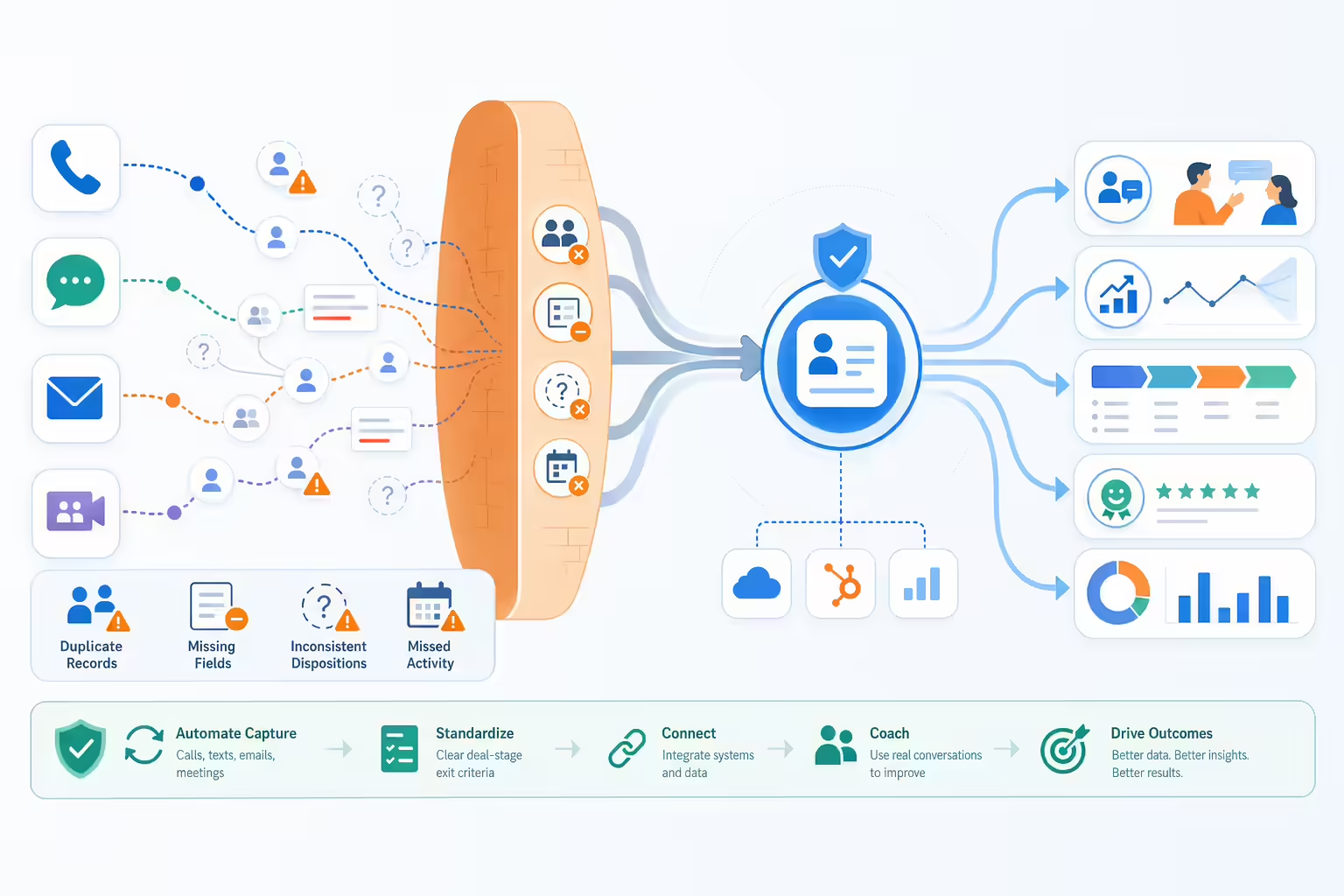
Sales teams still struggle with incomplete records, duplicate contacts, inconsistent dispositions, missed activity logging, and scattered communication channels. These issues are not cosmetic. They affect forecast confidence, speed to lead, rep coaching, attribution, and customer experience.
Salesforce’s report says sales teams are unifying data and simplifying tech to improve AI and agent outcomes. It also notes that sales pros face data concerns such as manual errors and duplicate data. That makes CRM hygiene a revenue issue, not only a RevOps cleanup task.
The best CRM programs usually share a few habits:
- Required activity fields are limited to what managers actually review.
- Calls, texts, emails, and meetings are captured automatically where possible.
- Deal stages have clear exit criteria.
- Reps get coaching from real conversations, not only lagging pipeline reports.
- Leaders review forecasts and market projections as forecasts, not guaranteed outcomes.
This is also the section where the 2026 market data becomes actionable. If CRM spend keeps growing, buyers will have more tools to choose from. The teams that win will not necessarily be the ones with the largest stack. They will be the ones with the clearest operating model for capturing, reviewing, and acting on customer data.
What Sales Leaders Should Do With These CRM Statistics
Use CRM statistics as a diagnostic tool, not a slide deck filler. The most useful action is to compare broad market signals against your own workflow.

Start with five questions:
- What percentage of rep time is spent selling versus updating systems?
- Which customer activities are missing from the CRM today?
- How often do managers review call, SMS, and follow-up data during coaching?
- Which reports are trusted enough to make pipeline decisions?
- Which AI or automation workflows depend on data that is currently incomplete?
Then turn those answers into a short action plan. Clean up the fields that drive coaching and forecasting. Automate call and SMS logging where possible. Create a simple standard for lead follow-up. Review whether your stack is helping reps move faster or forcing them to copy data across tools. Treat AI as a productivity layer that needs accurate activity data underneath it.
The market will keep producing bigger CRM numbers. Your team only benefits when the CRM becomes easier to trust and easier to act on.
CRM Statistics FAQ
What are the most important CRM statistics for 2026?
The most important 2026 CRM statistics are the market growth forecast, CRM adoption levels, AI adoption in sales workflows, rep selling time, and data-quality indicators. The headline market number from Fortune Business Insights is a forecast of about USD 126 billion in 2026, while the operational numbers from Salesforce, HubSpot, and Freshworks show how CRM is affecting sales workflows.

How big is the CRM market in 2026?
Fortune Business Insights expects the global CRM market to grow from about USD 126 billion in 2026 to about USD 321 billion by 2034. Because this is a forecast, it should be labeled as projected market size rather than final observed revenue.
How does CRM affect sales productivity?
CRM affects sales productivity when it reduces manual work, keeps customer history organized, and gives managers reliable activity data. Salesforce’s 2026 State of Sales report says surveyed reps spend 40% of the week selling, which makes workflow design around the CRM a major productivity issue.
What are the main types of CRM?
The main types are operational CRM, analytical CRM, and collaborative CRM. Operational CRM supports sales, marketing, and service workflows. Analytical CRM focuses on reporting and insights. Collaborative CRM helps teams share customer context across departments.
What are the 7 Cs of CRM?
The 7 Cs are commonly described as customer, cost, convenience, communication, coordination, customization, and community. Different sources use slightly different wording, so treat this as a framework for customer relationship planning rather than a fixed software standard.
Is CRM ROI guaranteed?
No. CRM ROI depends on adoption, data quality, workflow design, and how consistently teams act on CRM information. A CRM can improve visibility and follow-up, but it will not fix unclear sales processes or poor data discipline by itself.
How should sales teams use CRM data with Kixie?
Sales teams should use CRM data with Kixie by making call, SMS, disposition, and follow-up activity visible inside the customer workflow. That gives managers a cleaner view of outreach quality, response timing, and coaching opportunities without asking reps to recreate every interaction manually.
Ready to close more deals with Kixie?
See how Kixie's AI-powered tools can transform your sales and support operations.
Start Free Trial