

 HubSpot
 Salesforce
 Zoho
Zoho
 HighLevel
 Pipedrive
 ActiveCampaign
 Slack
Slack
 Zapier
TL;DR
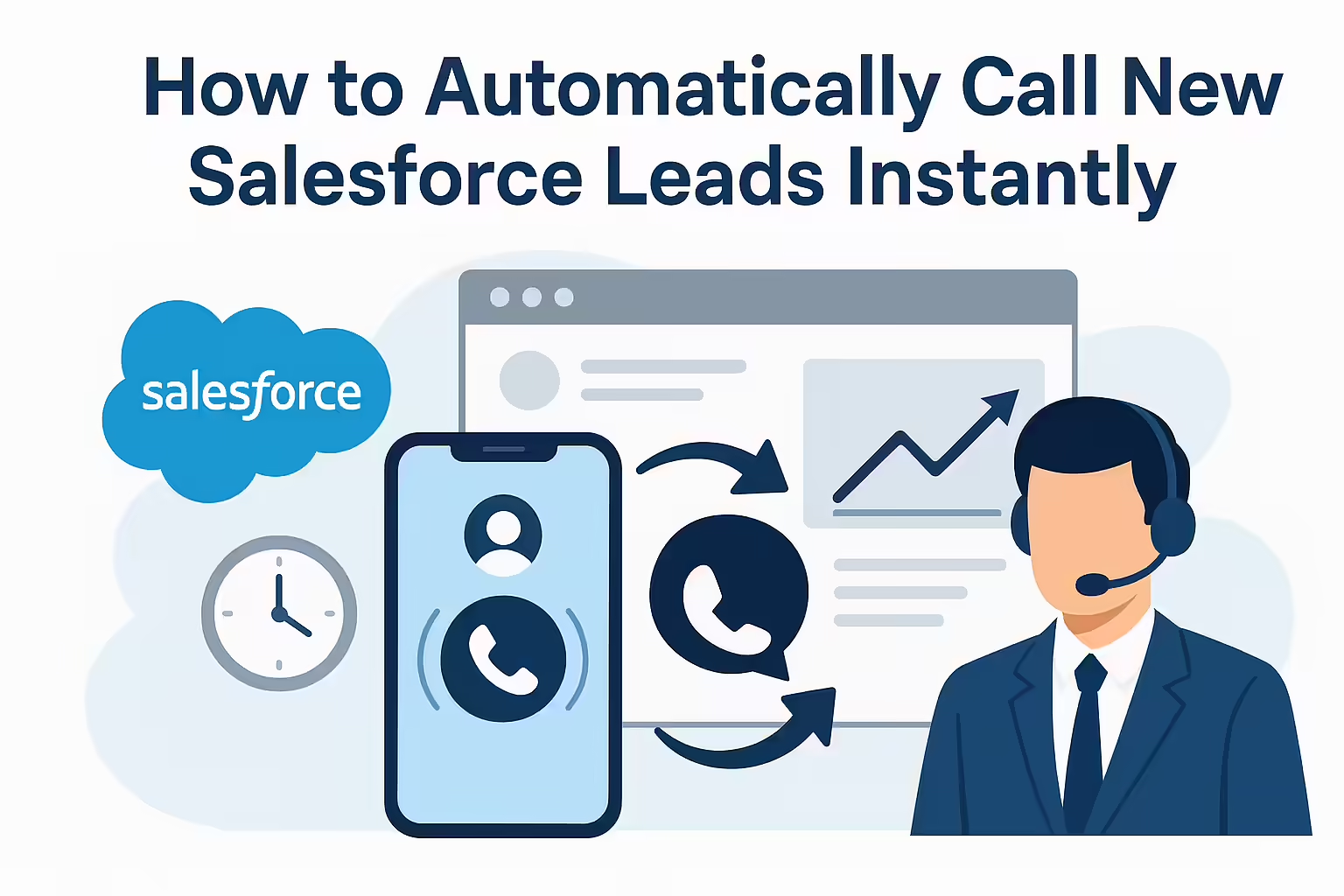
This report addresses the “Assignment-to-Action Gap”, noting that 80% of new leads never convert and the average industry response time is 42 hours. This delay is critical, as contacting a lead within 5 minutes yields 21x higher qualification rates compared to 30 minutes, and waiting 10 minutes (vs. 5) causes a 400% decrease in qualification odds. The failure is twofold: 1) Passive alerts (Slack, email) cause “Context Switching,” which consumes 40% of productive time and requires 23 minutes for a rep to refocus. 2) Native Salesforce operates on a “Pull Model”, limited by one active assignment rule and routing leads to passive queues. The solution is a “Push Model” like Kixie's Automated LeadCaller, an “Intelligent Triage System” that is TCPA compliant (solicited, human-to-human, not robocalling). This system instantly triggers on new lead creation, calls a rep, displays the Salesforce record via the Kixie PowerCall® dialer, and then automatically bridges the call to the new lead. This eliminates the gap, engaging 100% of leads in seconds to capture the 21x qualification bonus.
Table of Contents
- Your Salesforce Leads are Your Most Expensive, Perishable Asset.
- Deconstructing the "Speed-to-Lead" Conversion Cliff for Your Leads
- Your "New Salesforce Lead" Alerts Are Your Team's "Secret Productivity Killer"
- Why Native Salesforce Assignment Rules Guarantee Delay
- The Solution for Salesforce Leads: An "Intelligent Triage System" (Not "Robocalling")
- How Kixie's Automated LeadCaller Works for New Leads
- Stop Assigning Leads. Start Connecting With Them.
Your Salesforce Leads are Your Most Expensive, Perishable Asset.
As a sales leader, you are accountable for the entire revenue engine. A significant portion of your budget is dedicated to marketing campaigns that generate new inbound leads. These are assets that are becoming increasingly expensive. The average Cost Per Lead (CPL) has climbed dramatically, rising from $7.50 to $33 in the last decade alone. These are not just rows in a Salesforce report; they are high-cost, high-intent, and extraordinarily perishable financial assets.
Given this, the single greatest point of failure in modern B2B sales is the unmanaged chasm between lead creation and meaningful engagement. This is the “Assignment-to-Action Gap”. It is the financial black hole where your marketing ROI and sales potential go to die.
The data on this systemic waste is staggering:
- Research indicates that 80% of new leads never translate into sales.
- Even more alarmingly, over 30% of leads are never contacted at all.
This failure is not anecdotal; it is a structural default. A landmark Harvard Business Review audit of 2,241 U.S. firms found that the average response time to a web-generated lead was 42 hours. To solve this, sales leaders have created a system of “constant interruptions,” which include email alerts, CRM tasks, and a relentless stream of Slack notifications. This report will demonstrate that these passive alerts are not the solution; they are a primary cause of the failure. They represent “process inefficiencies”, a top challenge for sales leaders, and they create a destructive workflow that guarantees failure. The problem is not that your reps are slow; it's that the system you've built is designed for storage, not instant action.
Deconstructing the "Speed-to-Lead" Conversion Cliff for Your Leads
Because inbound leads are high-cost and highly perishable assets, “speed-to-lead” (the time it takes to respond to them) is arguably the single most important metric in a sales funnel. The value of an inbound lead does not decay gradually over hours; it falls off a “conversion cliff” in minutes. Any sales process that does not account for this cliff is, by definition, structurally designed to fail.
The “golden window” for contact is the first five minutes. The data, compiled from multiple authoritative studies, is conclusive:
- The 5-Minute Mandate: A foundational study by Lead Response Management and HBR confirms that contacting leads within five minutes yields 21x higher qualification rates than waiting just 30 minutes.
- The 5-Minute vs. 10-Minute Gap: The decay is immediate and unforgiving. The same study found a 400% decrease in the odds of qualifying a lead when response time slips from 5 minutes to 10 minutes.
- The “Golden Minute”: Further analysis of conversion data reveals a 391% conversion boost for sales teams that respond within one minute.
- The 1-Hour Benchmark: Even the commonly cited “best practice” of responding within an hour is a massive compromise. While teams that respond within 60 minutes are 7x more likely to convert than those who wait longer, this is a 66% reduction in potential compared to the 21x qualification boost available inside the five-minute window.
When compared to this data, the 42-hour industry average response time is not just “slow”; it is a complete financial forfeiture. The data proves that the entire game is won or lost before a sales rep, operating under a traditional model, has even seen the “new lead” notification in their inbox.
To fully illustrate the financial urgency, this data is consolidated below.
The “Speed-to-Lead” Conversion Cliff
| Response Time Window | Key Metric | Data Point |
|---|---|---|
| 0–1 Minute | Conversion Boost | 391% |
| 0–5 Minutes | Qualification Rate (vs. 30 min) | 21x Higher |
| 5 vs. 10 Minutes | Odds of Qualifying | 400% Decrease |
| 0–1 Hour | Conversion Rate (vs. >1 hr) | 7x Higher |
| > 24 Hours | Average Industry Reality | 42 Hours |
Your "New Salesforce Lead" Alerts Are Your Team's "Secret Productivity Killer"
Sales leaders' primary concerns include “sales team productivity” and “process inefficiencies”. To solve the problem of slow lead response times (which average 42 hours), many leaders implement a system of “constant interruptions,” which include email alerts, CRM tasks, and a relentless stream of Slack notifications. The paradox is that the very tools implemented to increase productivity are a primary driver of inefficiency.

This failure is rooted in a well-documented psychological phenomenon: “Context Switching.” Context switching is the act of “hopping between different tasks, apps, or projects”. It has been identified as the “secret sales productivity killer” because each “brief mental block” levies a severe “distraction tax” on your team's focus and output.
The quantified cost of this tax is severe:
- After a single interruption (like a Slack alert), it can take a person up to 23 minutes to re-focus on their original “deep work” task, such as writing a proposal or preparing for a demo.
- This constant switching can consume up to 40% of a person's productive time.
- The resulting lost productivity costs the global economy an estimated $450 billion annually.
A Slack or email notification for a new Salesforce lead is the worst possible kind of interruption. It is a high-cost, low-probability event. The rep is forced to pay the full 23-minute focus cost regardless of whether they successfully contact the lead. This creates a no-win scenario for your best reps. They are forced to choose between:
- Ignoring the ping to stay in-flow, thus guaranteeing they miss the 21x qualification window (from contacting a lead in 5 minutes vs. 30) and are blamed for the slow response time.
- Obeying the ping, shattering their focus for 23 minutes, and still being too late to capture the 400% qualification bonus that disappears after 5 minutes (compared to 10 minutes).
This management-designed failure loop burns out reps and destroys pipeline. The problem is not the interruption itself; it's that a passive notification is the wrong tool for an instantaneous problem.
Why Native Salesforce Assignment Rules Guarantee Delay
The root of the 42-hour average lead response delay and the 40% productivity loss from context switching lies in the very architecture of the tools being used. Sophisticated Salesforce users are often the most frustrated, as they have spent years trying to optimize a system that is, by design, incapable of solving this problem.
Salesforce is the world's best System of Record. It was never designed to be an instantaneous System of Action. The entire native Salesforce lead management process is a “Pull” Model”. A lead is created (Web-to-Lead), routed, and dropped into a queue. It then waits for a human rep, who has been passively notified, to manually pull it from the queue and initiate action. This “pull” step is the “Assignment-to-Action Gap” (the delay between creation and engagement), and its existence guarantees failure.
This flaw is not a configuration error; it is a structural limitation. The specific technical constraints that guarantee this delay include:
- The “One Active Rule” Constraint: Salesforce permits only one active lead assignment rule at a time. This forces administrators to build a single, monstrously complex rule to handle all possible logic, including territories, demo requests, partner leads, company size, etc..
- The “House of Cards”: This single rule becomes a fragile “house of cards”. It is notoriously “laborious” to test, QA, or debug” because Salesforce lacks native versioning or debugging tools for it. Consequently, admins are hesitant to modify it, and routing failures are common and difficult to diagnose.
- The “Queue” Dead End: The only output of a native assignment rule is to assign the lead to a User or a Queue. This action is a passive notification. It is the start of the 42-hour delay, not the solution to it.
No amount of in-house Salesforce optimization or “stricter lead qualification” can fix this fundamental “pull” model. The very act of using a Salesforce Queue is an operational decision to accept the 400% drop in qualification odds that occurs after the first five minutes.
The Solution for Salesforce Leads: An "Intelligent Triage System" (Not "Robocalling")
The only viable solution to the “Assignment-to-Action Gap” (the delay between a lead being created and a rep taking action) is to eliminate it entirely by redesigning the process. This requires a fundamental shift from a “pull” model (where reps are passively notified of leads in a queue) to a “push” model, which is made possible by an automated calling solution.
First, it is critical to handle a common and legitimate objection: this is not “robocalling”.
Objection Handling: This is Not "Robocalling"
The term “robocall” has a specific legal and functional definition: an unsolicited automated call that delivers a pre-recorded message. These are, in most cases, illegal under the Telephone Consumer Protection Act (TCPA) without specific consent.
An “Intelligent Triage” call, or an automated lead response, is the precise operational and legal opposite:
- It is SOLICITED: The entire process is triggered by the prospect requesting contact by filling out a web form.
- It is COMPLIANT: This web form submission, when properly configured, constitutes the prospect's “prior express written consent” under the TCPA, giving you permission to contact them.
- It is HUMAN-TO-HUMAN: The system does not play a pre-recorded message. Kixie's Automated LeadCaller connects your live sales rep to the live prospect.
This is not spam. This is a compliant, high-value, instantaneous customer service response to the request your prospect just made.
How Kixie's Automated LeadCaller Works for New Leads
Kixie's Automated LeadCaller is the engine that converts Salesforce from a passive “pull” model (where leads are dropped in a queue and require a rep to manually find them) into an active “Push” Model”. It makes assignment and action simultaneous.
The mechanism is simple, fast, and eliminates all points of human latency:
- Trigger: A new lead is created in Salesforce (e.g., from a Web-to-Lead form submission).
- Push: Instantly, Kixie bypasses all passive notifications (Slack, email) and places an immediate outbound call to the correct, available sales rep (or round-robins a team).
- Context: The sales rep answers their Kixie phone. The Kixie PowerCall® dialer instantly displays the new lead's complete Salesforce record on their screen, providing full context before the prospect ever says “hello”.
- Bridge: The moment the rep answers, Kixie automatically places the outbound call to the new lead, bridging the rep to the prospect.

The “Assignment-to-Action Gap” (the delay between lead creation and rep engagement) is eliminated. The result is a live, human-to-human conversation, with a fully-briefed sales rep, in seconds. Your team is now engaging the prospect while they are still on your website and thinking about your brand, capturing the 21x qualification bonus (for contacting leads within 5 minutes) by default, every time.
The operational difference is a night-and-day transformation.
Table 2: Operational Model Comparison: Native Salesforce “Pull” vs. Kixie “Push”
| Metric | “Native Salesforce “Pull” Model” | “Kixie “Push” Model” |
|---|---|---|
| Core Logic | “Assign to Queue” | “Connect to Human” |
| Average Time-to-Call | 42 Hours | < 30 Seconds |
| System Relies On... | Rep seeing a passive notification | Rep answering an active phone call |
| Rep Productivity Cost | High: 40% productivity loss per “context switch” | Low: Rep stays in-flow until a live call |
| Lead Engagement % | Low: >30% of leads never contacted | 100% of inbound leads are engaged |
| Probable Qualification Rate | 1x (Baseline) | 21x |
Stop Assigning Leads. Start Connecting With Them.
As a sales leader, you are accountable for maximizing the ROI on your two most expensive and critical assets: your marketing budget (which creates leads) and your sales team (which provides productivity).
The traditional “pull” model, built on native Salesforce assignment rules where leads wait passively in queues, actively destroys the value of both.
- It guarantees your lead assets decay, forcing you to forfeit the 21x qualification bonus (for making contact within 5 minutes) by ensuring you miss the 5-minute window.
- It guarantees your team's productivity is wasted, forcing them to pay a 40% “context switch” tax to chase stale leads they will likely never contact.
An automated “push” model, which actively connects available reps to new leads, is the “intelligent safety net” that protects both of these assets. It stops the 100 distracting, low-value notifications and replaces them with 5–10 high-value, actionable conversations.
The system, not the human, bears the cognitive load. Your rep is no longer a reactive task-switcher; they are an engaged, high-performing problem-solver. It is time to stop optimizing a broken “pull” model. Convert Salesforce from a passive “house of cards” into a high-velocity revenue engine. It is time to stop assigning leads and start connecting with them.
This transformation is achieved through Kixie's full, bi-directional Salesforce integration, which includes the Automated LeadCaller, a multi-line power dialer for proactive follow-up, and automatic call and SMS logging to maintain a perfect system of record.