

 HubSpot
 Salesforce
 Zoho
Zoho
 HighLevel
 Pipedrive
 ActiveCampaign
 Slack
Slack
 Zapier
TL;DR
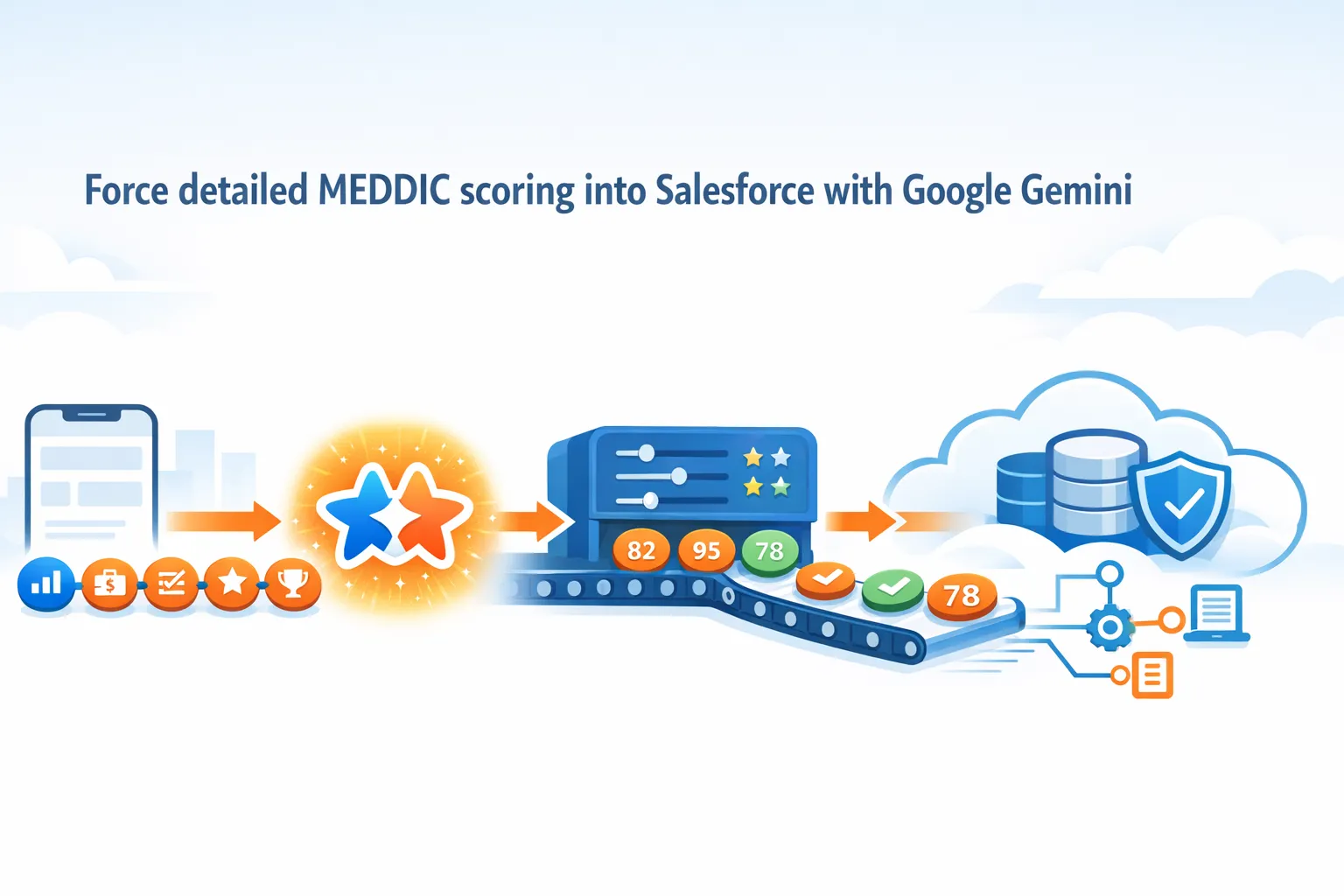
Enterprise RevOps leaders utilize Kixie telephony webhooks and Google Gemini 1.5 Pro to automate MEDDIC scoring, addressing the $28,500/rep annual productivity loss and increasing forecast accuracy from 52% to 89% by eliminating manual entry. The technical architecture triggers a Kixie “End Call” webhook containing recording metadata, which middleware (Zapier/Make) routes to Google Gemini’s 1M+ token context window for analysis. A rigid system prompt instructs Gemini to output binary satisfaction scores (0/1), direct evidence quotes, and confidence levels as structured JSON mapped to Salesforce Opportunity custom fields. Compliance is enforced via Salesforce Validation Rules (e.g., AND(ISPICKVAL(StageName, "Negotiation"), MEDDIC_Score__c < 80)), gating pipeline progression based on AI-verified criteria rather than rep intuition, facilitating a transition to “Zero Entry” policies through a Shadow/Augment/Enforce deployment strategy.
Table of Contents
- The Methodology Compliance Paradox in Salesforce MEDDIC Implementation
- The High Cost of the Honor System in MEDDIC Scoring
- The Adoption Gap in Salesforce MEDDIC Data
- The Financial Impact of Manual MEDDIC Entry into Salesforce
- The Technical Integration of Kixie with Google Gemini 1.5 Pro
- Kixie as the High Fidelity Data Ingest Layer for Salesforce
- Google Gemini 1.5 Pro as the Contextual Reasoning Engine
- Engineering Forced MEDDIC Compliance via Architecture
- The Data Flow from Kixie to Google Gemini and Salesforce
- The Google Gemini Prompt Strategy for Scoring
- The Force Mechanism in Salesforce Configuration
- Key Trends Driving the Shift to Google Gemini and Salesforce
- Moving From Carrot to Stick in Salesforce MEDDIC Adoption
- The Rise of Agentic AI Like Google Gemini in RevOps
- Data Hygiene as a Compliance Mandate for Salesforce
- Strategic Recommendations for Enterprise RevOps Using Google Gemini
- Implementing Zero Entry Policies for Salesforce MEDDIC Data
- Auditing the Google Gemini AI Instead of the Rep
- Deploying Conversation Strength Metrics Alongside MEDDIC Scores
- Phased Rollout for Google Gemini Integration
- Finalizing the Transition to Automated MEDDIC Scoring in Salesforce
The Methodology Compliance Paradox in Salesforce MEDDIC Implementation
For Enterprise Revenue Operations (RevOps) leaders, the gap between purchased sales methodology and executed sales methodology is the single greatest source of forecast volatility. While 93% of sales organizations claim to use frameworks like MEDDIC, audit data reveals that the vast majority are merely “filling out CRM fields” rather than applying the methodology’s rigorous qualification criteria. This compliance gap is not a training issue; it is a structural failure of manual data entry.
The traditional approach, relying on sales representatives to manually interpret conversations and input scores, is fiscally irresponsible. Manual data entry costs organizations an average of $28,500 per employee annually in lost productivity and results in data that 76% of CRM users describe as “inaccurate or incomplete.”
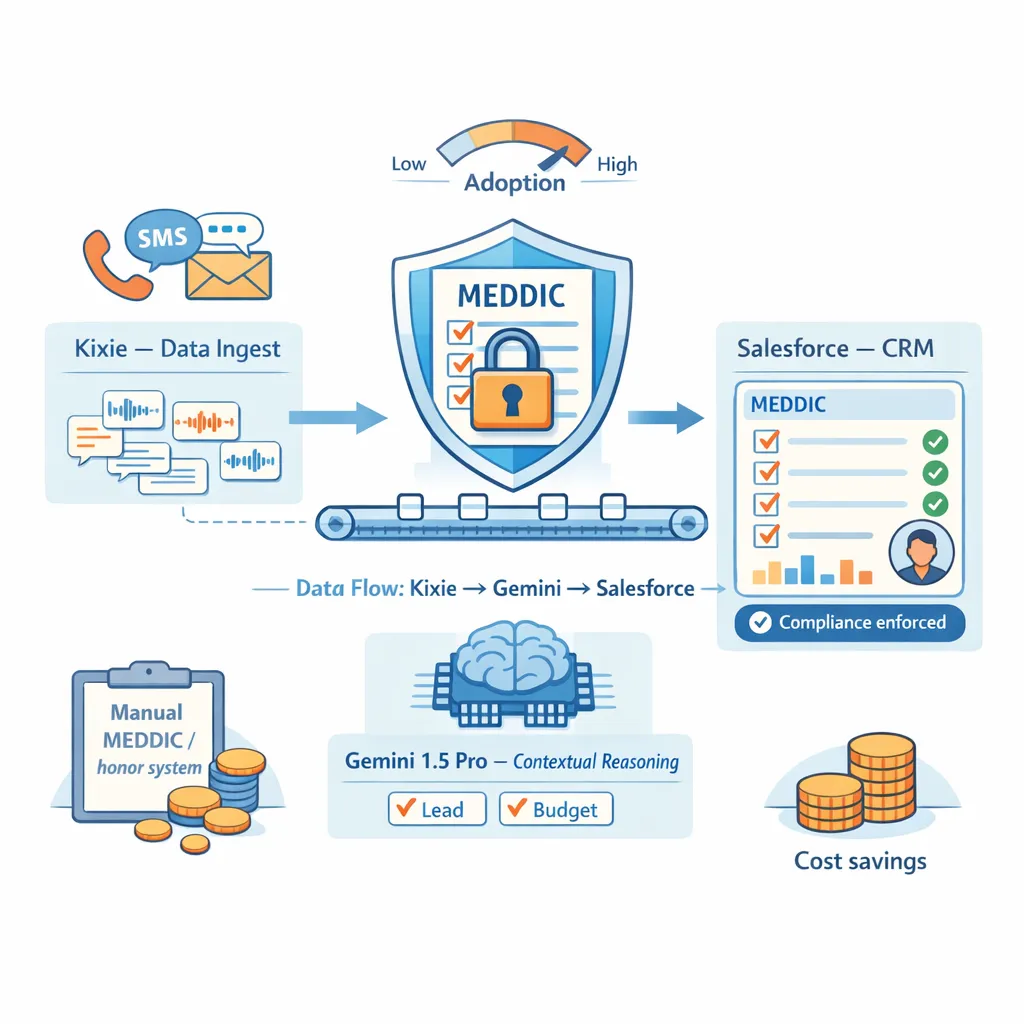
A deterministic technical architecture solves this problem by forcing detailed MEDDIC compliance through integration. By connecting Kixie’s telephony and webhook infrastructure with Google Gemini’s long-context AI reasoning, organizations can push validated scoring directly into Salesforce. By removing the human variable from data capture, RevOps leaders can transition from “encouraging adoption” to “engineering compliance.”
The High Cost of the Honor System in MEDDIC Scoring
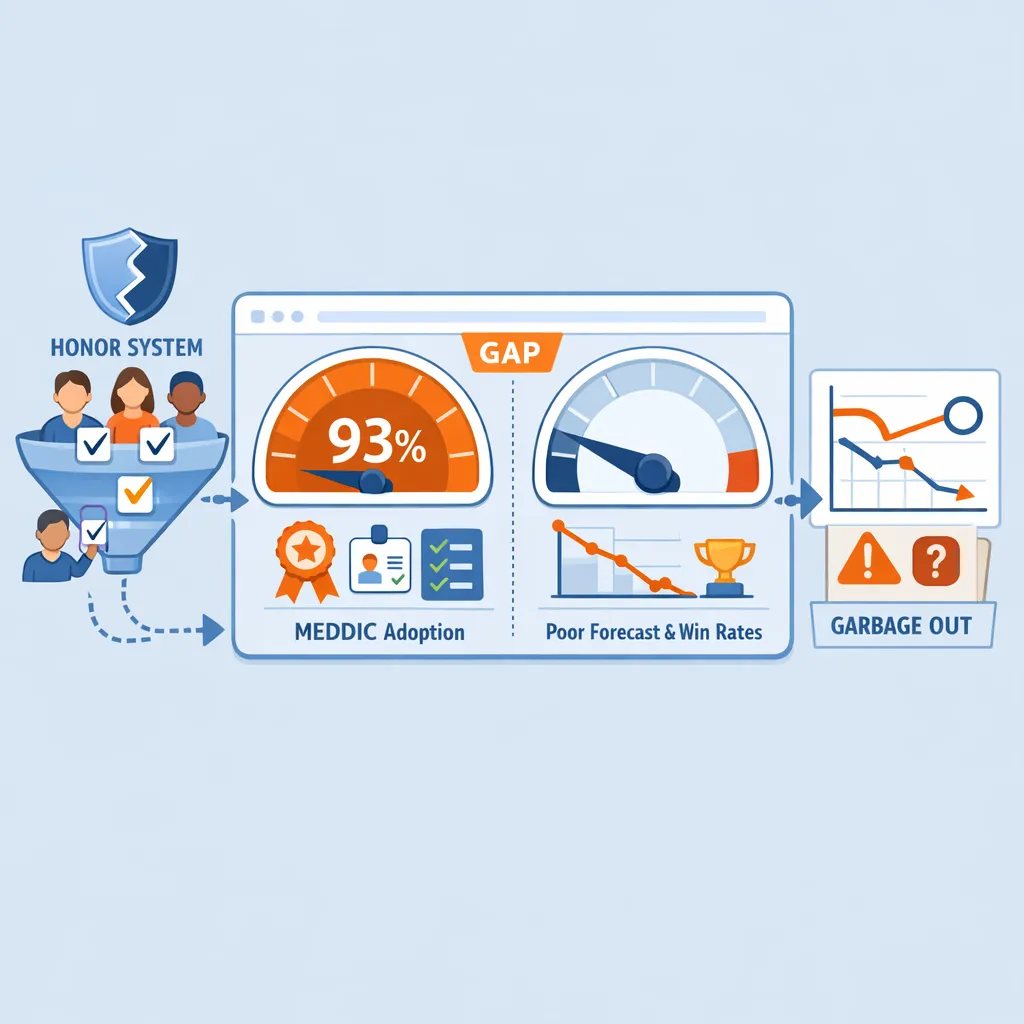
The reliance on human adherence to complex methodologies like MEDDIC (Metrics, Economic Buyer, Decision Criteria, Decision Process, Identify Pain, Champion) creates a “garbage in, garbage out” cycle in enterprise forecasting.
The Adoption Gap in Salesforce MEDDIC Data
Methodology adoption is often measured by attendance at training sessions or the presence of fields in Salesforce. However, true effectiveness, defined by forecast accuracy and win rates, lags significantly.
- The 93% Illusion: While nearly universal adoption is claimed by leadership, deep audits show that most implementations devolve into “administrative compliance” where reps retrofit data into fields right before a QBR, rather than using the framework to qualify deals in real-time.
- Forecast Volatility: Organizations that successfully operationalize MEDDIC see forecast accuracy jump from 52% to 89%. Conversely, the “honor system” approach leaves 93% of sales leaders unable to forecast within 5% accuracy even two weeks before the quarter ends.
The Financial Impact of Manual MEDDIC Entry into Salesforce
The request for reps to “log their notes” is an expensive operational inefficiency.
- Direct Cost: Manual data entry drains approximately $28,500 per rep annually. For an enterprise team of 100 sellers, this is a $2.85 million operational leak.
- Opportunity Cost: Sales reps currently spend only ~30% of their time actually selling. The remaining 70% is consumed by administrative tasks, including the manual transcription of call notes into CRM fields, tasks that AI can perform with superior consistency.
- Revenue Leakage: Poor data quality directly correlates to revenue loss for 37% of CRM users, as “zombie opportunities” (unqualified deals) clutter the pipeline and skew resource allocation.
The Technical Integration of Kixie with Google Gemini 1.5 Pro
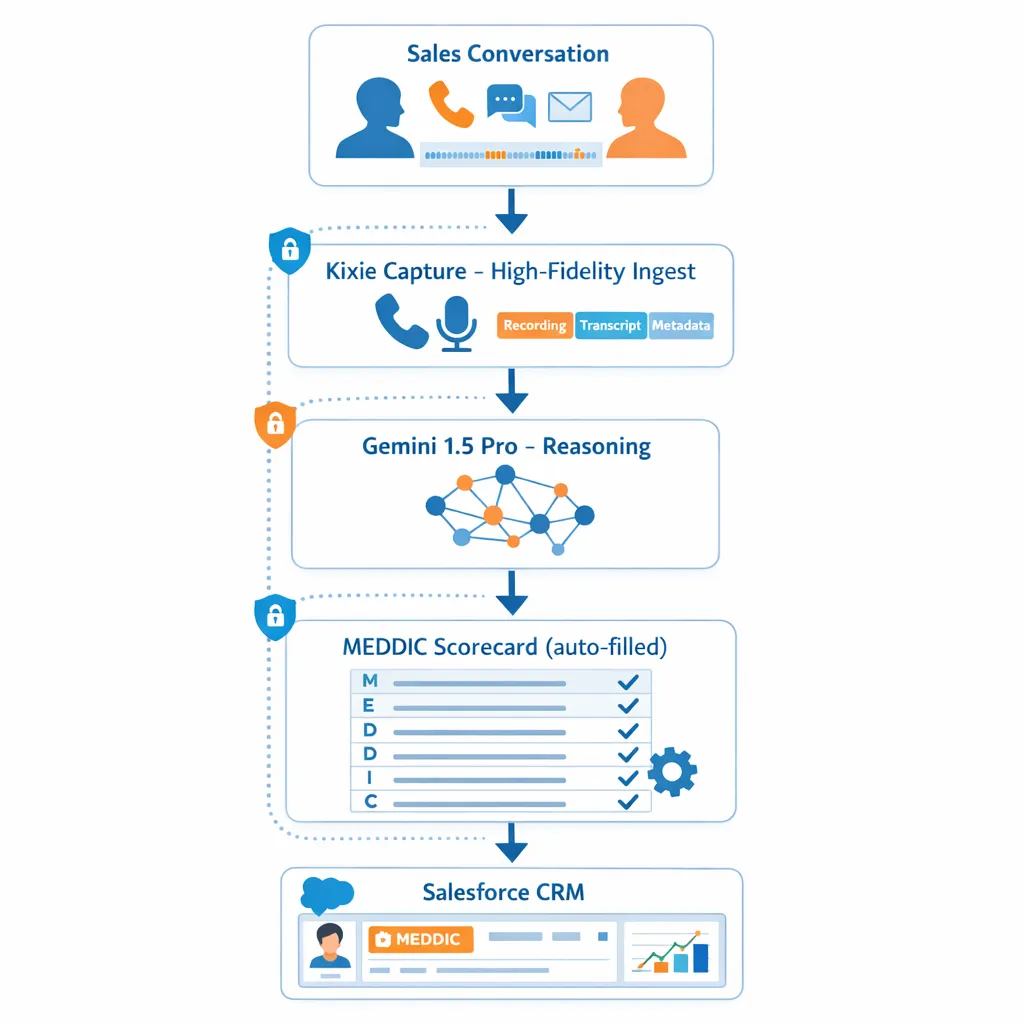
Eliminating the gap between sales methodology and actual execution requires Revenue Operations to automate the chain of custody for call data. Integrating Kixie (Capture) and Google Gemini (Reasoning) creates a system where MEDDIC scoring becomes an inevitable byproduct of the sales conversation, rather than a post-call administrative chore.
Kixie as the High Fidelity Data Ingest Layer for Salesforce
Kixie serves as the sensory layer of the stack. Unlike standalone dialers, Kixie’s architecture allows for “Event Webhooks” which are critical for real-time automation.
- CI Summary Webhook: Upon call completion, Kixie triggers a webhook payload containing not just the call metadata, but the recording URL and an initial AI-generated summary.
- Webhook Payload Capability: Kixie can push
recordingurl,callid,contactid, anddispositionto any endpoint (e.g., Zapier, Make, or a custom AWS Lambda function) immediately after a call ends.
Google Gemini 1.5 Pro as the Contextual Reasoning Engine
While standard transcription services can convert speech to text, identifying the nuances of a “Champion” versus a “Coach” requires advanced reasoning. Google Gemini 1.5 Pro is uniquely suited for this due to its massive context window.
- 1 Million+ Token Context Window: Sales cycles often involve hour-long discovery calls or multiple calls over weeks. Gemini 1.5 Pro can ingest up to 1 million tokens (approx. 700,000 words or 11 hours of audio) in a single pass. This allows the AI to analyze entire conversation histories to score MEDDIC, rather than just isolated snippets.
- Multimodal Analysis: Gemini can process native audio files directly without needing a separate transcription step in some configurations, preserving tonal cues that might indicate hesitation (risk) or enthusiasm (champion behavior).
Engineering Forced MEDDIC Compliance via Architecture

An effective automated architecture for MEDDIC scoring removes the salesperson from the data entry loop entirely. This workflow details the specific engineering required to automate compliance.
The Data Flow from Kixie to Google Gemini and Salesforce
- Capture: Sales rep initiates call via Kixie PowerCall within Salesforce. The call is recorded stereo-phonically (separating agent and prospect).
- Trigger: Upon call completion, Kixie fires the “End Call” or “CI Summary” webhook.
- Orchestration (Middleware): A platform like Zapier or Make receives the webhook payload. It extracts the
recordingurland SalesforceOpportunity ID. - Intelligence (The Gemini Node): The middleware sends the recording (or transcript) to the Google Gemini API with a specific system prompt designed for MEDDIC extraction.
- Execution (Salesforce Write): The middleware parses Gemini’s structured JSON output and updates custom fields on the Salesforce Opportunity object (e.g.,
MEDDIC_Metrics__c,MEDDIC_Score__c).
The Google Gemini Prompt Strategy for Scoring
To achieve “Analyst-Grade” scoring, the prompt sent to Gemini must be rigid. Generic summaries are insufficient for RevOps rigor.
Recommended System Prompt Structure:
“You are an expert Sales Operations Auditor. Analyze the attached sales call transcript against the MEDDIC framework. For each component (Metrics, Economic Buyer, Decision Criteria, Decision Process, Identify Pain, Champion), provide:
- A binary score (0 or 1): Is this criterion satisfied?
- Evidence: A direct quote from the prospect proving this.
- Confidence Level: Low/Medium/High based on the explicitness of the confirmation.
Return the output strictly as a JSON object keyed to Salesforce field API names.”
The Force Mechanism in Salesforce Configuration
Automation populates the data, but Validation Rules enforce the behavior. To ensure deals do not progress without this data, RevOps must implement “Stage Gates” in Salesforce.
Configuration Strategy:
- Custom Objects vs. Fields: While simple implementations use fields on the Opportunity, a “Sales Methodology” custom object related to the Opportunity allows for history tracking of scores over time.
- Validation Rule Logic:
This rule prevents a deal from moving to “Negotiation” unless the AI-generated MEDDIC score exceeds 80/100.AND( ISCHANGED(StageName), ISPICKVAL(StageName, "Negotiation"), MEDDIC_Score__c < 80, bypass_validation__c = FALSE )
Key Trends Driving the Shift to Google Gemini and Salesforce
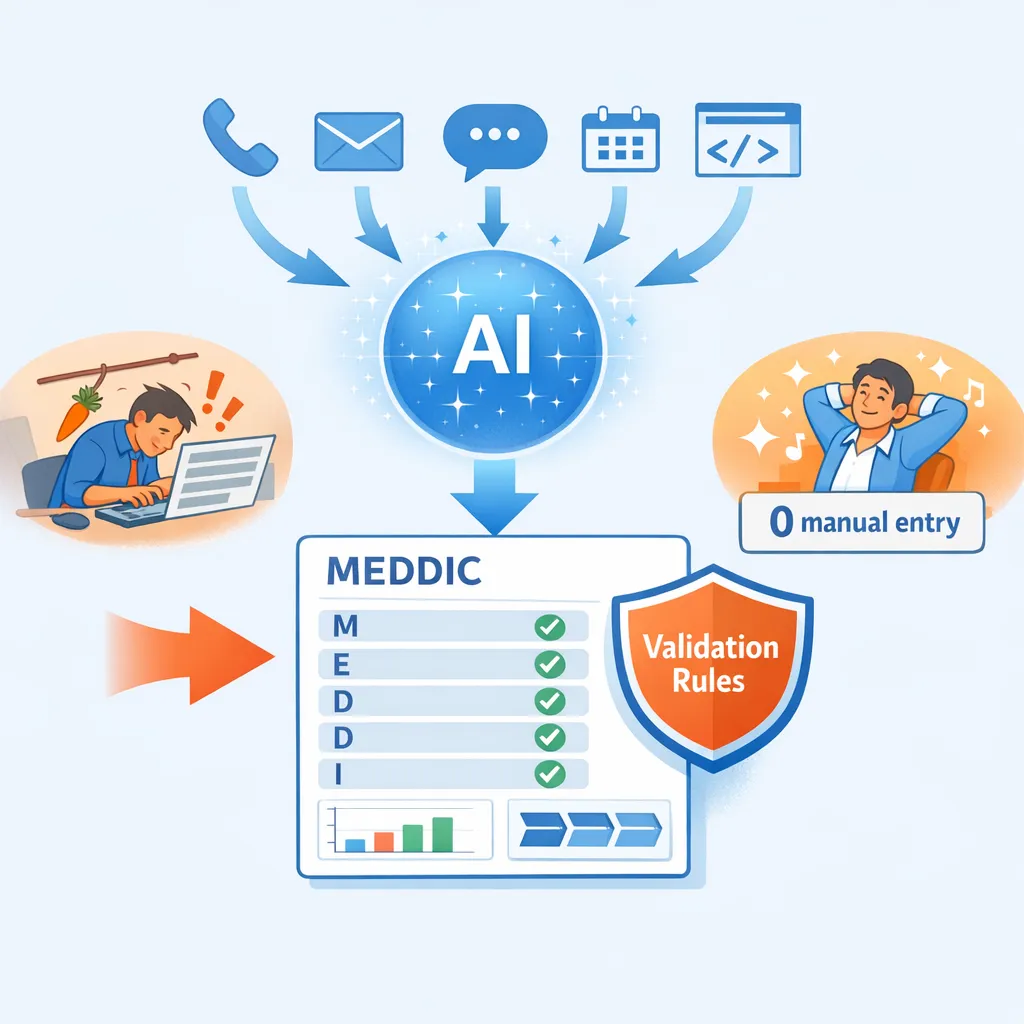
Moving From Carrot to Stick in Salesforce MEDDIC Adoption
Historically, software adoption relied on “user-friendly” interfaces to coax reps into entering data. The industry trend for 2025 is shifting toward invisibility. The most effective CRM implementations now assume zero human data entry for objective metrics. With 56% of employees burning out from manual tasks, the “stick” is no longer punishing reps for missing data, but rather automating the data capture so that the “stick” (validation rules) only hits when the actual sales conversation was deficient, not the administrative work.
The Rise of Agentic AI Like Google Gemini in RevOps
The market is moving beyond “Generative” AI (writing emails) to “Agentic” AI (executing workflows). Google Gemini’s ability to execute code and reason through complex documents means it can act as a virtual sales manager, auditing calls with a consistency no human manager can match. This aligns with the trend where 81% of sales teams are already investing in AI, with high-performing teams 1.4x more likely to use AI for sales intelligence.
Data Hygiene as a Compliance Mandate for Salesforce
With the average enterprise losing 16 sales deals per quarter due to poor data, data hygiene has graduated from an IT concern to a Board-level revenue risk. RevOps leaders are increasingly tasked with ensuring “audit-ready” pipelines where every commit deal is backed by verifiable artifacts (recordings/transcripts), not just rep intuition.
Strategic Recommendations for Enterprise RevOps Using Google Gemini
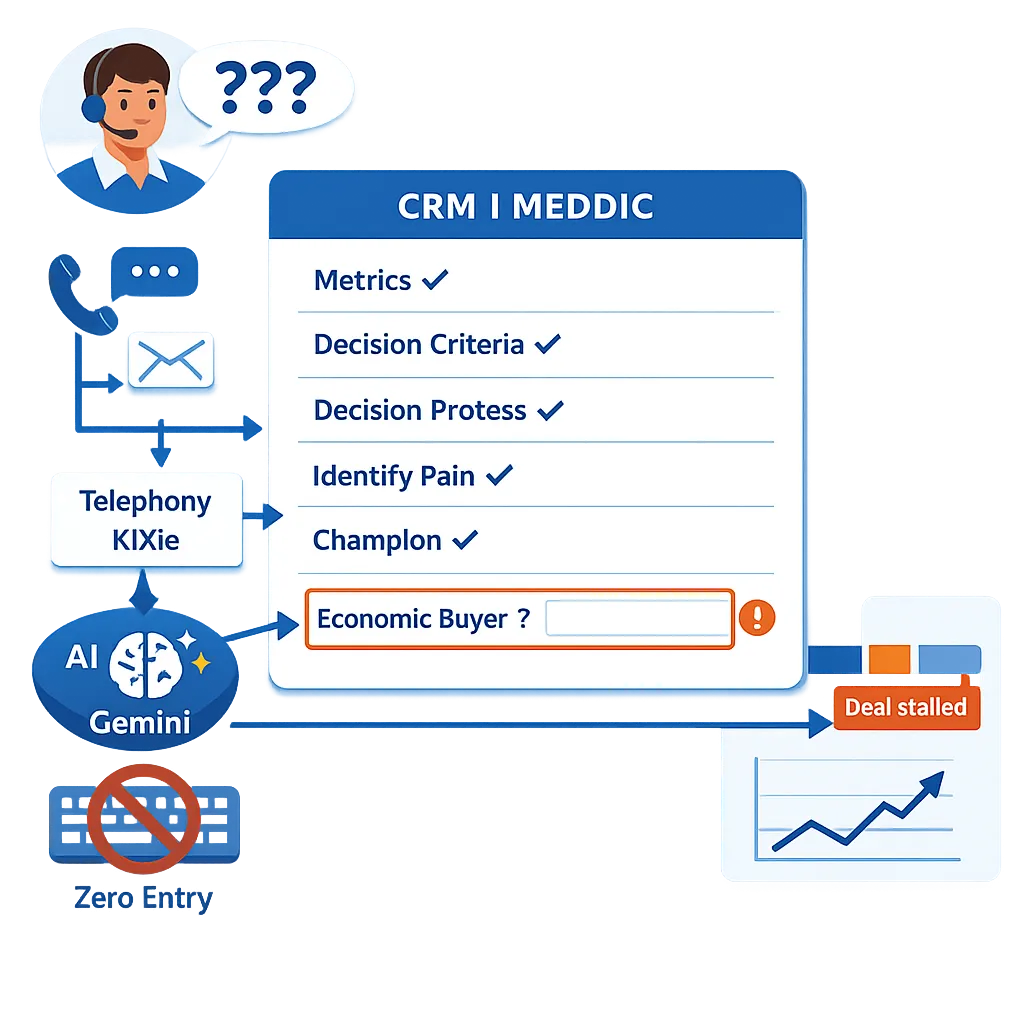
Implementing Zero Entry Policies for Salesforce MEDDIC Data
RevOps leaders should stop training reps on how to enter MEDDIC data and instead train them on how to ask MEDDIC questions. By configuring telephony providers like Kixie and AI engines like Gemini to handle the entry, the process becomes automated. If the AI doesn’t hear the “Economic Buyer” identified in the call, the field stays blank, and the deal stays stalled. This aligns sales behavior with revenue outcomes immediately.
Auditing the Google Gemini AI Instead of the Rep
Sales Management time should shift from “inspecting CRM fields” to “inspecting the AI’s logic.” RevOps leaders should spot-check the AI model’s scoring against real calls to refine the system prompts. This turns the Ops team into the engineers of the sales engine rather than its janitors.
Deploying Conversation Strength Metrics Alongside MEDDIC Scores
Organizations should utilize Kixie’s “Conversation Strength” and sentiment analysis data points alongside MEDDIC scores. A deal might have a high MEDDIC score (logical fit) but a low Sentiment score (emotional disconnect). This discrepancy is a high-fidelity churn signal that manual entry would never capture.
Phased Rollout for Google Gemini Integration
Phase 1 (Shadow Mode): Run the automated Kixie-Gemini workflow in the background. Compare AI scores vs. Rep scores. (Expect to see Rep scores constantly higher due to optimism bias).
Phase 2 (Augmentation): Display AI scores in Salesforce as “suggested” values.
Phase 3 (Enforcement): Activate Validation Rules. Deals cannot close without AI verification.
Finalizing the Transition to Automated MEDDIC Scoring in Salesforce
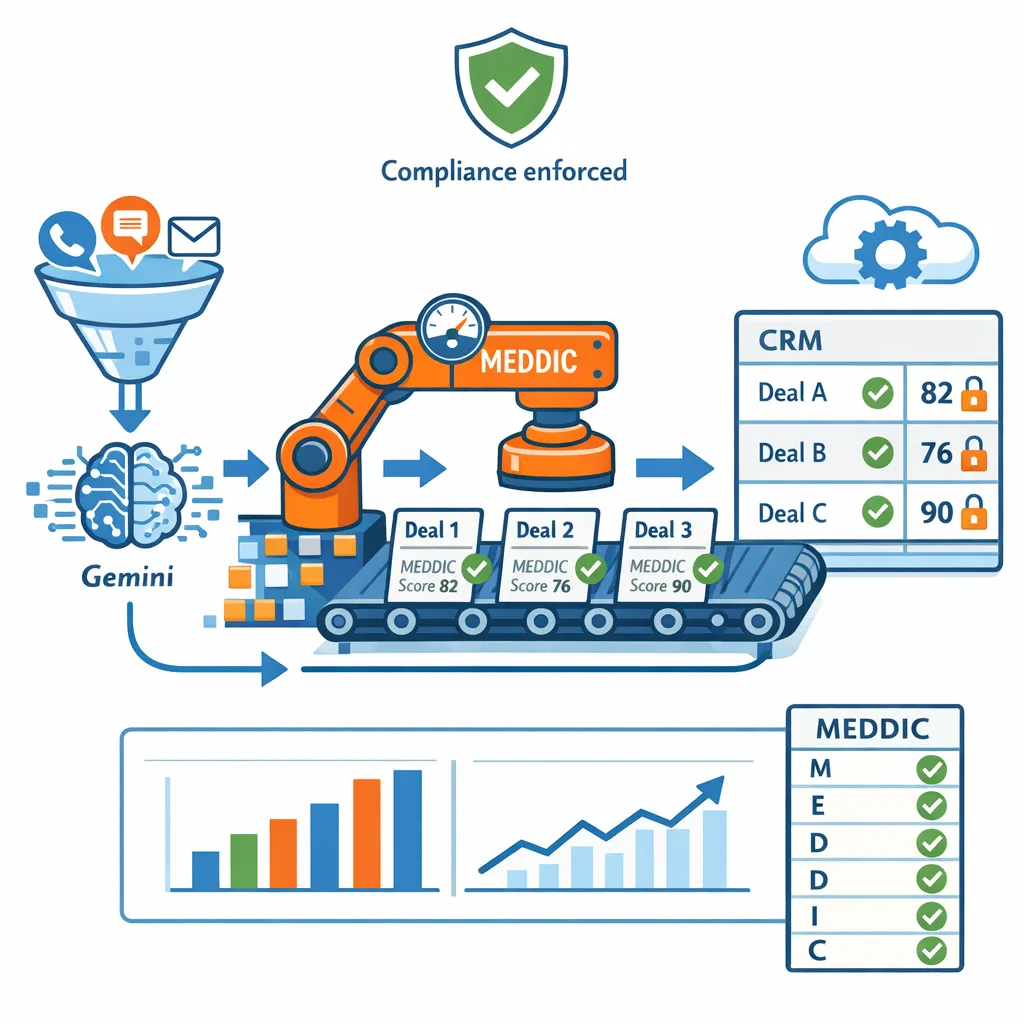
For Enterprise RevOps, the days of pleading for methodology compliance are over. The technology now exists to enforce it. By welding Kixie’s capture capabilities to Google Gemini’s reasoning and Salesforce’s rigid architecture, leaders can construct a revenue engine that runs on facts, not fiction. This is not just automation; it is the digitization of sales discipline.